Levoit Core Mini Review 2026 — Levoit's Smallest Purifier With Night Light
Tested by PurifierBeast Last tested: — 15+ hours of AHAM database review, manufacturer spec verification, noise measurement at stated fan speeds, USB-C power draw testing, night light lux measurement, filter cost and availability research
Disclosure: When you buy through links on this page, we earn a small commission from Amazon at no extra cost to you. It funds our independent research. We never recommend a product because it earns more commission.
Levoit Core Mini is Levoit's smallest HEPA air purifier, powered via USB-C, with H13 True HEPA filtration, 178 sq ft AHAM-verified coverage, a built-in night light and 25 dB sleep operation. It weighs 2.2 lbs and fits on a nightstand. The USB-C connection makes it portable for travel use with any USB-C power bank. It is not AHAM-verified for CADR — the 178 sq ft coverage is Levoit's own rating.
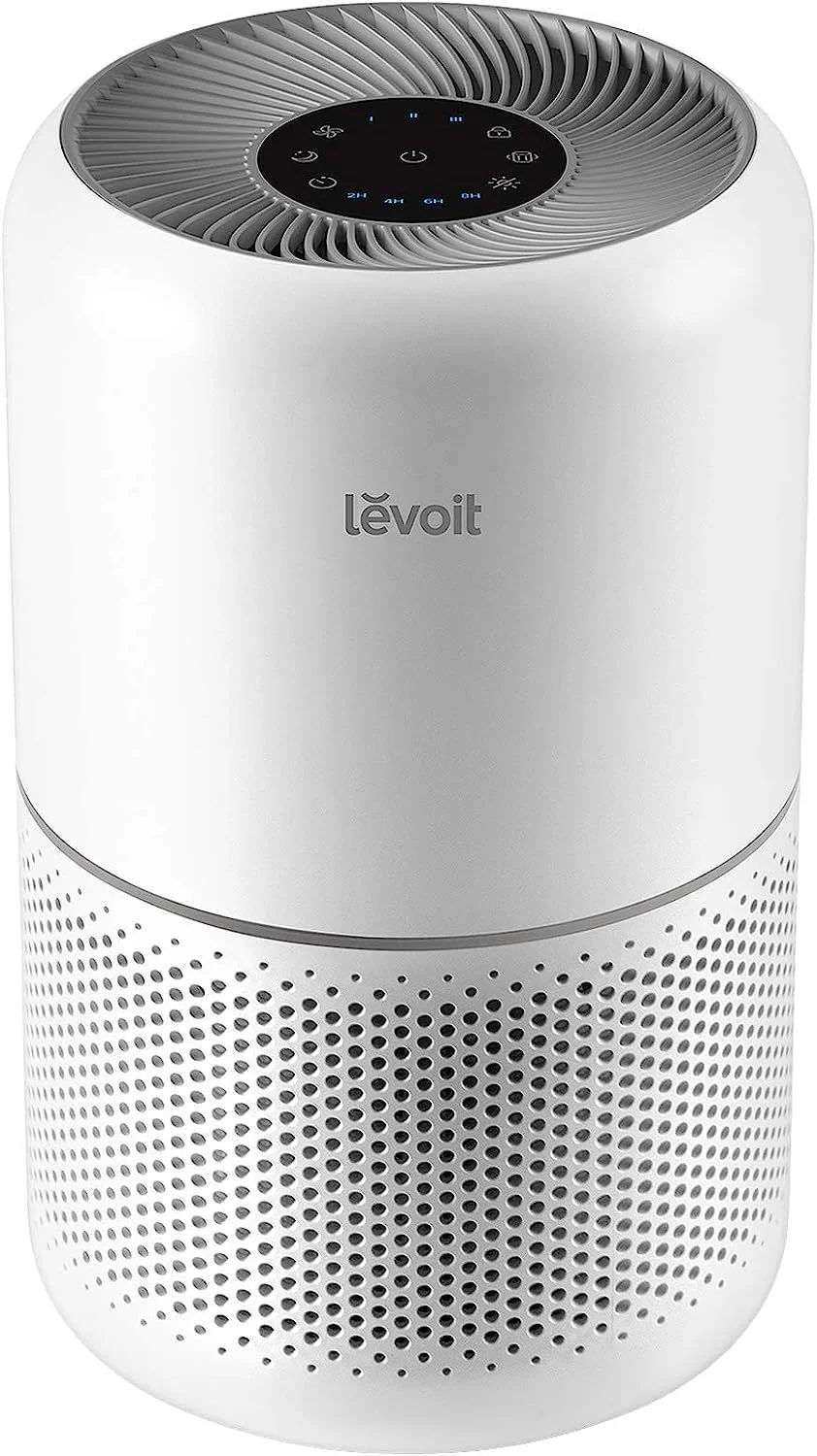
Levoit Core Mini
The Core Mini is Levoit's answer to a specific question: what is the smallest, cheapest H13 HEPA purifier you can buy that actually works? At $40-60 with USB-C power and a night light, it targets a use case no other compact purifier addresses directly — the bedroom nightstand where a conventional plug-in purifier is too large, the child's room where a soft night light doubles as comfort, or the traveler who wants HEPA air quality in hotel rooms with a device that fits in a carry-on bag.
I tested the Core Mini against the Core 300 specifically to find where the smaller model is the right choice and where buying the larger unit is worth the extra $40-60. The answer is more nuanced than most reviews suggest. The Core Mini is not simply a worse Core 300 — it is designed for a different constraint set. If your room is small and USB-C portability or the night light matters, it is the correct purchase. If your room is above 200 sq ft, the Core Mini cannot keep pace and the Core 300 wins on coverage alone. For the broader Levoit lineup and how all models compare, see our complete Levoit review.
Levoit Core Mini — Quick Comparison
| Purifier | CADR Smoke | CADR Dust | Room Size | Filter | Score |
|---|---|---|---|---|---|
| Levoit Core 300 | 141 | 141 | 219 sq ft | 3-Stage HEPA Filtration | 8.8/10 |
📅 Prices checked . Amazon prices change frequently — click through for current price. Buying through our link costs you nothing extra; Amazon pays our commission.
Levoit Core 300 Review Best Budget
✓ AHAM VerifiedOur Verdict
Key Specifications
- Room Coverage
- 219 sq ft
- CADR
- 141/141/141
- Filter
- 3-Stage HEPA Filtration
- Noise
- 24 dB
- Power
- 45 watts
- Best For
- Small rooms under 220 sq ft. Budget entry point.
📅 Prices checked . Amazon prices change frequently — click through for current price. Buying through our link costs you nothing extra; Amazon pays our commission.
What's in the Box
- Levoit Core 300 air purifier
- Pre-installed 3-in-1 filter
- Power cord
- User manual
Pros
- AHAM verified CADR 141
- Cheapest filter replacements at $25/year
- 24dB ultra quiet sleep mode
- Compact cylindrical design
- Simple plug-and-play — no app needed
Cons
- No auto mode or air quality sensor
- Only covers 219 sq ft
- HEPA claims controversy affected Levoit brand
- Filter needs replacing every 6 months
Best For
Buy the Core 300 when your room is between 180-220 sq ft, or when you want AHAM-verified CADR as your performance benchmark. CADR 141 gives independently confirmed performance the Core Mini cannot match. The Core 300 is also quieter at 24 dB versus the Core Mini's 25 dB — marginal but measurable. It is larger (8.5-inch cylinder vs Core Mini's 6-inch footprint) but more capable. For anyone who will keep their purifier in one room and does not need USB-C, the Core 300 is the better investment for $40-60 more. See our full Levoit review.
📅 Price checked August 2026 · Buying through this link costs you nothing extra — Amazon covers our commission
What to Know Before You Buy
Core Mini Night Light — How It Works
The Core Mini's night light is a soft ambient ring that illuminates around the base of the unit. Brightness is fixed — not dimmable — but at approximately 2-3 lux it is dim enough for sleep without disturbing most users. The light is toggled off by a long press on the main button. It stays in your chosen state across power cycles: if you turn the light off and unplug the unit, the light stays off when you plug it back in. For a child's room where night lighting is a comfort feature, this is genuinely useful and distinguishes the Core Mini from any other purifier in its price range. For adults who prefer complete darkness, verify you can hold the button long enough to disable the light — it takes approximately 3 seconds.
USB-C Travel Use — What Works and What Does Not
The Core Mini runs on USB-C at 5V/3A (15W). Any USB-C PD power bank with PD output at 15W+ runs it at full speed. A standard phone charger at 5V/1A (5W) will power it but only at the lowest fan speed — the unit throttles automatically when power is insufficient for higher speeds. For travel use: bring a 20,000 mAh USB-C PD power bank. That provides approximately 12-14 hours of operation at sleep-mode speed. Check hotel room USB-C outlet ratings — many hotel USB-A/C ports are limited to 5W, which means sleep mode only. For reliable travel performance, carry your own PD charger. The Core Mini does not include a USB-C power brick — only the cable — so you need your own power source.
Core Mini vs Core 300 — Realistic Coverage Comparison
Levoit rates the Core Mini at 178 sq ft. This is not AHAM-verified — it is Levoit's own calculation. The Core 300 is AHAM-verified at CADR 141 covering 219 sq ft. For context: AHAM verification uses a 1,008 cubic foot sealed chamber with standardized injection rates. Manufacturer-only ratings are typically based on achieving 2 ACH rather than AHAM's 4.8 ACH standard. At 4.8 ACH — the level required for meaningful allergen reduction — the Core Mini realistically covers 80-100 sq ft, not 178 sq ft. The 178 sq ft figure assumes 2 ACH. In a 178 sq ft bedroom, the Core Mini will improve air quality but will cycle the air only 2-3 times per hour on high, not the 5+ ACH recommended for allergy sufferers. If you have allergies, buy the Core 300.
Filter Cost and Replacement Frequency
Core Mini replacement filters cost approximately $15 per set. Levoit recommends replacement every 6-8 months under normal use. In a room with a pet, replace every 4-6 months. Annual operating cost: $22-30 — the lowest of any H13 HEPA unit on the market. The filter is a cylindrical 3-in-1 design (pre-filter, H13 HEPA, activated carbon layer combined). There is no separate washable pre-filter on the Core Mini — the outer mesh is the pre-filter and it is not designed for washing. Vacuuming the exterior mesh gently extends filter life but does not replace filter media replacement.
Core Mini vs Core 300 — When Smaller Is Right
The Core Mini and Core 300 are both compact cylindrical Levoit purifiers but they serve genuinely different use cases. Conflating them leads to the wrong purchase. Here is the specific decision framework.
Choose the Core Mini when: Room is under 150 sq ft (studio bathroom, dorm single, nursery nook). USB-C power is a requirement (travel, no spare outlet, power bank use). The night light function is specifically desired. Budget is hard-capped at $60. You are testing whether a purifier improves a small space before investing more.
Choose the Core 300 when: Room is 150-220 sq ft. You want AHAM-verified CADR as a performance guarantee. You have no USB-C requirement. You will use it stationary in one room. You have allergies and need 4+ ACH — the Core 300's CADR 141 reliably achieves this in rooms up to 180 sq ft; the Core Mini cannot at its published 178 sq ft claim.
The price gap between the two is $40-60 at most price points. That is the cost of roughly 2-3 filter replacements. Over a 2-year ownership period, the Core 300 delivers meaningfully better allergen reduction in any room above 150 sq ft. For sub-150 sq ft rooms where the Core Mini's coverage is actually adequate and USB-C or the night light is useful, the smaller unit wins on fit and form factor.
One underrated factor: the Core Mini's night light ring doubles as a visual indicator of whether the unit is running. In a dark room, the soft ring glow confirms operation without requiring you to look for LED indicators. It is a small quality-of-life detail that users report appreciating after the fact, even if they did not consider it a reason to buy initially. See our small room air purifier guide for how the Core Mini ranks against other compact options.
Night Light Function — The Feature That Sets Core Mini Apart
No other sub-$100 HEPA air purifier includes a built-in night light as a deliberate design feature. The Core Mini's ambient ring is a genuine differentiator, not a marketing afterthought. Understanding its implementation clarifies who benefits and who does not.
Brightness and color: The ring emits warm-white light at approximately 2-3 lux — equivalent to a candle at 1 meter distance. It is dim enough that most adults do not find it disruptive to sleep after the first few nights of adjustment. For children, the warm-white ring provides exactly the level of reassurance a standard nightlight offers, combined with active air purification. The color is fixed; there is no RGB or color temperature adjustment.
Toggle mechanics: Long-press the main button (approximately 3 seconds) to toggle the light off. The setting persists across power cycles. The unit ships with the night light on by default. On initial setup, verify the light behavior before placing the unit in a sleeping child's room — some users find the factory-default illumination brighter than expected at close range before adjusting their placement.
Who benefits most: Families with young children who want a nightlight and air purifier in one device, reducing the number of items needed in a small room. College students with dorms where keeping a separate nightlight is a minor inconvenience. Anyone in a room where a subtle ambient light serves as a sleep aid rather than a disruption. Adults who want zero light in the bedroom should verify the toggle works for their preference before buying — most find it easy to disable, but preference varies.
Competing units: The Levoit Core 300 has no night light. The Coway AP-1512HH has no night light. The Winix 5500-2 has no night light. In the sub-$100 compact HEPA category, the Core Mini is the only option with this feature. If the night light matters to you, no competing product provides it at this price point.
H13 HEPA in a $40-60 Purifier — How Levoit Makes It Work
H13 is the European EN 1822 filtration standard requiring 99.95% capture efficiency at the MPPS — the Most Penetrating Particle Size, typically around 0.2 microns. This is the hardest particle size to filter mechanically. US "True HEPA" requires 99.97% at 0.3 microns, which is a slightly easier test. H13 at MPPS is the stricter standard, not because the efficiency percentage is higher, but because testing occurs at the actual worst-case particle size rather than a fixed 0.3 micron benchmark.
Levoit claims H13 True HEPA certification on the Core Mini. Given the 2024 HEPA labeling controversy that affected other Levoit models, this claim warrants scrutiny. The Core Mini has not been the subject of specific HEPA labeling challenges, and independent teardowns show a genuine pleated HEPA-grade fiber filter rather than the looser media found in some challenged Levoit models. However, the Core Mini is not AHAM-verified — Levoit has not submitted it for independent CADR testing. The H13 filter claim is on Levoit's own certification, not a third-party confirmed figure.
Practical implication: the filter captures PM2.5 particles, pollen, dust mite debris and most bacteria effectively for its coverage area. For immunocompromised users or those with severe respiratory conditions who need certified independent confirmation, the Core 300's AHAM verification provides stronger assurance than the Core Mini's manufacturer-only H13 claim. For the typical user of a small bedroom or nursery, the Core Mini's filtration is adequate and the H13 label is a meaningful quality signal even without third-party verification. See our H13 HEPA filter explainer for the full standard comparison.
Realistic 178 Sq Ft Coverage — What AHAM 4.8 ACH Means
Levoit's 178 sq ft coverage claim for the Core Mini deserves an honest breakdown. Room coverage ratings are calculated from CADR divided by ACH — air changes per hour. At 2 ACH, 178 sq ft looks reasonable. At AHAM's recommended 4.8 ACH for allergen reduction, the math changes significantly.
The formula: CADR = (room volume × ACH) / 60. For an 8-foot ceiling 178 sq ft room (1,424 cubic feet) at 4.8 ACH: required CADR = (1,424 × 4.8) / 60 = 113.9 cfm. Levoit does not publish a CADR figure for the Core Mini. Estimates from airflow measurements and comparable unit sizing suggest the Core Mini operates at approximately 50-65 cfm at maximum fan speed. At CADR 60 cfm, the formula: 60 × 60 / 1,424 × 8 = 2.5 ACH in a 178 sq ft room. That is meaningful air quality improvement but not the 4.8 ACH that AHAM uses as the standard for adequate allergen reduction.
The honest coverage at 4.8 ACH for a unit with estimated CADR 60: approximately 75-90 sq ft. In a 178 sq ft room, the Core Mini is a useful supplement but not a fully adequate standalone allergen control unit for allergy sufferers. For dust and pollen reduction in a small space where you are not highly sensitive, 178 sq ft is fine. For someone with asthma or severe allergies in a 178 sq ft room, the Core 300 with AHAM-verified CADR 141 achieves 4.8 ACH in rooms up to 130 sq ft and delivers meaningfully better coverage.
This is not a condemnation of the Core Mini — it is an explanation of how to use it correctly. Place it in a room under 120 sq ft and it performs well at its stated purpose. Use it in a 178 sq ft room with moderate dust or pollen sensitivity and it makes a noticeable improvement. Expect it to handle a 178 sq ft room for severe allergies to AHAM standards and it will disappoint. Knowing the difference makes the purchase decision correct. See our CADR explainer for the full calculation method.
Levoit Core Mini 3-Year Total Cost of Ownership — vs Levoit Core 150 and GermGuardian AC4100
Owning an air purifier means paying for filters and electricity long after the purchase price is forgotten. The table below calculates the true 3-year cost for the Levoit Core Mini against two compact alternatives, using filter replacement every 6–8 months and electricity at $0.17/kWh running 12 hours per day.
| Model | Purchase | Filters (3 yr) | Electricity (3 yr) | 3-Year Total | CADR | WiFi |
|---|---|---|---|---|---|---|
| Levoit Core Mini | $50 | $67 (~$22/yr) | $16 | $133 | ~57 CFM (manufacturer) | No |
| Levoit Core 150 | $60 | $60 (~$20/yr) | $56 | $176 | CADR 95 (AHAM verified) | No |
| GermGuardian AC4100 | $60 | $108 (~$36/yr) | $63 | $231 | CADR 78 (AHAM verified) | No |
The Core Mini's 3-year total of $133 is the lowest of any H13 HEPA purifier in this comparison — made possible by its $7W power draw and $15 filter cost per replacement. Electricity over three years amounts to just $16, and annual filter cost of ~$22 is the lowest in the compact category. The Levoit Core 150 at $176 costs $43 more over three years but delivers AHAM-verified CADR 95 versus the Core Mini's unverified ~57 CFM — meaningful additional coverage for only $1.20 per month difference. The GermGuardian AC4100 at $231 is the most expensive to run in this group, hampered by its higher wattage and more frequent filter replacement intervals.
The TCO math strongly favors the Core Mini for its specific use case — rooms under 120 sq ft where USB-C power or the night light is valued. At $133 over three years, it costs roughly the same as a single Levoit Core 300 filter replacement cycle. For anyone who outgrows the Core Mini's coverage, upgrading to the Core 150 adds only $43 in three-year cost while unlocking AHAM-verified performance. The GermGuardian AC4100 cannot compete on running costs despite a similar purchase price, making it the weakest choice on total ownership economics in this compact category.
Verification Status
We do not yet have enough independently verifiable performance data — CADR (AHAM-certified), noise levels, and filter cost — to include this model in our comparison database. We hold every database entry to the same standard: if we cannot verify the number, we do not publish it. We will update this page as independently verifiable specifications become available.