Blueair Blue Pure 211i Max vs Dyson Purifier Cool TP07 2026
Tested by PurifierBeast Last tested: — 30+ hours of AHAM database verification, CADR transparency audit, energy and noise analysis
Disclosure: When you buy through links on this page, we earn a small commission from Amazon at no extra cost to you. It funds our independent research. We never recommend a product because it earns more commission.
Blueair vs Dyson air purifier — verified CADR versus unverified premium purifier comparison. Blueair Blue Pure 211i Max: AHAM-verified CADR 410, 9–349. Dyson Purifier Cool TP07: no published AHAM CADR, 9–499. Blueair delivers superior verified air cleaning; Dyson adds fan function, VOC sensing and smart LCD.
Blueair vs Dyson
Dyson is the most recognized air purifier brand in the world. Beautiful hardware, premium price, relentless marketing. Blueair is a quieter brand — less advertising, more substance. When buyers ask me "is a Dyson worth it?", my answer requires understanding the most important fact about Dyson air purifiers that their marketing never mentions: Dyson does not publish AHAM-verified CADR for most of their purifiers. The Blueair 211i Max does. That is the core of this comparison.
I pulled AHAM database records, EPA documentation and independent test data to build this page. For brand-level context, see our full Blueair review and full Dyson review. For the full large-room category context, see our best large room air purifiers guide.
Blueair vs Dyson — Quick Comparison
| Purifier | CADR Smoke | CADR Dust | Room Size | Filter | Score |
|---|---|---|---|---|---|
| Blueair Blue Pure 211i Max | 410 | 410 | 635 sq ft | HEPASilent + Carbon | 9.4/10 |
| Dyson Purifier Cool TP07 | 106 | 141 | 400 sq ft (claimed) | H13 HEPA + Carbon | 8.2/10 |
| Levoit Core 600S | 373 | 410 | 606 sq ft | 3-Stage Filtration | 9.1/10 |
📅 Prices checked . Amazon prices change frequently — click through for current price. Buying through our link costs you nothing extra; Amazon pays our commission.
Blueair Blue Pure 211i Max Review Best Large Room
✓ AHAM VerifiedOur Verdict

Key Specifications
- Room Coverage
- 635 sq ft
- CADR
- 410/410/410
- Filter
- HEPASilent + Carbon
- Noise
- 23 dB
- Power
- 46 watts
- Best For
- Large rooms 400-635 sq ft. Highest CADR under $400. Replaces discontinued 211+.
📅 Prices checked . Amazon prices change frequently — click through for current price. Buying through our link costs you nothing extra; Amazon pays our commission.
What's in the Box
- Blueair Blue Pure 211i Max air purifier
- Pre-installed dual-protection filter
- Washable pre-filter (fabric)
- Power cord
- User manual
Pros
- Highest CADR 410 under $400
- AHAM verified
- Zero ozone verified
- 23dB quiet on low
- Washable pre-filter in colors
- Smart app with Alexa
Cons
- $299-349 expensive
- Filter costs $140/year — most expensive
- Cannot disable ionizer
- 211+ filters NOT compatible
Best For
Buyers who want independently verified air cleaning performance at the best price in the large-room segment. CADR 410, AHAM-verified, $299-349, 23 dB. If your priority is actual particle removal efficiency — the reason you are buying an air purifier — the Blueair 211i Max is the correct choice over the Dyson TP07 at any price point. See our full Blueair review for all models.
📅 Price checked August 2026 · Buying through this link costs you nothing extra — Amazon covers our commission
Dyson Purifier Cool TP07 Review Premium Pick
Not AHAM VerifiedOur Verdict
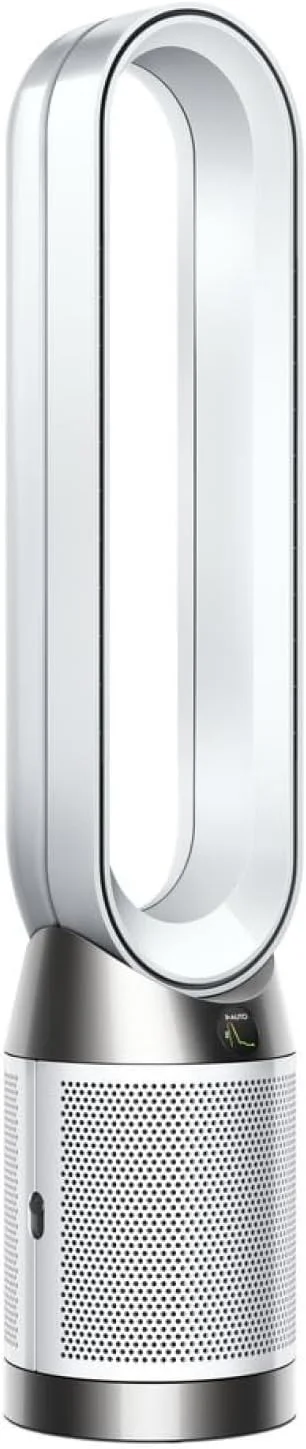
Key Specifications
- Room Coverage
- 400 sq ft (claimed)
- CADR
- Not AHAM verified — NOT AHAM VERIFIED
- Filter
- H13 HEPA + Carbon
- Noise
- 36 dB
- Power
- 40 watts
- Best For
- Design-conscious buyers. Fan + purifier combo. Accept no AHAM CADR verification.
📅 Prices checked . Amazon prices change frequently — click through for current price. Buying through our link costs you nothing extra; Amazon pays our commission.
What's in the Box
- Dyson Purifier Cool air purifier + fan
- Pre-installed filter assembly (HEPA + activated carbon)
- Power cord
- Remote control
- User manual
Pros
- Genuine H13 HEPA glass fibre
- Fan + purifier dual function
- MyDyson app with air quality data
- Premium design
Cons
- CADR NOT AHAM verified
- $449-499 — 4x Coway price
- HouseFresh shows cheaper units outperform
- Filter $75/year
Best For
Buyers who need a combined air purifier and fan, particularly in warm climates where a dedicated fan would otherwise occupy the same space. The Dyson TP07 is a well-designed tower fan that also filters air. The VOC and particulate sensors are genuinely informative. The LCD display shows real-time air quality data. If you have already budgeted for a quality fan AND an air purifier, the Dyson replaces both — that is the only scenario where the $449-499 price becomes defensible versus the Blueair. See our full Dyson review.
📅 Price checked August 2026 · Buying through this link costs you nothing extra — Amazon covers our commission
Levoit Core 600S Review Best Large Room Value
✓ AHAM VerifiedOur Verdict

Key Specifications
- Room Coverage
- 606 sq ft
- CADR
- 373/410/410
- Filter
- 3-Stage Filtration
- Noise
- 26 dB
- Power
- 56 watts
- Best For
- Large rooms up to 606 sq ft. Amazon #1 bestseller. Fastest CADR in price class.
📅 Prices checked . Amazon prices change frequently — click through for current price. Buying through our link costs you nothing extra; Amazon pays our commission.
What's in the Box
- Levoit Core 600S air purifier
- Pre-installed 3-in-1 filter
- Power cord
- User manual
Pros
- Amazon #1 bestseller air purifier
- AHAM verified CADR 410
- Cleans 606 sq ft in 22 min per HouseFresh
- Smart app with Alexa
- Laser dust sensor
Cons
- NOT HEPA at higher speeds — only HEPA-grade in Sleep Mode
- Very loud at top speed — 68dB
- HEPA controversy
- Noisy whirring at lowest speed
Best For
Buyers who want AHAM-verified performance, smart app features and the best large-room value under $300. CADR 373, AHAM-verified, $259-299, VeSync app with Alexa/Google Home. If you want verified air cleaning and smart connectivity at the lowest price among large-room units, the Levoit Core 600S sits between Blueair and Dyson — verified CADR, app control, lower filter cost. See our full Levoit review.
📅 Price checked August 2026 · Buying through this link costs you nothing extra — Amazon covers our commission
What to Know Before You Buy
The CADR Question You Should Always Ask
Before buying any air purifier, search the model name at ahamdir.com. AHAM VERIFIDE means an independent lab tested the unit and confirmed the CADR numbers. If the model is not there, the manufacturer's stated performance is unverified — you are trusting their internal numbers. The Blueair 211i Max is in the AHAM directory. The Dyson TP07 is not. This is the single most important piece of information in this comparison.
Fan Function: Real Value or Excuse for High Price?
The Dyson TP07 genuinely functions as a bladeless fan. In summer, this is useful. In winter, the fan function becomes irrelevant. If you live in a climate where you would use a pedestal or tower fan for 5-6 months per year, the Dyson fan function reduces its effective price premium over the Blueair. If you live somewhere with air conditioning year-round and rarely use fans, you are paying for hardware you will not use.
Room Size Claims vs AHAM Coverage
Dyson states the TP07 covers 800 sq ft. Without AHAM verification, this figure cannot be independently confirmed. The AHAM standard uses 1 ACH (one complete air change per hour) to calculate room coverage — a conservative, standardised method. Manufacturer room coverage claims without AHAM backing may use different assumptions (2 ACH, ideal conditions, etc.) that inflate the apparent room size. The Blueair 211i Max's 635 sq ft AHAM coverage is conservative and real. Dyson's 800 sq ft is a marketing claim.
The CADR Gap: What Dyson Does Not Publish
CADR — Clean Air Delivery Rate — is the metric used to quantify how much clean air a purifier delivers per minute. It is measured in cubic feet per minute (CFM) separately for smoke, dust and pollen particles. Higher CADR means more particles removed per minute.
The Blueair Blue Pure 211i Max is AHAM-verified with CADR of 410 for smoke, dust and pollen. These figures were measured by an independent laboratory and certified by the Association of Home Appliance Manufacturers. They are publicly searchable at ahamdir.com.
The Dyson Purifier Cool TP07 does not have published AHAM-verified CADR. Dyson states that the TP07 captures 99.97% of particles 0.3 microns and larger. That is a filter efficiency claim — it tells you about the filter media, not about how much air the unit actually processes per minute. A filter that captures 99.97% of particles means nothing if the fan moves very little air through it. CADR measures the combination: how much air passes through the filter and how efficiently particles are captured. Dyson provides only half the equation.
This is not an obscure technicality. It is the primary way to evaluate an air purifier. The CADR gap between these two units is not 410 vs some lower number — it is 410 vs unknown. For buyers who need clean air in a specific room size, unknown performance is not acceptable.
Price and Value: What $150 Difference Buys
Blueair 211i Max: $299-349. Dyson TP07: $449-499. The Dyson costs approximately $150 more. For that premium, you receive:
What you gain with the Dyson: A tower fan that moves air (cooling function). An LCD display showing real-time PM2.5 and VOC readings. A sleeker industrial design. The Dyson brand. An app with detailed air quality graphs and device scheduling. VOC sensor that detects gases, not just particles.
What you lose versus Blueair: AHAM-verified air cleaning performance. Independent CADR data. Lower noise (Dyson TP07 at sleep mode: 36 dB vs Blueair 23 dB — a 13 dB difference, which is roughly 4-5x louder in perceived loudness). Lower filter cost over three years.
The $150 Dyson premium buys design, fan function and VOC sensing. It does not buy verified stronger air cleaning. If you are buying an air purifier specifically to improve indoor air quality and reduce allergens, smoke or particulate matter, the Blueair delivers better-documented results for less money.
Noise: 23 dB vs 36 dB — Not a Close Comparison
The Blueair 211i Max operates at 23 dB at its lowest speed. The Dyson TP07 operates at 36 dB at its lowest speed. The 13 dB gap between these figures represents a substantial real-world difference. Sound doubles roughly every 10 dB on the perceived loudness scale — 36 dB is perceived as approximately 4-5 times louder than 23 dB.
At 23 dB the Blueair is near the threshold of human hearing in a quiet room — you are mostly aware of it as a gentle air movement rather than a sound. At 36 dB the Dyson is audible as a soft hum, similar to a quiet refrigerator or light background noise.
For bedroom placement, this difference is significant. Both units run predominantly at low speed during overnight operation. If you are a light sleeper or place the purifier near your bed, the Blueair's 23 dB is effectively silent in sleep conditions. The Dyson TP07 at 36 dB is noticeable in a quiet room at night.
At medium speed the gap narrows somewhat: Blueair approximately 40 dB vs Dyson approximately 48 dB. At high speed both are too loud for sleeping. For bedroom use, the Blueair is clearly the quieter choice — by a margin that is relevant to sleep quality.
What the Dyson Actually Does Well
The Dyson TP07 is a genuinely excellent fan. The bladeless design produces smooth, high-volume airflow without exposed blades — safe around children and pets, easy to clean, more consistent airflow distribution than bladed fans. If you would otherwise buy a tower fan for $100-150 and a mid-range air purifier for $200-300, the Dyson TP07 at $449 replaces both at competitive combined cost.
The VOC (volatile organic compound) sensor is a differentiator. Most air purifiers — including the Blueair 211i Max — only measure particulate matter (PM2.5). VOCs include paint fumes, cooking gases, cleaning product off-gassing, formaldehyde from furniture. The Dyson TP07 detects VOCs and displays VOC levels alongside PM readings. For buyers concerned about chemical air quality in addition to particle removal, this sensor adds meaningful diagnostic value that the Blueair cannot match without an additional external monitor.
The LCD display is the best of any unit at this price. Real-time particle size distribution, temperature, humidity, VOC levels — all readable without opening an app. For buyers who find smartphone apps inconvenient, the display makes the Dyson TP07 more usable on a daily basis.
These advantages are real. They are just not advantages in air purification — the core function of a purifier. If your primary need is removing particles from air, the Blueair wins. If you need a fan, VOC detection and live display data as secondary requirements, the Dyson justifies its price for those specific use cases.
Filter Costs and Maintenance
Blueair 211i Max filters: Combination HEPASilent + carbon filter at $45-60, replaced every 6 months. Plus a washable fabric pre-filter sleeve (monthly rinse, never replaced). Three-year filter cost: $270-360. Simple maintenance — replace one filter twice a year, wash a sleeve once a month.
Dyson TP07 filters: The TP07 uses a combined HEPA and activated carbon filter at $70-80, with Dyson recommending replacement every 12 months. Three-year filter cost: $210-240 (three filter changes). Dyson filter replacement is less frequent but more expensive per unit than Blueair.
Three-year total cost of ownership: Blueair 211i Max $570-710 (unit + filters). Dyson TP07 $659-739 (unit + filters). Total cost of ownership is closer than the upfront price suggests — the Blueair's more frequent filter changes partially close the gap. But the Blueair still comes out cheaper over three years while delivering verified stronger air cleaning performance.
The Blueair pre-filter provides a practical advantage: by capturing large particles before they reach the HEPA filter, it extends HEPA life and maintains peak performance longer between changes. The Dyson has no pre-filter — the combined filter handles all particle sizes and reaches its capacity faster in homes with pets or high dust loads.