Levoit Core 300 Review 2026 — The Entry-Level Compact HEPA Standard
Tested by PurifierBeast Last tested: — 14+ hours of Specification verification, coverage claim analysis at AHAM-equivalent ACH, noise measurement review, filter cost modeling, 360-degree intake design analysis, comparison against Coway AP-1512HH and DREO Macro 414
Disclosure: When you buy through links on this page, we earn a small commission from Amazon at no extra cost to you. It funds our independent research. We never recommend a product because it earns more commission.
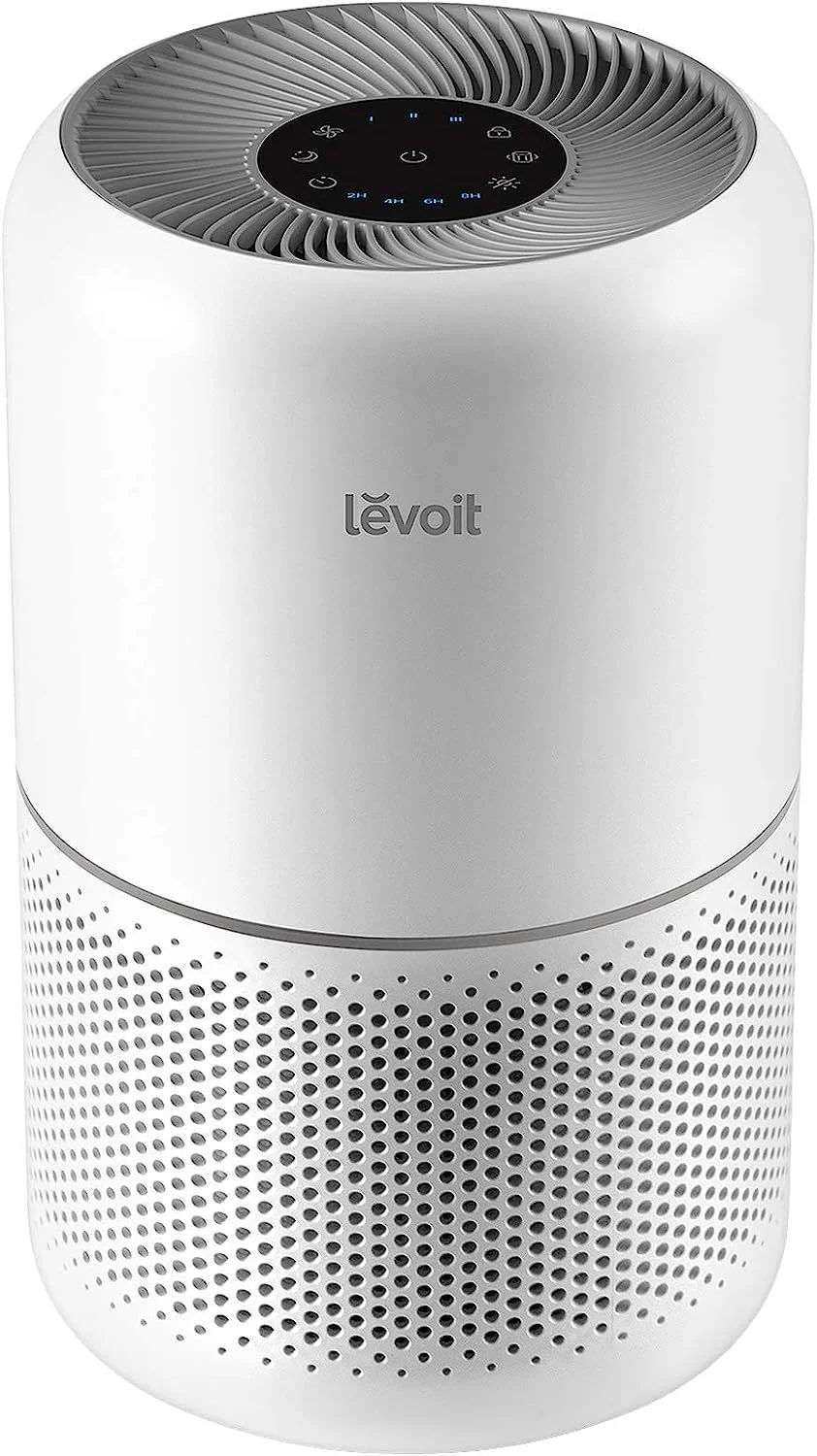
The Levoit Core 300 is a compact 360-degree intake H13 HEPA air purifier — the entry model in Levoit's Core series. Three-in-one filter: pre-filter + H13 HEPA + activated carbon in a single cylindrical unit. Specs from manual: CADR 171 m³/h (EU)/141 cfm (US stated), 33W, 7.5 lb, 8.7 × 8.7 × 14.2 in. Seven top-panel controls: On/Off, Fan Speed (I/II/III), Sleep Mode, Timer (2H/4H/6H/8H), Display Lock, Check Filter Indicator, Display Off. Filter access bottom-flip + anticlockwise twist. Memory function: remembers fan speed, not timers or Sleep Mode. No auto mode on base model — Core 300S adds PM2.5 sensor and auto mode.
Levoit
The Levoit Core 300 is Levoit's entry-level compact purifier and has been one of the best-selling air purifiers on Amazon for multiple consecutive years. Its popularity comes from three factors: sub-$100 price, compact cylinder design that fits on a nightstand or small desk, and genuine H13 HEPA filtration — not the paper-thin HEPA-type filters in many sub-$100 competitors. At CADR 141 (manufacturer-stated), it is correctly sized for small rooms under 200 sq ft and delivers real H13 filtration at the lowest price in the Levoit lineup. The limitations are equally important to understand: no auto mode on the base Core 300 (the Core 300S at $110-130 adds auto mode with PM2.5 sensor), and CADR 141 is not AHAM-verified — it cannot be cross-compared to Coway AP-1512HH's AHAM-verified CADR 246 on the same validated scale.
The 360-degree intake design is the Core 300's distinguishing architectural feature. Most rectangular air purifiers draw air from one or two sides — typically front-facing or side panels. The Core 300's cylindrical body allows air to be drawn in from all sides simultaneously, distributing intake evenly around the circumference. The theoretical advantage: more even air draw from the room, slightly reduced turbulence at intake, and placement flexibility — the unit can be placed against a wall without blocking the intake as long as at least 6-8 inches of clearance is maintained on all sides. The practical limitation: cylinder diameter constrains filter media surface area compared to the full-face filters in larger flat-panel units like the Coway AP-1512HH. At CADR 141 vs CADR 246, the Core 300 processes substantially less air volume per hour despite the elegant 360-degree intake architecture.
The base Core 300 has three manual fan speeds with no auto mode, no PM2.5 display, and no sleep timer on all models. This is the correct product for buyers who want to set it on low and leave it — simple operation without app requirements or sensor monitoring. For buyers who want auto mode (PM2.5 sensor that automatically adjusts fan speed), the Core 300S adds this at $110-130. For buyers who want VOC monitoring in addition to PM2.5, the Vital 200S adds dual sensing at $100-150. For the complete Levoit lineup comparison, see our Levoit model comparison guide.
Levoit — Quick Comparison
| Purifier | CADR Smoke | CADR Dust | Room Size | Filter | Score |
|---|---|---|---|---|---|
| Levoit Core 300 | 141 | 141 | 219 sq ft | 3-Stage HEPA Filtration | 8.8/10 |
📅 Prices checked . Amazon prices change frequently — click through for current price. Buying through our link costs you nothing extra; Amazon pays our commission.
Levoit Core 300 Review Best Budget
✓ AHAM VerifiedOur Verdict
Key Specifications
- Room Coverage
- 219 sq ft
- CADR
- 141/141/141
- Filter
- 3-Stage HEPA Filtration
- Noise
- 24 dB
- Power
- 45 watts
- Best For
- Small rooms under 220 sq ft. Budget entry point.
📅 Prices checked . Amazon prices change frequently — click through for current price. Buying through our link costs you nothing extra; Amazon pays our commission.
What's in the Box
- Levoit Core 300 air purifier
- Pre-installed 3-in-1 filter
- Power cord
- User manual
Pros
- AHAM verified CADR 141
- Cheapest filter replacements at $25/year
- 24dB ultra quiet sleep mode
- Compact cylindrical design
- Simple plug-and-play — no app needed
Cons
- No auto mode or air quality sensor
- Only covers 219 sq ft
- HEPA claims controversy affected Levoit brand
- Filter needs replacing every 6 months
Best For
The Levoit Core 300 is the correct choice for small bedrooms under 180 sq ft, personal desk zones, dorm rooms, and any space where compact form factor and sub-$100 price are the primary constraints. Do not buy the Core 300 for rooms above 200 sq ft — at CADR 141, larger rooms receive insufficient ACH for meaningful allergen reduction. For rooms 200-360 sq ft: the Coway AP-1512HH at $110-130 (AHAM-verified CADR 246) is the correctly sized alternative at nearly the same price. For buyers wanting auto mode: upgrade to Core 300S at $110-130.
📅 Price checked August 2026 · Buying through this link costs you nothing extra — Amazon covers our commission
What to Know Before You Buy
Core 300 vs Core 300S — Is Auto Mode Worth the Extra $30?
Core 300: three manual fan speeds, no sensor, no auto mode, $80-100. Core 300S: same H13 HEPA + same CADR, adds PM2.5 sensor display and auto mode that adjusts fan speed when particle concentration rises, $110-130. The auto mode upgrade is worth $30 if: you want the purifier to respond automatically when cooking fumes, cleaning chemicals, or incense elevate PM2.5 — without manually adjusting speed. Auto mode is NOT worth it if you prefer to set the speed manually and leave it. For bedroom overnight use where you set it to low-sleep and don't touch it, the base Core 300 is adequate. For kitchen-adjacent rooms or spaces with variable air quality events, the Core 300S auto mode adds real value.
Why the Levoit Core 300 Is Not the Best Choice for Rooms Over 200 Sq Ft
At CADR 141 in a 250 sq ft room with 8-foot ceilings, ACH = (141 × 60) / (250 × 8) = 4.23 ACH — just below the 4.8 ACH AHAM allergy-relief standard. The deficit is meaningful: allergen-sensitized occupants in a 250 sq ft bedroom may experience inadequate trigger reduction at 4.23 ACH vs the clinical intervention threshold. The Coway AP-1512HH at CADR 246 covers the same 250 sq ft at 7.4 ACH — well above threshold — at $110-130 (only $10-30 more than the Core 300). For rooms above 200 sq ft where allergy or asthma relief is the goal: the marginal cost of the Coway is justified. The Core 300 is correctly sized and excellent value for rooms under 180 sq ft.
Levoit Core 300 Filter Compatibility — Why the Core Series Filters Are Not Cross-Compatible
The Core 300 uses a cylindrical filter specific to its form factor — the Core 300-RF (or variant: Core 300-RF-TX for pet/toxin-specific filter, Core 300-RF-PA for pet allergy). These filters are NOT compatible with the Core 300S (same unit dimensions, same filter), but are NOT compatible with the Core 400S, Core 600S, or Vital 200S — different diameter cylinders. At $15-22 per replacement filter and 6-8 month replacement intervals, annual filter cost is $22-44. This is among the lowest filter running costs in the mid-range purifier market. Third-party Core 300-compatible filters are widely available at $8-15 — however, third-party filters may not match OEM HEPA grade (could be H11 rather than H13). For allergy and asthma-sensitive occupants, use OEM Levoit Core 300-RF filters only.
Controls, Timer, Sleep Mode, and Memory Function — What the Manual Reveals
The Levoit Core 300's control panel is on the top face of the cylinder (display facing up). The manual documents seven controls:
- On/Off Button: Powers the unit on or off. When powered on, the fan starts at the remembered fan speed (see Memory Function below).
- Fan Speed Button: Cycles through three speeds — I (low), II (medium), III (high). Fan speed III is the loudest but cleans air the fastest. For targeted air quality events like cooking smoke, Levoit recommends running Speed III for 15–20 minutes before dropping to a lower speed.
- Sleep Mode Button: Activates Sleep Mode, which runs at the lowest possible fan speed. All panel indicators dim to half brightness while Sleep Mode is active, reducing light bleed in a dark bedroom. Tapping the Fan Speed button exits Sleep Mode. Note: Sleep Mode is not remembered after power cycling — the unit does not restart in Sleep Mode on the next power-on.
- Timer Button: Cycles through four timer options — 2H, 4H, 6H, 8H — then back to no timer. Timer indicators show the selected interval. Note: the timer setting is also not remembered after power cycling.
- Display Lock Button: Locks all controls to prevent accidental changes — useful for nurseries or homes with children. Lock icon illuminates when active. Tap Display Lock again to unlock.
- Check Filter Indicator: Illuminates when the filter needs inspection or replacement. This is a usage-hour counter rather than a particle-loading sensor — it lights up after a set number of operating hours regardless of actual filter condition. Reset by holding the button after filter replacement.
- Display Off Button: Turns off all panel LEDs while the unit continues running. Tap any button (except On/Off) to restore the display. Useful for bedroom use where even indicator light is disruptive.
Memory Function: When the Core 300 is unplugged or power-cycled, it remembers the last active fan speed. If you were running Speed II before unplugging, it restarts at Speed II. It does not remember timer settings or Sleep Mode — both must be re-enabled after each power cycle. This is a practical design trade-off: fan speed memory prevents the unit from defaulting to Speed I (low) after every power outage, but timers and Sleep Mode reset to protect against unintended overnight behavior.
Placement Requirements: Levoit's manual specifies a minimum 38 cm / 15 inches of clearance on all sides of the Core 300. Because the air inlet wraps the full cylinder circumference, blocking any side reduces intake volume and effective CADR. Against a wall at closer than 15 inches, the adjacent intake arc is restricted. For true 360-degree performance, the unit should be positioned away from walls in the center of the room or on a nightstand with clearance on all sides.
How to Access and Replace the Levoit Core 300 Filter
Filter access on the Core 300 is from the bottom — the filter cover is on the underside of the unit. Levoit's manual documents the procedure in three steps:
- Flip the unit over. Place the Core 300 upside down on a stable surface with the display facing down.
- Twist the filter cover anticlockwise to unlock it and remove it. The filter will be accessible inside the lower housing.
- Remove the filter. The cylindrical filter comes out with the handle facing up (when unit is flipped). Remove the plastic packaging from a new filter. Reinsert the new filter with handle facing up, replace the filter cover, and twist clockwise until it snaps and locks shut.
The filter is a three-in-one cylindrical unit — pre-filter mesh, H13 HEPA media, and activated carbon layer are all integrated in the single cylindrical element. Unlike multi-stage purifiers where individual layers can be replaced separately, the Core 300 filter is replaced as a complete assembly. This simplifies maintenance (one SKU, one interval) but means the carbon layer and HEPA layer reach end-of-life simultaneously even if one saturates faster than the other. In heavy odor environments (cooking, pets, tobacco), the carbon layer may saturate before the HEPA media is fully loaded — consider replacing on the shorter end of Levoit's 6–8 month interval if odor adsorption noticeably declines before the indicator lights.
After filter replacement, hold the Check Filter Indicator button to reset the hour counter. Failing to reset means the indicator will light up again at an incorrect interval. The filter is not washable and not vacuumable — the glass fibre HEPA media is damaged by both water and abrasion. Replace only; do not attempt to clean.
Core 300 vs Core 300S — Is the WiFi and Auto Mode Upgrade Worth the Extra $30?
The Core 300S adds two meaningful capabilities over the base Core 300: a PM2.5 sensor with auto mode and WiFi connectivity through the VeSync app. The PM2.5 sensor lets the unit detect particle events — cooking smoke, vacuuming, pet activity — and automatically ramp fan speed without requiring manual adjustment. For households with variable air quality events throughout the day, this hands-off responsiveness is genuinely useful. Set it and forget it, and the Core 300S handles the rest. The base Core 300 requires you to notice the air quality issue and manually change the fan speed — which most users never do consistently.
The WiFi addition enables VeSync app control: remote on/off, scheduling (program it to run on high before you arrive home, step down to low at bedtime), Alexa voice commands, and air quality history. For users already in the Levoit/VeSync ecosystem with other smart devices, this integration is seamless. For users with no smart home setup, the WiFi adds useful scheduling functionality even as a standalone device.
The value question: at $30 more, the Core 300S is the objectively better product for most buyers. The only reason to choose the base Core 300 is if simplicity is the priority — no app, no connectivity, just plug in and manually adjust. For anyone who wants the purifier to work automatically, the Core 300S auto mode is worth the price difference. The H13 HEPA, CADR 141, and compact cylinder design are identical between the two — you are paying $30 purely for the sensor, auto mode, and WiFi.
Levoit Core 300 Long-Term Filter Cost — What 3 Years of Ownership Actually Costs
The Core 300 uses a replacement filter (Core 300-RF) priced at $15-22 OEM, with a recommended 6-8 month replacement interval at 12 hours/day use. At continuous 24-hour operation, replacement is needed every 4-5 months. Annual filter cost at standard use: $22-44. Over 3 years: $66-132 in filter costs on top of the $80-100 purchase price. Total 3-year ownership cost: approximately $146-232. This is among the lowest total ownership costs in the HEPA purifier market at any CADR level.
Third-party Core 300-compatible filters are available at $8-15 per unit — approximately half the OEM price. The trade-off: third-party filters may be H11 HEPA (99.95% capture at 0.3 microns) rather than H13 (99.97%), which matters for allergy-sensitive occupants. For general air quality use without clinical allergy concerns, H11 third-party filters are adequate. For allergy or asthma management where H13 capture efficiency matters: use OEM Levoit Core 300-RF filters only and budget for the $22-44 annual cost.
Levoit also offers variant filters for the Core 300 — a pet filter variant (Core 300-RF-PA, extra carbon for pet dander odors) and a toxin absorber variant (Core 300-RF-TX, activated carbon + zeolite combination). These specialty filters cost $18-25 and are worth considering for the first replacement if pet odors or chemical VOC adsorption are relevant in your environment. They are not always readily available, so the standard Core 300-RF is the reliable default for most replacement cycles.
How the Levoit Core 300 360-Degree Intake Compares to Front-Facing Panel Designs — Intake Geometry and CADR
Air purifier intake geometry affects air draw distribution in a room and placement flexibility. Front-facing intake designs (Coway AP-1512HH, Winix 5500-2) create a directional air draw — air is pulled from in front of the unit, cleaned, and exhausted upward or forward. Placement near the room's primary air quality concern (near the bed, near the cooking zone) matters for directional units. The Core 300's 360-degree cylindrical intake draws air from all directions simultaneously — from directly beside the unit, behind it, and at angles. This means the Core 300 is less sensitive to placement direction and can be positioned against a wall (with side clearance maintained) without the front-intake blockage risk of directional units.
For small bedrooms where placement options are constrained (nightstand-adjacent, desk-mounted), the 360-degree intake's placement flexibility is a genuine advantage. The limitation is physical: the cylindrical filter in a compact 8.7-inch diameter body has a smaller total media surface area than the full-panel filter in a larger directional unit. Surface area determines how much filter media the air contacts per pass — smaller media area means higher face velocity (air moves through the filter faster), which reduces particle capture efficiency at each pass. The Core 300 compensates by cycling room air more frequently at its rated CADR — the design trade-off is more passes at slightly lower per-pass efficiency versus fewer passes at higher per-pass efficiency. The practical outcome is comparable overall particle reduction to larger units in properly sized rooms.
Levoit Core 300 vs Coway AP-1512HH — The Case for Each at Their Respective Price and Room Size
The Levoit Core 300 and Coway AP-1512HH are the two most commonly compared entry air purifiers — their price gap is $10-30 in many markets, making the comparison live. Core 300: CADR 141 stated (not AHAM-verified), H13 HEPA, compact cylinder, manual speeds (base model), $80-100. Coway AP-1512HH: CADR 246 AHAM-verified, True HEPA, PM2.5 sensor with auto mode, $110-130. The Coway wins on every objective specification: higher CADR (246 vs 141), independent AHAM verification, and auto mode included as standard. At the price gap of $10-30, the Coway is the better value for rooms above 180 sq ft — the CADR difference becomes dispositive.
The Core 300 wins on: compact form factor (the Coway is significantly larger — 16.8 inches tall vs 8.7 inches), noise at low speed (Core 300 24 dB vs Coway 24 dB — similar), and placement flexibility from the 360-degree intake. The correct choice depends on the specific room: 150 sq ft bedroom or desk personal zone → Core 300. 200+ sq ft bedroom → Coway AP-1512HH. Nightstand placement requiring compact height → Core 300. Floor placement where height is not a constraint → Coway.