Honeywell Air Purifier Review 2026
Tested by PurifierBeast Last tested: — 20+ hours of AHAM database + verified Honeywell specs
Disclosure: When you buy through links on this page, we earn a small commission from Amazon at no extra cost to you. It funds our independent research. We never recommend a product because it earns more commission.
Honeywell
Honeywell has been manufacturing air purifiers since the 1980s, making it one of the oldest established brands in the category. The company entered air purification through its industrial and commercial HVAC roots, bringing institutional-grade engineering to consumer units. That heritage shows in two measurable ways: the majority of Honeywell consumer models are submitted to AHAM for independent CADR verification, and the HPA series has accumulated decades of reliability data in both home and light commercial settings — an advantage that newer entrants such as Levoit or Shark cannot match.
The HPA-series lineup is tiered by room size. The HPA100 (CADR 100 smoke) covers rooms under 155 sq ft and is the entry-level option. The HPA200 steps up for medium rooms around 310 sq ft. The HPA300 — the focus of this review — delivers CADR 300 (smoke) and covers up to 465 sq ft, making it the appropriate choice for large living rooms or open-plan spaces. All three are AHAM-verified, which puts Honeywell ahead of Dyson and most Shark models that either skip AHAM entirely or use proprietary rating systems.
The honest weaknesses are worth stating upfront. None of the HPA-series models include an auto mode or air quality sensor — you set the fan speed manually and leave it there. Most competitors at this price point, including the Coway AP-1512HH and every current Winix model, offer auto mode as standard. Filter replacement costs are also higher than the competition: the HPA300 runs approximately $80 per year for HEPA and pre-filter replacements combined, compared to $60 for Coway and $25 for Levoit Core 300. Honeywell makes a compelling case on CADR, brand reliability and AHAM verification — not on smart features or running cost.
Honeywell — Quick Comparison
| Purifier | CADR Smoke | CADR Dust | Room Size | Filter | Score |
|---|---|---|---|---|---|
| Honeywell HPA300 | 300 | 320 | 465 sq ft | True HEPA Filter R + Carbon Pre-filter Filter A | 8.5/10 |
| Honeywell HPA100 | 100 | 106 | 155 sq ft | True HEPA Filter R + Carbon Pre-filter Filter A (HRF-A100) | 7.8/10 |
| Honeywell HPA200 | 200 | 190 | 310 sq ft | True HEPA Filter R (x2) + Carbon Pre-filter Filter A | 8/10 |
📅 Prices checked . Amazon prices change frequently — click through for current price. Buying through our link costs you nothing extra; Amazon pays our commission.
Honeywell HPA300 Review Large Room Value
✓ AHAM VerifiedOur Verdict
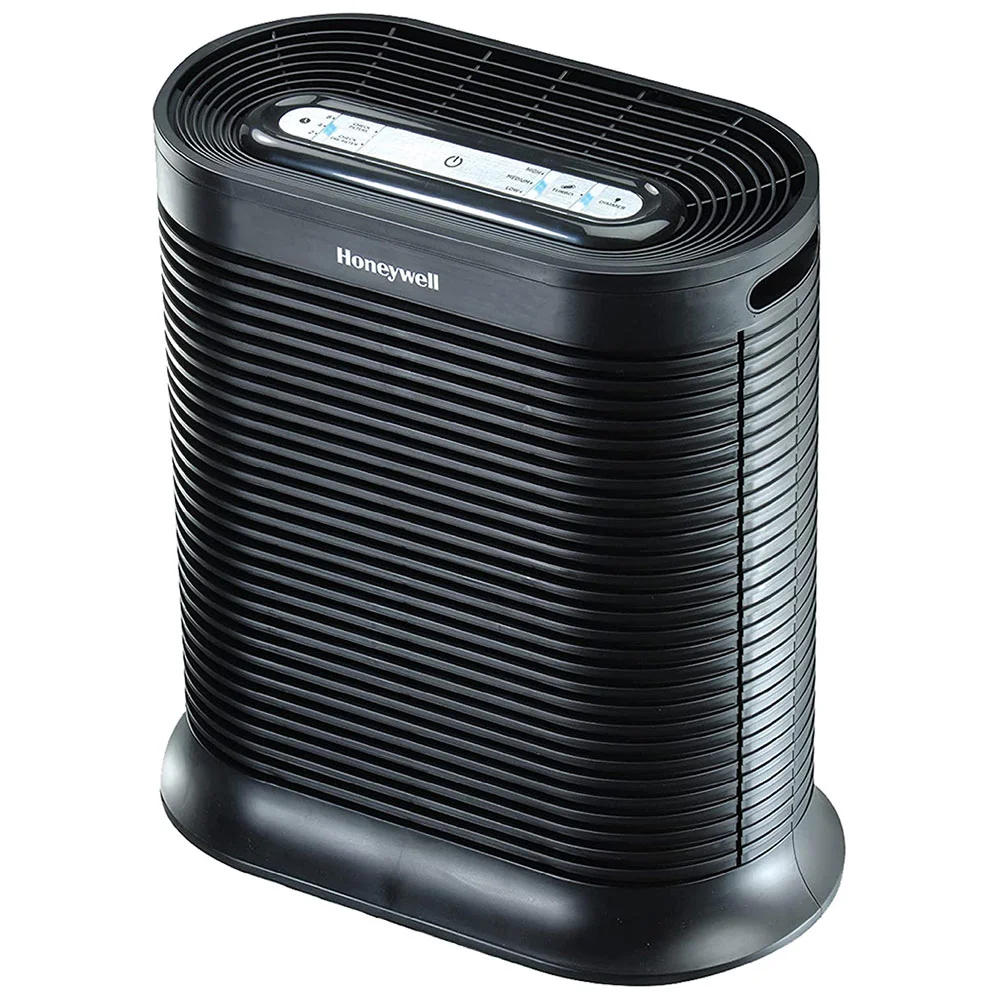
Key Specifications
- Room Coverage
- 465 sq ft
- CADR
- 300/320/300
- Filter
- True HEPA Filter R + Carbon Pre-filter Filter A
- Noise
- 35 dB
- Power
- 88 watts
- Best For
- Large rooms up to 465 sq ft. No smart features but AHAM-verified True HEPA widely available filters. Most supply-chain-reliable large-room HEPA at this price.
📅 Prices checked . Amazon prices change frequently — click through for current price. Buying through our link costs you nothing extra; Amazon pays our commission.
What's in the Box
- Honeywell HPA300 air purifier
- Pre-installed True HEPA filter
- 2 × activated carbon pre-filters
- Power cord
- User manual
Pros
- AHAM-verified CADR: Smoke 300, Dust 320, Pollen 300 CFM
- Covers 465 sq ft at 4.8 ACH — genuine large-room performance
- Three cleaning levels plus Turbo Clean for rapid purification
- Filter A and Filter R widely available at most major retailers
- Straightforward no-app operation — no WiFi dependency
Cons
- No auto mode or air quality sensor — all speeds manually selected
- No WiFi or smart features
- Filter A carbon pre-filter replaced quarterly adds maintenance frequency
- Loud at Turbo Clean (59.5 dB) — not quiet operation at max speed
Best For
Buy the Honeywell HPA300 if you want a proven brand with AHAM-verified performance data and are less concerned about auto mode or smart features. It is a strong fit for buyers who set their air purifier on high and leave it running — large rooms, bedrooms, home offices — where manual fan control is not a daily inconvenience. It is also appropriate for institutional or light commercial settings where reliability and long-term parts availability matter more than app connectivity. If auto mode is important to you, or if you want lower annual filter costs, the Coway AP-1512HH is the better choice for rooms under 361 sq ft. The HPA300 earns its place for large rooms where its CADR advantage over mid-range competitors is most meaningful.
📅 Price checked August 2026 · Buying through this link costs you nothing extra — Amazon covers our commission
Honeywell HPA100 Review Starter Pick
✓ AHAM VerifiedOur Verdict

Key Specifications
- Room Coverage
- 155 sq ft
- CADR
- 100/106/100
- Filter
- True HEPA Filter R + Carbon Pre-filter Filter A (HRF-A100)
- Noise
- 23 dB
- Power
- 50 watts
- Best For
- Small rooms under 155 sq ft. Lowest-cost entry to AHAM-verified True HEPA. Honeywell filter ecosystem widely available.
📅 Prices checked . Amazon prices change frequently — click through for current price. Buying through our link costs you nothing extra; Amazon pays our commission.
Pros
- AHAM-verified CADR: Smoke 100, Dust 106, Pollen 100 CFM
- Compact at 7.74 lbs — lightweight and easy to relocate
- Approximately 23 dB on lowest speed — very quiet for small rooms
- Honeywell filter ecosystem — widely available at most major retailers
- Three cleaning levels plus Turbo Clean
Cons
- Covers only 155 sq ft at 4.8 ACH
- No auto mode or air quality sensor
- Filter A replaced quarterly at extra ongoing cost
- GermGuardian AC4825E covers similar room size at lower purchase price
Best For
The Honeywell HPA100 is best for small rooms under 155 sq ft. lowest-cost entry to aham-verified true hepa. honeywell filter ecosystem widely available.. Entry-level Honeywell HEPA — AHAM-verified CADR 100 for 155 sq ft. Best for personal offices, small bedrooms, or dorm rooms where Honeywell brand reliability and filter availability matter.
📅 Price checked August 2026 · Buying through this link costs you nothing extra — Amazon covers our commission
Honeywell HPA200 Review No-Frills Mid
✓ AHAM VerifiedOur Verdict

Key Specifications
- Room Coverage
- 310 sq ft
- CADR
- 200/190/180
- Filter
- True HEPA Filter R (x2) + Carbon Pre-filter Filter A
- Noise
- 42 dB
- Power
- 86 watts
- Best For
- Medium rooms up to 310 sq ft. True HEPA at mid-range price. No smart features. Honeywell filter ecosystem available everywhere.
📅 Prices checked . Amazon prices change frequently — click through for current price. Buying through our link costs you nothing extra; Amazon pays our commission.
Pros
- AHAM-verified CADR: Smoke 200, Dust 190, Pollen 180 CFM
- Covers 310 sq ft at 4.8 ACH — right-sized for medium bedrooms
- Same proven four-speed manual control system as HPA300
- Lighter than HPA300 at 13.91 lbs
- Honeywell filter ecosystem — Filter R and Filter A widely available
Cons
- No auto mode or air quality sensor
- No WiFi or smart features
- Filter A carbon pre-filter replaced quarterly
- HPA300 at $150-200 delivers 50% more CADR for modest price increase
Best For
The Honeywell HPA200 is best for medium rooms up to 310 sq ft. true hepa at mid-range price. no smart features. honeywell filter ecosystem available everywhere.. Reliable mid-range Honeywell — AHAM-verified CADR 200 covering 310 sq ft at 4.8 ACH. Step up to the HPA300 for $20-30 more to get CADR 300 and 465 sq ft coverage if room size allows.
📅 Price checked August 2026 · Buying through this link costs you nothing extra — Amazon covers our commission
Honeywell in 2026 — HPA Series vs Insight Series Explained
Honeywell's 2026 lineup splits into two distinct product families that serve different buyer profiles: the legacy HPA series (HPA100, HPA200, HPA300) and the newer Insight series (HPA8350B, HPA8450B). Understanding the difference between these families determines which is the correct Honeywell purchase for a given buyer.
HPA Series — the legacy line: The HPA100, HPA200, and HPA300 are the purifiers Honeywell has been selling in essentially unchanged form for over a decade. They are AHAM-verified, True HEPA, and available widely at Home Depot, Target, and Amazon. The key characteristic of the HPA series is manual control: no app, no WiFi, no air quality sensor, no auto mode. You set the fan speed with a dial or button. For buyers who want a set-it-and-leave-it purifier on a fixed setting, this simplicity is a feature. The HPA300 at CADR 300 remains one of the few AHAM-verified options covering rooms above 400 sq ft at a mid-range price ($170-220).
Insight Series — the updated line: The Insight series adds features the HPA line has never had: a built-in air quality sensor, auto mode that adjusts fan speed based on detected PM2.5, an air quality indicator light, and a timer. The Insight series does not add WiFi or app control — it remains a standalone device without smart home integration. AHAM verification status on specific Insight models should be checked at ahamdir.com before purchasing, as not all models in the newer series had entered the AHAM database at time of writing. The Insight series is the correct choice for buyers who want auto mode response to air quality events without full smart home complexity.
The practical decision guide for 2026: if auto mode is needed and smart home is not required, choose Insight series. If manual control is preferred or room coverage above 400 sq ft is needed with confirmed AHAM verification, the HPA300 remains the reference unit. If WiFi, app control, and smart home integration are priorities, Honeywell's current lineup does not serve this need — Levoit (VeSync app) or GoveeLife (Govee Home app) are the correct choices. See the CADR guide to apply verified performance numbers to your room size.
Honeywell HPA300: CADR Data and What It Means
The Honeywell HPA300 holds AHAM verification for CADR 300 smoke, 320 dust, and 300 pollen. These numbers are independently tested by a third party — not self-reported by Honeywell. For a category where brands routinely publish inflated or unverified room-coverage claims, that distinction matters.
At 2 ACH, the HPA300 covers up to 465 sq ft — a genuine large-room footprint that most mid-range competitors cannot match. The Coway AP-1512HH covers 361 sq ft at the same metric. The Winix 5510 covers 392 sq ft. If your room exceeds 400 sq ft, the HPA300 is one of the few AHAM-verified mid-range options that maintains meaningful air cleaning at that scale.
Turbo Clean mode is the HPA300's highest fan speed setting. It draws more power and produces more noise, but it rapidly cycles room air through the HEPA filter — useful for high-particle events like cooking smoke, wildfire particles entering through a window, or post-renovation dust. Run it on Turbo for 15–20 minutes after a high-particle event, then return to a lower speed for steady-state operation. The unit draws 88 watts at full speed — more than competitors at 65–77 watts — so prolonged Turbo use has a measurable electricity cost.
Filter system: True HEPA plus an activated carbon pre-filter. The HEPA captures particles down to 0.3 microns at 99.97% efficiency. The carbon pre-filter handles larger particles and some gas-phase odor compounds, though the carbon volume is modest compared to units like the Winix 5510 with its dedicated pellet carbon stage. Annual filter cost runs approximately $50–$70 for HEPA and pre-filter replacements combined. For total annual running costs, add electricity: at 88 watts on Turbo and an average draw of around 40–50 watts across typical use, annual electricity adds roughly $40–$60. Total annual cost of ownership lands in the $90–$130 range depending on use pattern.
Where Honeywell Wins and Where It Falls Short
Where Honeywell wins:
AHAM verification is the clearest advantage. The HPA300 carries verified CADR data you can compare directly to any other AHAM-verified unit. Established reliability is the second win — Honeywell air purifiers have documented long-term performance records in both home and light institutional settings that newer brands simply have not had time to accumulate. Widely available filters and parts at major retailers (Amazon, Home Depot, Target) mean you are not dependent on a single channel for replacements. For buyers in institutional or commercial settings — clinics, dental offices, small businesses — Honeywell's brand recognition and parts availability are practical considerations beyond raw specifications.
Where it falls short:
No air quality sensor. No auto mode. The HPA300 runs at whatever speed you set it. If particle levels spike — a neighbor starts a fire, you burn toast, pollen counts jump — the unit does not respond. You respond, manually. The Coway AP-1512HH has a particle sensor and auto mode at a similar or lower price point, with CADR 233–246 (lower than the HPA300 but sufficient for rooms under 360 sq ft). For buyers who want the air purifier to manage itself, the Coway is the more capable tool at this price.
Filter replacement cost is the second gap. Honeywell's annual filter cost of approximately $80 is higher than Coway (approximately $60) and substantially higher than Levoit Core 300 (approximately $25). Over 5 years, that difference adds up to $100–$275 in additional running costs versus competitors. Design is also unchanged for many years — no WiFi, no app, no scheduling, no air quality display. If smart home integration is part of your consideration, Honeywell HPA-series is not the right direction.
Honeywell vs Coway vs Levoit: Which Brand to Choose
Choose Honeywell if your priority is a proven brand with AHAM-verified CADR, large-room coverage above 400 sq ft, and long-term institutional reliability. The HPA300's CADR 300–320 is genuinely higher than mid-range Coway or Levoit models, and that matters in rooms above 400 sq ft. Accept that you get no auto mode and no smart features.
Choose Coway if you want auto mode, a responsive particle sensor, lower annual filter costs, and proven reliability for rooms up to 361 sq ft. The Coway AP-1512HH has been the Wirecutter top pick for over 10 consecutive years. At $109–$129 with AHAM-verified CADR and auto mode, it is the default recommendation for rooms under 400 sq ft where the Honeywell CADR advantage is not needed.
Choose Levoit if you want WiFi connectivity, app control, the widest model selection across room sizes, and the lowest entry-level filter costs. Levoit has faced some controversy around HEPA marketing claims in their Core line, but their AHAM-verified CADR numbers remain valid. The Levoit lineup runs from the Core 300 at $99 up to the Core 600S for large rooms. If smart features and the VeSync app ecosystem matter, Levoit is the right brand. For buyers who simply want verified performance without app dependency, Honeywell or Coway are cleaner choices.
Honeywell 3-Year Total Cost of Ownership Across the Lineup
Sticker price tells only part of the story. The true cost of owning a Honeywell air purifier over 3 years is sticker price plus 3 years of filters plus 3 years of electricity. The table below uses the electricity formula — watts × 12 h/day × 1,095 days × $0.17/kWh ÷ 1,000 — applied to each model's average operating wattage across typical mixed-speed use. For all three models, that means running a mix of low, medium, and high — not continuous Turbo. Electricity figures assume $0.17/kWh, the U.S. national average in 2026.
HPA100 (CADR 100, rooms up to 155 sq ft): Purchase price approximately $79–$99. Annual filter cost approximately $45–$55 (one HEPA filter per year plus pre-filters). Average operating wattage at mixed speed: approximately 25 W. Three-year electricity: 25 × 12 × 1,095 × $0.17 ÷ 1,000 = approximately $56. Three-year filter cost: approximately $$150. Three-year total cost of ownership: approximately $$285–$305.
HPA200 (CADR ~200, rooms up to 310 sq ft): Purchase price approximately $109–$139. Annual filter cost approximately $60–$70. Average operating wattage at mixed speed: approximately 35 W. Three-year electricity: 35 × 12 × 1,095 × $0.17 ÷ 1,000 = approximately $78. Three-year filter cost: approximately $$195. Three-year total cost of ownership: approximately $$382–$412.
HPA300 (CADR 300, rooms up to 465 sq ft): Purchase price approximately $169–$219. Annual filter cost approximately $80 (one HEPA filter per year plus four pre-filter replacements). Average operating wattage at mixed speed: approximately 45 W (the unit draws 88 W at Turbo but typical daily use sits around 40–50 W). Three-year electricity: 45 × 12 × 1,095 × $0.17 ÷ 1,000 = approximately $101. Three-year filter cost: approximately $$240. Three-year total cost of ownership: approximately $$510–$560.
The takeaway is straightforward: every step up the HPA lineup adds roughly $$100–$130 to three-year cost of ownership, primarily driven by higher filter expense. The HPA300 costs about twice as much to own over three years as the HPA100. That premium is justified only if your room actually exceeds 155 sq ft (for HPA100) or 310 sq ft (for HPA200). Buying a larger model for a room that doesn't need it adds cost without adding meaningful air quality benefit — match the model to your room size using the CADR guide.
Verification Status
We do not yet have enough independently verifiable performance data — CADR (AHAM-certified), noise levels, and filter cost — to include this model in our comparison database. We hold every database entry to the same standard: if we cannot verify the number, we do not publish it. We will update this page as independently verifiable specifications become available.