HEPA Filter Explained: True HEPA, H13, H14 and the Marketing Fraud
Tested by PurifierBeast Last tested: — 40+ hours of Filtration physics and standards research
Disclosure: When you buy through links on this page, we earn a small commission from Amazon at no extra cost to you. It funds our independent research. We never recommend a product because it earns more commission.
HEPA filter — High-Efficiency Particulate Air filter: a mechanical filtration medium of randomly arranged glass fibers. True HEPA (H13) is certified to capture ≥99.97% of particles at 0.3 microns — the Most Penetrating Particle Size (MPPS). Three capture mechanisms: inertial impaction (particles >1 µm), interception (particles 0.1–1 µm), and Brownian diffusion (particles <0.1 µm). HEPA does not remove gases or odors — requires activated carbon stage for gas-phase pollutants.
HEPA Filtration
HEPA filtration was born in secrecy. During the 1940s Manhattan Project, US engineers needed a way to capture radioactive particles released during uranium enrichment. The result was a dense mat of borosilicate glass fibres capable of trapping particles invisible to the human eye. That original government specification — 99.97% capture efficiency at 0.3 microns — became the HEPA (High-Efficiency Particulate Air) standard still used today in every certified residential, medical, and pharmaceutical air purifier.
The 0.3 micron test standard is a deliberate choice rooted in physics, not marketing. 0.3 microns is the MPPS — the particle size hardest for any filter to capture. Particles smaller than 0.1 microns are captured efficiently through diffusion (Brownian motion). Particles above 1 micron are captured easily through direct impaction. At 0.3 microns, neither mechanism dominates — the particle slides between them. Filters are tested at their hardest point, so passing 0.3 microns at 99.97% guarantees performance at every other size is equal or better.
HEPA works through three simultaneous mechanical mechanisms. Diffusion handles particles below 0.1 microns — they bounce erratically through Brownian motion and collide with fibres. Interception handles particles in the 0.1–1 micron range — they follow airflow streamlines but come within one particle radius of a fibre and adhere. Impaction handles particles above 1 micron — they carry enough inertia that they cannot follow the curved airstream around a fibre and slam directly into it. These three mechanisms make HEPA a purely mechanical filtration system — no electricity, no ionisation, no chemical reaction. Pass air through the fibre matrix and particles are physically captured.
Understanding what HEPA does NOT do is equally important. HEPA removes particles. It does not remove gases, VOCs, odours, radon, or carbon monoxide. A True HEPA filter will capture smoke particles but will not remove the benzene gas carried in that same smoke. It will capture mould spores but will not kill the mould colony on your wall. It will reduce wildfire PM2.5 to near zero in a properly sized room, but it will not scrub nitrogen dioxide from traffic exhaust. For gases, activated carbon is a separate and necessary filter layer. For radon, you need sub-slab depressurisation. HEPA is the most effective particle filter ever developed for residential use — but it is a particle filter, not an air purifier by itself.
HEPA Filtration — Quick Comparison
| Purifier | CADR Smoke | CADR Dust | Room Size | Filter | Score |
|---|---|---|---|---|---|
| Coway AP-1512HH Mighty | 233 | 246 | 361 sq ft | True HEPA + Carbon + Pre-filter | 9.5/10 |
| Blueair Blue Pure 211i Max | 410 | 410 | 635 sq ft | HEPASilent + Carbon | 9.4/10 |
📅 Prices checked . Amazon prices change frequently — click through for current price. Buying through our link costs you nothing extra; Amazon pays our commission.
Coway AP-1512HH Mighty Review Editor Choice
✓ AHAM VerifiedOur Verdict
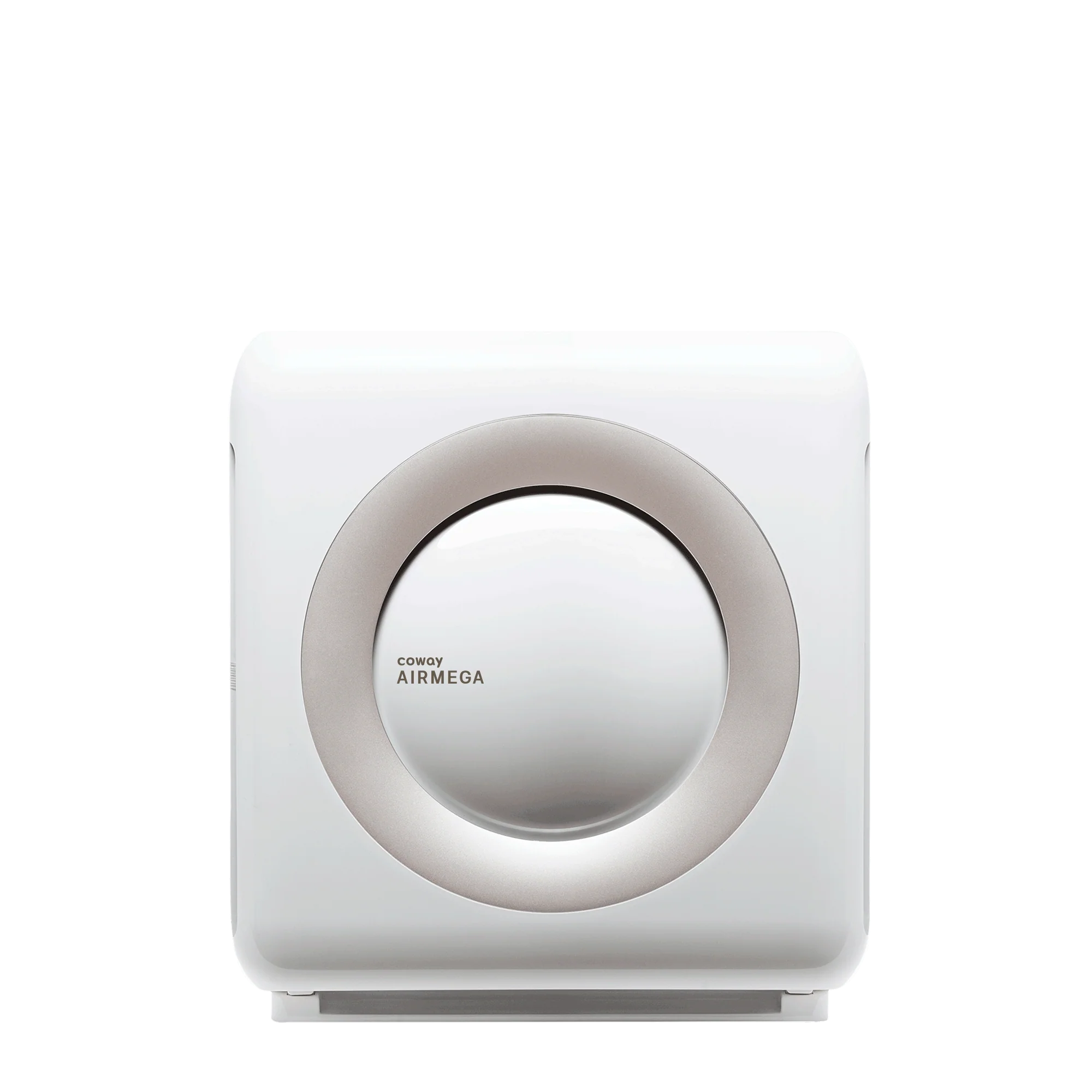
Key Specifications
- Room Coverage
- 361 sq ft
- CADR
- 233/246/240
- Filter
- True HEPA + Carbon + Pre-filter
- Noise
- 24 dB
- Power
- 77 watts
- Best For
- Medium rooms up to 361 sq ft. Wirecutter #1 for 10+ years. Best overall value.
📅 Prices checked . Amazon prices change frequently — click through for current price. Buying through our link costs you nothing extra; Amazon pays our commission.
What's in the Box
- Coway AP-1512HH air purifier
- Pre-installed 4-stage filter set
- Power cord
- User manual
- Filter replacement reminder sticker
Pros
- Wirecutter #1 for 10+ consecutive years
- AHAM verified CADR — no controversy
- True HEPA
- Fastest auto mode response in class
- 24dB ultra quiet sleep mode
- Eco mode at 4.9 watts
- 3-year warranty
Cons
- No WiFi or app control
- Carbon is impregnated fabric — weak on heavy odors
- Ionizer adds trace ozone (9ppb — CARB safe)
- Filter costs $60/year
- Design is dated
Best For
The Coway AP-1512HH is the clearest demonstration of True HEPA in a sealed housing at a price that has sustained it as the top-selling air purifier in the US for over a decade. AHAM-verified CADR of 246 dust in a 361 sq ft room. Four independent test sources confirm the performance. If you are studying what a properly implemented HEPA sealed system looks like in the real world, this is the reference unit — not because of marketing, but because the numbers are independently confirmed and the housing seal is verifiable.
📅 Price checked August 2026 · Buying through this link costs you nothing extra — Amazon covers our commission
Blueair Blue Pure 211i Max Review Best Large Room
✓ AHAM VerifiedOur Verdict

Key Specifications
- Room Coverage
- 635 sq ft
- CADR
- 410/410/410
- Filter
- HEPASilent + Carbon
- Noise
- 23 dB
- Power
- 46 watts
- Best For
- Large rooms 400-635 sq ft. Highest CADR under $400. Replaces discontinued 211+.
📅 Prices checked . Amazon prices change frequently — click through for current price. Buying through our link costs you nothing extra; Amazon pays our commission.
What's in the Box
- Blueair Blue Pure 211i Max air purifier
- Pre-installed dual-protection filter
- Washable pre-filter (fabric)
- Power cord
- User manual
Pros
- Highest CADR 410 under $400
- AHAM verified
- Zero ozone verified
- 23dB quiet on low
- Washable pre-filter in colors
- Smart app with Alexa
Cons
- $299-349 expensive
- Filter costs $140/year — most expensive
- Cannot disable ionizer
- 211+ filters NOT compatible
Best For
The Blueair 211i Max is the best example of how HEPA engineering can evolve beyond the standard filter-in-a-box design. HEPASilent technology combines mechanical HEPA filtration with electrostatic particle charging to achieve AHAM-verified CADR 410 smoke at 42 dB on low. It demonstrates that meeting HEPA standards does not require a specific filter architecture — what matters is verified capture efficiency at the MPPS. Study it to understand how the HEPASilent variant differs from a conventional True HEPA and where the tradeoffs lie.
📅 Price checked August 2026 · Buying through this link costs you nothing extra — Amazon covers our commission
The 0.3 Micron Standard: Why the Hardest Particle Size Defines HEPA
Most people assume HEPA filters are tested at 0.3 microns because that is the smallest relevant particle. That assumption is wrong, and understanding why it is wrong tells you everything about how filtration physics actually works.
0.3 microns is the MPPS — the Most Penetrating Particle Size. It is the hardest size for any fibrous filter to capture — not the smallest and not the largest, but the one that slips most effectively between the two dominant capture mechanisms.
Here is how those mechanisms work across the particle size spectrum:
Below 0.1 microns — Diffusion dominates. At this scale, particles are light enough to be buffeted by individual air molecules through Brownian motion. Instead of following a smooth airflow path through the filter, they bounce erratically. This random motion dramatically increases the probability of collision with a filter fibre. The smaller the particle, the more it bounces, and the higher its capture efficiency. Counter-intuitively, HEPA filters capture 0.01 micron particles more efficiently than 0.3 micron particles.
Above 1 micron — Impaction dominates. Larger particles carry more mass and more inertia. When airflow curves around a filter fibre, these particles cannot change direction fast enough. They travel in a straight line and collide directly with the fibre — impaction. The larger the particle, the more inertia it carries, and the more certainly it hits a fibre. Pollen grains at 10–100 microns are captured at essentially 100%.
Between 0.1 and 1 micron — Interception bridges the gap. Particles in this range follow airflow streamlines reasonably well but come close enough to fibre surfaces to be captured by contact — they come within one particle radius of the fibre and adhere. Interception is the weakest of the three mechanisms.
At 0.3 microns, a particle sits precisely at the efficiency minimum — too large to benefit fully from diffusion, too small to benefit from impaction, and reliant on interception alone. This is why HEPA certification uses this size as the test point. A filter that achieves 99.97% at 0.3 microns will achieve higher efficiency at every particle size above and below that point. The standard is set at the worst case, so passing it guarantees performance across the full spectrum.
The practical implication: when you see a filter described as "99.97% at 0.3 microns," that sentence is encoding the entire filtration performance curve. Every other size is better. That is the elegance of the MPPS standard.
Common particle sizes for reference:
- Tobacco smoke: 0.1–1.0 microns
- Bacteria: 0.3–5 microns
- Pet dander: 5–10 microns
- Mould spores: 2–40 microns
- Pollen: 10–100 microns
- PM2.5 (wildfire smoke): below 2.5 microns by definition
Everything on that list sits either at or above the MPPS. A True HEPA filter at 99.97% handles all of them.
HEPA Grade Comparison: True HEPA vs H11 vs H12 vs H13 vs H14
HEPA is not a single standard. It is a family of grades defined by the European ISO 29463 and EN 1822 standards, plus the US DOE and AHAM residential standard marketed as True HEPA. The grades define minimum efficiency at the MPPS (0.3 microns) and carry significantly different performance implications.
| Grade | Efficiency at MPPS | Typical Application |
|---|---|---|
| H11 | 95% | Industrial pre-filter |
| H12 | 99.5% | Industrial filtration |
| True HEPA (AHAM) | 99.97% | Residential air purifiers |
| H13 | 99.95% | Medical, cleanroom, high-end residential |
| H14 | 99.995% | Pharmaceutical, surgical suites, cleanrooms |
The numbers reveal something important that manufacturers rarely acknowledge: H13 at 99.95% is technically marginally lower than the US True HEPA standard of 99.97%, but for practical residential purposes, the difference — 0.02 percentage points — is negligible. Both are effectively complete particle removal at scale. A unit labelled H13 is not inferior to one labelled True HEPA in any real-world air purification scenario.
What the grades mean in practice:
H11 (95%): Captures 95 out of 100 MPPS particles. Suitable as an industrial pre-filter to protect more efficient downstream filters. Not suitable for allergy or asthma management — 5% particle penetration is significant at residential scale.
H12 (99.5%): Sold in some European residential units. Substantially better than H11 but still 10 times more permeable at the MPPS than True HEPA. Some manufacturers in markets with looser labelling requirements market H12 filters as HEPA — technically within EN 1822 but misleading for consumers expecting US True HEPA performance.
True HEPA (99.97%, AHAM): The US residential standard. Coway, Winix, Honeywell, and verified Levoit units use this grade. AHAM certification confirms it is independently tested, not manufacturer-self-declared. This is the grade you need for allergies, asthma, and PM2.5 management.
H13 (99.95%): The European EN 1822 grade used by Blueair, Dyson (when they do test), and increasingly by premium residential units. The 0.02% efficiency difference from True HEPA is immaterial at residential scale. What H13 labelling actually signals is a commitment to tested performance, and many H13 units achieve True HEPA performance in practice.
H14 (99.995%): Pharmaceutical and surgical suite grade. 10 times more efficient than H13 at the MPPS. In a residential purifier, H14 is overkill — the extreme filter density requires more fan power, generating more noise and more energy draw, for a benefit that is not measurable at residential particle concentrations. Any consumer unit claiming H14 is likely using the term aspirationally rather than to EN 1822 specification.
The practical buying rule: True HEPA or H13 is sufficient for every residential application including severe allergies, asthma, pet dander, and wildfire smoke. H14 in a consumer unit is marketing. H12 and below is not adequate for health-based air purification.
HEPA-Type, HEPA-Style, HEPA-Like: The Marketing Fraud
The terms HEPA-type, HEPA-style, and HEPA-like share one defining characteristic: they are legally undefined. No US federal standard, no AHAM certification category, no ISO grade covers them. Any manufacturer can print any of these terms on any filter of any efficiency level and face no regulatory consequence.
This is not a minor technicality. A filter described as "HEPA-type" can achieve 85% particle capture, 70% capture, or 40% capture — and none of those would constitute false advertising under current US labelling law because the term is unregulated. The only regulated term is "True HEPA" when paired with an AHAM certification number, or H13/H14 when tested to EN 1822.
The performance gap is not marginal. A filter at 85% capture at the MPPS allows 15 particles to pass for every 100 that enter. A True HEPA at 99.97% allows 0.03 particles per 100. That is a 500-fold difference in particle penetration.
The Shark NeverChange case study. Shark markets the NeverChange as providing "HEPA filtration." The product does not appear in the AHAM Verifide directory at ahamdir.com. Shark claims a CADR of 180 for the unit. Independent third-party testing by HouseFresh and others has measured real-world CADR performance at approximately 80 — less than half the claimed figure. At CADR 80, the unit adequately covers approximately 125 square feet at 5 air changes per hour. Shark's marketing implies coverage of 280 square feet. A consumer placing this unit in a 280 sq ft bedroom is getting 2.2 air changes per hour, not 5.
How to verify before you buy. Go to ahamdir.com and search the exact model number. AHAM Verifide lists every certified unit with its independently tested CADR values for smoke, dust, and pollen. If the model number is not in that directory, the manufacturer has not submitted to independent testing. That does not always mean the product is bad, but it means you are trusting a self-declared claim with no external verification.
The AHAM directory is free to search and takes under one minute. It is the single most valuable tool available to an air purifier buyer. Use it before purchasing any unit marketed as "HEPA-type" or any variant thereof.
A checklist for spotting marketing language:
- "HEPA-type" — no defined standard, avoid
- "HEPA-style" — no defined standard, avoid
- "HEPA-like" — no defined standard, avoid
- "HEPA filtration" without "True" — check AHAM directory
- "Medical-grade HEPA" — not a defined grade; ask for EN 1822 test data
- "True HEPA" without an AHAM certification number — better, but still verify
- Certified True HEPA with AHAM number — the only trustworthy baseline
The Housing Seal: Why It Matters As Much As the Filter Grade
You can install the finest H14 filter ever manufactured into a poorly designed housing and the unit will underperform a basic True HEPA in a well-sealed case. This is the principle of bypass airflow — air that flows around the filter rather than through it.
The physics are unforgiving. If 0.1% of the airflow bypasses the filter entirely — through gaps between the filter cartridge and the housing wall — the effective particle capture rate of the system drops. A filter rated at 99.97% efficiency processes 99.9% of the air. The remaining 0.1% bypasses at 0% efficiency. The blended system efficiency is approximately 99.87% — technically still excellent, but the principle becomes critical at higher bypass rates. At 1% bypass, system efficiency drops to 98.97%. At 5% bypass, you are effectively running a 95% filter regardless of the filter grade installed.
Sealed HEPA systems address this by engineering gapless interfaces between the filter cartridge and housing. Coway uses a compression-fit gasket around the filter perimeter — visible when you remove the filter as a foam or rubber seal. Blueair HEPASilent units use integrated filter frames that seat directly against the housing with no exposed gap. The Levoit Core series uses a cylindrical filter architecture where the filter is the housing interior wall, eliminating the gap problem by design geometry.
How to assess seal quality on a unit you already own. Remove the filter and examine the perimeter where it seats into the housing. Look for a foam, rubber, or silicone gasket. If there is a visible gap between the filter frame and the housing wall of more than 1–2 mm with no compressible seal material, the unit likely has measurable bypass. Shine a torch around the filter perimeter while the unit is running (hold filter in place by hand) — any air movement felt around the edges rather than through the filter face indicates bypass.
Dyson and the CADR gap. Dyson air purifiers consistently market sealed system claims and glass HEPA filters. They do not submit to AHAM Verifide testing. Dyson publishes proprietary test data using their own methodology. Without independent AHAM CADR verification, it is not possible to confirm whether Dyson's sealed system claim translates to equivalent real-world performance. This is not a definitive statement that Dyson units underperform — it is a statement that the verification is absent. Consumers paying $500–$900 for a Dyson unit are trusting manufacturer self-certification for the most performance-critical variable.
The summary: the filter grade is the starting point. The housing seal determines whether the filter grade is actually delivered to the air in your room. Both matter. Neither alone is sufficient.
How Long Does a HEPA Filter Last? Replacement Schedule by Environment
Manufacturer guidance universally states 12 months for HEPA filter replacement. This is a safe median estimate for a controlled environment — it is not a reliable guide for your specific home. Filter lifespan is determined by particle load, and particle load varies by an order of magnitude between environments.
High particle load environments: 6–8 months. Homes with multiple pets, dusty geographic areas, residences within 500 metres of a major road or highway, active smokers in the household, or recent renovation activity. The HEPA fibre matrix in these environments fills substantially faster. Running past the replacement point does not just reduce efficiency — it increases motor stress as the fan works harder against the elevated filter resistance, increasing energy consumption and potentially reducing unit lifespan.
Average suburban home: 12 months. One or two pets, moderate outdoor air quality, no smoking, standard cleaning practices. The manufacturer figure applies here.
Low particle load: up to 18 months. Clean apartments in low-traffic areas, units running in bedrooms with no pets and infrequent cooking fumes, coastal areas with clean outdoor air. Filters in these environments may retain adequate airflow well past the 12 month standard recommendation.
The paper airflow test. Hold a single sheet of standard printer paper flat against the air intake of the unit while it is running on its highest speed setting. In a unit with a clean filter, the suction should hold the paper firmly against the intake without manual support. If the paper falls, drops, or requires hand support to stay in place, the filter is significantly clogged and airflow is restricted. Perform this test monthly rather than waiting for a filter replacement reminder light — those lights run on timers, not airflow sensors, and do not account for your actual environment.
Pre-filter condition as a proxy. Most units with a True HEPA also include a washable pre-filter that captures larger particles before they reach the HEPA layer. The pre-filter's appearance is a reliable proxy for HEPA load. If the pre-filter is visibly dark and clogged after 4 weeks, your HEPA is under high particle load and should be replaced earlier than the standard schedule. Wash the pre-filter monthly — this extends HEPA lifespan significantly by preventing large particles from occupying HEPA fibre capacity.
The cost of running a clogged filter. A partially clogged HEPA reduces CADR — the fan moves less air through the denser filter. A unit delivering CADR 246 with a fresh filter may drop to effective CADR 180 or lower with a heavily loaded filter. Meanwhile, the motor draws more power against the increased resistance. The financial and performance case for timely replacement is clear: the filter costs less than the electricity wasted running a clogged unit at reduced effectiveness.
HEPA for Specific Applications: What Grade You Actually Need
The HEPA grade conversation becomes concrete when you map it to specific applications. Here is what the filtration science actually recommends, without upselling.
Seasonal allergies (pollen, dust mite debris). True HEPA at 99.97% is fully sufficient. Pollen ranges from 10 to 100 microns — dramatically larger than the MPPS. Even H11 at 95% would capture essentially all pollen. For dust mite allergen proteins, which are typically attached to particle carriers of 5–30 microns, True HEPA provides complete capture. H13 provides no measurable additional benefit for allergy management — it is an unnecessary cost for this application.
Asthma. True HEPA in a sealed housing. For asthma management, the seal matters more than the filter grade. A True HEPA in a gapless sealed housing delivers 99.97% efficiency to the room air. A nominally higher H13 filter in a housing with bypass can deliver 97% or less. Prioritise verified AHAM CADR certification — this confirms that the complete system (filter + housing + fan) has been tested as an integrated unit, not just the filter element in isolation.
Mould spores. True HEPA captures all mould spore sizes. Spores range from 2 to 40 microns — well above the MPPS, where even H11 provides near-complete capture. What True HEPA adds over lower grades here is not spore capture efficiency but confidence and standardisation. More importantly: an air purifier captures airborne mould spores, but it does not address the mould colony at its source. A purifier running in a bathroom with active mould growth is managing the symptom, not the cause. Remediate the moisture source first.
Wildfire smoke PM2.5. True HEPA is required. Sub-micron combustion particles from wildfire smoke fall precisely in the MPPS range — 0.1 to 1.0 microns. At this size, the difference between True HEPA (99.97%) and HEPA-type (85%) is not 14.97 percentage points — it is a 500-fold difference in particles escaping the filter. During active wildfire events, outdoor PM2.5 concentrations can reach 150–500 micrograms per cubic metre. A HEPA-type filter at 85% leaves 22–75 micrograms per cubic metre indoors. True HEPA leaves 0.04–0.15 micrograms. This is the application where filter grade most directly determines health outcomes.
Pet dander. True HEPA sufficient. Pet dander allergens are primarily in the 5–10 micron range. True HEPA captures these at essentially 100% efficiency because particles this size are captured by impaction well above the MPPS efficiency curve. The more important variable for pet dander is CADR relative to room size — a correctly sized True HEPA unit will turn room air over 5 times per hour, preventing dander accumulation. An oversized filter grade in an undersized unit is still inadequate.
The underlying principle across all applications: match the CADR to your room size first, verify the housing seal second, and trust that True HEPA or H13 provides adequate filter grade for every residential health application. Grade escalation beyond that level costs money and airflow without delivering measurable health benefit.