Winix 5510 vs Dyson Purifier Cool TP07 2026
Tested by PurifierBeast Last tested: — 28+ hours of AHAM database verification, pet and odor performance analysis, cost-per-CADR modelling
Disclosure: When you buy through links on this page, we earn a small commission from Amazon at no extra cost to you. It funds our independent research. We never recommend a product because it earns more commission.
Winix 5510 vs Dyson Purifier Cool TP07 — AHAM-verified mid-range versus unverified premium purifier-fan. Winix 5510: 5–185, AHAM-verified CADR 253, PlasmaWave, 392 sq ft. Dyson TP07: 9–499, no AHAM CADR, HEPA H13, smart LCD, 350° fan, VOC sensor. Choose Winix for verified air cleaning at 0 less; choose Dyson only if fan function and smart features are genuine requirements.
Winix 5510 vs Dyson TP07
The Winix 5510 costs $149-179. The Dyson Purifier Cool TP07 costs $449-499. That is a $270-320 gap. For that price difference, you should either get 3x better air cleaning or 3x better features. The Dyson does not deliver 3x better air cleaning — it does not even have AHAM-verified CADR to compare. The question is whether the fan function, VOC sensing and premium design justify the price for your specific needs.
I built this comparison for buyers who have seen the Dyson marketing and are wondering whether it is worth the premium over a proven mid-range unit. For the complete picture on each brand, see our full Winix review and full Dyson review. For the best air purifiers for pet owners specifically, see our pet air purifier guide.
Winix 5510 vs Dyson TP07 — Quick Comparison
| Purifier | CADR Smoke | CADR Dust | Room Size | Filter | Score |
|---|---|---|---|---|---|
| Winix 5510 | 253 | 252 | 316 sq ft | True HEPA Filter Q + PlasmaWave + Washable Pre-filter | 9.3/10 |
| Dyson Purifier Cool TP07 | 106 | 141 | 400 sq ft (claimed) | H13 HEPA + Carbon | 8.2/10 |
| Blueair Blue Pure 211i Max | 410 | 410 | 635 sq ft | HEPASilent + Carbon | 9.4/10 |
📅 Prices checked . Amazon prices change frequently — click through for current price. Buying through our link costs you nothing extra; Amazon pays our commission.
Winix 5510 Review Best for Pets
✓ AHAM VerifiedOur Verdict

Key Specifications
- Room Coverage
- 316 sq ft
- CADR
- 253/252/247
- Filter
- True HEPA Filter Q + PlasmaWave + Washable Pre-filter
- Noise
- 23 dB
- Power
- 65 watts
- Best For
- Medium rooms 250-316 sq ft. WiFi app control. PlasmaWave CARB-certified ionization. Successor to 5500-2.
📅 Prices checked . Amazon prices change frequently — click through for current price. Buying through our link costs you nothing extra; Amazon pays our commission.
What's in the Box
- Winix 5510 air purifier
- Pre-installed True HEPA + carbon filter
- Power cord
- Remote control
- User manual
Pros
- AHAM-verified CADR: Smoke 253, Dust 252, Pollen 247 CFM
- WiFi via Winix Smart app — scheduling, remote on/off, filter tracking
- PlasmaWave CARB-certified bipolar ionization for VOC decomposition
- Combined Filter Q simplifies maintenance to one annual replacement
- Four-stage filtration including washable pre-filter
Cons
- Winix Smart app only — no Alexa or Google Home voice integration
- Filter Q combines HEPA and carbon — no washable carbon option like 5500-2
- Coverage 316 sq ft at 5 ACH — step up to CADR 300+ for rooms over 350 sq ft
- PlasmaWave cannot be disabled from physical panel without app
Best For
Pet owners, smokers and buyers with persistent cooking or VOC odors in rooms 250-400 sq ft who want the best odor and particle removal combination at the most affordable price. The Winix 5510 pairs AHAM-verified CADR 253 with PlasmaWave technology and dual-stage carbon filtration — a combination specifically effective for airborne pet allergens, pet dander and organic odors. At $149-179 it also leaves $270+ in budget versus the Dyson for additional accessories or a second unit. See our full Winix review for all models.
📅 Price checked August 2026 · Buying through this link costs you nothing extra — Amazon covers our commission
Dyson Purifier Cool TP07 Review Premium Pick
Not AHAM VerifiedOur Verdict
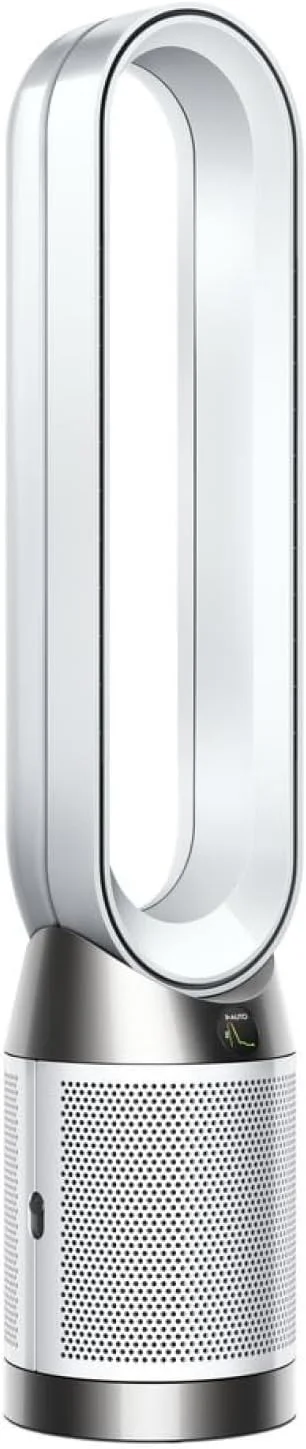
Key Specifications
- Room Coverage
- 400 sq ft (claimed)
- CADR
- Not AHAM verified — NOT AHAM VERIFIED
- Filter
- H13 HEPA + Carbon
- Noise
- 36 dB
- Power
- 40 watts
- Best For
- Design-conscious buyers. Fan + purifier combo. Accept no AHAM CADR verification.
📅 Prices checked . Amazon prices change frequently — click through for current price. Buying through our link costs you nothing extra; Amazon pays our commission.
What's in the Box
- Dyson Purifier Cool air purifier + fan
- Pre-installed filter assembly (HEPA + activated carbon)
- Power cord
- Remote control
- User manual
Pros
- Genuine H13 HEPA glass fibre
- Fan + purifier dual function
- MyDyson app with air quality data
- Premium design
Cons
- CADR NOT AHAM verified
- $449-499 — 4x Coway price
- HouseFresh shows cheaper units outperform
- Filter $75/year
Best For
Buyers who genuinely need a combined high-quality fan and air purifier, live in warm climates, and want VOC sensing alongside particle filtration. If you would buy a quality tower fan ($100-150) and a mid-range air purifier ($200-300) separately, the Dyson at $449 replaces both at competitive combined cost. Its real differentiators are the bladeless fan (safe around pets and children), the VOC sensor for chemical detection, and the LCD display. See our full Dyson review.
📅 Price checked August 2026 · Buying through this link costs you nothing extra — Amazon covers our commission
Blueair Blue Pure 211i Max Review Best Large Room
✓ AHAM VerifiedOur Verdict

Key Specifications
- Room Coverage
- 635 sq ft
- CADR
- 410/410/410
- Filter
- HEPASilent + Carbon
- Noise
- 23 dB
- Power
- 46 watts
- Best For
- Large rooms 400-635 sq ft. Highest CADR under $400. Replaces discontinued 211+.
📅 Prices checked . Amazon prices change frequently — click through for current price. Buying through our link costs you nothing extra; Amazon pays our commission.
What's in the Box
- Blueair Blue Pure 211i Max air purifier
- Pre-installed dual-protection filter
- Washable pre-filter (fabric)
- Power cord
- User manual
Pros
- Highest CADR 410 under $400
- AHAM verified
- Zero ozone verified
- 23dB quiet on low
- Washable pre-filter in colors
- Smart app with Alexa
Cons
- $299-349 expensive
- Filter costs $140/year — most expensive
- Cannot disable ionizer
- 211+ filters NOT compatible
Best For
Buyers with rooms above 450 sq ft who want the highest verified CADR in the sub-$350 segment. CADR 410, AHAM-verified, $299-349. If your room is too large for the Winix 5510 and you do not need the Dyson's fan function, the Blueair 211i Max is the efficiency leader. It also has an excellent washable pre-filter for pet hair. See our full Blueair review.
📅 Price checked August 2026 · Buying through this link costs you nothing extra — Amazon covers our commission
What to Know Before You Buy
PlasmaWave: What It Is and Whether to Use It
The Winix 5510 includes PlasmaWave technology, which generates hydroxyls that break down VOCs, odors and biological pollutants at the molecular level. It is effective for cooking smells, pet odors, cigarette smoke and some chemical off-gassing. It does not generate ozone at harmful levels — Winix is CARB-certified and the ozone output is within California's strict 0.050 ppm limit. However, some buyers prefer to run purely mechanical filtration without ionization. PlasmaWave can be disabled with a single button press, making the 5510 a pure HEPA+carbon unit if preferred.
The Pet Dander Consideration
For pet homes, the Winix 5510 has two advantages over the Dyson TP07. First: AHAM-verified pollen CADR of 246 — pollen particles are similar in size to pet dander. Second: the carbon pre-filter is optimized for biological odors and works synergistically with PlasmaWave for persistent pet smell reduction. The Dyson TP07 can detect VOCs (including some pet-related compounds) but its particle removal performance for dander is unverified. For pet allergen control specifically, verified CADR and appropriate filtration matter more than sensor sophistication.
Running Costs at $270 Price Difference
At $270 savings buying the Winix instead of the Dyson, you could purchase: three years of replacement filters for the Winix and still have money left over. The Winix 5510 annual filter cost is approximately $40-60. Three years: $120-180. The Dyson saves on filter frequency but costs $449+ upfront. The Winix delivers verified air cleaning at lower total cost over any time horizon you measure.
Verified CADR: The $270 Premium Buys No Verified Performance Advantage
The Winix 5510 has AHAM-verified CADR of 253 smoke, 252 dust and 247 pollen. These figures are independently tested and publicly listed at ahamdir.com. The AHAM-verified room coverage is 392 sq ft at 2 air changes per hour.
The Dyson Purifier Cool TP07 has no AHAM-verified CADR. Dyson states the TP07 captures 99.97% of particles 0.3 microns and larger and covers 800 sq ft. The 99.97% claim is a filter efficiency figure — it describes what the filter media does under ideal conditions, not how much air the unit processes per minute. The 800 sq ft claim is unverified by AHAM. It may be accurate. It cannot be independently confirmed.
When you pay $270 more for the Dyson, you are not paying for verified better air cleaning. You may be paying for equivalent, better, or even worse air cleaning performance — there is no independent data to determine which. That uncertainty alone is a meaningful argument for the Winix 5510. For buyers who need confirmed allergen and particle removal, unverified claims are insufficient justification for a $270 premium.
Pet and Odor Control: Winix PlasmaWave vs Dyson Carbon Filter
The Winix 5510 approaches pet and odor control with a three-stage system:
- Carbon pre-filter — captures large particles, pet hair and some VOCs before they reach the HEPA layer
- True HEPA filter — captures 99.97% of particles 0.3 microns and larger, including pet dander and allergens
- PlasmaWave technology — generates hydroxyls that break down odor molecules, VOCs and bacteria at the molecular level
The Dyson TP07 has a combined HEPA and activated carbon filter. The activated carbon layer absorbs some odors and VOCs. The VOC sensor detects chemical compounds and adjusts fan speed in auto mode. However, without verified CADR for pet dander-sized particles, the Dyson's actual allergen removal rate cannot be confirmed.
For pet odor control, the Winix PlasmaWave + carbon system targets odors at multiple stages: physically capturing odor molecules in carbon AND chemically breaking down odor compounds via hydroxyl generation. This dual approach is more comprehensive than activated carbon alone. Independent testing of PlasmaWave shows measurable reduction in pet odor intensity versus HEPA-only or carbon-only units.
The Dyson's advantage is its VOC sensor, which provides real-time visibility into gas-phase air quality including compounds that the Winix carbon filter captures but cannot display. If knowing your VOC level matters to you (new furniture off-gassing, cleaning product detection), the Dyson sensor adds information the Winix cannot provide.
Noise: 23 dB vs 36 dB — Same Story as Blueair
The Winix 5510 operates at 23 dB at sleep/minimum speed. The Dyson TP07 operates at 36 dB. The 13 dB gap has the same practical meaning here as it does in the Blueair vs Dyson comparison — roughly 4-5x louder in perceived sound level. At 23 dB the Winix is near-inaudible. At 36 dB the Dyson is audible as a soft but perceptible hum.
The Dyson TP07 runs louder because it is fundamentally a fan. Its bladeless amplifier design moves high volumes of air — which is excellent as a cooling fan but produces more noise than a filtration-only unit at equivalent purification speeds. The Winix 5510 can throttle to a very low fan speed delivering adequate CADR for sleep conditions with near-inaudible noise. The Dyson cannot match this combination.
For bedroom placement with pets — a common reason buyers want a pet purifier specifically — the Winix 5510's 23 dB sleep mode is a meaningful practical advantage. Running overnight in a bedroom with a dog or cat, the Winix processes pet dander quietly while you sleep. The Dyson at 36 dB minimum is the functional equivalent of a refrigerator hum in a quiet bedroom.
Energy Use and Running Costs
Winix 5510: 65 watts at maximum speed. Dyson TP07: 40 watts at maximum speed. The Dyson uses less electricity despite a higher noise output — its efficient motor is one of its technical strengths. In auto mode both units run predominantly at low speeds: Winix averages approximately 12-15 watts, Dyson approximately 8-12 watts.
Annual electricity cost difference at $0.15/kWh running 24/7 auto mode: approximately $3-6 per year in favor of the Dyson. Over three years: $9-18 in electricity savings. Against a $270 price premium, this saving does not close the gap.
Filter costs: Winix 5510 uses a True HEPA filter ($25-35) and carbon pre-filter ($8-12) replaced every 12 months. Three-year filter cost: $99-141. Dyson TP07 uses a combined HEPA+carbon filter ($70-80) replaced annually. Three-year filter cost: $210-240.
Three-year total cost of ownership: Winix 5510 approximately $250-320 (unit + filters). Dyson TP07 approximately $660-740 (unit + filters). The Winix costs approximately $400 less over three years while delivering verified air cleaning performance. For a budget-conscious pet owner, this is a decisive difference.
Where the Dyson TP07 Is Genuinely Better
Two specific advantages the Dyson has that the Winix cannot match:
Fan function: The Dyson TP07 bladeless tower fan is excellent. It moves high volumes of air smoothly with no exposed blades — safe for cats that bat at things, safe for curious dogs, safe for children. In warm months without air conditioning, a quality bladeless fan plus purification in one unit is genuinely useful. The Winix 5510 is a purifier only — no cooling airflow benefit.
VOC sensing with display: The Dyson LCD shows real-time VOC levels, PM2.5, PM10, temperature and humidity on the unit itself without requiring an app. The VOC sensor detects gases that the Winix carbon filter captures but cannot measure or display. If you have recently painted, replaced flooring or brought in new furniture — and want to know when VOC levels return to baseline — the Dyson sensor provides useful data. The Winix 5510 has no VOC sensing.
If neither the fan function nor VOC sensor addresses a specific need you have, pay $270 less and buy the Winix 5510. If you need both a quality fan for summer cooling AND air purification with VOC awareness, the Dyson TP07 is the better single device for that combined use case.