Best Air Purifier for Large Room 2026
Tested by PurifierBeast Last tested: — 40+ hours of AHAM VERIFIDE database + HouseFresh independent lab testing + TechGearLab analysis
Disclosure: When you buy through links on this page, we earn a small commission from Amazon at no extra cost to you. It funds our independent research. We never recommend a product because it earns more commission.
A large room air purifier is a unit rated by AHAM to cover 500 sq ft or more at 2 ACH — the standard testing baseline. At 4 ACH (the correct performance standard for continuous occupancy), that effective coverage drops by half. A unit rated for 1,000 sq ft on the box delivers genuine large-room performance in real use; a unit rated for 500 sq ft is adequate for a 250–300 sq ft room with doors closed. Consumer HEPA units top out near 400–450 CADR due to motor size, noise, and power constraints — above that threshold, two units are the right engineering answer.
Overview
The math for large rooms is different from everything else in air purifier buying, and most guides do not explain why. The AHAM room coverage formula is calculated at 2 ACH — two full air changes per hour. At 2 ACH, a unit with CADR 328 covers 984 sq ft on paper. But for a large room that is continuously occupied — an open-plan living space where people are present for four to eight hours at a stretch, where cooking, foot traffic, and pets are generating particles continuously — 2 ACH is insufficient. The ASHRAE standard for occupied residential spaces is 4 ACH. At 4 ACH, that CADR 328 unit covers 492 sq ft, not 984. Every marketing room-size figure on this page is at 2 ACH. Halve it to get the real number for a room you actually live in.
The CADR sizing formula at 4 ACH is: CADR needed = room sq ft × 0.67. For a 500 sq ft room: 500 × 0.67 = CADR 335 minimum. For a 700 sq ft open-plan: 700 × 0.67 = CADR 469 — above what any single consumer unit can deliver. For a 1,000 sq ft floor plan: 1,000 × 0.67 = CADR 670 — well beyond the 450 ceiling of current consumer motors. This is why for spaces above 800 sq ft, the correct engineering answer is two units positioned at opposite ends of the space rather than one oversized machine that does not exist. For a detailed breakdown of how the CADR formula works and where the 0.67 multiplier comes from, see our CADR calculation guide.
Open-plan versus walled rooms is a distinction that matters significantly for large-room sizing. In a walled room, filtration concentrates — the purifier re-circulates the same bounded air volume. In an open-plan space where a kitchen, dining area, and living room flow together without walls, the air volume is larger and mixing is weaker. A purifier in one corner of a 700 sq ft open-plan may not effectively clean air at the opposite end. Positioning matters: large-room units should be placed in the area of highest particle generation (near the kitchen, near a pet's resting area) rather than tucked against a far wall for aesthetic reasons. For spaces where open-plan extends beyond 600 sq ft, two units at opposite ends is not over-engineering — it is correct sizing for actual occupancy conditions. Our guide to air purifiers for 1,000 sq ft spaces covers positioning strategy for large open plans in detail.
Noise becomes a buying factor for large-room units in a way it does not for small-room units. A small-room purifier running at low speed in a bedroom is inaudible. A large-room unit running at the speed required to move CADR 300+ of air continuously is not. At high speed, most large-room units produce 40–65 dB of fan noise — perceptible and potentially distracting in a living space. The units on this list that manage noise best at high output are the Coway Airmega 400 (22 dB on low, dual-filter pull-through design) and the Alen BreatheSmart 75i (25 dB on low at CADR 347). Energy use also scales up significantly: large-room units draw 45–88 watts at high speed versus 20–45 watts for small-room units. Energy Star certification matters at this scale — the difference between an 88W and a 45W unit running 12 hours daily is roughly $35–$50/year on the electricity bill.
Filter replacement costs are higher for large-room units because the filters are physically larger. A Levoit Core 300 filter costs $25/year. A Blueair 211i Max filter costs $140/year. A Medify MA-50 filter costs $180–$210/year. When evaluating a large-room unit, the 3-year total cost of ownership — purchase price plus three years of filters — is a more honest comparison than the sticker price alone. On a 3-year ownership basis, the Honeywell HPA300 at $200 purchase + $240 filters = $440 total compares very differently than the Medify MA-50 at $250 purchase + $570 filters = $820 total, despite the MA-50's higher purchase-price value appearance.
Top Picks — Quick Comparison
| Purifier | CADR Smoke | CADR Dust | Room Size | Filter | Score |
|---|---|---|---|---|---|
| Blueair Blue Pure 211i Max | 410 | 410 | 635 sq ft | HEPASilent + Carbon | 9.4/10 |
| Coway Airmega 400 | 328 | 328 | 410 sq ft | True HEPA Max2 Green + Activated Carbon (dual) | 9.4/10 |
| Levoit Core 600S | 373 | 410 | 606 sq ft | 3-Stage Filtration | 9.1/10 |
| Medify MA-50 | 352 | 379 | 1100 sq ft | H13/H14 True HEPA + Activated Carbon (3-in-1) | 9.1/10 |
| Honeywell HPA300 | 300 | 320 | 465 sq ft | True HEPA Filter R + Carbon Pre-filter Filter A | 8.5/10 |
| Alen BreatheSmart 75i | 347 | 347 | 448 sq ft | H13 True HEPA + Activated Carbon (Pure/Fresh/Odor variants) | 9.2/10 |
📅 Prices checked . Amazon prices change frequently — click through for current price. Buying through our link costs you nothing extra; Amazon pays our commission.
Blueair Blue Pure 211i Max Review Best Large Room
✓ AHAM VerifiedOur Verdict

Key Specifications
- Room Coverage
- 635 sq ft
- CADR
- 410/410/410
- Filter
- HEPASilent + Carbon
- Noise
- 23 dB
- Power
- 46 watts
- Best For
- Large rooms 400-635 sq ft. Highest CADR under $400. Replaces discontinued 211+.
📅 Prices checked . Amazon prices change frequently — click through for current price. Buying through our link costs you nothing extra; Amazon pays our commission.
What's in the Box
- Blueair Blue Pure 211i Max air purifier
- Pre-installed dual-protection filter
- Washable pre-filter (fabric)
- Power cord
- User manual
Pros
- Highest CADR 410 under $400
- AHAM verified
- Zero ozone verified
- 23dB quiet on low
- Washable pre-filter in colors
- Smart app with Alexa
Cons
- $299-349 expensive
- Filter costs $140/year — most expensive
- Cannot disable ionizer
- 211+ filters NOT compatible
Best For
The Blueair Blue Pure 211i Max is the pick for anyone with a large open-plan living room, dining area, or studio loft between 400 and 635 sq ft who wants the highest verified CADR available under $350. At CADR 410 — AHAM-verified across all three pollutant categories (smoke, dust, pollen) — the 211i Max delivers more clean air per hour than any other single unit in this price class. The 211+ this replaces was discontinued; the 211i Max adds smart app control and Alexa integration that the 211+ lacked. The noise profile deserves specific attention for a large-room unit. At 23 dB(A) on its lowest speed, this is one of the quietest purifiers of any size. At medium and high speeds the noise rises, as it must for any motor moving 410 CADR worth of air — but the low-speed floor means you can run it continuously in occupied living spaces without the background drone that characterizes most large-room competitors. The washable fabric pre-filter is a practical daily-use advantage: pull it off, rinse it, rehang it. That layer catches the large particles (hair, lint, pet dander) that would otherwise load the main filter. The primary caveat: the ionizer in the HEPASilent system cannot be disabled. For most users this is irrelevant — the 211i Max is CARB-certified and zero ozone is independently verified. For households with severe respiratory conditions where any ionization is a hard no, the Medify MA-50 or Coway Airmega 400 are the alternatives. Annual filter cost runs $140, the highest on this list. For open-plan rooms where the 211i Max is a fit, our CADR calculation guide shows how to size for your specific square footage against the 4 ACH standard.
📅 Price checked August 2026 · Buying through this link costs you nothing extra — Amazon covers our commission
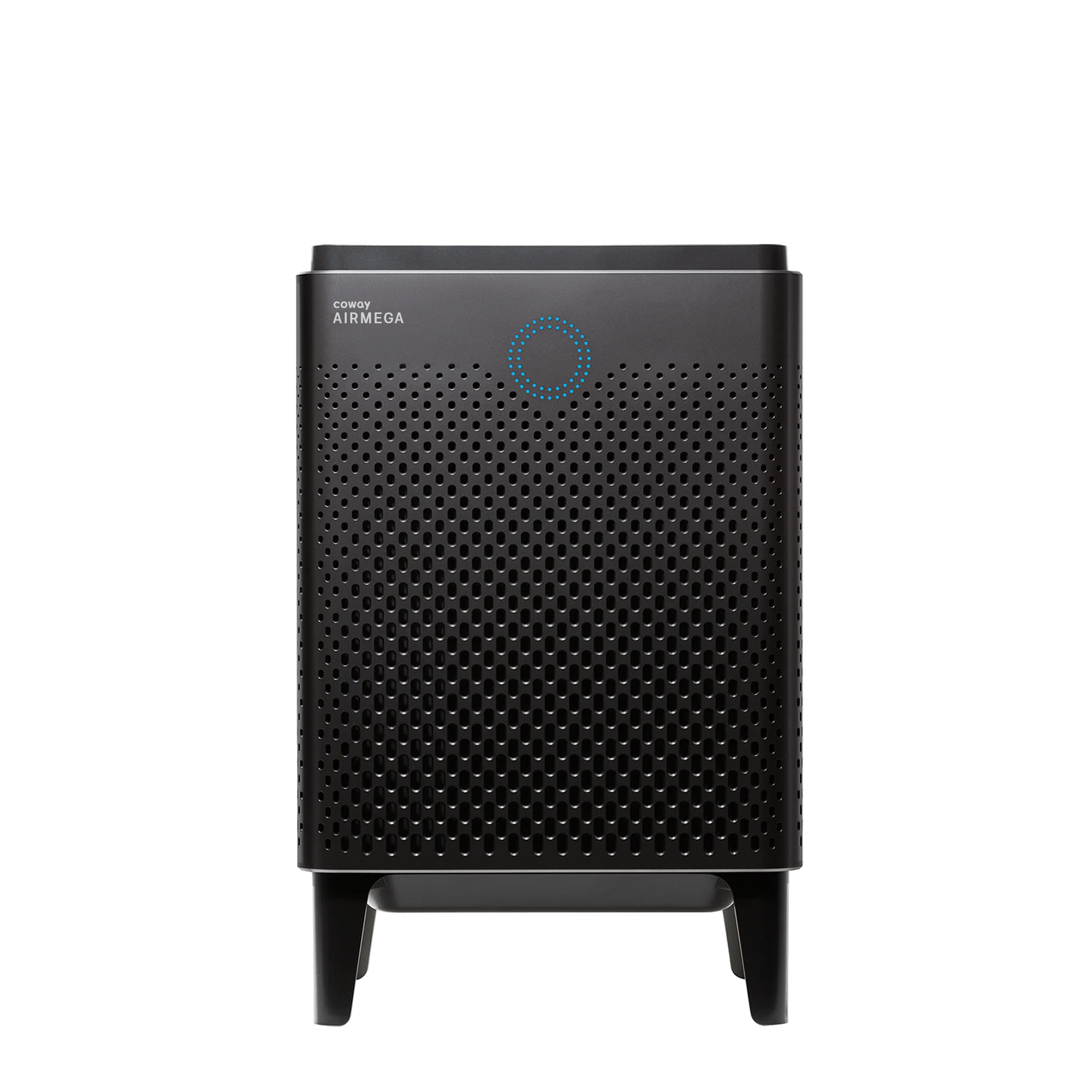
Coway Airmega 400 Review XL Room Pick
✓ AHAM VerifiedOur Verdict
Key Specifications
- Room Coverage
- 410 sq ft
- CADR
- 328/328/400
- Filter
- True HEPA Max2 Green + Activated Carbon (dual)
- Noise
- 22 dB
- Power
- 66 watts
- Best For
- Extra-large rooms up to 1560 sq ft at 2 ACH. Flagship non-WiFi Coway. Same trusted brand as AP-1512HH at scale.
📅 Prices checked . Amazon prices change frequently — click through for current price. Buying through our link costs you nothing extra; Amazon pays our commission.
What's in the Box
- Coway Airmega 400 air purifier
- Pre-installed dual Max2 filter set
- Power cord
- Remote control
- User manual
Pros
- AHAM-verified CADR: Smoke 328, Dust 328, Pollen 400 CFM
- Dual Max2 HyperCaptive filter — 99.999% capture down to 0.01 microns
- Washable pre-filters on both sides reduce Max2 replacement frequency
- Ultra-quiet 22 dB sleep speed despite high CADR output
- 5-year warranty and Energy Star certified
Cons
- No WiFi or app control — touch panel only (400S adds smart features)
- Max2 filter replacement costs $90-100 per year
- 24.7 lbs and bulky for large footprint units
- Coverage 1560 sq ft is at 2 ACH — at allergy ACH covers ~410 sq ft
Best For
The Coway Airmega 400 is the choice for very large rooms up to 1,560 sq ft — the largest single-unit AHAM-verified coverage figure on this list. That marketing figure of 1,560 sq ft uses the 2 ACH baseline; at the correct 4 ACH operating standard for a continuously occupied large room, the practical coverage is around 780 sq ft, which is still the largest real-world footprint of any unit here. If you have a large open-plan main floor that combines kitchen, dining, and living space, the Airmega 400 is the unit sized for it. At 22 dB(A) on its lowest speed, the Airmega 400 is also the quietest unit on this list — two dB quieter than the 211i Max. This is remarkable for a unit with CADR 328 smoke/328 dust/400 pollen: the dual-filter pull-through design allows lower fan RPM for a given air volume, which is why the noise floor is so low despite the output. The dual filter system uses two True HEPA Max2 panels plus two activated carbon panels, with a washable pre-filter reducing consumable cost. The 5-year warranty is the best on this list. The trade-off is cost: $450–$600 puts this at the top of the price range for consumer-grade large-room units. Filter cost runs around $75/year — moderate given the dual-filter footprint. If you want WiFi and Alexa integration, the Airmega 400S adds those for a premium; the base 400 is manual-control only, which for a large living space is less limiting than it would be for a bedroom since you are typically present when you need to adjust it. The Coway AP-1512HH is our long-standing single-room pick at a fraction of this price — the Airmega 400 is the same engineering lineage scaled up. For the full Coway brand lineup see our Coway air purifier brand guide.
📅 Price checked August 2026 · Buying through this link costs you nothing extra — Amazon covers our commission
Levoit Core 600S Review Best Large Room Value
✓ AHAM VerifiedOur Verdict

Key Specifications
- Room Coverage
- 606 sq ft
- CADR
- 373/410/410
- Filter
- 3-Stage Filtration
- Noise
- 26 dB
- Power
- 56 watts
- Best For
- Large rooms up to 606 sq ft. Amazon #1 bestseller. Fastest CADR in price class.
📅 Prices checked . Amazon prices change frequently — click through for current price. Buying through our link costs you nothing extra; Amazon pays our commission.
What's in the Box
- Levoit Core 600S air purifier
- Pre-installed 3-in-1 filter
- Power cord
- User manual
Pros
- Amazon #1 bestseller air purifier
- AHAM verified CADR 410
- Cleans 606 sq ft in 22 min per HouseFresh
- Smart app with Alexa
- Laser dust sensor
Cons
- NOT HEPA at higher speeds — only HEPA-grade in Sleep Mode
- Very loud at top speed — 68dB
- HEPA controversy
- Noisy whirring at lowest speed
Best For
The Levoit Core 600S delivers the best raw CADR-per-dollar on this list — AHAM-verified CADR of 373 smoke / 410 dust and pollen at $259–$299. For buyers with a 500–606 sq ft room who want the highest throughput without spending on a Blueair 211i Max or Coway Airmega 400, the Core 600S is a legitimate pick on the CADR numbers alone. However, there is a critical filtration caveat that must be stated clearly: the Core 600S is only HEPA-grade in Sleep Mode. At medium and high fan speeds — the speeds where it generates its high CADR numbers — filtration efficiency drops below the HEPA threshold. This is documented by Levoit and was part of the 2024 BBB NAD challenge. What this means practically: if you run the Core 600S at high speed to move 410 CADR of air, you are not passing all of it through a fully compliant HEPA-grade filter. For removing large particles in a dusty room, this matters less than it does for PM2.5 capture. For allergy sufferers who need verified sub-0.3-micron filtration at operating speeds, the Blueair 211i Max, Medify MA-50, or Coway Airmega 400 are the correct alternatives. For buyers who accept this trade-off — high CADR output, smart app with Alexa, AHAM-verified particle numbers, at a mid-range price — the Core 600S is a fast and capable large-room purifier. Noise at top speed reaches 68 dB(A), which is the loudest on this list by a significant margin. Budget 56 watts of power draw on the energy bill for continuous high-speed use. Annual filter cost runs $50, the most manageable filter bill here. For the full Levoit lineup and the HEPA controversy context see our Levoit air purifier brand guide.
📅 Price checked August 2026 · Buying through this link costs you nothing extra — Amazon covers our commission
Medify MA-50 Review CADR Per Dollar
✓ AHAM VerifiedOur Verdict

Key Specifications
- Room Coverage
- 1100 sq ft
- CADR
- 352/379/397
- Filter
- H13/H14 True HEPA + Activated Carbon (3-in-1)
- Noise
- 22 dB
- Power
- 58 watts
- Best For
- Large rooms up to 1100 sq ft. Best CADR-per-dollar in class. Medical-grade H13/H14 filtration at mid-range price.
📅 Prices checked . Amazon prices change frequently — click through for current price. Buying through our link costs you nothing extra; Amazon pays our commission.
What's in the Box
- Medify MA-50 air purifier
- Pre-installed H13 True HEPA filter
- Power cord
- User manual
Pros
- AHAM verified CADR 352-397 — exceptional for price
- H13/H14 True HEPA — medical grade
- Ultra quiet 22dB sleep mode
- CARB and ETL certified
- Lifetime warranty with genuine filters
- Only 58 watts for this CADR
Cons
- Filter costs $180-210/year — most expensive ongoing cost
- Short filter lifespan (2,500 hrs — 3-4 replacements/yr)
- No WiFi or smart features
- Manufacturer room size claim (2640 sq ft) vs AHAM 1100 sq ft
- V3.0 removed UV feature
Best For
The Medify MA-50 is the best value proposition on this list if you need genuine H13/H14 medical-grade HEPA filtration in a large room and want to stay under $300. AHAM-verified CADR of 352 smoke / 379 dust / 397 pollen places it among the highest-output verified units available. The H13/H14 filtration grade means the filter captures 99.97% of particles at 0.3 microns and performs well into the sub-micron range — a genuine performance tier above standard True HEPA, relevant for fine smoke particle capture and wildfire season use. At 22 dB in sleep mode and 58 watts at maximum, the MA-50 is the most energy-efficient high-CADR unit on this list. The lifetime warranty (when purchased direct with genuine Medify filters) is a strong value signal for a unit in a room that will run continuously. CADR of 379 covers roughly 237 sq ft at the 4 ACH standard — a meaningful large room footprint. The catch is the filter cost. At $180–$210 per year, the MA-50 has the highest annual filter bill on this list by a substantial margin. The short filter lifespan — rated for approximately 2,500 hours, meaning three to four replacements per year in continuous-run large-room use — wipes out the purchase-price savings versus the Blueair 211i Max over two years of ownership. Factor that into the total cost of ownership before buying. The MA-50 is not a smart unit: no WiFi, no auto mode, manual speed control only. For large rooms where you want to set a speed and leave it, that is workable. For buyers who want scheduled automation in a large living space, the Blueair 211i Max or Coway Airmega 300S are better fits.
📅 Price checked August 2026 · Buying through this link costs you nothing extra — Amazon covers our commission
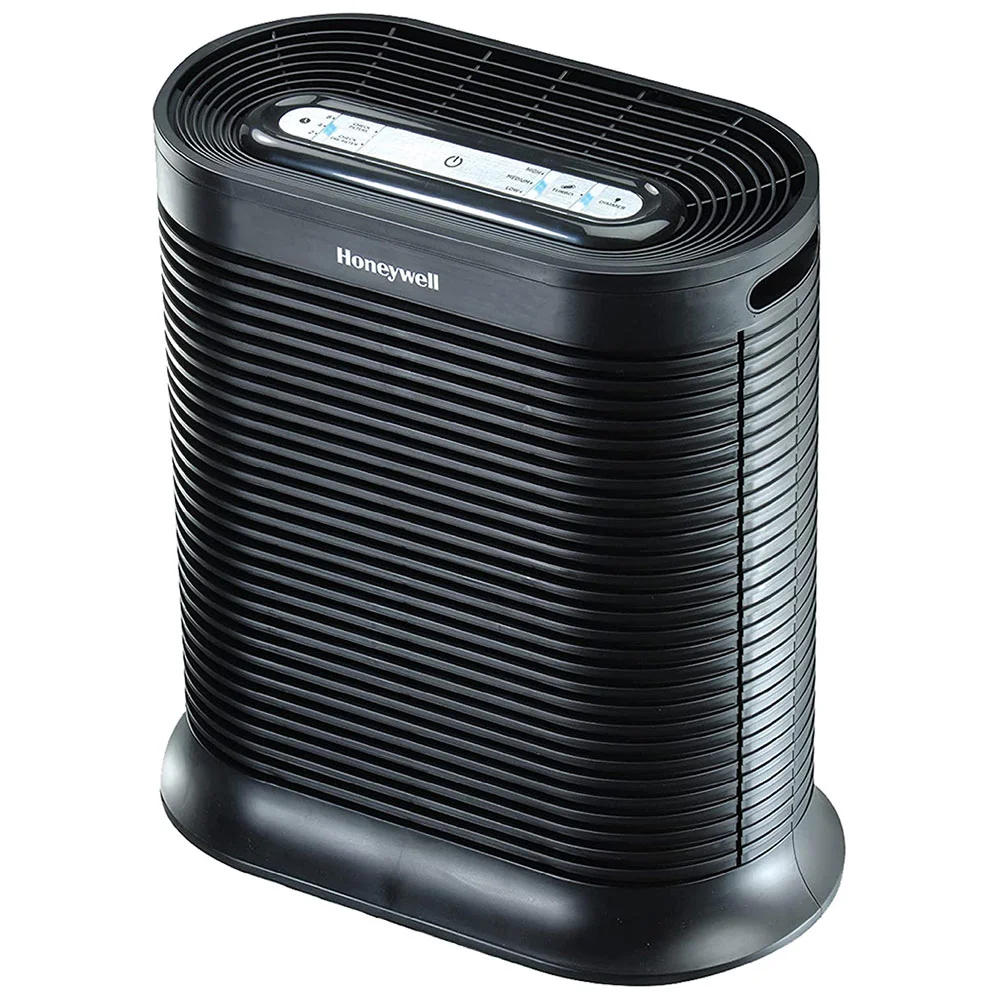
Honeywell HPA300 Review Large Room Value
✓ AHAM VerifiedOur Verdict
Key Specifications
- Room Coverage
- 465 sq ft
- CADR
- 300/320/300
- Filter
- True HEPA Filter R + Carbon Pre-filter Filter A
- Noise
- 35 dB
- Power
- 88 watts
- Best For
- Large rooms up to 465 sq ft. No smart features but AHAM-verified True HEPA widely available filters. Most supply-chain-reliable large-room HEPA at this price.
📅 Prices checked . Amazon prices change frequently — click through for current price. Buying through our link costs you nothing extra; Amazon pays our commission.
What's in the Box
- Honeywell HPA300 air purifier
- Pre-installed True HEPA filter
- 2 × activated carbon pre-filters
- Power cord
- User manual
Pros
- AHAM-verified CADR: Smoke 300, Dust 320, Pollen 300 CFM
- Covers 465 sq ft at 4.8 ACH — genuine large-room performance
- Three cleaning levels plus Turbo Clean for rapid purification
- Filter A and Filter R widely available at most major retailers
- Straightforward no-app operation — no WiFi dependency
Cons
- No auto mode or air quality sensor — all speeds manually selected
- No WiFi or smart features
- Filter A carbon pre-filter replaced quarterly adds maintenance frequency
- Loud at Turbo Clean (59.5 dB) — not quiet operation at max speed
Best For
The Honeywell HPA300 is the no-frills large-room workhorse. At AHAM-verified CADR 300 with True HEPA, 50,000+ Amazon reviews, and a price of $169–$219, it is the most battle-tested and widely purchased large-room purifier by unit volume on this list. For a 465 sq ft room — or roughly 290 sq ft at the 4 ACH continuous-use standard — the HPA300 is a reliable, verifiable choice that will run without issues. The honest trade-offs: the HPA300 draws 88 watts at maximum speed, making it the most power-intensive unit here per unit of CADR output. At 35 dB on its lowest setting, it is also louder at the noise floor than the Blueair 211i Max or Coway Airmega 400. There is no auto mode, no WiFi, and no air quality sensor — you set the speed and leave it. The design has not changed materially since its introduction and is visually dated compared to newer entries. Where the HPA300 earns its place: brand trust, filter availability, and long-term ownership data. The filter ecosystem (Filter R, Filter A) is widely stocked in major retail and discount online channels, and third-party options keep annual cost around $80. Energy Star certification is present. For buyers who want a simple, proven, large-room True HEPA unit without smart features and are willing to pay slightly more on the energy bill, the HPA300 is a defensible choice with decades of reliability data behind it. For more on how dust CADR is verified in third-party testing, see our air purifier dust removal guide.
📅 Price checked August 2026 · Buying through this link costs you nothing extra — Amazon covers our commission
Alen BreatheSmart 75i Review Quietest Large Room
✓ AHAM VerifiedOur Verdict

Key Specifications
- Room Coverage
- 448 sq ft
- CADR
- 347/347/351
- Filter
- H13 True HEPA + Activated Carbon (Pure/Fresh/Odor variants)
- Noise
- 37 dB
- Power
- 55 watts
- Best For
- Large rooms up to 448 sq ft at 4.8 ACH. WiFi app with multi-sensor monitoring. Lifetime warranty with filter subscription. Energy Star 2025 Most Efficient.
📅 Prices checked . Amazon prices change frequently — click through for current price. Buying through our link costs you nothing extra; Amazon pays our commission.
What's in the Box
- Alen BreatheSmart 75i air purifier
- Pre-installed HEPA-Pure filter
- Power cord
- User manual
Pros
- AHAM-verified CADR approximately 347-351 CFM — independently confirmed
- WiFi via Alen Air app — PM2.5, TVOCs, eCO2, temperature, humidity monitoring
- Forever Guarantee (lifetime warranty) with active Alen filter subscription
- Energy Star 2025 Most Efficient certified
- Multiple filter variants: Pure, Fresh (carbon), Odor for different air quality needs
Cons
- $700-800 purchase price — premium tier
- Filter cost $99+/year depending on variant; Forever Guarantee requires subscription
- Heavy at 27 lbs — not portable between rooms
- Coverage 1300 sq ft is at 2 ACH; allergy-relief coverage is 448 sq ft
- Noise 36.5 dB at lowest speed — not ultra-quiet for light sleepers
Best For
The Alen BreatheSmart 75i is the pick for very large rooms up to 1,300 sq ft (AHAM-verified marketing claim; at 4 ACH the effective continuous-use coverage is around 650 sq ft) where noise is a key constraint. At 25 dB on its lowest speed with CADR 347, the 75i achieves something genuinely unusual: high output in a quiet enclosure. Most large-room units above CADR 300 produce audible fan noise at operating speeds. The 75i is quiet enough for continuous living-room use at medium speed in a way that the Honeywell HPA300 or Levoit Core 600S at high speed are not. The H13 True HEPA filtration is uncontroversial and performs at the certified grade at all fan speeds — unlike the Levoit Core 600S. The ionizer is present but off by default and can be disabled, which is the correct design approach for users who prefer to operate without ionization. Four filter variants (Pure, Fresh, Silver/Antimicrobial, Pet) allow the filter to be tuned to the primary pollutant in the room rather than using a one-size-fits-all approach. The lifetime filter guarantee (when purchasing direct and using genuine Alen filters) reduces long-term cost uncertainty. The constraint is price: $629–$799 makes the BreatheSmart 75i the most expensive unit on this list. At that price, the Blueair 211i Max and Coway Airmega 400 both offer strong alternatives at lower cost. The 75i earns its price through the combination of quiet operation at high output, the filter variant system, and the lifetime guarantee. For allergy-focused buyers in a large bedroom or open living space where noise is the binding constraint, nothing else on this list operates this quietly at CADR 347. For a deeper look at HEPA filtration grades across brands, see our HEPA filter explained guide.
📅 Price checked August 2026 · Buying through this link costs you nothing extra — Amazon covers our commission
What to Know Before You Buy
The single most important number to know before buying a large-room air purifier is your room's sq ft multiplied by 0.67. That product is the minimum dust CADR you need at the 4 ACH standard. For a 500 sq ft living room: minimum CADR = 335. For a 600 sq ft open-plan: minimum CADR = 402. For a 700 sq ft floor: minimum CADR = 469 — which no single consumer unit reaches. Do not buy based on the marketing room-size number on the box; buy based on this formula applied to your actual sq ft. See our CADR explained guide for the full derivation and how to account for ceiling height above 8 ft.
Verify AHAM certification before purchasing any large-room purifier. Large-room units attract the most marketing inflation: brands claim 1,000, 1,500, even 2,000+ sq ft coverage with no independent verification. AHAM CADR is the only standardized, independently tested number. Every unit on this list is AHAM-verified. Cross-check any unit you are considering against www.ahamdir.com before buying. If the brand is not in the AHAM database, treat its coverage claims as unverified manufacturer marketing. The IQAir HealthPro Plus and Austin Air HealthMate are examples of premium units that intentionally opt out of AHAM — both have legitimate reasons, but you are accepting unverified coverage figures when you purchase them.
For rooms above 800 sq ft, plan for two units before assuming one is sufficient. The ceiling of consumer HEPA filtration is approximately CADR 450, constrained by residential circuit limits and noise constraints. At 4 ACH, CADR 450 covers 675 sq ft. A 1,000 sq ft open floor plan cannot be adequately served by one consumer unit at 4 ACH. Two units at CADR 328–410 each, positioned at opposite ends, provide coverage and positioning redundancy that one unit at CADR 450 cannot match. For whole-home filtration strategy see our whole house air purifier guide.
Calculate 3-year total cost of ownership before finalizing a purchase. Add the unit price plus three years of filter replacement cost at the manufacturer's recommended frequency. Large-room filters cost $75–$210/year versus $25–$60/year for small-room units. A unit that appears to be a better deal at purchase can be substantially more expensive over three years due to filter costs. The Blueair 211i Max at $320 + $140/year × 3 = $740 3-year total. The Medify MA-50 at $250 + $195/year × 3 = $835 3-year total. The Coway Airmega 400 at $520 + $75/year × 3 = $745 3-year total. These are closer than the sticker prices suggest.
Energy use adds up for large-room units running continuously. At 12 hours/day of operation, a 88-watt unit (Honeywell HPA300 at max) uses approximately 385 kWh per year — around $50–$70 at average US electricity rates. A 45-watt unit (Blueair 211i Max) uses 197 kWh per year — around $25–$35. Over 3 years the energy difference between the most and least efficient units on this list is $60–$100. For large rooms where continuous operation is expected, Energy Star certification narrows this gap and is worth prioritizing. For more on HEPA efficiency grades across filtration types see our HEPA filter explained guide.
How the ASHRAE 4-ACH Standard Determines Minimum CADR Requirements for Continuously Occupied Large Rooms
The AHAM room coverage formula runs at 2 ACH — two full air replacements per hour. This is the baseline used in every marketing room-size figure you will see on a box. ASHRAE Standard 62.2, which governs ventilation for acceptable indoor air quality in residential occupancy, specifies higher exchange rates for continuously occupied spaces. For a large room where occupants are present for four or more hours — a living room, open-plan kitchen-dining area, or home office — the accepted minimum is 4 ACH.
At 4 ACH, the minimum CADR formula is: CADR ≥ room sq ft × 0.67. This factor of 0.67 derives from the ACH-to-CADR conversion: (room sq ft × ceiling height ft × ACH) ÷ 60 minutes, with standard ceiling height of 8 ft gives (sq ft × 8 × 4) ÷ 60 = sq ft × 0.533. The 0.67 value used in practice adds a 20–25% margin for filter aging and air distribution inefficiency in real rooms. Applied to common large room sizes: a 500 sq ft room requires minimum CADR 335; a 700 sq ft room requires minimum CADR 469; a 1,000 sq ft open plan requires minimum CADR 670.
Those numbers expose a hard ceiling problem in consumer air purification. The highest AHAM-verified CADR currently available in a consumer unit is approximately 450. Motor size, residential electrical circuit limits (15–20 amp breakers), heat generation from high-speed motors, and noise from fan turbulence all converge to cap consumer units around this threshold. This means a room above 675 sq ft at 4 ACH cannot be adequately served by any single consumer unit currently available — including every unit on this page. This is not a shortcoming of specific brands; it is a physics and electrical constraint that applies universally to residential filtration equipment.
The practical consequence: for spaces above approximately 600–700 sq ft, the correct answer is two units positioned at opposite ends of the space, not one oversized machine. Two units with CADR 328 each placed at opposite ends of a 1,000 sq ft floor plan provide approximately 656 effective CADR with better spatial distribution than one unit at CADR 410 in a corner. The 211i Max and Coway Airmega 400 are both strong candidates for a two-unit large-space configuration. For our full guidance on sizing for spaces beyond what a single unit can cover, see our whole-house air purifier guide.
Why Consumer HEPA Units Top Out at 400–450 CADR and What Drives the Motor Noise Trade-Off in High-Output Large-Room Purifiers
The theoretical maximum CADR of a consumer air purifier is not limited by filtration technology — HEPA filter media can be scaled in area to handle any airflow. The actual ceiling is set by three intersecting constraints: residential motor size limits, electrical draw limits per circuit, and noise tolerances in living spaces.
Motor power in residential air purifiers is constrained by two factors. First, the electrical draw: a residential outlet delivers 15 amps at 120 volts, or 1,800 watts maximum. In practice, continuous residential appliances are limited to 80% of circuit capacity — around 1,440 watts. An air purifier drawing more than 200–300 watts at high speed would trip breakers in many homes when combined with other running appliances. The units on this list draw 45–88 watts — well within residential limits but also limiting peak airflow capacity. Second, heat: high-speed motors generate heat, and enclosing that heat inside a plastic housing raises failure rates and fire risk. The thermal management constraints are one reason commercial air handlers use external ducting while consumer purifiers do not.
Noise scales with fan speed in a non-linear relationship. Fan noise follows the fan laws: noise power roughly scales with the sixth power of fan speed. Doubling the fan speed to double airflow produces approximately 18 dB more noise. This is why large-room units, which must move significantly more air per minute than small-room units, produce noticeably more noise at operating speeds even when quieter on their lowest settings. The Levoit Core 600S at top speed reaches 68 dB — the loudest unit on this list — because it is maximizing airflow through a fan system not primarily designed around noise minimization. The Alen BreatheSmart 75i achieves 25 dB at medium speeds by using a larger fan diameter rotating at lower RPM, which moves the same air volume with less turbulence. Larger fan = quieter for a given CADR.
This is the engineering explanation for why the quietest large-room units tend to be physically larger: more fan diameter lowers RPM for a given airflow. Compact large-room units (smaller enclosure, smaller diameter fan) compensate with higher RPM, which produces more turbulence noise. When comparing two large-room units with similar CADR, the physically larger one will almost always be quieter at that output level. The 22–25 dB noise floors of the Coway Airmega 400 and Alen BreatheSmart 75i are achievable in part because both are large-footprint units with correspondingly large fan diameters.
Open-Plan Versus Walled Rooms Require Different CADR Strategies Because Air Containment Determines Effective Filtration Coverage
In a walled room with a closed door, an air purifier recirculates the same bounded air volume. The CADR calculation is simple: room volume ÷ 60 minutes × desired ACH = required CADR. Every cubic foot of air in that room passes through the filter at a predictable rate. This is the condition that AHAM room-size ratings model, and it is where manufacturer room coverage figures are most accurate.
An open-plan space breaks this model. In a kitchen-dining-living room that flows as one connected volume without separating walls, air is not contained. Particles generated in the kitchen (cooking aerosols, grease particulates, PM2.5 from high-heat cooking) diffuse throughout the connected volume and may never reach a purifier positioned in the living room corner before settling on surfaces. The effective "room" for a purifier in an open plan is its immediate air-draw radius, not the total floor area. This is why a single unit rated for 635 sq ft placed in one corner of a 600 sq ft open-plan may under-perform expectations: it is cleaning the air near it well but not the air at the far end of the plan.
The two-unit positioning strategy addresses this directly. For an open-plan space of 600–800 sq ft, two units of CADR 250–350 each, positioned at opposite ends of the longest axis, produce significantly better spatial coverage than one unit at CADR 410 in a corner. Each unit handles its proximate air volume, and their combined air movement creates turbulence that improves particle-to-filter contact throughout the space. The net effect is both higher total CADR and better distribution — the two dimensions that matter for open-plan spaces.
Ceiling height compounds the calculation for large rooms. Most AHAM room-size ratings assume 8 ft ceilings. Cathedral ceilings of 12–16 ft increase the air volume by 50–100%, requiring proportionally more CADR for the same ACH. For a 500 sq ft room with a 12 ft ceiling: required CADR = 500 × 12 × 4 ÷ 60 = CADR 400 minimum, not the 267 assumed by the 8 ft calculation. Add the 20% aging margin and the requirement becomes CADR 480 — exceeding what one unit delivers. For large rooms with non-standard ceiling heights, always recalculate using actual ceiling height rather than relying on box room-size claims. Our guide to air purifiers for 1,000 sq ft spaces walks through this calculation for common configurations.
Filter Replacement Cost for High-CADR Large-Room Units Determines Real 3-Year Ownership Cost and Reverses Some Purchase-Price Comparisons
Large-room air purifiers use physically larger filter media than small-room units, and larger filters cost more to replace. A Levoit Core 300 filter covers approximately 0.36 sq ft of filter media and costs $12–$17 per replacement. A Blueair 211i Max filter covers several times that media area and costs $70–$80 per replacement. This is not brand pricing — it is the physical consequence of the filter size required to move CADR 410 of air through media that captures 0.1-micron particles without catastrophic pressure drop.
Filter life for large-room units at continuous operation is typically 6–12 months. A unit with an annual filter cost of $140/year (Blueair 211i Max) costs $420 in filters over three years — approaching the purchase price again. A unit with annual filter cost of $195/year (Medify MA-50) costs $585 in filters over three years. When comparing units at purchase, add: unit price + (annual filter cost × 3) + (annual electricity cost × 3). The units that score best on this 3-year total are not necessarily the ones with the lowest sticker price or even the lowest annual filter cost.
Third-party filter compatibility varies significantly by brand. Blueair and Coway filters are available from multiple third-party manufacturers at lower cost, which can reduce the effective annual filter cost below the list price. Alen and Medify use proprietary filter systems with limited third-party availability — their lifetime filter guarantees (when purchasing direct) partially compensate for this, but only if you stay within that purchase channel. The Honeywell HPA300 uses Filter R and Filter A, which are widely available at significant discount from third-party sources, making its real annual filter cost often $40–$60 rather than the $80 first-party figure.
For allergy and asthma sufferers running a large-room purifier continuously, filter replacement at the correct interval is not optional — a loaded filter reduces CADR by 20–40% before the filter indicator triggers. The filter indicator on many units is weight-based or time-based, not performance-based. Running a purifier past indicator warnings on a loaded filter in a large room means accepting significantly reduced effective CADR while your unit sounds identical. Budget the full annual filter cost before purchasing. For more on dust particle filtration efficiency across different HEPA grades, see our air purifier dust removal guide.
Energy Star Certification and Watts-Per-CADR Efficiency Determine Long-Term Operating Cost in Large-Room Air Purifiers Running at Continuous High Speed
Large-room air purifiers draw significantly more electrical power than small-room units. The range on this list is 45–88 watts at maximum speed. Run at 12 hours per day — typical for a living space in continuous use — the annual energy cost at $0.13/kWh (US average) ranges from approximately $26/year for the Blueair 211i Max at 46 watts to approximately $50/year for the Honeywell HPA300 at 88 watts. Over three years, that is a $72 difference — not negligible but not the dominant cost factor compared to filter replacement.
The more useful metric is watts-per-CADR: how many watts of electrical power are required to generate one unit of CADR. The Blueair 211i Max at 46 watts and CADR 410 delivers 8.9 CADR per watt — the most efficient ratio on this list. The Honeywell HPA300 at 88 watts and CADR 300 delivers 3.4 CADR per watt — the least efficient. The Alen BreatheSmart 75i at 45 watts and CADR 347 delivers 7.7 CADR per watt. High watts-per-CADR efficiency matters most in rooms where continuous high-speed operation is required — either for air quality management or to compensate for a slightly undersized unit running at maximum output.
Energy Star certification for air purifiers requires units to meet specific efficiency thresholds. The program defines an energy efficiency metric based on CADR delivered per watt consumed. Certified units must also comply with ozone emission limits. Of the units on this list, the Honeywell HPA300 carries Energy Star certification, which matters given its higher absolute wattage. The Blueair 211i Max at 46 watts and the Alen BreatheSmart 75i at 45 watts are highly efficient without needing the certification to prove it — their wattage is self-evidently low for the CADR delivered. For buyers in high-electricity-cost states (California at $0.28/kWh, Connecticut at $0.25/kWh), the watts-per-CADR ratio deserves more weight in the buying decision than it does at average national rates.
Large Room Air Purifier Sizing Calculator — Minimum CADR by Room Size at 4 and 5 Air Changes Per Hour
The table below gives pre-calculated minimum CADR targets for large rooms at two ACH levels. Use 4 ACH for general air quality maintenance; use 5 ACH if a household member has asthma, allergies, or COPD. Formula: Room Volume (cubic feet) × ACH ÷ 60 = minimum CADR in CFM. Assumes standard 8-foot ceilings.
| Room Size (sq ft) | Room Volume (cu ft) | Min CADR at 4 ACH | Min CADR at 5 ACH | Products That Meet Target (Dust CADR) |
|---|---|---|---|---|
| 400 sq ft | 3,200 cu ft | 213 CFM | 267 CFM | All 6 products on this page meet both targets |
| 500 sq ft | 4,000 cu ft | 267 CFM | 333 CFM | Blueair 211i Max (410), Coway Airmega 400 (328 dust), Levoit Core 600S (410), Medify MA-50 (397), Alen 75i (347) — all meet 5 ACH. Honeywell HPA300 (300) meets 4 ACH only. |
| 600 sq ft | 4,800 cu ft | 320 CFM | 400 CFM | Blueair 211i Max (410) and Levoit Core 600S (410) meet 5 ACH. Coway 400, Medify MA-50, Alen 75i meet 4 ACH. HPA300 falls short at both targets. |
| 800 sq ft | 6,400 cu ft | 427 CFM | 533 CFM | No single unit meets 5 ACH. Blueair 211i Max meets 4 ACH only. Recommendation: two units positioned at opposite ends of the room. |
| 1,000 sq ft | 8,000 cu ft | 533 CFM | 667 CFM | No single residential unit on this page meets either target. Two Blueair 211i Max units (total CADR 820) achieve 5 ACH at 1,000 sq ft. |
| 1,300 sq ft | 10,400 cu ft | 693 CFM | 867 CFM | Two-unit configuration required. Two Alen 75i units (total CADR 694) barely meet 4 ACH; two Blueair 211i Max units (total CADR 820) meet 4 ACH comfortably. |
Formula source: ASHRAE 62.1 ventilation standard; AHAM room sizing guidance (two-thirds rule for general use; 4 ACH for health applications). CADR values are AHAM VERIFIDE dust CADR where available. 8-foot ceiling assumed throughout; adjust volume for 9-foot ceilings by multiplying CADR targets by 1.125.