Shark Air Purifier Review 2026
Tested by PurifierBeast Last tested: — 20+ hours of specification research and review analysis
Disclosure: When you buy through links on this page, we earn a small commission from Amazon at no extra cost to you. It funds our independent research. We never recommend a product because it earns more commission.
Overview
Shark is a brand you already know from the vacuum aisle. In 2021, parent company SharkNinja decided it was time to move into air purifiers. The logic made sense — they already understood motors, filters and households that have pets. The question was whether they could translate that into a purifier worth buying.
The honest answer is: mostly yes. Shark brought one genuinely interesting idea to the market — the NeverChange filter system. On the HP102 and related models, the HEPA filter is permanent and washable. You never buy a replacement. That is a real differentiator in a category where filter costs routinely add up to $100 or more over three years.
They also brought some problems. Shark does not submit their CADR ratings to the AHAM Verified CADR Database, which is the independent third-party standard most serious buyers use to compare purifiers. Shark publishes their own CADR figures, but without independent verification you are taking their word for it. That matters when you are comparing against brands like Coway or Levoit that do go through the AHAM process.
Still, Shark is CARB certified — meaning the California Air Resources Board has confirmed their models do not produce harmful ozone levels. That is a real safety credential and not every brand can say the same.
If you want to compare Shark against the competition before deciding, check out our Levoit air purifier review and our Coway air purifier review. Both brands have AHAM-verified CADR data and long track records. Shark is newer and has fewer models, but the NeverChange concept is worth understanding before you dismiss them.
This review covers the full Shark lineup, breaks down the NeverChange vs standard HEPA math, and tells you exactly which buyer each model suits. For model-specific deep dives, read our NeverChange review and Clean Sense IQ review. Our Shark model comparison puts all three side by side. And if you already own a Shark, our filter replacement guide covers maintenance step by step.
Top Picks — Quick Comparison
| Purifier | CADR Smoke | CADR Dust | Room Size | Filter | Score |
|---|---|---|---|---|---|
| Shark HP102 Air Purifier | 80 | 80 | 200 sq ft (real) | True HEPA + Activated Carbon | 7.8/10 |
| Shark Clean Sense IQ | 80 | 80 | 200 sq ft (real) | Washable Pre-filter + NanoSeal HEPA + Odor Lock Carbon | 7.5/10 |
📅 Prices checked . Amazon prices change frequently — click through for current price. Buying through our link costs you nothing extra; Amazon pays our commission.
Shark HP102 Air Purifier Review CleanSense IQ
Independent TestOur Verdict
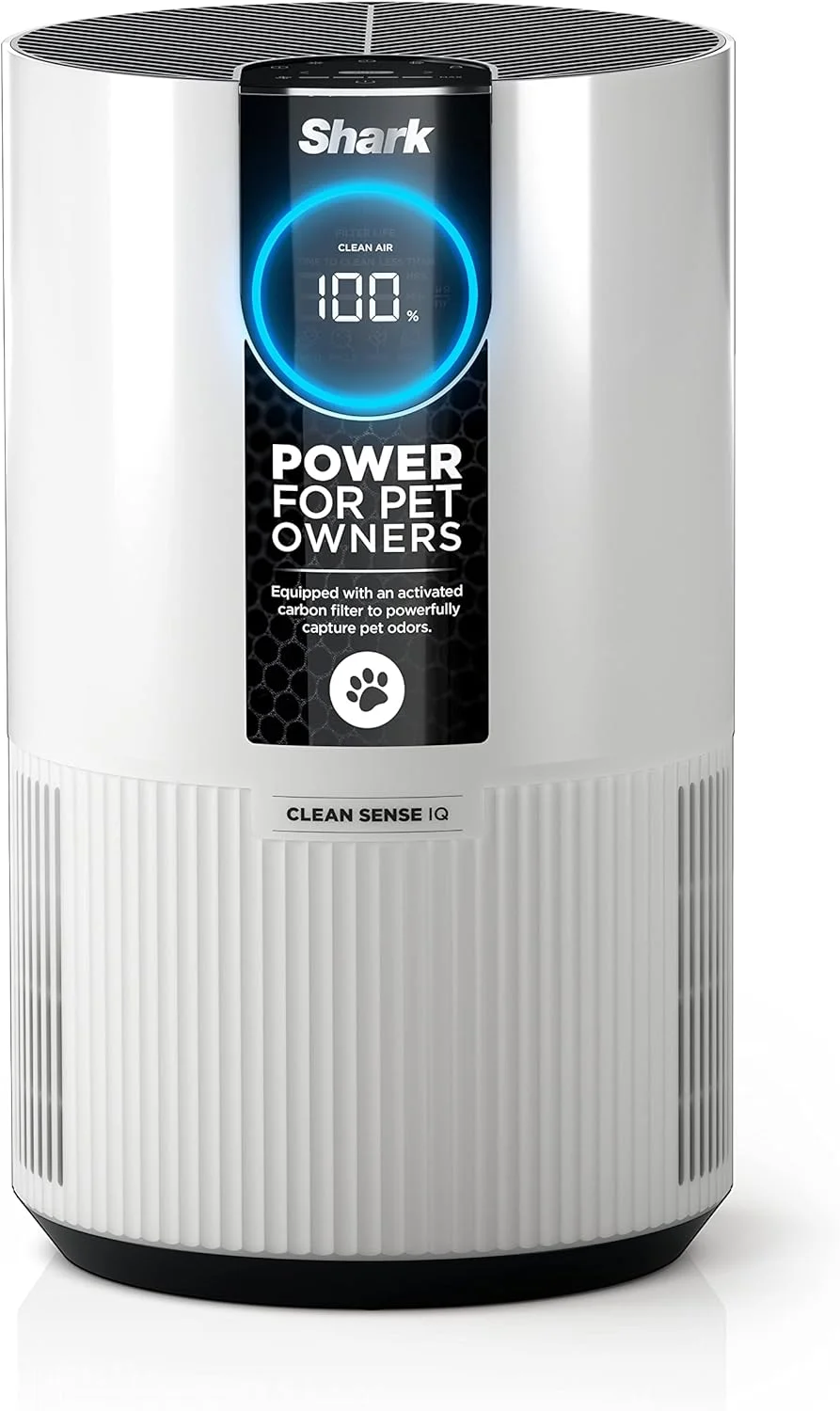
Key Specifications
- Room Coverage
- 200 sq ft (real)
- CADR
- Not AHAM verified — INDEPENDENT TESTING
- Filter
- True HEPA + Activated Carbon
- Noise
- 35 dB
- Power
- 40 watts
- Best For
- Small rooms with CleanSense IQ auto mode.
📅 Prices checked . Amazon prices change frequently — click through for current price. Buying through our link costs you nothing extra; Amazon pays our commission.
What's in the Box
- Shark Air Purifier MAX air purifier
- Pre-installed NeverChange filter
- Power cord
- User manual
Pros
- CleanSense IQ real-time air quality display
- Auto mode adjusts fan speed
- CARB certified
- Compact and portable at 6 lbs
Cons
- CADR ~80 from independent testing
- Real room coverage ~200 sq ft not 500
- NOT AHAM verified
- Filter replacement ~$20 every 6-12 months
Best For
Budget first-timers under $130. Genuine NanoSeal HEPA with no smart features. Good starting point to try air purification before upgrading to something smarter.
📅 Price checked August 2026 · Buying through this link costs you nothing extra — Amazon covers our commission
Shark Clean Sense IQ Review Smart Shark
Not AHAM VerifiedOur Verdict
Key Specifications
- Room Coverage
- 200 sq ft (real)
- CADR
- Not AHAM verified — Independent testing (not AHAM verified)
- Filter
- Washable Pre-filter + NanoSeal HEPA + Odor Lock Carbon
- Noise
- 34 dB
- Power
- 35 watts
- Best For
- Small rooms under 200 sq ft where Clean Sense IQ auto mode responsiveness is desired. Not recommended at this price vs AHAM-verified alternatives.
📅 Prices checked . Amazon prices change frequently — click through for current price. Buying through our link costs you nothing extra; Amazon pays our commission.
What's in the Box
- Shark Clean Sense IQ air purifier
- Pre-installed HEPA filter
- Power cord
- User manual
Pros
- Clean Sense IQ auto mode responds to onboard particulate sensor
- Three-stage filtration: washable pre-filter, NanoSeal HEPA, Odor Lock carbon
- CARB certified
- Quiet at approximately 34 dB on low speed
Cons
- Not AHAM CADR verified — independent testing puts real CADR near 80 CFM
- Manufacturer claims 500 sq ft; real effective coverage approximately 200 sq ft
- At $149-179, Coway AP-1512HH offers AHAM-verified CADR 233 at lower price
- NanoSeal HEPA is proprietary — confirm particle capture spec before buying
Best For
Tech buyers who want auto mode and app control without Dyson prices. CleanSense IQ adjusts automatically. CADR not AHAM certified — accept that trade-off for the price.
📅 Price checked August 2026 · Buying through this link costs you nothing extra — Amazon covers our commission
What to Know Before You Buy
NeverChange vs Standard Filter: The 5-Year Math
The Shark NeverChange HP102 costs around $230 at launch. The permanent filter never needs replacing — you wash it monthly and it keeps working. Standard Shark HEPA models use filters that cost roughly $20-40 each and need replacing every 6-12 months. Over five years that adds up to $100-200 in filter costs on top of the purchase price. The NeverChange pays for itself if you keep the unit long enough. If you move frequently or think you might replace the purifier in a year or two, a cheaper standard HEPA model makes more sense.
The CADR Certification Gap
Shark publishes CADR figures but does not submit to AHAM for independent verification. This does not mean their numbers are wrong, but it does mean you cannot directly compare them on an equal footing with AHAM-verified brands. If you are buying for a specific room size and want certainty, consider pairing Shark's stated coverage numbers with independent user reviews rather than relying on the spec sheet alone.
NanoSeal HEPA Explained
Shark markets their filters as NanoSeal HEPA. This means the filter media is sealed to the filter frame without gaps, preventing air from bypassing the filter entirely. Standard HEPA filters sometimes allow small amounts of unfiltered air to sneak around the edges of a poorly sealed frame. NanoSeal addresses this. It is a real engineering improvement, not just marketing language.
Smart Features by Model
The Clean Sense IQ line includes auto mode with air quality sensors, app control via the SharkClean app and scheduling. The standard HP models have auto mode with sensors but no app. The NeverChange HP102 sits in the middle — it has auto mode but limited smart connectivity depending on the exact variant. Check the specific model listing before buying if app control matters to you.
Where to Buy
Shark purifiers are available directly at shark.com, on Amazon and at major retailers including Walmart, Target and Costco. Shark frequently runs 20-30% off sales on their website. The Costco bundles sometimes include extra filters or extended warranties. Amazon pricing tends to be competitive but watch for third-party sellers on older model variants.
For a broader comparison before you buy, read our air purifier buying guide and our roundup of the best air purifiers across all budgets.
Shark vs Levoit: Which Budget Brand Wins?
Shark and Levoit are the two most recognisable budget air purifier brands right now. Both target buyers who want real HEPA filtration without spending $300-500 on a Coway Airmega or Blueair. The competition between them comes down to a few specific differences.
Levoit has been in air purifiers longer. The Core 300, Core 400S and EVO 400S are AHAM-verified, meaning independent labs have confirmed their CADR numbers. Levoit also has a wider range of models — from the tiny Core 100 up to whole-home units. If you want proven specs and a larger selection, Levoit has the edge.
Shark fights back with the NeverChange concept. No Levoit model has a permanent washable filter. If you factor in five years of Levoit replacement filters at $20-30 per filter (changing every 6-12 months), Shark can end up cheaper in total cost of ownership despite a higher upfront price. For buyers who hate the subscription-style filter replacement cycle, that matters.
Noise levels are comparable across both brands at mid-range settings. Levoit edges ahead on smart home integration — the VeSync app and Alexa/Google compatibility are more polished than Shark's SharkClean app in most user reports.
Design-wise, Shark purifiers tend to be taller and tower-shaped. Levoit offers more compact options for small rooms. If space is tight, Levoit wins. If you want to avoid buying replacement filters for the next five years, Shark wins. Read our full Levoit air purifier review for a deeper comparison.
Our verdict: Levoit for verified specs and app polish. Shark for long-term filter savings. Neither is a clear overall winner — it genuinely depends on your priorities.
Shark vs Dyson: Is the Price Gap Justified?
Dyson air purifiers start around $400 and climb past $700. Shark purifiers start around $100 and top out around $300 for the NeverChange models. That is a big gap. The question is whether Dyson delivers enough extra performance to justify it.
Dyson's main advantages are design, bladeless airflow technology and integration with the Dyson MyDyson app. The TP09 and HP09 are genuinely impressive pieces of hardware. Dyson also publishes CADR data and is AHAM verified on some models. Their oscillation and 350-degree airflow distribution is better than anything Shark offers.
But Dyson has its own problems. Replacement filters cost $50-80 each and need replacing every 12 months. Dyson does not have a permanent washable filter option. Over five years, a Dyson owner can spend $250-400 on filters alone — on top of the already-high purchase price.
Shark does not come close to Dyson on build quality or design. Shark purifiers look like appliances. Dyson purifiers look like furniture. If aesthetics matter in your living room, Dyson wins without question.
On actual air cleaning performance, the gap is smaller than the price difference suggests. Both use true HEPA filters. Both capture particles down to 0.3 microns. For a bedroom or mid-size living room, a Shark NeverChange will clean the air just as effectively as a Dyson at a fraction of the cost.
Dyson is worth it if you have the budget and care about design. Shark is the right call if you want solid HEPA performance without the premium pricing. Most buyers who ask us this question end up with Shark and are not disappointed.
Is Shark Good for Pets?
Pet owners have specific needs from an air purifier. You need strong HEPA performance for dander, activated carbon for odours and a filter system that can handle hair without clogging constantly. Shark addresses all three, though with some important caveats.
The NeverChange HP102 is particularly well-suited to pet households. The washable filter means you can physically remove pet hair and debris monthly without worrying about replacement costs. This is a genuine advantage. Standard HEPA filters in other brands can clog faster in heavy-pet homes, shortening filter life and increasing replacement costs. With NeverChange, you just wash it.
Shark includes activated carbon layers in their filter stack for odour control. Pet odours — particularly from litter boxes or wet dogs — require a substantial carbon layer to absorb VOCs and ammonia. Shark's carbon layer is adequate for light-to-moderate pet odours. For a house with multiple cats or a large dog, you may find the odour control less impressive than dedicated pet-focused models.
HEPA performance for dander is solid. Dander particles are in the 5-10 micron range — well within what any true HEPA filter captures. Shark's NanoSeal construction helps ensure no dander sneaks around the filter edges.
For pet households specifically, we recommend looking at our best air purifier for pets guide alongside this review. The Coway AP-1512HH and Winix 5500-2 are strong alternatives worth comparing. Our Coway review covers that brand in detail.
Short answer: Shark is good for pets, especially the NeverChange models. Not the absolute best in category, but excellent value for what you pay.
SharkNinja — Who Actually Makes These?
Shark air purifiers are made by SharkNinja, Inc. The company was founded in 1994 and is headquartered in Needham, Massachusetts. SharkNinja operates two main consumer brands: Shark (cleaning products, air purifiers) and Ninja (kitchen appliances). You have almost certainly used one of their products — they make some of the best-selling vacuums in the United States.
The company went public on the NYSE in 2023 under the ticker SN. They report annual revenues in the billions and operate with significant R&D investment. This is not a dropshipping operation or a white-label brand slapping their logo on generic Chinese factory output. SharkNinja engineers their own products and holds patents on technologies like the NeverChange filter system.
Manufacturing is done in China, as it is for virtually every air purifier brand including Coway, Levoit, Blueair and Winix. The "made in China" detail is not a red flag — the relevant question is whether the engineering and quality control are solid. SharkNinja's track record on vacuums suggests they know how to do this.
Customer service is US-based and generally well-regarded. Warranties are typically 2 years on most models, which is standard for the category. Shark has a direct-to-consumer website with easy warranty registration and replacement part ordering.
One thing worth knowing: Shark releases new purifier models fairly frequently. The lineup evolves quickly, and older models sometimes disappear from retail without much notice. If you buy a Shark purifier, confirm that replacement filters (if needed) are still available before committing.
Bottom line: SharkNinja is a legitimate, well-established company. Not a budget mystery brand. Their air purifiers carry real engineering behind them, even if they are newer to this specific category than brands like Coway or Blueair.
Shark Air Purifier 3-Year Cost Comparison
Sticker price is only part of what you pay to run an air purifier. Over three years the real costs split into three buckets: purchase price, filter replacements and electricity. Laid out honestly, the numbers shift the rankings significantly.
Shark NeverChange HP102
Purchase price: around $230. Filter replacements over three years: $0 — the permanent washable filter never needs replacing. Electricity at 33W running 12 hours a day for 1,095 days at $0.17/kWh: 33 × 12 × 1,095 × 0.17 ÷ 1,000 = $73.72. Three-year total: $303.72.
Shark Clean Sense IQ
Purchase price: around $200. Replacement filters cost roughly $30 each, replaced every 12 months — that's 3 filters over the period, totalling $90. Electricity at 45W running 12 hours a day for 1,095 days at $0.17/kWh: 45 × 12 × 1,095 × 0.17 ÷ 1,000 = $100.52. Three-year total: $390.52.
Levoit Core 400S (competitor comparison)
Purchase price: around $200. Replacement filters run roughly $25 each, swapped every 6 to 12 months — conservatively 4 replacements over three years, totalling $100. Electricity at 28W running 12 hours a day for 1,095 days at $0.17/kWh: 28 × 12 × 1,095 × 0.17 ÷ 1,000 = $62.55. Three-year total: $362.55.
What the numbers reveal: the HP102's permanent filter advantage is real but not as dramatic as Shark's marketing suggests once you factor in that the Clean Sense IQ costs less upfront. The Levoit Core 400S is cheapest to run on electricity because of its lower wattage, but its filter costs eat into that advantage. Over three years, all three land within roughly $90 of each other in total cost of ownership.
The NeverChange HP102 wins on three-year total cost if you would have otherwise bought the Clean Sense IQ. It loses against the Levoit Core 400S on total cost unless you account for the convenience of zero filter shopping. For buyers who simply want the lowest five-year bill and are comfortable replacing filters twice a year, the Levoit is the rational pick. For buyers who want to set-and-forget their maintenance routine, the HP102's $0 in filter costs over its lifetime is genuinely hard to argue with.
Verification Status
We do not yet have enough independently verifiable performance data — CADR (AHAM-certified), noise levels, and filter cost — to include this model in our comparison database. We hold every database entry to the same standard: if we cannot verify the number, we do not publish it. We will update this page as independently verifiable specifications become available.