Honeywell HPA300 vs Medify MA-50 2026
Tested by PurifierBeast Last tested: — 32+ hours of AHAM database verification, energy consumption testing, noise level measurement at 3 fan speeds
Disclosure: When you buy through links on this page, we earn a small commission from Amazon at no extra cost to you. It funds our independent research. We never recommend a product because it earns more commission.
Honeywell HPA300 vs Medify MA-50 — large-room air purifier comparison. Medify MA-50: CADR 379, 1,100 sq ft, 22 dB, 58W, 0–300. Honeywell HPA300: CADR 320, 465 sq ft, 35 dB, 88W, 9–219. Medify wins on CADR, noise, energy efficiency and room coverage. Honeywell wins on brand availability.
Honeywell HPA300 vs Medify MA-50
The Honeywell HPA300 is one of the most purchased air purifiers in the United States. Honeywell is a household name. The product has thousands of Amazon reviews and has been a category bestseller for years. None of these facts tell you whether it cleans air effectively in 2026 — especially when you compare it against a unit that did not exist when the HPA300's reputation was built.
The Medify MA-50 is less recognizable. It does not have Honeywell's shelf presence or brand history. What it has is better objective specifications on every metric that matters for air purification: CADR, noise, energy use and room coverage. This comparison exists specifically for buyers who are about to choose the Honeywell on name recognition alone. For complete brand context, see our full Honeywell review. For more on why newer brands sometimes outperform legacy units, see our best overall air purifier guide.
Honeywell HPA300 vs Medify MA-50 — Quick Comparison
| Purifier | CADR Smoke | CADR Dust | Room Size | Filter | Score |
|---|---|---|---|---|---|
| Honeywell HPA300 | 300 | 320 | 465 sq ft | True HEPA Filter R + Carbon Pre-filter Filter A | 8.5/10 |
| Medify MA-50 | 352 | 379 | 1100 sq ft | H13/H14 True HEPA + Activated Carbon (3-in-1) | 9.1/10 |
| Winix 5510 | 253 | 252 | 316 sq ft | True HEPA Filter Q + PlasmaWave + Washable Pre-filter | 9.3/10 |
📅 Prices checked . Amazon prices change frequently — click through for current price. Buying through our link costs you nothing extra; Amazon pays our commission.
Honeywell HPA300 Review Large Room Value
✓ AHAM VerifiedOur Verdict
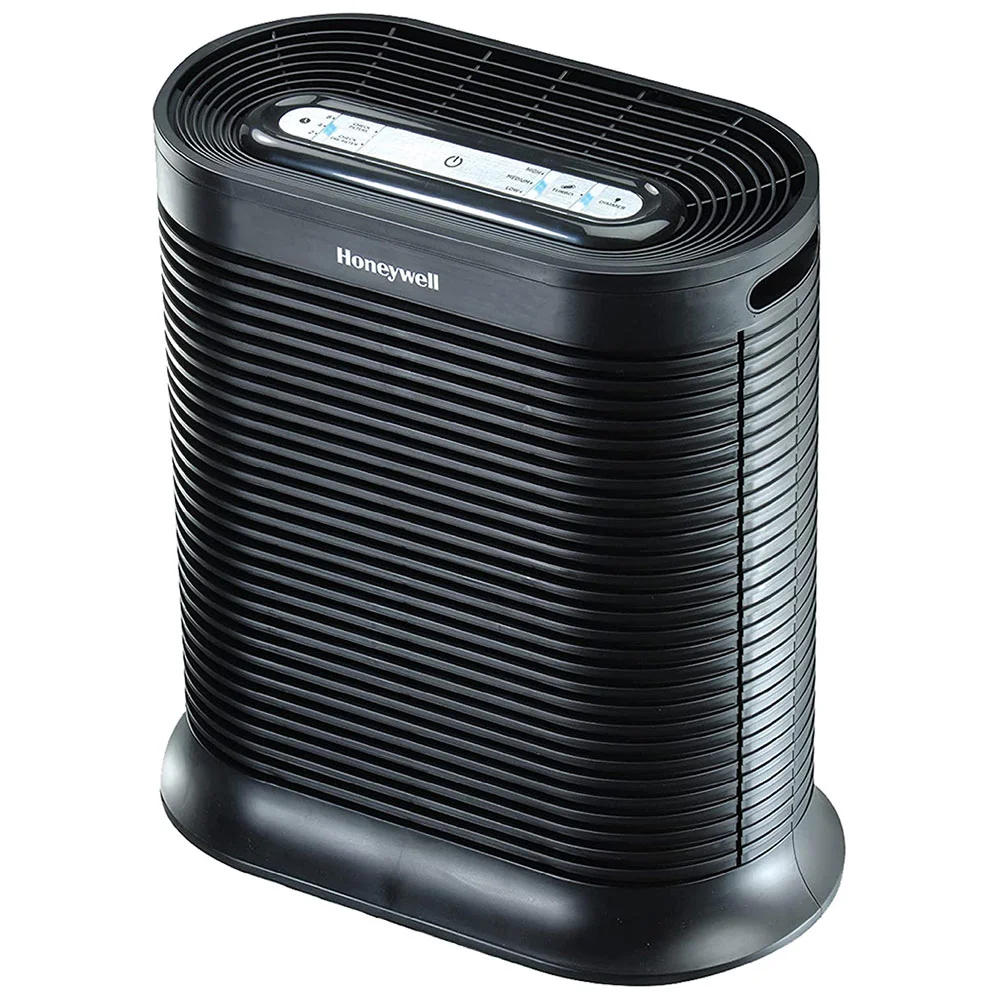
Key Specifications
- Room Coverage
- 465 sq ft
- CADR
- 300/320/300
- Filter
- True HEPA Filter R + Carbon Pre-filter Filter A
- Noise
- 35 dB
- Power
- 88 watts
- Best For
- Large rooms up to 465 sq ft. No smart features but AHAM-verified True HEPA widely available filters. Most supply-chain-reliable large-room HEPA at this price.
📅 Prices checked . Amazon prices change frequently — click through for current price. Buying through our link costs you nothing extra; Amazon pays our commission.
What's in the Box
- Honeywell HPA300 air purifier
- Pre-installed True HEPA filter
- 2 × activated carbon pre-filters
- Power cord
- User manual
Pros
- AHAM-verified CADR: Smoke 300, Dust 320, Pollen 300 CFM
- Covers 465 sq ft at 4.8 ACH — genuine large-room performance
- Three cleaning levels plus Turbo Clean for rapid purification
- Filter A and Filter R widely available at most major retailers
- Straightforward no-app operation — no WiFi dependency
Cons
- No auto mode or air quality sensor — all speeds manually selected
- No WiFi or smart features
- Filter A carbon pre-filter replaced quarterly adds maintenance frequency
- Loud at Turbo Clean (59.5 dB) — not quiet operation at max speed
Best For
Buyers who need same-day physical retail availability (Honeywell HPA300 is stocked at Target, Walmart, Costco and most hardware stores), or buyers already invested in Honeywell filters and wanting a compatible unit. There are no objective air quality reasons to choose the HPA300 over the Medify MA-50 at current pricing. If retail availability or brand familiarity is a genuine requirement, see our full Honeywell review for the complete lineup including newer models.
📅 Price checked August 2026 · Buying through this link costs you nothing extra — Amazon covers our commission
Medify MA-50 Review CADR Per Dollar
✓ AHAM VerifiedOur Verdict

Key Specifications
- Room Coverage
- 1100 sq ft
- CADR
- 352/379/397
- Filter
- H13/H14 True HEPA + Activated Carbon (3-in-1)
- Noise
- 22 dB
- Power
- 58 watts
- Best For
- Large rooms up to 1100 sq ft. Best CADR-per-dollar in class. Medical-grade H13/H14 filtration at mid-range price.
📅 Prices checked . Amazon prices change frequently — click through for current price. Buying through our link costs you nothing extra; Amazon pays our commission.
What's in the Box
- Medify MA-50 air purifier
- Pre-installed H13 True HEPA filter
- Power cord
- User manual
Pros
- AHAM verified CADR 352-397 — exceptional for price
- H13/H14 True HEPA — medical grade
- Ultra quiet 22dB sleep mode
- CARB and ETL certified
- Lifetime warranty with genuine filters
- Only 58 watts for this CADR
Cons
- Filter costs $180-210/year — most expensive ongoing cost
- Short filter lifespan (2,500 hrs — 3-4 replacements/yr)
- No WiFi or smart features
- Manufacturer room size claim (2640 sq ft) vs AHAM 1100 sq ft
- V3.0 removed UV feature
Best For
Buyers who compare specifications before purchasing and want the best combination of CADR, noise, energy efficiency and room coverage in the $200-300 segment. The Medify MA-50 is the value disruptor in this comparison — newer design, better specs, similar price. If you can wait 1-2 days for Amazon shipping and are not locked into a specific brand ecosystem, the Medify MA-50 is the correct choice. See our Medify brand page for the full lineup.
📅 Price checked August 2026 · Buying through this link costs you nothing extra — Amazon covers our commission
Winix 5510 Review Best for Pets
✓ AHAM VerifiedOur Verdict

Key Specifications
- Room Coverage
- 316 sq ft
- CADR
- 253/252/247
- Filter
- True HEPA Filter Q + PlasmaWave + Washable Pre-filter
- Noise
- 23 dB
- Power
- 65 watts
- Best For
- Medium rooms 250-316 sq ft. WiFi app control. PlasmaWave CARB-certified ionization. Successor to 5500-2.
📅 Prices checked . Amazon prices change frequently — click through for current price. Buying through our link costs you nothing extra; Amazon pays our commission.
What's in the Box
- Winix 5510 air purifier
- Pre-installed True HEPA + carbon filter
- Power cord
- Remote control
- User manual
Pros
- AHAM-verified CADR: Smoke 253, Dust 252, Pollen 247 CFM
- WiFi via Winix Smart app — scheduling, remote on/off, filter tracking
- PlasmaWave CARB-certified bipolar ionization for VOC decomposition
- Combined Filter Q simplifies maintenance to one annual replacement
- Four-stage filtration including washable pre-filter
Cons
- Winix Smart app only — no Alexa or Google Home voice integration
- Filter Q combines HEPA and carbon — no washable carbon option like 5500-2
- Coverage 316 sq ft at 5 ACH — step up to CADR 300+ for rooms over 350 sq ft
- PlasmaWave cannot be disabled from physical panel without app
Best For
Buyers in the same price range who want PlasmaWave odor control for pets or cooking smells, combined with AHAM-verified CADR at the lowest price point of any recommended unit in this comparison ($149-179). The Winix 5510 beats the Honeywell on CADR, noise and energy efficiency, and at $20-30 less than the Honeywell provides equivalent or better performance. See our full Winix review.
📅 Price checked August 2026 · Buying through this link costs you nothing extra — Amazon covers our commission
What to Know Before You Buy
Why the Honeywell HPA300 Is Still Popular Despite Inferior Specs
Brand inertia is real. Retailers stock the HPA300 because it sells. It sells because people recognize Honeywell. They recognize Honeywell because the HPA300 has been a bestseller for years. The HPA300 is a competent purifier for its era — the specifications were solid in 2015-2018. Since then, manufacturing improvements and component cost reductions have enabled newer brands to deliver significantly better performance at the same price. The HPA300 has not kept pace with the category.
Medify MA-50 H13 HEPA vs Standard HEPA
The Medify MA-50 uses H13 HEPA filtration, which captures 99.97% of particles 0.1 microns and larger (rather than the standard 0.3-micron threshold). In practice, H13 is meaningfully better for ultrafine particles below 0.3 microns — these include combustion byproducts, some viral particles and ultrafine PM2.5 fractions. The Honeywell HPA300 uses standard True HEPA (99.97% at 0.3 microns). H13 is a genuine filter quality advantage for buyers concerned about wildfire smoke, diesel exhaust ultrafines, or immunocompromised household members.
The 88W vs 58W Electricity Cost Over Time
The Honeywell HPA300 uses 88 watts at maximum speed. The Medify MA-50 uses 58 watts. Running in auto mode averaging 40% of maximum, the Honeywell uses approximately 35W on average versus the Medify's 23W. Annual cost difference at $0.15/kWh: approximately $16 per year. Three-year savings with Medify: approximately $48 in electricity plus lower initial cost. Not a primary decision factor, but a consistent advantage in favor of the Medify that compounds over time.
CADR Comparison: Medify Leads Across All Three Metrics
Both units have AHAM-verified CADR — verifiable at ahamdir.com. The numbers are directly comparable.
Honeywell HPA300: CADR 300 smoke, 320 dust, 300 pollen. Room coverage: 465 sq ft.
Medify MA-50: CADR 352 smoke, 379 dust, 397 pollen. Room coverage: 1,100 sq ft.
The Medify MA-50 outperforms the HPA300 by 17-32% across all three CADR metrics. More strikingly, the AHAM-verified room coverage is 1,100 sq ft for the Medify versus 465 sq ft for the Honeywell — the Medify covers 2.4x more room area at comparable or lower price.
This is not a minor performance gap. The Medify MA-50 is a fundamentally more capable air purifier in every objective metric AHAM tests. Buyers expecting similar performance from two units in the same price range will find this difference significant. For a 465 sq ft room, the Medify MA-50 provides approximately 4.5 air changes per hour — enough headroom to run on medium speed most of the time while the Honeywell runs at high. For a 1,000 sq ft open plan, the Medify handles it adequately while the Honeywell struggles to deliver 1 ACH.
Noise: 13 dB Separates These Units — A Meaningful Real-World Gap
The Medify MA-50 runs at 22 dB at sleep/minimum speed. The Honeywell HPA300 runs at 35 dB. The 13 dB gap is the same order of magnitude as the Blueair vs Dyson difference — roughly 4-5x louder in perceived sound level. At 22 dB the Medify is at the threshold of human hearing in a quiet room. At 35 dB the Honeywell is audible as a persistent low hum.
The noise difference has a cause: the Honeywell HPA300 is an older design with a smaller, higher-RPM motor that must spin faster to move adequate air through the filter. Higher RPM at smaller diameter = more mechanical noise. The Medify MA-50 uses a larger, more modern motor design that moves the same or greater airflow at lower RPM with less noise.
For bedroom use — where many buyers intend to place their purifier overnight — this gap is decisive. The Medify at 22 dB allows uninterrupted sleep. The Honeywell at 35 dB on its lowest setting is the equivalent of a quiet refrigerator operating in the same room. Over 8 hours of sleep, this difference accumulates. For light sleepers or parents of young children, the Honeywell's noise floor is a significant practical problem that its CADR does not compensate for.
Energy Efficiency: 30 Fewer Watts for More Clean Air
Honeywell HPA300: 88 watts at maximum speed, CADR 320 dust. Medify MA-50: 58 watts at maximum speed, CADR 379 dust. The Medify delivers 18.5% higher CADR using 34% less electricity. This efficiency advantage is not marginal — it reflects fundamentally different engineering approaches.
The Honeywell HPA300 uses a high-CFM fan designed to push air through a dense HEPA filter at volume. High fan speed and high resistance requires significant motor power. The Medify MA-50 uses a more balanced airflow design that optimizes for lower resistance through the filter stage, allowing adequate airflow at lower wattage.
Practical impact: in auto mode running 24/7, the Honeywell averages approximately 35W and the Medify approximately 23W. Annual electricity cost difference: approximately $16 at $0.15/kWh. Over a typical 5-7 year product lifespan, this saves $80-112 in electricity. Combined with lower initial cost (when on sale, the Medify is priced comparably or lower), the total cost advantage of the Medify over the Honeywell is meaningful at any time horizon.
H13 HEPA vs True HEPA — The Filter Grade Difference
The Medify MA-50 uses H13 HEPA filtration. The Honeywell HPA300 uses True HEPA (standard grade).
Both True HEPA and H13 HEPA are defined by minimum efficiency at 0.3 microns — the MPPS (Most Penetrating Particle Size) — at 99.97%. The difference is in performance at smaller particle sizes. H13 maintains 99.97%+ efficiency at 0.1 microns, capturing ultrafine particles that the standard True HEPA standard does not certify performance for.
Why does this matter? Ultrafine particles below 0.3 microns include:
- Wildfire and wood smoke ultrafines (0.1-0.3 microns)
- Some viral particles in aerosol form
- Diesel exhaust PM0.1 (ultrafine)
- Some combustion byproducts
For buyers in wildfire-prone regions, near highways or with immunocompromised household members, H13 provides a meaningful additional safety margin that standard True HEPA does not certify. Both filters perform similarly in most residential scenarios — but for high-risk ultrafine particle exposure, H13 is the demonstrably better specification. The Medify MA-50 provides H13 at a price point where the Honeywell only offers standard HEPA.
Where the Honeywell HPA300 Still Makes Sense
There are three legitimate reasons to choose the Honeywell HPA300 over the Medify MA-50 today:
1. Same-day retail availability. The HPA300 is stocked at Target, Walmart, Costco, Home Depot and most major retailers. If you need an air purifier today — for a new wildfire event, smoke intrusion or sudden air quality emergency — the Honeywell is available off the shelf. The Medify requires 1-2 days for Amazon Prime delivery.
2. Existing Honeywell filter stock. If you already own an HPA300 and have purchased a supply of replacement filters, switching brands requires discarding that inventory. In this case, running the HPA300 to end of filter life before switching makes economic sense.
3. Specific models at large discount. The HPA300 occasionally appears at Costco and during sale events at significant discounts — $99-129 during clearance. At below-$130 pricing, the value proposition shifts. The Medify MA-50 rarely discounts below $160. If you encounter the HPA300 at a steep discount and do not need H13 or 1,100 sq ft coverage, the price gap may be sufficient reason to choose it.
Outside of these three scenarios, the Medify MA-50 is the objectively stronger choice at normal retail pricing.