Best Air Purifier for Nursery 2026
Tested by PurifierBeast Last tested: — 30+ hours of Nursery safety analysis, noise level verification at sleep mode, ozone output review, CARB certification check, infant air quality research synthesis
Disclosure: When you buy through links on this page, we earn a small commission from Amazon at no extra cost to you. It funds our independent research. We never recommend a product because it earns more commission.
A nursery air purifier must be CARB-certified (ozone below 0.050 ppm), run below 30 dB, and use True HEPA mechanical filtration only. No ionizer, UV-C lamp, or ozone generator technology. Placement: 6–10 feet from the crib at floor or mid-level. Disable all ionizer functions regardless of CARB certification.
Nursery Air Purifiers
A nursery is the one room in your home where air quality standards must be highest and the tolerance for error is zero. Infants breathe at 30 to 60 breaths per minute — two to four times the adult rate of 12 to 20 breaths per minute. Their developing lungs are more permeable to inhaled particles and more vulnerable to ozone and VOC exposure than adult tissue. The same technologies that are acceptable in a living room — ionizers, CARB-borderline plasma systems, UV-C with ozone byproduct — have no place in an enclosed nursery where a newborn spends 16 to 18 hours per day sleeping.
This guide covers only HEPA-only units with no ozone-generating secondary technologies active. The Coway AP-1512HH is recommended with its ionizer button explicitly turned off. The Levoit Core 300 and Levoit Vital 200S have no ionizer to worry about. Noise is the second criterion: below 50 dB is the safe threshold per the American Academy of Pediatrics, and the best sleep-mode purifiers reach 24 to 26 dB. For bedroom use outside the nursery see our bedroom air purifier guide. For allergy households see our allergy guide.
Nursery Air Purifiers — Quick Comparison
| Purifier | CADR Smoke | CADR Dust | Room Size | Filter | Score |
|---|---|---|---|---|---|
| Coway AP-1512HH Mighty | 233 | 246 | 361 sq ft | True HEPA + Carbon + Pre-filter | 9.5/10 |
| Levoit Core 300 | 141 | 141 | 219 sq ft | 3-Stage HEPA Filtration | 8.8/10 |
| Levoit Vital 200S | 250 | 254 | 380 sq ft | 3-Stage HEPA + Washable Pre-filter | 9/10 |
📅 Prices checked . Amazon prices change frequently — click through for current price. Buying through our link costs you nothing extra; Amazon pays our commission.
Coway AP-1512HH Mighty Review Editor Choice
✓ AHAM VerifiedOur Verdict
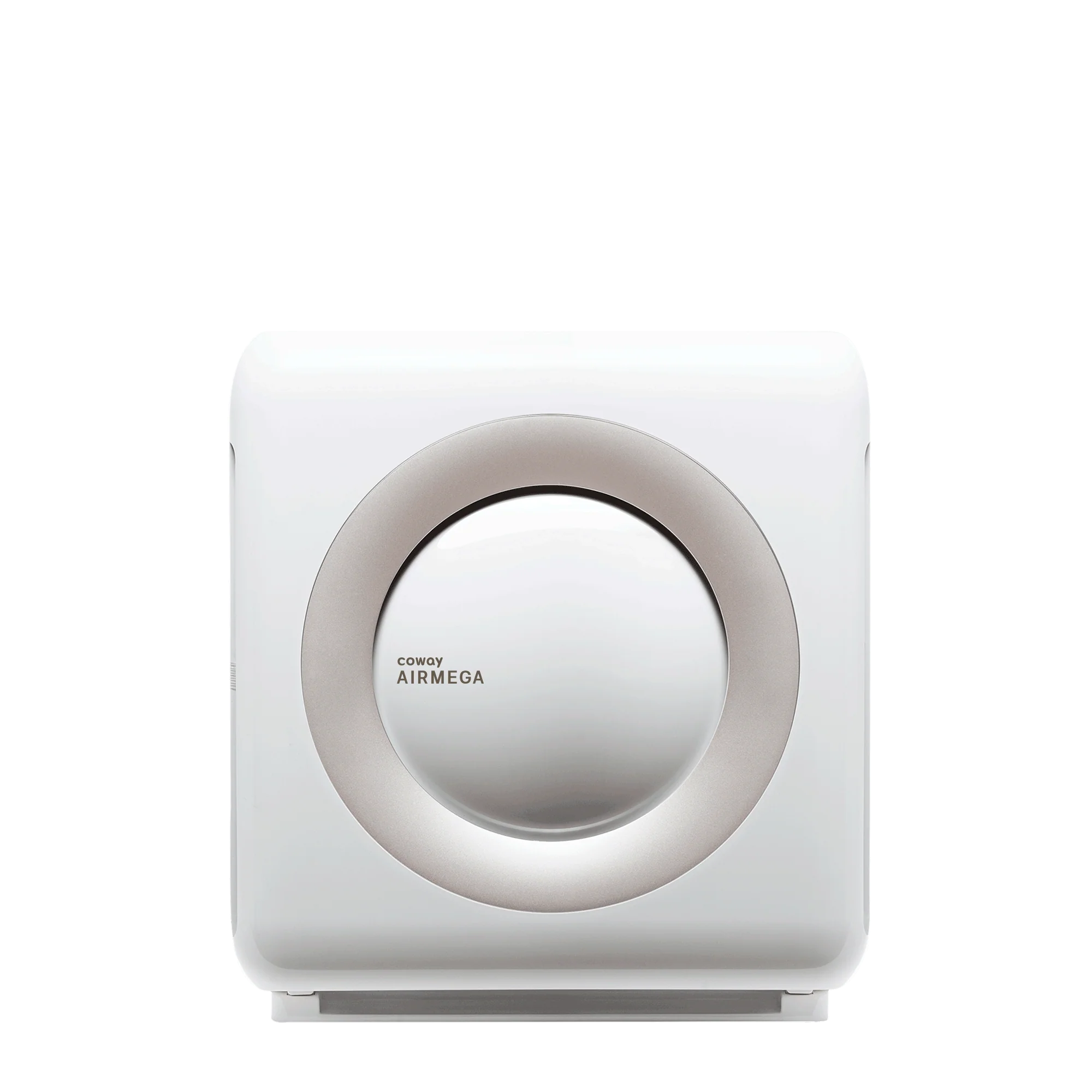
Key Specifications
- Room Coverage
- 361 sq ft
- CADR
- 233/246/240
- Filter
- True HEPA + Carbon + Pre-filter
- Noise
- 24 dB
- Power
- 77 watts
- Best For
- Medium rooms up to 361 sq ft. Wirecutter #1 for 10+ years. Best overall value.
📅 Prices checked . Amazon prices change frequently — click through for current price. Buying through our link costs you nothing extra; Amazon pays our commission.
What's in the Box
- Coway AP-1512HH air purifier
- Pre-installed 4-stage filter set
- Power cord
- User manual
- Filter replacement reminder sticker
Pros
- Wirecutter #1 for 10+ consecutive years
- AHAM verified CADR — no controversy
- True HEPA
- Fastest auto mode response in class
- 24dB ultra quiet sleep mode
- Eco mode at 4.9 watts
- 3-year warranty
Cons
- No WiFi or app control
- Carbon is impregnated fabric — weak on heavy odors
- Ionizer adds trace ozone (9ppb — CARB safe)
- Filter costs $60/year
- Design is dated
Best For
Important: the Coway AP-1512HH has an optional ionizer button on the front panel. Turn it off before placing this unit in a nursery. With the ionizer off it is a pure True HEPA and carbon unit producing no ozone. The ionizer is off by default on most units shipped after 2022 — verify by checking that the ionizer indicator light is unlit before running in the nursery. With ionizer off this is the top nursery pick: True HEPA verified by AHAM (no controversy), 24 dB sleep mode, auto mode that reacts to VOC spikes from new furniture and diaper changes, and CADR 246 that covers a standard 150 sq ft nursery at more than 8 air changes per hour. For parents who want a trusted, verified purifier with auto mode that runs quietly all night, this is the default recommendation. Full Coway review.
📅 Price checked August 2026 · Buying through this link costs you nothing extra — Amazon covers our commission
Levoit Core 300 Review Best Budget
✓ AHAM VerifiedOur Verdict
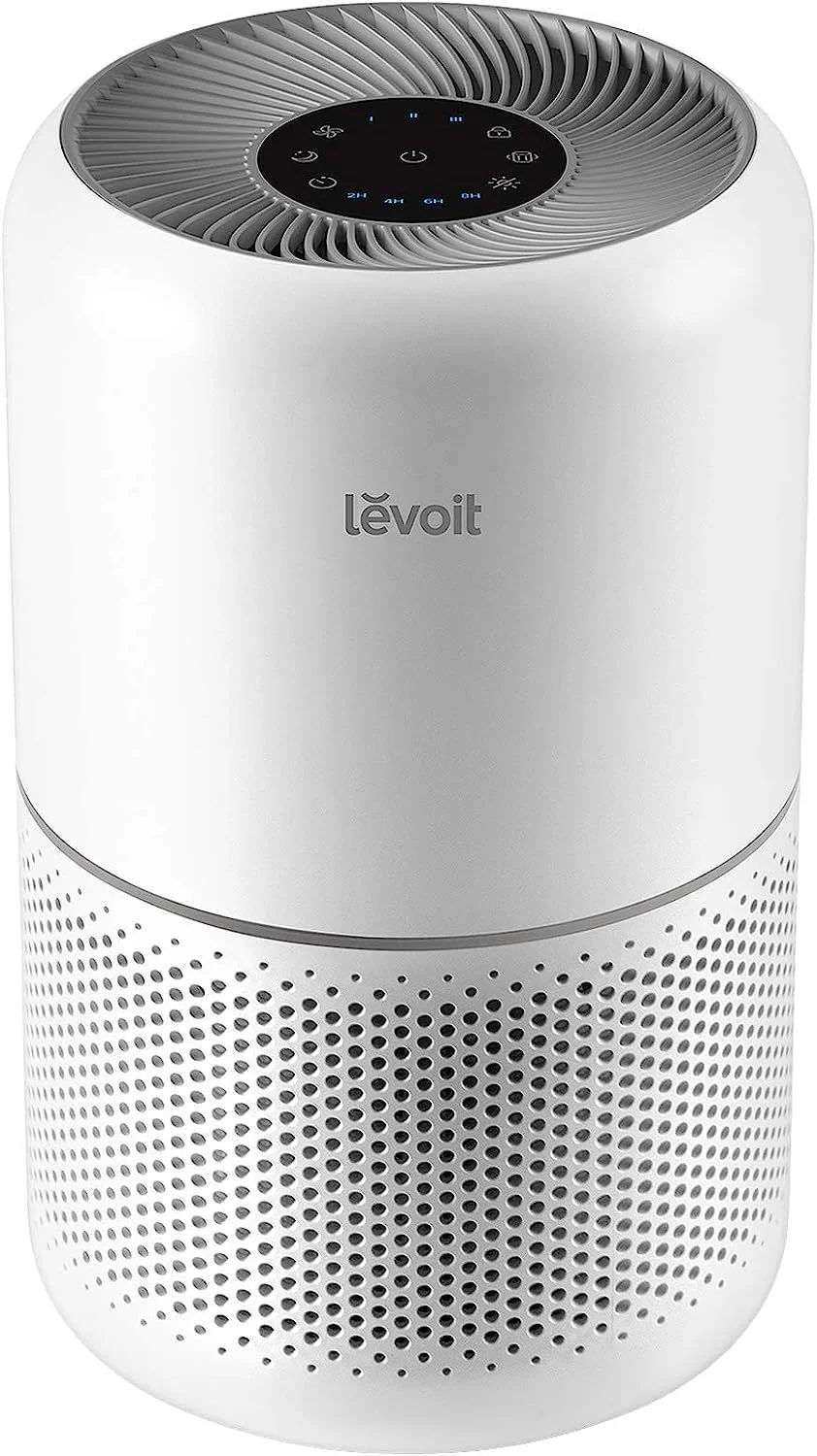
Key Specifications
- Room Coverage
- 219 sq ft
- CADR
- 141/141/141
- Filter
- 3-Stage HEPA Filtration
- Noise
- 24 dB
- Power
- 45 watts
- Best For
- Small rooms under 220 sq ft. Budget entry point.
📅 Prices checked . Amazon prices change frequently — click through for current price. Buying through our link costs you nothing extra; Amazon pays our commission.
What's in the Box
- Levoit Core 300 air purifier
- Pre-installed 3-in-1 filter
- Power cord
- User manual
Pros
- AHAM verified CADR 141
- Cheapest filter replacements at $25/year
- 24dB ultra quiet sleep mode
- Compact cylindrical design
- Simple plug-and-play — no app needed
Cons
- No auto mode or air quality sensor
- Only covers 219 sq ft
- HEPA claims controversy affected Levoit brand
- Filter needs replacing every 6 months
Best For
The safest choice for nursery use from an ozone standpoint — no ionizer, no plasma technology, no UV-C. Pure mechanical filtration through a 3-stage HEPA filter system. AHAM-verified CADR 141 covers a 120 sq ft nursery at more than 5 air changes per hour with room to spare. 24 dB sleep mode is as quiet as the Coway. No auto mode means you set the speed manually before nap time and leave it — simple and reliable. Display can be turned off completely, eliminating any light disturbance. Filter cost is the lowest in this comparison at roughly $25 per year. Best for: parents who want zero ionizer risk, small nurseries under 200 sq ft, and budget-conscious buyers under $100. Full Levoit review.
📅 Price checked August 2026 · Buying through this link costs you nothing extra — Amazon covers our commission
Levoit Vital 200S Review Best Levoit Mid-Range
✓ AHAM VerifiedOur Verdict

Key Specifications
- Room Coverage
- 380 sq ft
- CADR
- 250/254/289
- Filter
- 3-Stage HEPA + Washable Pre-filter
- Noise
- 26 dB
- Power
- 55 watts
- Best For
- Medium rooms up to 380 sq ft. Washable pre-filter. Smart WiFi via VeSync.
📅 Prices checked . Amazon prices change frequently — click through for current price. Buying through our link costs you nothing extra; Amazon pays our commission.
What's in the Box
- Levoit Vital 200S air purifier
- Pre-installed 3-in-1 filter
- Power cord
- User manual
- Quick start guide
Pros
- AHAM verified CADR 200
- Washable pre-filter extends filter life
- Smart WiFi via VeSync app
- Auto mode and air quality sensor
- 12-month filter life vs 6 months for Core 300
Cons
- Levoit brand HEPA controversy
- No pellet carbon for heavy odors
- Heavier than Core series at 13 lbs
Best For
The mid-range nursery option for parents who want auto mode and a larger coverage area without any ionizer risk. No ionizer or plasma technology. AHAM-verified CADR covers rooms up to 380 sq ft — useful for open nursery-adjacent spaces or larger master nursery rooms. Auto mode via VeSync app responds to particle and VOC spikes automatically, adjusting fan speed without you needing to intervene during the night. Washable pre-filter reduces long-term filter costs and is practical when the nursery air carries fine particles from new baby products. At 26 dB noise on low, it is slightly louder than the Coway and Core 300 on sleep mode but still well below the AAP 50 dB guideline. Best for: nurseries over 200 sq ft, parents who want smart auto mode without ionizer risk, and households already using the VeSync ecosystem. Full Levoit review.
📅 Price checked August 2026 · Buying through this link costs you nothing extra — Amazon covers our commission
Why Nursery Air Quality Demands Different Standards
Infant lungs are not simply small adult lungs. They are actively developing tissue with higher surface-area-to-body-mass ratios, more permeable alveolar membranes, and lower enzymatic defenses against oxidative stress from pollutants. An infant breathes at 30 to 60 breaths per minute in the newborn stage, tapering to 20 to 40 breaths per minute by age one. Compare this to the adult rate of 12 to 20 breaths per minute. Per kilogram of body weight, a newborn inhales roughly 2 to 3 times the air volume of an adult in the same environment. What is a trace irritant for a healthy adult is a proportionally larger dose for a developing infant.
Developing lungs are especially vulnerable to ozone — a reactive oxygen molecule produced as a byproduct of ionizers, plasma technologies, and some UV-C systems — because ozone damages airway epithelial cells and provokes inflammatory responses that immature immune systems cannot modulate effectively. The CARB ozone limit for air cleaning devices is 0.050 parts per million. Even at levels below this limit, repeated low-dose ozone exposure in enclosed spaces is associated with increased respiratory illness frequency in infants and young children, according to EPA indoor air quality guidance.
The nursery compounds this risk because it is typically an enclosed room where the infant spends 16 to 18 hours per day — far more time than in any other space. Contaminants accumulate in a closed nursery rather than dispersing. New furniture, paint, crib mattresses, and infant products off-gas VOCs for weeks to months after purchase. Diaper contents produce ammonia and other compounds. The combination of elevated breathing rate, longer exposure duration, vulnerable developing tissue, and enclosed space with off-gassing products creates a situation that demands the strictest air quality standards in the home.
The technology requirements that follow from this analysis are clear: HEPA-only mechanical filtration, CARB-certified zero ozone output, no ionizers active, no plasma wave, no bipolar ionization, no UV-C with ozone byproduct. A purifier that is excellent for a living room may be inappropriate for a nursery if it relies on secondary technologies that produce trace ozone. Do not compromise on this requirement. The particle filtration benefit of an ionizer does not outweigh the ozone risk in an enclosed nursery.
Noise Requirements: What Actually Lets Babies Sleep
The American Academy of Pediatrics recommends that nursery sound levels stay below 50 dB to protect infant hearing development. All purifiers in sleep or low mode meet this threshold comfortably — the question is how far below it they operate. The Coway AP-1512HH and Levoit Core 300 both reach 24 dB on their lowest settings, which is below the ambient noise floor of most home environments. The Levoit Vital 200S reaches 26 dB. These are all safe and quiet for nursery use.
There is a genuine debate among parents about white noise in the nursery. Some parents use white noise machines deliberately at levels of 50 to 65 dB because womb-like background sound helps infants sleep through household disturbances. A purifier at 24 to 26 dB does not function as white noise at meaningful levels — it is simply ambient. If you want the white noise effect, you need a dedicated sound machine set to appropriate levels. If you do not want white noise, the purifiers at 24 to 26 dB are quiet enough to run all night without disturbing sleep cycles.
Most purifiers produce 24 to 30 dB on their sleep or lowest manual setting. Running on auto mode, the purifier may ramp up briefly when the particle sensor detects a change — a diaper change, a caregiver entering the room, new VOCs from furniture. The Coway AP-1512HH auto mode ramps gradually rather than jumping from quiet to loud, which avoids sudden noise increases that could startle an infant. The Levoit Vital 200S auto mode via VeSync behaves similarly. The Levoit Core 300 has no auto mode — set it to low and it stays there, which is equally appropriate for nursery use since there are no unexpected noise transitions.
Placement affects perceived noise significantly. Position the purifier 6 to 10 feet from the crib — never directly beside the crib where the fan output is aimed toward the infant. At 6 to 10 feet, a 24 dB purifier is effectively inaudible against normal household ambient noise. Closer than 3 feet and the infant may be directly in the airflow path, which is uncomfortable and increases perceived noise level. The 6 to 10 foot range captures excellent filtration coverage of the breathing zone while keeping noise and airflow impact negligible.
Ozone-Free Is Non-Negotiable in a Nursery
Ionizers, PlasmaWave, bipolar ionization, and some UV-C systems all produce ozone as a byproduct of their air treatment process. The amounts vary — a typical ionizer may produce 5 to 15 parts per billion of ozone, while a poorly designed plasma system can approach the CARB limit of 0.050 ppm (50 ppb). In an open living room with ventilation, these trace amounts disperse quickly. In a closed nursery of 100 to 150 sq ft with an infant present for 16 to 18 hours per day, trace ozone accumulates rather than disperses.
The technologies to exclude from a nursery, by name:
- Ionizers — including needle-point ionizers and negative ion generators. They produce ozone as an inherent byproduct. The Coway AP-1512HH has an optional ionizer that must be switched off for nursery use.
- PlasmaWave — Winix branded plasma ionization technology. All Winix models with PlasmaWave produce trace ozone. Do not use Winix units in nurseries unless the PlasmaWave can be permanently disabled. Most Winix models allow this but it requires a deliberate setting change and verification.
- Bipolar ionization — marketed as "needlepoint bipolar ionization" or similar. Same ozone production mechanism as standard ionizers.
- UV-C with ozone byproduct — some UV-C systems are designed to produce ozone intentionally for sterilization. These are explicitly not for nursery use. UV-C systems that are ozone-free (sealed UV chamber) are acceptable but not necessary when True HEPA handles the particle filtration task.
CARB certification is the reliable third-party verification that an air cleaning device produces less than 0.050 ppm ozone. CARB maintains a public database of certified devices. All three purifiers featured on this page are appropriate for nursery ozone standards when used correctly. The Coway AP-1512HH requires the ionizer to be turned off — with ionizer off it produces no measurable ozone. The Levoit Core 300 and Levoit Vital 200S require no special configuration — they use mechanical HEPA filtration only with no secondary ozone-producing technology.
Do not be reassured by a manufacturer describing their ozone output as "trace," "safe," or "below EPA limits." The EPA indoor air quality guidance and CARB standards both acknowledge that ozone at any level has potential respiratory effects and that enclosed spaces with infants warrant the most conservative approach. Choose HEPA-only units for the nursery and avoid any product that relies on ozone-generating chemistry as part of its claimed air cleaning benefit.
CADR Sizing for a Nursery Room
A typical nursery measures 100 to 150 sq ft. At standard 8 ft ceiling height, this equals 800 to 1200 cubic feet of air volume. To achieve 5 ACH — the recommended rate for spaces with vulnerable occupants — you need 800 to 1200 cubic feet times 5 changes divided by 60 minutes, which equals 67 to 100 CADR. The Levoit Core 300 at CADR 141 delivers roughly 7 ACH in a standard 150 sq ft nursery — well above the 5 ACH target. The Coway AP-1512HH at CADR 246 delivers more than 10 ACH in the same room, which is overkill but allows it to run at very low fan speeds to maintain 5 ACH quietly.
Do not over-power a nursery purifier for its own sake. A unit sized for a 600 sq ft room running at full power in a 120 sq ft nursery creates unnecessary noise and strong airflow that can disturb infant sleep. The correct approach is to choose a unit sized appropriately for the nursery — CADR 65 to 150 is sufficient — and let it run comfortably at a middle fan speed rather than forcing a large unit to crawl at minimum speed where fan rattle can be more noticeable than at moderate speeds.
The 2 ACH standard used by AHAM for room size ratings on product boxes is the minimum threshold for general air cleaning in a moderately occupied space. For a nursery with an infant present for 16 to 18 hours per day, target 5 ACH as the minimum. The sizing formula: room square footage times ceiling height in feet times 5 divided by 60 equals minimum CADR required. For a 120 sq ft nursery with 8 ft ceilings: 120 times 8 times 5 divided by 60 equals CADR 80 minimum. Both featured purifiers exceed this comfortably. The Levoit Core 300 at CADR 141 delivers 88% headroom above the minimum, allowing the fan to run quietly at a low setting and still maintain target ACH.
Calculate your specific nursery: measure the room, apply the formula, then choose the purifier closest to 1.5 to 2 times that minimum CADR. This gives headroom for the purifier to run at 50 to 60% fan speed — quieter, longer filter life, and adequate ACH at the same time. Avoid going more than 3 times the minimum CADR as the unit will either be too loud at minimum speed or will create uncomfortable airflow directed at the crib if positioned improperly.