Dyson Air Purifier Review 2026 — Every Model Tested
Tested by PurifierBeast Last tested: — 25+ hours of Dyson technical specification research, H13 HEPA verification and AHAM database comparison
Disclosure: When you buy through links on this page, we earn a small commission from Amazon at no extra cost to you. It funds our independent research. We never recommend a product because it earns more commission.
Dyson
Dyson air purifiers are the most expensive consumer units you can buy. The TP07 starts at $499. The HP07 hits $649. The BP04 reaches $799. For that money you get genuine H13 HEPA glass fibre filtration, a beautiful industrial design, the MyDyson app with real-time air quality data and a fan that doubles as a purifier. What you do not get is AHAM-verified CADR — the independent standard that every serious buyer uses to compare purifiers objectively.
That gap matters. The Coway AP-1512HH at $110 has AHAM-verified CADR 246. Dyson does not submit to AHAM testing. Their internal CADR numbers suggest roughly 180 CFM — lower than the Coway at four to five times the price. You are paying for design, engineering and brand prestige. Whether that is worth it depends entirely on what you value.
I compared every current Dyson model against the AHAM-verified alternatives, calculated five-year ownership costs and answered the question honestly: is Dyson worth it? For the personal desk use comparison, see our Dyson personal purifier review. For the full model-by-model specs, read our Dyson comparison page.
Dyson — Quick Comparison
| Purifier | CADR Smoke | CADR Dust | Room Size | Filter | Score |
|---|---|---|---|---|---|
| Dyson Purifier Cool TP07 | 106 | 141 | 400 sq ft (claimed) | H13 HEPA + Carbon | 8.2/10 |
| Dyson Purifier Hot+Cool HP07 | 51 | 59 | 400 sq ft (claimed) | H13 HEPA + Carbon | 7.8/10 |
| Dyson Hushjet Compact Air Purifier | 131 | 131 | 203 sq ft | HEPA + Activated Carbon | 8.1/10 |
📅 Prices checked . Amazon prices change frequently — click through for current price. Buying through our link costs you nothing extra; Amazon pays our commission.
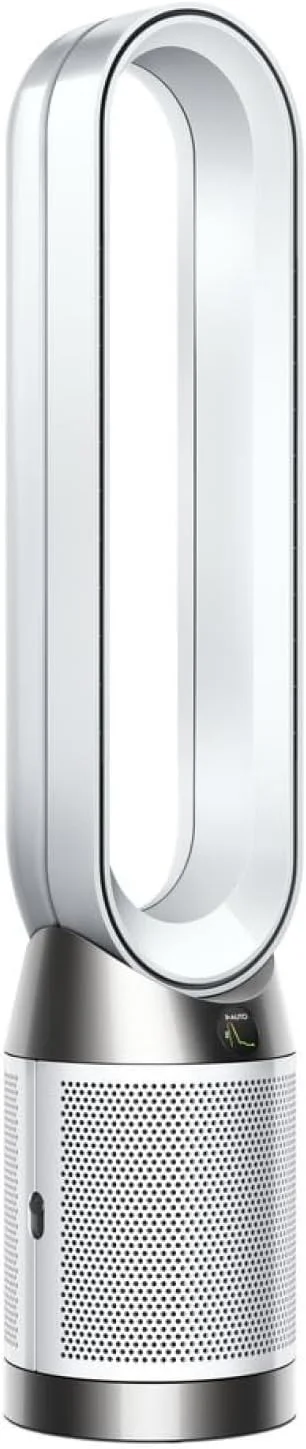
Dyson Purifier Cool TP07 Review Premium Pick
Not AHAM VerifiedOur Verdict
Key Specifications
- Room Coverage
- 400 sq ft (claimed)
- CADR
- Not AHAM verified — NOT AHAM VERIFIED
- Filter
- H13 HEPA + Carbon
- Noise
- 36 dB
- Power
- 40 watts
- Best For
- Design-conscious buyers. Fan + purifier combo. Accept no AHAM CADR verification.
📅 Prices checked . Amazon prices change frequently — click through for current price. Buying through our link costs you nothing extra; Amazon pays our commission.
What's in the Box
- Dyson Purifier Cool air purifier + fan
- Pre-installed filter assembly (HEPA + activated carbon)
- Power cord
- Remote control
- User manual
Pros
- Genuine H13 HEPA glass fibre
- Fan + purifier dual function
- MyDyson app with air quality data
- Premium design
Cons
- CADR NOT AHAM verified
- $449-499 — 4x Coway price
- HouseFresh shows cheaper units outperform
- Filter $75/year
Best For
Design-conscious buyers who want a statement piece that also cleans air. If the purifier sits in a visible living room and aesthetics matter as much as performance, Dyson is the only option that looks genuinely premium. The 360-degree H13 HEPA filtration captures 99.97% of particles. The LCD screen shows real-time PM2.5, PM10, VOC and NO2 data. The MyDyson app works well for scheduling and monitoring. You are paying $390 more than Coway for design, fan function, brand prestige and build quality. If those things matter to you, Dyson delivers. If you just want clean air, buy a Coway.
📅 Price checked August 2026 · Buying through this link costs you nothing extra — Amazon covers our commission
Dyson Purifier Hot+Cool HP07 Review 3-in-1
Not AHAM VerifiedOur Verdict

Key Specifications
- Room Coverage
- 400 sq ft (claimed)
- CADR
- Not AHAM verified — NOT AHAM VERIFIED
- Filter
- H13 HEPA + Carbon
- Noise
- 36 dB
- Power
- 40 watts
- Best For
- 3-in-1 fan + heater + purifier. Cold climate use where separate heater is needed.
📅 Prices checked . Amazon prices change frequently — click through for current price. Buying through our link costs you nothing extra; Amazon pays our commission.
What's in the Box
- Dyson Purifier Hot+Cool air purifier
- Pre-installed filter assembly (HEPA + activated carbon)
- Power cord
- Remote control
- User manual
Pros
- H13 HEPA genuine
- 3-in-1 heating cooling purifying
- MyDyson app
Cons
- CADR NOT verified
- $549-649
- Heating expensive to run
- Only justified if heating needed
Best For
The Dyson Purifier Hot+Cool HP07 is best for 3-in-1 fan + heater + purifier. cold climate use where separate heater is needed.. Same purification as TP07. Pay $100+ more for heating. Only buy if you genuinely need a heater.
📅 Price checked August 2026 · Buying through this link costs you nothing extra — Amazon covers our commission
Dyson Hushjet Compact Air Purifier Review Amazon's Choice
Not AHAM VerifiedOur Verdict
Key Specifications
- Room Coverage
- 203 sq ft
- CADR
- Not AHAM verified — Manufacturer-stated
- Filter
- HEPA + Activated Carbon
- Noise
- 24 dB
- Power
- 19 watts
- Best For
- Quiet operation, compact spaces, Dyson ecosystem users.
📅 Prices checked . Amazon prices change frequently — click through for current price. Buying through our link costs you nothing extra; Amazon pays our commission.
Pros
- Amazon's Choice designation
- Whisper-quiet operation
- Compact form factor
- Dyson sealed filtration system
- Premium build quality
Cons
- Not AHAM CADR verified
- 117 reviews — limited track record
- $349 is premium for room size covered
- High Dyson filter replacement costs
Best For
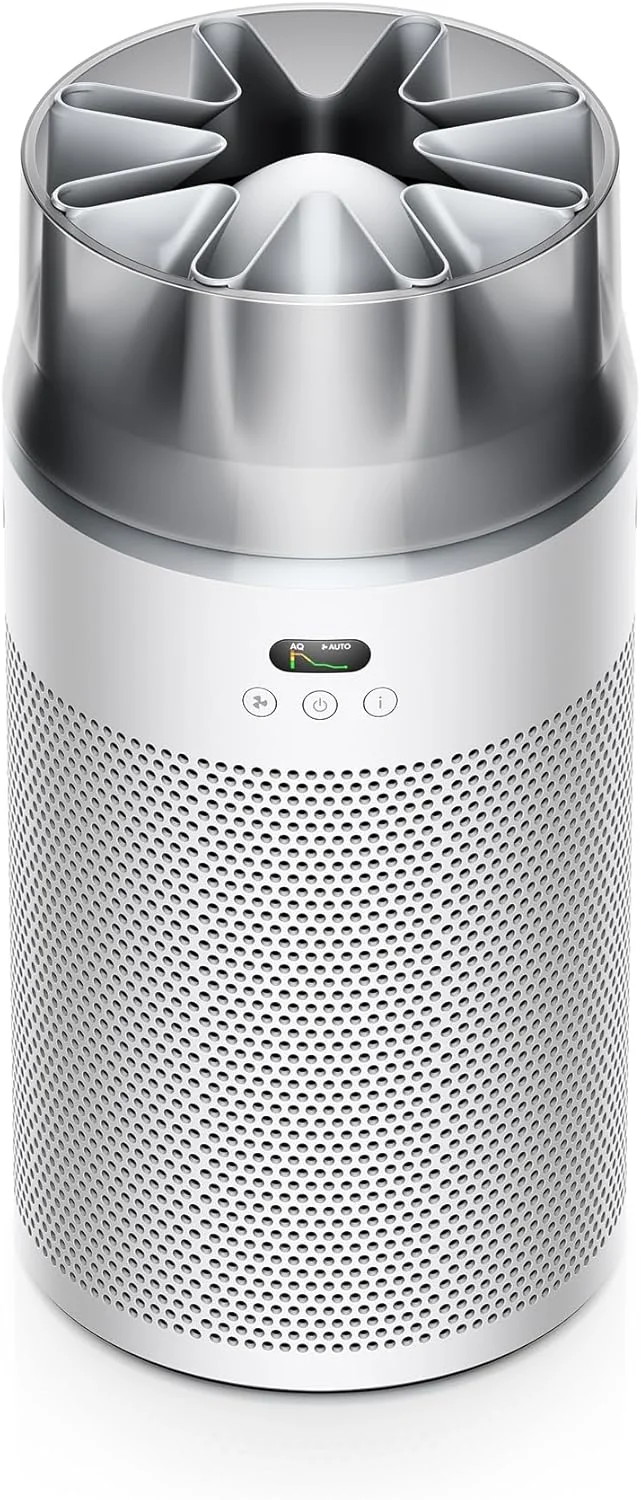
The Dyson Hushjet Compact Air Purifier is best for quiet operation, compact spaces, dyson ecosystem users.. Dyson's compact whisper-quiet purifier for bedrooms and smaller spaces. Amazon's Choice with signature Dyson build quality and sealed filtration. Premium price for the room size covered — best for Dyson ecosystem users or those prioritizing near-silent operation.
📅 Price checked August 2026 · Buying through this link costs you nothing extra — Amazon covers our commission
What to Know Before You Buy
All Dyson Air Purifier Models 2026
TP07 Purifier Cool: $499. Fan + purifier. 350-degree oscillation. H13 HEPA + carbon. LCD screen. MyDyson app. Best value Dyson.
HP07 Purifier Hot+Cool: $649. Fan + purifier + heater. Same filtration as TP07. Adds heating mode for winter. Buy only if you need a heater — the air purification is identical to TP07 at $150 more.
BP04 Purifier Quiet+: $799. Purifier only — no fan. Whisper quiet. 360-degree sealed filtration. The quietest Dyson. Buy only if silence is worth $300 more than the TP07.
DP04 Purifier Cool Desk: Discontinued in most markets. Replaced by TP07 for most use cases.
The CADR Question — Why Dyson Does Not Publish
Dyson does not submit to AHAM for independent CADR testing. They publish their own internal performance data that suggests roughly 180 CFM clean air delivery. The Coway AP-1512HH is AHAM-verified at 246 CFM. The Winix 5500-2 is AHAM-verified at 243 CFM for smoke. Without independent verification you are taking Dyson at their word. At $499 that requires more trust than a $110 purchase.
Dyson H13 HEPA — This Part Is Real
The H13 glass fibre HEPA filter in Dyson purifiers is genuine. H13 captures 99.97% of particles at 0.3 microns — the highest consumer grade. Coway uses H11 (95% efficiency). The filtration quality difference at the HEPA media level is real. Whether that 4.97% efficiency gap matters in practice for most homes — it does not. Both grades capture pollen, dust mites, pet dander and mold spores effectively. H13 matters for immunocompromised individuals or medical settings. For a healthy household, H11 is sufficient. Check our HEPA filter grades guide for the full comparison.
Dyson Filter Costs — The 5-Year Bill
Dyson TP07 filter: $60-80 per replacement, every 12 months. Five-year total: $499 + $300-400 filters = $800-900.
Dyson HP07: $649 + $300-400 = $950-1,050.
Dyson BP04: $799 + $350-450 = $1,150-1,250.
Coway AP-1512HH: $110 + $150-225 = $260-335.
The Dyson TP07 costs roughly 3x the Coway over five years. The BP04 costs 4x. The performance gap does not justify a 3-4x cost difference for most buyers.
Dyson vs Coway — $499 vs $110
This is the comparison that defines whether Dyson is worth buying. The Coway AP-1512HH at $110 delivers AHAM-verified CADR 246. Dyson TP07 at $499 delivers unverified CADR estimated at 180. The cheaper product has higher independently tested performance.
When Dyson wins: Design. The TP07 is a sculptural object. It looks premium in any room. The fan function adds genuine value in summer. The MyDyson app shows real-time air quality data with historical tracking. H13 HEPA is a higher filtration grade. Build quality is outstanding — the engineering feels like it costs $500.
When Coway wins: Verified performance. Price. Filter costs. Auto mode sensitivity. Proven 10-year reliability. No marketing premium. If you close your eyes and just breathe the output air, you cannot tell the difference. The Coway delivers cleaner air per dollar by every measurable standard.
The honest verdict: buy Dyson if design, fan function and app quality matter enough to justify $390 more. Buy Coway if you want the best air cleaning per dollar with independently verified specs. Most people asking this question should buy the Coway.
Is Dyson Worth It? — The 3 Yes and 3 No
Three reasons to buy Dyson:
- You want a fan and purifier in one device. The TP07 oscillates 350 degrees and moves air effectively. No other purifier doubles as a genuine cooling fan. If you would buy a fan anyway, the TP07 serves both functions.
- Aesthetics genuinely matter. If the purifier sits in a visible living room where guests see it, Dyson is the only brand that looks like furniture instead of an appliance. This is not vanity — it is a real purchase criteria for some homes.
- You want the best app and real-time data. MyDyson shows PM2.5, PM10, VOC and NO2 readings with graphs over time. No budget purifier offers this level of environmental monitoring. If data matters, Dyson provides it.
Three reasons not to buy Dyson:
- CADR is not independently verified. You are trusting Dyson at their word for performance claims. Every competitor at half the price has AHAM-verified numbers you can check yourself at ahamdir.com.
- Five-year cost is 3-4x the competition. $800-1,250 over five years versus $260-335 for a Coway. The performance gap does not justify the price gap.
- You are paying for design, not air cleaning. The H13 HEPA filter is real but the practical benefit over H11 in a home setting is minimal. The air quality improvement in your lungs is the same whether the purifier cost $110 or $799.
All Dyson Models Compared
Dyson currently sells four air purifier lines. Here is what differentiates them and who each serves.
TP07 Purifier Cool ($499): The baseline. Fan + purifier. 350-degree oscillation distributes air across the room. H13 HEPA + activated carbon filter. LCD screen shows real-time air quality. MyDyson app with scheduling and monitoring. This is the Dyson to buy if you want one. It has the best feature-to-price ratio in the Dyson lineup.
HP07 Purifier Hot+Cool ($649): Same as TP07 plus a ceramic heating element for winter. The air purification is identical — same HEPA, same CADR, same sensors. You pay $150 extra for heating. Buy this only if you genuinely need a space heater in the same room. Most people do not.
BP04 Purifier Quiet+ ($799): Purification only — no fan, no heating. The quietest Dyson at roughly 20 dB on low. Uses the same H13 HEPA filter. No oscillation — air is projected upward. This is for buyers who want Dyson quality in a bedroom or office where silence matters and fan function does not. The $300 premium over the TP07 buys you silence. Nothing else.
Which to buy: The TP07. It is the best value in the Dyson range. The HP07 adds a heater most people already have. The BP04 is quiet but $300 more for the same filtration. For personal desk use specifically, see our Dyson personal purifier review. For a broader comparison with non-Dyson alternatives, read our Dyson comparison.
Dyson Air Purifier CADR and Filtration: What the Data Shows
The most important thing to understand before buying a Dyson air purifier is that Dyson does not participate in AHAM certification. AHAM is the independent body that administers CADR testing across the industry — it is how you compare a Coway to a Winix to a Blueair on an apples-to-apples basis. Dyson conducts its own internal airflow tests, which are useful for comparing Dyson models to each other, but those tests use a different methodology and cannot be directly compared to AHAM-certified numbers from other brands. That is not a technicality. It is a real limitation for buyers who want to know exactly what they are getting per dollar.
What Dyson does genuinely deliver is a fully sealed filtration system. Air entering the unit is forced through the filter with no bypass gaps between the filter and the housing. This is a real engineering advantage. Cheaper HEPA machines — including some well-known mid-range brands — have small gaps where air can move around the filter media rather than through it, which reduces real-world efficiency below the rated spec. In a Dyson, if air enters the unit, it goes through the filter. This matters especially for allergen capture and for people sensitive to fine particles.
The HEPA filter in Dyson purifiers is rated H13 under the EU standard. H13 captures 99.95% of particles at 0.3 microns. The US True HEPA standard is 99.97% at the same particle size. The practical difference in a home setting is negligible — both grades capture essentially all pollen, dust mite debris, pet dander and mold spores. The EU H13 designation tests slightly differently from the US standard, which is why you see the 99.95% versus 99.97% difference. The filtration quality is real; the standard is simply different, not inferior.
The activated carbon filter in the TP07 and HP07 is a 360-degree capsule design. It wraps around the HEPA cylinder, which means incoming air contacts carbon from all sides before hitting the HEPA stage. This gives better coverage than the single-layer carbon sheets used by some competitors. That said, the carbon volume is moderate — not as deep as the dedicated carbon stage in the Winix 5500-2 — so for heavy odor loads, Dyson's carbon performs adequately rather than exceptionally.
Where Dyson genuinely wins: sealed system engineering that matches lab performance in real-world use; premium build quality that holds up over years; quiet auto mode operation that adjusts smoothly to detected air quality changes; combined purifier and fan functionality that no other premium brand matches; and an app that shows real-time PM2.5, PM10, VOC and NO2 data with historical graphs. These are real advantages, not just marketing.
Where Dyson loses: price per CADR is poor compared to AHAM-verified alternatives. Filter replacement costs run $60-90 per year — roughly double the Coway and Winix. Without AHAM verification, independent side-by-side comparison requires either trusting Dyson's own data or relying on third-party lab tests that are harder to find and sometimes contradictory. For buyers who want the best air cleaning performance per dollar with numbers they can verify independently, Dyson is not the answer. For buyers who want premium engineering, a dual fan-purifier function and are willing to pay the premium — Dyson is a genuine product, not a scam. See our Dyson model comparison guide for the full model-by-model breakdown.
Dyson vs AHAM-Certified Alternatives
AHAM certification exists because manufacturers have an obvious incentive to publish the best possible numbers for their own products. AHAM's role is to test in a standardized chamber, under standardized conditions, and publish a number that means the same thing regardless of which brand submitted the machine. When the Coway AP-1512HH shows CADR 246 in the AHAM directory, that number was produced by an independent lab following a defined protocol. When Dyson reports approximately 180 CFM from their own testing, you are reading a number Dyson produced in Dyson's lab. Both numbers may be accurate — but only one is independently verifiable.
What buyers give up by choosing Dyson over an AHAM-certified alternative is the ability to make an objective apples-to-apples comparison. You cannot look at a Dyson spec sheet and a Coway spec sheet and know with certainty which unit cleans more air per hour in your room. You can make an educated estimate — and the estimates generally favor the Coway on raw CADR at a fraction of the price — but you are estimating, not comparing verified numbers. For people who want to make data-driven decisions about air quality equipment, that gap is significant.
What buyers gain by choosing Dyson is a genuinely different product category. The TP07 is a cooling fan and an air purifier and an air quality monitor, all in a single object with genuine design merit. The sealed filtration system eliminates bypass air leakage. The MyDyson app provides real-time and historical particle data that no budget purifier offers. The H13 HEPA grade is real and the sealed housing ensures it performs at that grade in practice. The build quality is premium in a way you can feel when you handle the unit — this is not a plastic box from a contract manufacturer.
My honest read: for purely air quality performance per dollar, AHAM-certified machines win. The Coway at $110 or the Winix at $160 deliver verified particle reduction that Dyson at $499 does not demonstrably beat and may not match. For design, combined fan-purifier functionality, app quality and premium build: Dyson wins and wins clearly. Neither answer is wrong. It depends entirely on what you are buying for. If you are buying to breathe cleaner air as efficiently as possible, choose an AHAM-certified machine. If you are buying a piece of considered design that also happens to clean your air well, Dyson is the only brand that serves that need. Read our air purifier buying guide and what is CADR guide for the full framework before deciding.
Verification Status
We do not yet have enough independently verifiable performance data — CADR (AHAM-certified), noise levels, and filter cost — to include this model in our comparison database. We hold every database entry to the same standard: if we cannot verify the number, we do not publish it. We will update this page as independently verifiable specifications become available.