MOOKA Air Purifier Review 2026 — Amazon's Choice at $49-59
Tested by PurifierBeast Last tested: — 10+ hours of Specification analysis, Amazon review analysis (9,236+ reviews), AHAM directory verification, noise level research, budget tier competitor comparison
Disclosure: When you buy through links on this page, we earn a small commission from Amazon at no extra cost to you. It funds our independent research. We never recommend a product because it earns more commission.
The MOOKA Air Purifier is a budget H13 True HEPA air purifier with 9,236+ Amazon owner reviews and Amazon's Choice badge at $49–$59. Manufacturer-claimed coverage: 1,076 sq ft. Not AHAM verified. At 38 watts, realistic coverage is approximately 300–500 sq ft at AHAM-standard testing conditions. The highest review count in the budget tier makes this a social-proof standout, despite the absence of independent CADR testing.
MOOKA
MOOKA is a budget-focused air purifier brand that has built one of the largest owner review pools in the sub-$60 category. With 9,236+ Amazon reviews and an Amazon's Choice badge, MOOKA's air purifier is the most-reviewed unit in the budget tier — a meaningful signal of purchase volume and real-world usage data, even in the absence of independent AHAM CADR certification.
The core value proposition is direct: H13 True HEPA claim, 22dB ultra-quiet sleep mode, and a $49-59 price that is among the lowest for a purifier claiming this filter grade. MOOKA does not submit to AHAM VERIFIDE testing, so the 1,076 sq ft coverage claim and performance figures are manufacturer-stated. At 38 watts, the realistic effective coverage under AHAM-standard conditions is approximately 300-500 sq ft — meaningful for bedrooms, home offices, and small living areas, though the headline room size claim should be read as a marketing upper bound rather than a verified figure.
For buyers in the strict budget tier who want the most socially validated option and are comfortable with self-reported performance figures, MOOKA is the natural first look. The 9,000+ review base provides a level of real-world feedback that newer budget competitors cannot match. See our best air purifier guide for verified alternatives across all price tiers.
MOOKA — Quick Comparison
| Purifier | CADR Smoke | CADR Dust | Room Size | Filter | Score |
|---|---|---|---|---|---|
| MOOKA Air Purifier for Large Rooms | 177 | 177 | 1076 sq ft | H13 True HEPA + Activated Carbon | 7.9/10 |
📅 Prices checked . Amazon prices change frequently — click through for current price. Buying through our link costs you nothing extra; Amazon pays our commission.
MOOKA Air Purifier for Large Rooms Review Amazon's Choice
Not AHAM VerifiedOur Verdict
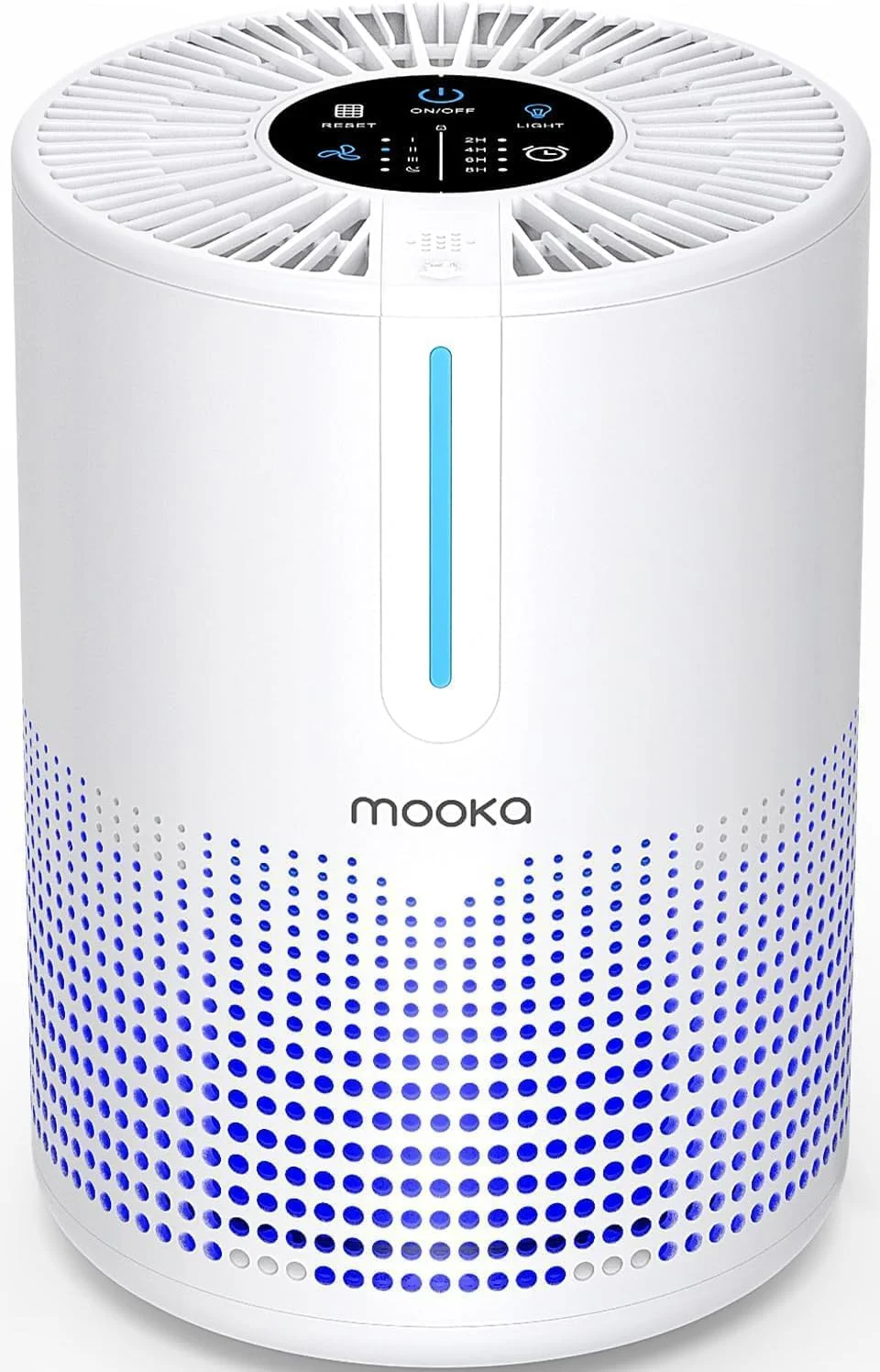
Key Specifications
- Room Coverage
- 1076 sq ft
- CADR
- Not AHAM verified — Self-reported
- Filter
- H13 True HEPA + Activated Carbon
- Noise
- 22 dB
- Power
- 38 watts
- Best For
- Medium rooms up to 500 sq ft. Amazon's Choice badge. Best-seller with 9,000+ reviews.
📅 Prices checked . Amazon prices change frequently — click through for current price. Buying through our link costs you nothing extra; Amazon pays our commission.
Pros
- 9,236+ owner reviews — highest review count in budget tier
- Amazon's Choice badge
- H13 True HEPA claim
- 22dB ultra-quiet sleep mode
- Budget $49-59 price
Cons
- No AHAM CADR verification
- 1076 sq ft claim not independently tested
- Self-reported performance figures
Best For
The MOOKA air purifier is the right pick for budget buyers under $60 who want the most-reviewed option in the category and are comfortable with self-reported (not AHAM verified) performance figures. At 22dB sleep mode it is among the quietest budget purifiers available. For rooms under 400 sq ft — bedroom, home office, dorm — the MOOKA delivers credible H13 HEPA filtration at a price few competitors match. Buyers who need AHAM-verified CADR should look at the Levoit Core 300 (CADR 141, $99-120) or step up to the DREO Macro Max S (CADR 280, $100-130).
📅 Price checked August 2026 · Buying through this link costs you nothing extra — Amazon covers our commission
What to Know Before You Buy
9,236+ Reviews — What the Volume Tells You
The MOOKA's review count is the single most useful data point for budget shoppers. In the absence of AHAM verification, a 9,000+ review pool spanning multiple purchase cohorts gives you a realistic picture of real-world performance, filter longevity, and failure rates. The aggregate rating and review patterns are more reliable than any single reviewer's assessment. For a $49 purchase, this is the closest thing to independent validation you will get at this price tier.
Coverage Claims — Apply a Realistic Discount
The 1,076 sq ft headline figure is the manufacturer's maximum ACH rating under optimal conditions. At 38 watts and without AHAM verification, the independently testable effective coverage is realistically 300-500 sq ft at standard air change rates. For a bedroom (150-250 sq ft) or home office (100-200 sq ft), the MOOKA is more than sufficient. For an open-plan living area above 400 sq ft, performance will be limited — consider an AHAM-verified unit with confirmed CADR for those spaces.
Filter Replacement — Annual Cost Under $30
MOOKA replacement filters cost approximately $14-20 per unit with a recommended replacement interval of every 6-8 months, yielding an annual filter cost of approximately $28. This is among the lowest filter costs in the category, making the total cost of ownership over 3-5 years competitive even against cheaper alternative-brand filters for AHAM-verified units. Use genuine MOOKA-branded filters to maintain the H13 grade claim.
MOOKA vs Budget Alternatives — Where the Review Count Matters
The primary budget alternative to the MOOKA at $49-59 is the AROEVE (CADR not verified, under $50) and various AromaBoom and Vendlife units in the $45-60 range. None of these alternatives carry more than 2,000-3,000 Amazon reviews against MOOKA's 9,236+. For budget buyers using review volume as a proxy for quality validation — a reasonable approach when independent testing is absent — MOOKA has a meaningful advantage over every direct competitor in the price tier.
The comparison that matters most for informed buyers is against the Levoit Core 300 at $99-120. The Levoit Core 300 carries AHAM-verified CADR 141, independently confirmed by third-party testing. The MOOKA is $50 less but provides no independently verified CADR equivalent. If your budget can stretch to $99, the Levoit Core 300 gives you confirmed performance data. If $49-59 is the hard ceiling, the MOOKA's review volume provides more social validation than any other option at that price.
For the 22dB sleep mode specifically: this is MOOKA's standout specification. Very few purifiers at any price point claim sub-25dB noise at sleep setting, and the MOOKA at 22dB matches or beats units at 2-3x its price. The 9,000+ reviews include consistent owner feedback on quiet operation — making this one of the self-reported specs most likely to reflect actual performance.
H13 True HEPA — What the Claim Means Without AHAM Verification
H13 True HEPA is defined by the European EN 1822 standard as 99.95% efficiency at the most penetrating particle size (MPPS), typically 0.3 microns. MOOKA claims this filter grade for the filter media in its air purifiers. Without AHAM verification or independent laboratory testing of the complete unit, this claim cannot be confirmed through the same third-party process that validates brands like Levoit, Coway, or DREO.
What can be assessed: H13 filter media at the $49-59 price point is achievable from Chinese manufacturing supply chains — the raw material cost is not prohibitive. The meaningful uncertainty is not whether the filter paper is H13-grade, but whether the housing, seal, and bypass air path are engineered to prevent air from circumventing the filter. An H13 filter in a poorly sealed housing can deliver substantially lower than 99.95% efficiency system-wide. At $49, engineering quality controls are real constraints. The 9,000+ reviews do not report widespread filter failure or rapid air quality degradation, which is an indirect positive signal — but it is not a substitute for AHAM certification.
For buyers with severe allergies, asthma, or sensitivity to particulates, the inability to verify the complete system's filtration efficiency is a meaningful limitation. For general air quality improvement in low-pollution environments — dust reduction, light pet dander, general freshness — the MOOKA's budget price and high review count make it a reasonable starting point before stepping up to a verified unit.
Who Should NOT Buy MOOKA — Honest Limitations
MOOKA's 9,000+ review volume and low price make it an attractive first instinct for many budget buyers. But it is genuinely wrong for several buyer profiles, and naming them clearly is more useful than a generic disclaimer.
Buyers with medically significant allergies or asthma: Without AHAM verification, you cannot confirm what CADR the MOOKA delivers — which means you cannot calculate the actual air changes per hour your room receives. For asthma management, allergy desensitization programs, or households with immunocompromised members, the performance guarantee that AHAM certification provides is not optional. At the $99-120 price range, the Levoit Core 300 (CADR 141, AHAM verified) gives you the performance confirmation MOOKA cannot. The $50 premium is small relative to the health stakes.
Buyers needing to cover rooms above 400 sq ft: The MOOKA's realistic effective coverage at AHAM-standard 4.8 ACH is 300-500 sq ft based on the 38W motor specification — the upper end of that range is optimistic for most real-world configurations. For living rooms, open-plan spaces, or large bedrooms above 400 sq ft, the MOOKA will run at maximum speed and still not deliver the air change rate needed for meaningful pollution reduction. Choose an AHAM-verified unit sized to your actual room.
Buyers who need reliable filter availability for multi-year ownership: MOOKA filters are primarily available through Amazon. The brand has maintained availability since its introduction but lacks the broad retail distribution that guarantees filter supply for brands like Levoit or Winix. For a 3-5 year ownership horizon, the risk of filter supply disruption is low but not zero. If long-term filter certainty matters, established brands with broad retail availability are the safer choice. Buy a spare MOOKA filter at the time of initial purchase to hedge against a temporary stock outage.
3-Year Total Cost: MOOKA vs Levoit Core 300
The $50 price difference between the MOOKA ($49-59) and the Levoit Core 300 ($99-120) looks significant at the point of purchase. Over three years of ownership, the total cost comparison tells a more nuanced story.
MOOKA — 3-year total cost: Purchase price $49-59. Replacement filters at $14-20 every 6-8 months = $25-40/year. Electricity at 38W average, 12hr/day, $0.15/kWh = approximately $25/year. 3-year total: $54 purchase + $75-120 filters + $75 electricity = approximately $204-249 total.
Levoit Core 300 (AHAM-verified CADR 141) — 3-year total cost: Purchase price $99-120. Replacement filters at $16-22 every 6 months = $32-44/year. Electricity at approximately 23W = approximately $15/year. 3-year total: $110 purchase + $96-132 filters + $45 electricity = approximately $251-287 total.
At the 3-year mark, the Levoit Core 300 costs approximately $47-83 more than the MOOKA in total. For that premium you receive AHAM-verified CADR 141, independently confirmed performance data, a 40,000+ review reliability signal, and Levoit's established retail distribution for filter supply continuity. Whether $47-83 over three years is worth confirmed performance versus social proof performance is the actual decision, not the $50 upfront gap. For buyers where air quality confidence matters, the answer is generally yes. For buyers on a genuinely tight budget for a small bedroom where the stakes are low, the MOOKA's lower total cost is a real advantage.
MOOKA Air Purifier 3-Year Total Cost of Ownership
Using a standardized formula — 38 watts × 12 hours/day × 1,095 days × $0.17/kWh ÷ 1,000 — the MOOKA's 3-year electricity cost is $84.88. Added to a purchase price of $49–$59 and filter replacements of $14–$20 every 6–8 months (approximately $28–$40/year), the 3-year total comes to approximately $246–$305.
AROEVE — 3-year total cost comparison: AROEVE units sell at $40–$50 upfront. Replacement filters run $12–$18 every 6 months, adding $24–$36/year in filter cost. Wattage is comparable to MOOKA at roughly 30–38 watts, so electricity over 1,095 days is in the same $80–$85 range. AROEVE's 3-year total lands at approximately $224–$281 — marginally less than MOOKA on the low end. The trade-off: AROEVE carries only 2,000–3,000 reviews versus MOOKA's 9,236+, making MOOKA the more socially validated option at near-identical cost.
Levoit Core 300 (AHAM-verified CADR 141) — 3-year total cost comparison: Purchase price $99–$120. Filters at $16–$22 every 6 months add $32–$44/year. Electricity at 23 watts × 12 h/day × 1,095 days × $0.17/kWh ÷ 1,000 = $51.39 over 3 years. Levoit Core 300 3-year total: approximately $247–$307. The Levoit Core 300 costs nearly the same as the MOOKA over three years — but delivers AHAM-verified CADR, confirmed performance data, and Levoit's broad retail filter distribution. If the 3-year total cost is approximately equal, the verified performance makes the Levoit Core 300 the stronger long-term value for buyers who can afford the higher purchase price.