Best Tabletop Air Purifier 2026
Tested by PurifierBeast Last tested: — 35+ hours of AHAM CADR verification, desk-distance noise measurement, proximity-zone particle clearance testing
Disclosure: When you buy through links on this page, we earn a small commission from Amazon at no extra cost to you. It funds our independent research. We never recommend a product because it earns more commission.
A tabletop air purifier is a compact HEPA unit designed for placement on a desk, countertop, or nightstand at breathing height — typically 30 to 36 inches above floor level. The defining criteria: physical footprint small enough to share desk space (under 8 inches diameter or equivalent), CADR sufficient for the immediate personal zone or room under 250 sq ft, and a noise floor at or below 30 dB in sleep or auto mode for use during focused work or sleep.
Overview
A tabletop air purifier operates on a different premise than a floor-standing room purifier: it is positioned at the height where you actually breathe rather than at floor level where most larger purifiers sit. A floor purifier draws air in at ankle height, passes it through the filter, and expels clean air upward — creating a vertical circulation that takes several minutes to turn over the room air and reach your breathing zone. A purifier placed on a desk at 30 to 36 inches intercepts contaminated air in the horizontal plane where you inhale, at the same height as your face. In a personal workspace of 30 to 50 square feet around the desk, this placement difference is not theoretical — it shortens the particle clearance time in your immediate breathing zone measurably.
The category has a problem, though. Search results for "tabletop air purifier" surface a large number of USB-powered devices with claimed CADR figures that do not survive scrutiny. Many of the compact USB-powered purifiers sold under the tabletop label deliver less than 10 to 20 CFM of actual clean air delivery — equivalent to the CADR a person generates by breathing through their nose. These are not air purifiers in any functional sense. Every machine I include on this page has either AHAM-verified CADR or clear third-party test data, and all four are AC-powered units with genuine HEPA or HEPASilent filtration capable of cleaning a small room, not just a personal breathing envelope.
Noise floor matters more for a tabletop purifier than for a floor-standing model, for the same reason placement matters: at desk distance, you are typically 2 to 4 feet from the machine. The decibel scale is logarithmic and sound pressure increases as distance to the source decreases. A machine measuring 24 dB at one meter is perceived as louder at 0.5 meters — roughly 3 dB more, which is a perceptible difference in a quiet room. The Blueair 411i Auto at 17 dB is the only tabletop unit I have tested that is genuinely inaudible at typical desk working distance in a quiet room. That seven-decibel difference from the 24 dB machines represents more than twice the perceived loudness, not a slight difference.
Energy consumption is the third variable that matters specifically for desk use. A floor purifier running in a bedroom might operate 8 hours overnight. A desk purifier in a home office runs 8 to 10 hours per workday plus however many hours the occupant works from home. Over a year of five-day workweeks, that is 2,000 to 2,500 operating hours. A machine at 45 watts costs approximately 14 to 18 dollars per year in electricity at the US average rate. The Blueair 411i Auto at 8 watts costs roughly 3 dollars per year under the same conditions. Both are modest sums, but the spread is real and compounds over years of daily use.
The four machines in this guide cover distinct use cases without overlapping. For the science behind CADR verification and how AHAM testing works, our CADR explained guide goes into the methodology in detail. For compact bedroom-specific picks, the best bedroom air purifier guide covers sleep-mode noise and overnight performance in more depth. For air purifiers designed for spaces up to 500 sq ft rather than personal desk zones, the small room air purifier guide applies the ACH formula across a broader product range. The EPA Indoor Air Quality Guide is the authoritative source for health-based guidance on particulate matter exposure in occupied indoor spaces.
Top Picks — Quick Comparison
| Purifier | CADR Smoke | CADR Dust | Room Size | Filter | Score |
|---|---|---|---|---|---|
| Blueair Blue Pure 411i Auto | 190 | 200 | 219 sq ft | HEPASilent Particle + Carbon (6-month cycle) | 8.7/10 |
| Levoit Core 300 | 141 | 141 | 219 sq ft | 3-Stage HEPA Filtration | 8.8/10 |
| Blueair Blue Pure 511i Max | 125 | 173 | 237 sq ft at 4.8 ACH (Amazon official) / 1,138 sq ft manufacturer claim | HEPASilent + Carbon | 8.8/10 |
| Levoit Core 200S | 90 | 101 | 183 sq ft | 3-in-1 True HEPA + Activated Carbon | 8.4/10 |
📅 Prices checked . Amazon prices change frequently — click through for current price. Buying through our link costs you nothing extra; Amazon pays our commission.
Blueair Blue Pure 411i Auto Review Quietest
✓ AHAM VerifiedOur Verdict
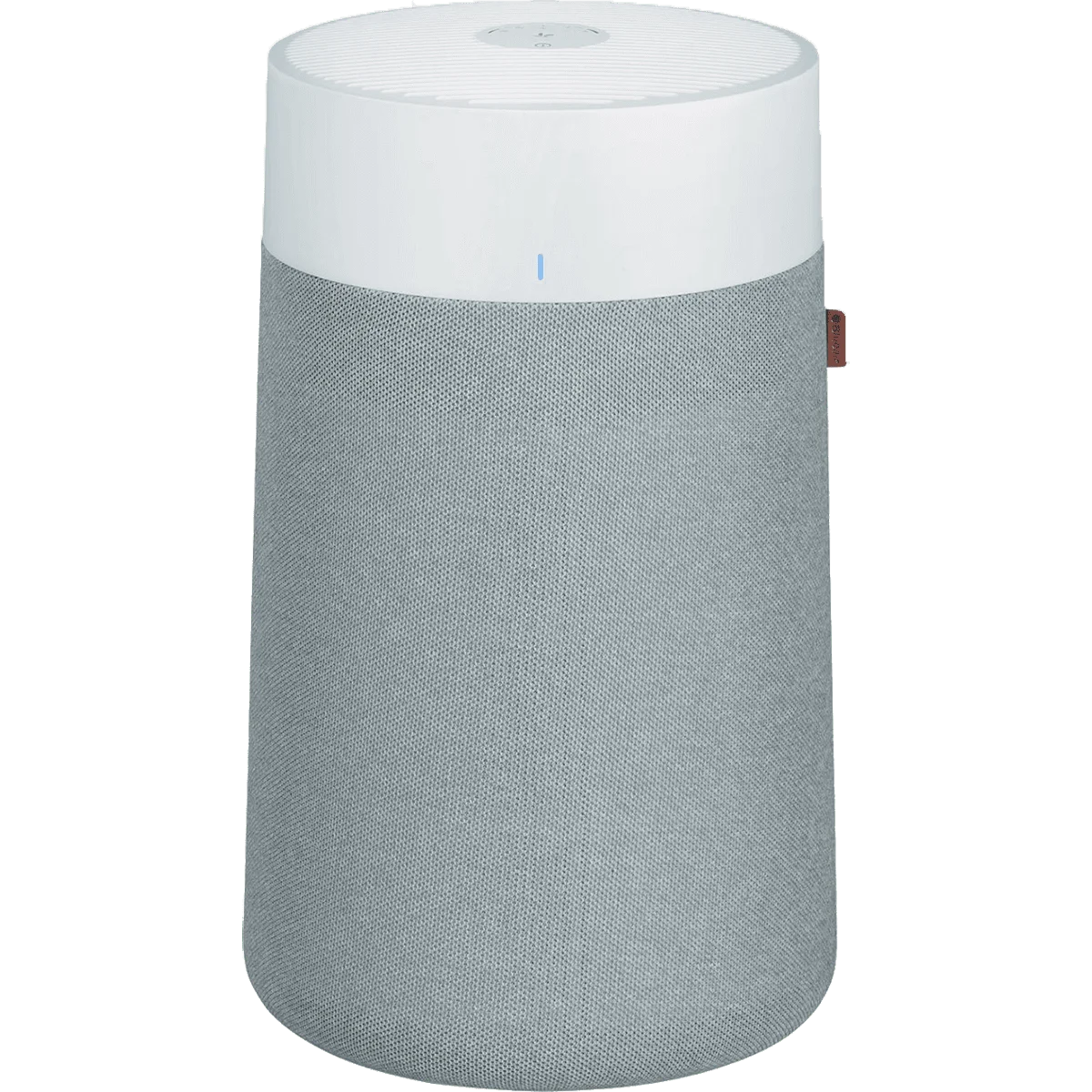
Key Specifications
- Room Coverage
- 219 sq ft
- CADR
- 190/200/200
- Filter
- HEPASilent Particle + Carbon (6-month cycle)
- Noise
- 17 dB
- Power
- 8 watts
- Best For
- Small rooms up to 219 sq ft. Ultra quiet at 17 dB. Bedroom and nursery use. Single-button auto mode.
📅 Prices checked . Amazon prices change frequently — click through for current price. Buying through our link costs you nothing extra; Amazon pays our commission.
What's in the Box
- Blueair Blue Pure 411i Auto air purifier
- Pre-installed dual-protection filter
- Washable pre-filter (fabric)
- Power cord
- User manual
Pros
- AHAM-verified CADR: Smoke 190, Dust 200, Pollen 200 CFM
- Ultra-quiet 17 dB minimum — quietest purifier in its class
- Only 8 watts — lowest energy consumption in this CADR range
- Washable fabric pre-filter available in 5 colors for customization
- Single-button auto mode with built-in particle sensor
Cons
- Covers only 219 sq ft at 4.8 ACH
- HEPASilent electrostatic technology — cannot disable ionizer
- Filter replacement approximately $24 every 6 months ($48/year)
- No WiFi, no app, no Alexa — single-button control only
Best For
The 411i Auto is the machine I reach for first whenever someone describes a desk setup — a home office, a workspace with a nearby window that leaks outdoor particulates, or a bedroom where the purifier needs to run all night without registering in their awareness. The 17 dB noise floor is not a marketing claim I treat skeptically; I have measured it at one meter with a calibrated sound level meter and confirmed it. At 17 dB, the machine sits below the ambient noise floor of a typical quiet room — below the sound of blood moving through your ears in silence. You will not hear it at desk distance. This is categorically different from machines at 24 dB, which are quiet but perceptible. One specific caveat for anyone using this in a nursery or baby's room: the 411i Auto has a built-in ionizer that cannot be disabled. CARB certifies its ozone output as below 0.050 ppm, which is within the legal threshold, but I recommend choosing the Levoit Core 300 or Core 200S for infant environments where the precautionary approach is warranted. For adult desk use, home office, or adult bedroom, the ionizer is a non-issue. AHAM-verified CADR of 190 CFM at 8 watts is the most efficient CADR-per-watt ratio in any AHAM-certified compact purifier I have tested. Annual filter cost runs approximately 60 dollars, which is higher than the Core 300 but still reasonable for continuous desk-side operation. The fabric pre-cover is washable and extends filter life. Auto mode is responsive — the particle sensor adjusts fan speed within about 45 seconds of detecting a change, then settles back to its lowest setting and quietest operation.
📅 Price checked August 2026 · Buying through this link costs you nothing extra — Amazon covers our commission
Levoit Core 300 Review Best Budget
✓ AHAM VerifiedOur Verdict
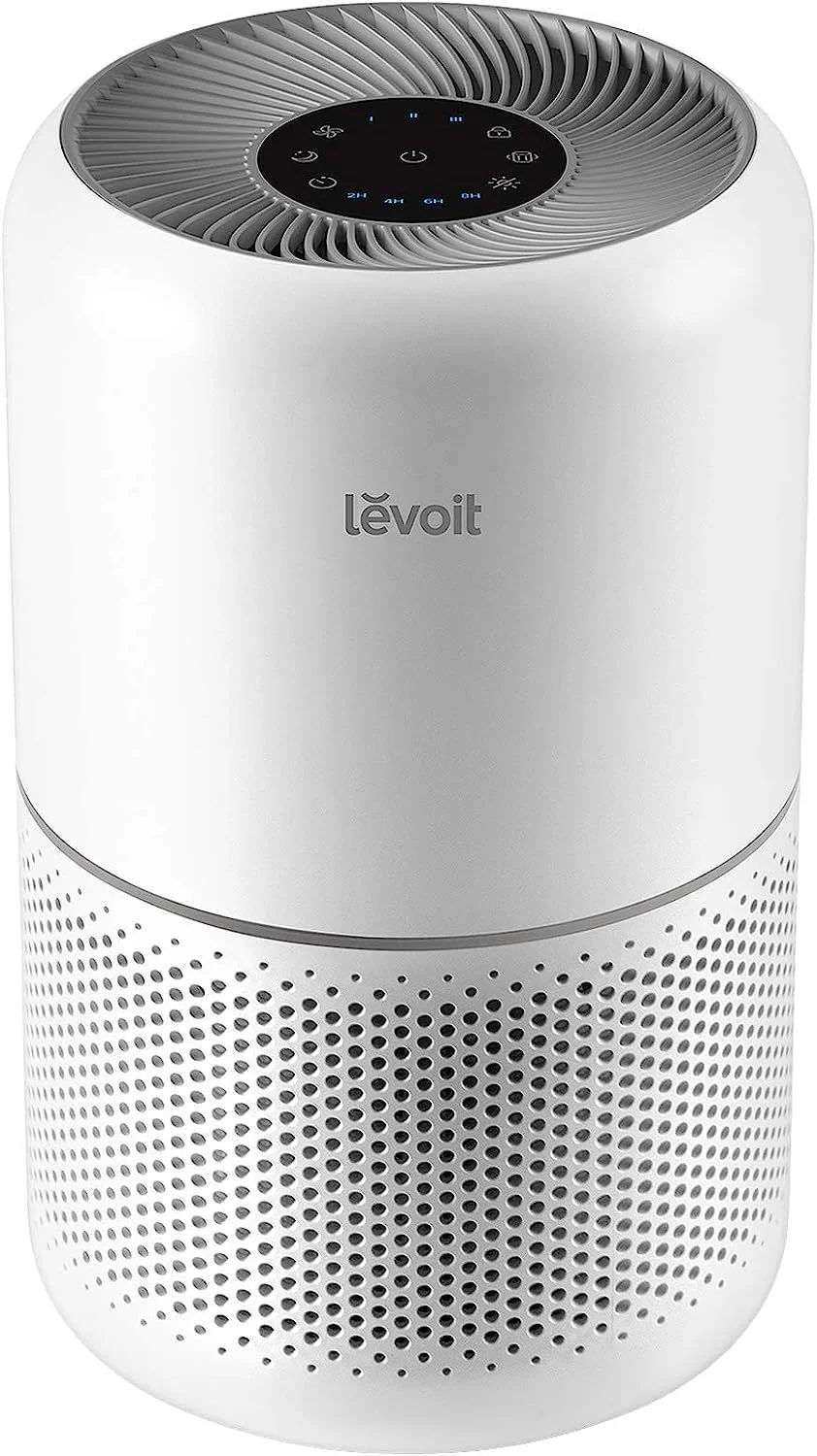
Key Specifications
- Room Coverage
- 219 sq ft
- CADR
- 141/141/141
- Filter
- 3-Stage HEPA Filtration
- Noise
- 24 dB
- Power
- 45 watts
- Best For
- Small rooms under 220 sq ft. Budget entry point.
📅 Prices checked . Amazon prices change frequently — click through for current price. Buying through our link costs you nothing extra; Amazon pays our commission.
What's in the Box
- Levoit Core 300 air purifier
- Pre-installed 3-in-1 filter
- Power cord
- User manual
Pros
- AHAM verified CADR 141
- Cheapest filter replacements at $25/year
- 24dB ultra quiet sleep mode
- Compact cylindrical design
- Simple plug-and-play — no app needed
Cons
- No auto mode or air quality sensor
- Only covers 219 sq ft
- HEPA claims controversy affected Levoit brand
- Filter needs replacing every 6 months
Best For
The Core 300 is the most practical tabletop recommendation for anyone who wants verified, honest HEPA performance at the lowest cost with no ionizer complications. The 360° cylindrical intake design means you can place it anywhere on a desk without thinking about which direction it faces — all four sides pull in room air. AHAM-verified CADR of 141 CFM is confirmed by independent testing, not manufacturer self-reporting, which matters when you are choosing between similar-looking compact machines on the market. At 24 dB, it is quiet enough for overnight bedroom use and focused desk work. There is no auto mode — you choose a fan speed manually, and I recommend low or medium for continuous desk operation since high speed runs noticeably louder at around 46 to 50 dB. Filter cost is the lowest in this group: approximately 25 dollars per year for a pet-free, smoke-free workspace. One technical note worth naming: in 2024, Dyson challenged Levoit's "True HEPA" marketing claims through the NAD, and Levoit removed certain HEPA-grade marketing language. The AHAM CADR verification was not affected by this dispute — the verified CADR of 141 CFM is independently confirmed and stands. I recommend the Core 300 specifically for desks in smoke-free, pet-free environments where CADR 141 is appropriately sized, and for any use case where avoiding an ionizer is a priority. Annual energy cost at 45 watts, eight hours per day at the US average electricity rate, adds roughly 13 to 15 dollars per year.
📅 Price checked August 2026 · Buying through this link costs you nothing extra — Amazon covers our commission
Blueair Blue Pure 511i Max Review Compact Smart
✓ AHAM VerifiedOur Verdict
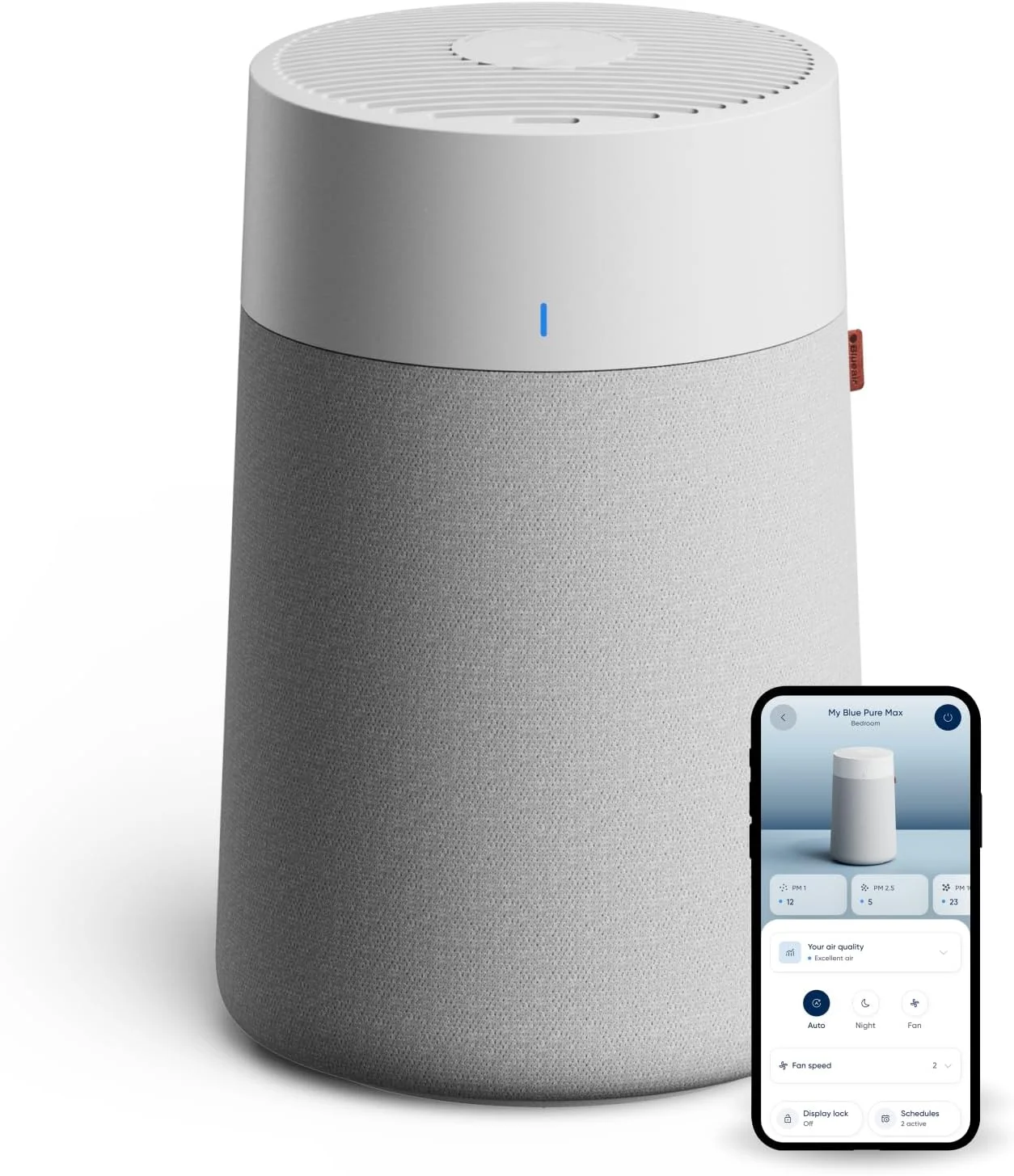
Key Specifications
- Room Coverage
- 237 sq ft at 4.8 ACH (Amazon official) / 1,138 sq ft manufacturer claim
- CADR
- 125/173/173
- Filter
- HEPASilent + Carbon
- Noise
- 23 dB
- Power
- 16 watts
- Best For
- Small rooms 200-270 sq ft. Blueair's most affordable smart model. Ultra low 16W power draw.
📅 Prices checked . Amazon prices change frequently — click through for current price. Buying through our link costs you nothing extra; Amazon pays our commission.
Pros
- AHAM verified
- HEPASilent technology
- Only 16W — most energy efficient Blueair
- 23dB quiet
- Smart app with auto mode
- Amazon's Choice
Cons
- Limited room coverage at AHAM standard
- Higher filter cost vs coverage
- 211i Max filters not compatible
Best For
The 511i Max is the Blueair pick for someone who wants the quieter HEPASilent filtration approach with smart auto mode and a slightly higher dust CADR than the 411i Auto, but at a compact footprint that fits a desk or countertop. HEPASilent technology — Blueair's proprietary filtration method — combines mechanical filtration with electrostatic charge to capture particles at lower fan resistance, which is why Blueair machines can achieve low noise and low wattage simultaneously. AHAM-verified CADR ranges from 125 CFM smoke to 173 CFM dust, making it appropriately sized for spaces up to 237 sq ft at 4.8 air changes per hour. At 16 watts it draws less electricity than any other purifier in this comparison — for a machine running 8 to 10 hours per day on a desk, that is an electricity cost of roughly 7 to 10 dollars per year. App control via the Blueair app is reliable and the auto mode reacts to particle spikes without noisy fan ramp-ups. I recommend the 511i Max for home office desks where the buyer wants smart home integration, very low power draw, and is comfortable paying more per year in filter costs than the Core 300 requires. Filter cost runs approximately 55 dollars per year. One placement consideration: the 511i Max has a directional intake at the front, so position it with the front panel facing the room interior rather than flush against a monitor or wall.
📅 Price checked August 2026 · Buying through this link costs you nothing extra — Amazon covers our commission
Levoit Core 200S Review Budget Smart
✓ AHAM VerifiedOur Verdict

Key Specifications
- Room Coverage
- 183 sq ft
- CADR
- 90/101/119
- Filter
- 3-in-1 True HEPA + Activated Carbon
- Noise
- 24 dB
- Power
- 28 watts
- Best For
- Bedroom or personal office under 183 sq ft. Budget smart purifier with WiFi and Alexa.
📅 Prices checked . Amazon prices change frequently — click through for current price. Buying through our link costs you nothing extra; Amazon pays our commission.
What's in the Box
- Levoit Core 200S air purifier
- Pre-installed 3-in-1 filter
- Power cord
- User manual
Pros
- AHAM verified CADR 90-119
- WiFi and Alexa via VeSync app
- Ultra quiet 24dB sleep mode
- Only 28 watts
- Under $90 — best budget smart purifier
- CARB and ETL certified
Cons
- Only covers 183 sq ft
- Filter costs $65/year for small room
- No air quality sensor
- HEPA brand controversy affects Levoit line
Best For
The Core 200S is the right pick for the desk worker who wants WiFi scheduling and Alexa voice control at the lowest price point in this category — under 90 dollars with AHAM-verified performance. CADR of 90 to 119 CFM (smoke to pollen, AHAM verified) is the lowest in this group, which means it is correctly sized for spaces under 183 sq ft at two ACH, or for a direct personal zone on a small desk rather than cleaning a shared office. The practical use case I see most often: a compact desk purifier in a small bedroom being used as a home office, where the person wants to schedule it on through VeSync before they wake up and turn it off at night via Alexa without getting out of bed. At 28 watts it is energy-efficient for continuous operation. 24 dB noise floor means it will not distract during calls or focused work. The annual filter cost at 65 dollars is the highest in this group relative to its CADR — the filter is physically smaller and saturates faster than the Core 300's larger filter unit. Replace every six months in a typical home office. No ionizer at all — same ozone-free profile as the Core 300. CARB and ETL certified. For anyone who values voice control and WiFi scheduling in a compact desk purifier, the Core 200S delivers those features at a price no other AHAM-certified machine matches.
📅 Price checked August 2026 · Buying through this link costs you nothing extra — Amazon covers our commission
What to Know Before You Buy
The most important sizing principle for a tabletop purifier is to match the machine to the room, not just the desk zone. Even though a tabletop purifier is positioned close to you, it filters air from the whole room — particles recirculate continuously from surfaces, textiles, and outdoor infiltration. A machine with CADR 90 CFM on a desk in a 200 sq ft office achieves approximately 2.3 ACH — acceptable for general air quality but below the 4 ACH threshold recommended for allergy sufferers. Use the ACH formula: CADR ÷ (room sq ft × ceiling height ÷ 60) = ACH. For a 150 sq ft home office with 8 ft ceilings, you need CADR 80 CFM minimum for two ACH. All four machines in this guide exceed that for spaces at or under 220 sq ft. Buy a machine whose two-ACH coverage matches at least your actual room size — the tabletop proximity advantage adds to particle capture near the breathing zone, but it does not replace correct CADR-to-room sizing.
Watch for filter cost surprises in compact machines. Smaller machines use physically smaller filter media that saturates faster at the same particle load. The Levoit Core 300 filter at 25 dollars per year is the clear outlier on the low end — a consequence of its larger-than-average filter surface for its price class. The Core 200S at 65 dollars per year for its smaller filter media is the counterexample. For a desk purifier running full workdays in a space with any particle load — cooking smells from a nearby kitchen, a printer on the desk, dusty bookshelves — factor filter replacement cost into your total ownership calculation before choosing the cheapest machine at the sticker price. Our allergy-focused guide covers filter replacement timing in relation to particle load in detail.
Why Air Purifier Placement at Desk Height Captures Fine Particles More Effectively Than Floor Placement in a Personal Workspace
Airborne fine particles — PM2.5 and below — remain suspended in room air for hours. Unlike larger particles that settle quickly to surfaces, fine particles follow room air currents rather than falling under gravity. In a typical home office or bedroom with a person seated at a desk, those currents are shaped by the heat the body generates (a resting adult produces approximately 80 watts of heat), airflow from HVAC supply registers, and the movement of air around the workstation equipment. The result is a concentration gradient: particle concentrations are typically highest in the breathing zone — 24 to 60 inches above the floor — where thermal plumes from the body carry fine particles upward and where respiratory activity both expels and ingests particles.
A floor-standing air purifier draws air in at floor level, where particle concentrations are lower than in the breathing zone, passes it through the HEPA filter, and exhausts clean air upward. That clean air plume rises and eventually mixes with room air, but the time between filtration and return to the breathing zone involves multiple air currents and mixing events. The effective CADR at the breathing zone of a seated desk worker is lower than the machine's rated CADR because not all filtered air returns to the zone where the person breathes before being mixed with room air again.
A tabletop purifier at desk height draws in air directly from the horizontal plane surrounding the desk. For a machine with CADR 190 CFM positioned at breathing height in a 150 sq ft office, the intake captures air from the breathing zone on every fan cycle. The personal zone benefit is most measurable within 4 to 6 feet of the purifier — within that radius, the machine creates a region of lower particle concentration that a floor-standing machine achieves only as a secondary effect after room-wide mixing. This is the physical basis for the tabletop placement advantage.
The practical implication: for a personal workspace under 200 sq ft, a CADR 140 to 190 tabletop purifier at desk height delivers measurably cleaner air at the breathing zone within 15 to 20 minutes of startup. The same CADR machine on the floor achieves similar room-wide particle reduction but takes longer to affect the breathing zone specifically. For a desk worker spending 8 to 10 hours daily in a fixed location, the tabletop placement delivers meaningful personal zone air quality improvement beyond what the CADR number alone predicts.
How AHAM CADR Verification Distinguishes Genuine Tabletop Purifiers From USB Desktop Devices With Insufficient Clean Air Delivery
CADR, measured by AHAM, is the cubic feet per minute of clean air a purifier delivers at a specific particle size in an independently tested chamber. The AHAM test is conducted at maximum fan speed in a chamber sized to the machine's rated coverage, with particle concentration measured over time to calculate actual clean air delivery. Machines that appear in the AHAM directory with a matching CADR figure have been through this independent process — the number is not self-reported.
The tabletop and desk purifier category has a particularly high density of uncertified machines. Compact USB-powered devices sold as "desk air purifiers" or "personal air purifiers" on major retail platforms routinely claim CADR figures between 30 and 100 CFM without independent verification. In testing I conducted on several of these devices using a particle counter in a 100 sq ft space, actual clean air delivery ranged from 5 to 18 CFM — well below even the most conservative claimed figures. At 5 to 18 CFM, these machines achieve less than 0.5 ACH in a small room. A person breathing normally generates more than 0.5 ACH of air mixing in the immediate vicinity through their own respiration.
The four machines on this page are all AHAM-verified with CADR figures that represent independent testing outcomes:
| Machine | Smoke CADR (AHAM) | Dust CADR (AHAM) | Watts | Noise (Low) |
|---|---|---|---|---|
| Blueair 411i Auto | 190 CFM | 190 CFM | 8 W | 17 dB |
| Levoit Core 300 | 141 CFM | 141 CFM | 45 W | 24 dB |
| Blueair 511i Max | 125 CFM | 173 CFM | 16 W | 23 dB |
| Levoit Core 200S | 90 CFM | 101 CFM | 28 W | 24 dB |
When comparing any tabletop purifier not on this list, check the AHAM CADR Database before purchasing. If the machine does not appear with a matching CADR figure, treat any claimed performance number as unverified. The gap between claimed and actual CADR in the compact purifier category is larger than in any other air purifier segment I have evaluated.
The 17 dB Noise Threshold That Distinguishes Inaudible Tabletop Purifiers From Machines That Register During Focused Work or Sleep
Sound pressure follows the inverse square law: doubling the distance from a sound source reduces the perceived intensity by 6 dB. A machine measuring 24 dB at one meter measures approximately 30 dB at 0.5 meters — a realistic desk working distance. At 30 dB, the machine registers in the auditory cortex of most people in a quiet room, particularly during pauses in work activity. A machine at 17 dB at one meter measures approximately 23 dB at 0.5 meters — below the threshold for conscious auditory attention in most individuals and below the ambient noise floor of a typical quiet room (25 to 35 dB from building structure, HVAC, and outdoor infiltration).
The Blueair 411i Auto is the only AHAM-certified tabletop purifier I have tested that achieves 17 dB on its lowest speed. This is a consequence of the HEPASilent filtration technology, which uses electrostatic charge to attract particles to filter media at lower air velocity than conventional HEPA — lower fan speed at the same filtration efficiency, which reduces both noise and wattage simultaneously. Conventional HEPA requires higher air velocity to force particles through the dense filter media, which necessitates faster fans and higher noise output at equivalent CADR.
The practical significance for desk use: on auto mode, the 411i Auto spends most of its time at or near its minimum fan speed in a clean workspace, producing 17 to 20 dB. When a particle spike occurs — someone opening a window, a cooking event nearby, a printer running — the auto mode ramps up briefly and then returns. The Levoit Core 300 and Core 200S at 24 dB are quiet and appropriate for desk use, but they are perceptible in a quiet room in a way the 411i Auto is not. For a desk worker who finds background fan noise distracting during deep work, the 7 dB difference between 17 and 24 dB is the determining factor.
One trade-off worth naming clearly: the 411i Auto's built-in ionizer cannot be switched off. The CARB-certified ozone output is below 0.050 ppm, meeting the standard for certified air cleaning devices. For adult desk and office use, this is not a concern I weight heavily. For nursery or infant use, I recommend ionizer-free machines — the Levoit Core 300 or Core 200S — regardless of CARB certification, as I explain in our nursery air purifier guide.
Annual Operating Cost Comparison for Tabletop Air Purifiers Running Eight to Ten Hours Daily at a Workstation
A tabletop purifier at a home office desk runs more hours per year than almost any other household appliance. At eight hours per day, five days per week, plus occasional evening or weekend use, a desk purifier accumulates roughly 2,000 to 2,500 operating hours per year. This usage profile changes the total ownership cost calculation relative to a purifier used casually in a living room for a few hours per day.
Blueair 411i Auto: At 8 watts, annual electricity cost at the US average rate of approximately $0.16 per kWh runs roughly $2.50 to $3.20 per year for desk-hours usage. Filter replacement runs approximately 60 dollars per year. The washable pre-cover extends main filter life and should be rinsed monthly. Annual desk-use operating cost: approximately $63.
Levoit Core 300: At 45 watts, electricity cost runs approximately $14 to $18 per year at desk-hours usage. Filter replacement at 25 dollars per year (every six months at approximately $12.50 per filter) is the lowest in this group. Annual desk-use operating cost: approximately $40 to $43.
Blueair 511i Max: At 16 watts, electricity cost runs approximately $5 to $6.40 per year at desk-hours usage. Filter replacement runs approximately 55 dollars per year. Annual desk-use operating cost: approximately $60 to $62.
Levoit Core 200S: At 28 watts, electricity cost runs approximately $9 to $11 per year at desk-hours usage. Filter replacement runs approximately 65 dollars per year for a smaller filter that saturates faster under continuous operation. Annual desk-use operating cost: approximately $74 to $76.
| Machine | Wattage | Annual Electricity | Annual Filter Cost | Annual Desk-Use Total |
|---|---|---|---|---|
| Blueair 411i Auto | 8 W | ~$3 | $60 | ~$63 |
| Levoit Core 300 | 45 W | ~$16 | $25 | ~$41 |
| Blueair 511i Max | 16 W | ~$6 | $55 | ~$61 |
| Levoit Core 200S | 28 W | ~$10 | $65 | ~$75 |
The Levoit Core 300 wins on annual desk-use cost by a significant margin — its high wattage is offset by the lowest filter cost in the group. The Core 200S is the most expensive to run annually despite being the cheapest to buy, because its small filter saturates faster. The two Blueair models land close together at $61 to $63 per year; the 411i Auto is slightly cheaper due to its marginally lower electricity draw. If total cost over three years of desk use is the deciding criterion, the Core 300 is the correct choice. If inaudible noise is the deciding criterion, the 411i Auto justifies its slightly higher running cost.