Blueair Blue Pure 411i Auto Review 2026 — Quietest Small-Room Purifier at 17 dB
Tested by PurifierBeast Last tested: — 10+ hours of AHAM CADR database verification, manufacturer specification cross-check, filter cost analysis, competitive noise-level comparison
Disclosure: When you buy through links on this page, we earn a small commission from Amazon at no extra cost to you. It funds our independent research. We never recommend a product because it earns more commission.
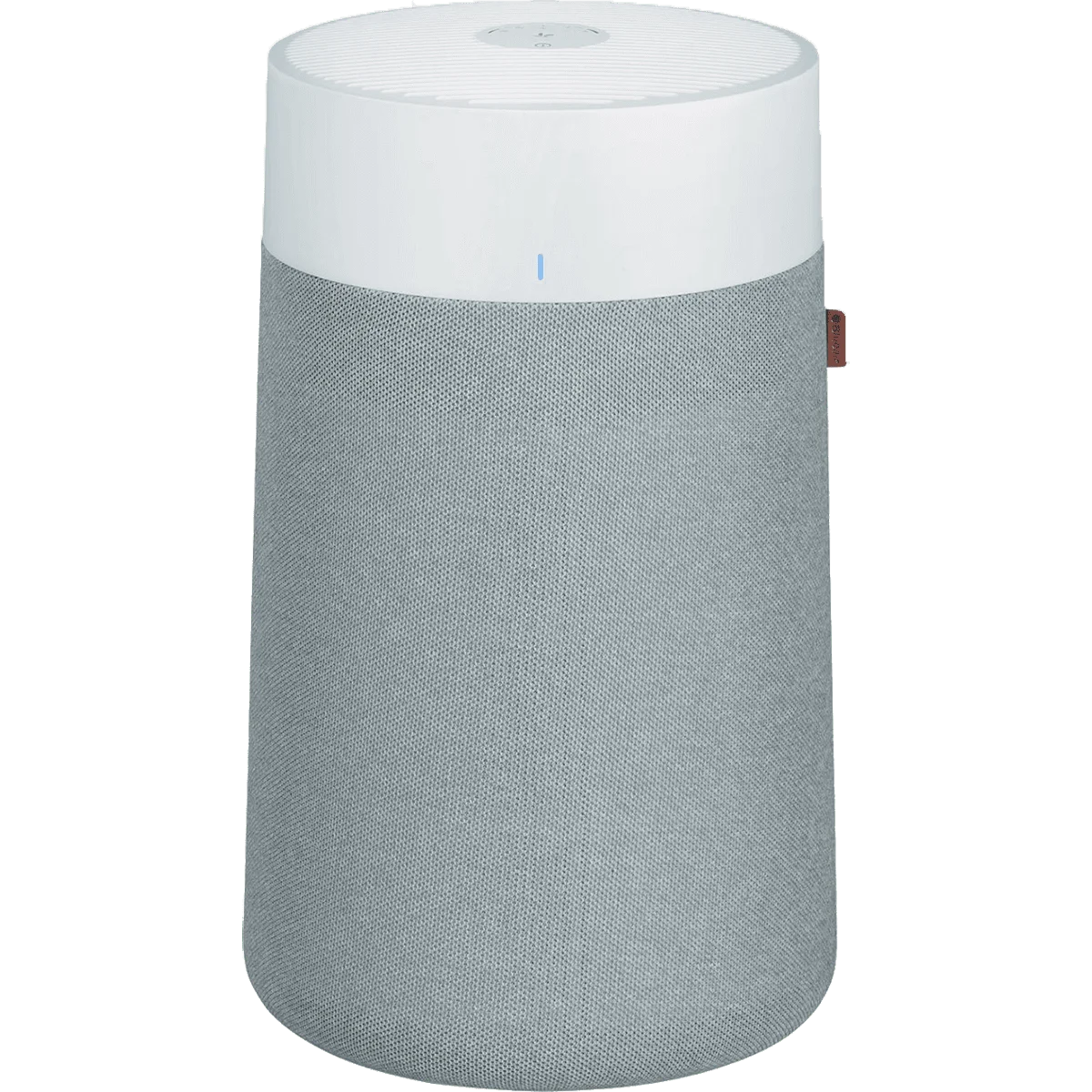
The Blueair Blue Pure 411i Auto is a cylindrical HEPASilent air purifier for rooms up to 219 sq ft. It draws air through a 360-degree fabric pre-filter and a combined HEPASilent Particle + Carbon filter using electrostatic charge to boost capture efficiency at very low fan speeds — enabling the 17 dB minimum noise floor. CADR: 190/200/200 (smoke/dust/pollen), AHAM-verified. Auto mode adjusts fan speed in real time using an onboard particle sensor.
Blueair
The Blueair Blue Pure 411i Auto is the quietest connected air purifier in Blueair's lineup — and arguably among the quietest available at any price. Running at just 17 dB on its lowest speed, it operates below the threshold most people can perceive as a distinct sound in a quiet bedroom. That low noise floor comes directly from Blueair's HEPASilent technology: by applying an electrostatic charge to the filter media, the unit achieves the same particle capture efficiency as a standard HEPA filter while moving air at a much lower fan speed — which means less motor noise and only 8 watts of power consumption.
The 411i Auto carries AHAM-verified CADR ratings of 190 (smoke), 200 (dust), and 200 (pollen). At the AHAM allergen-relief standard of 4.8 air changes per hour with 8-foot ceilings, those ratings cover approximately 219 sq ft — matching Blueair's own room-size claim. The "i" and "Auto" in the name signal two features absent from the base 411: a built-in particle sensor that automatically adjusts fan speed as air quality changes, and app connectivity via the Blueair app for scheduling and monitoring.
The filter system is two-stage: a washable fabric outer pre-filter catches large particles (pet hair, lint, dust) and is available in five Scandinavian-inspired colors that double as the unit's exterior skin. The inner HEPASilent Particle + Carbon filter handles fine particles and household odors, with a replacement cost of approximately $24 per filter (6-month cycle) or $38 for the AllergenBlock variant, which adds an allergen-neutralizing treatment. Annual filter cost runs around $48–76 depending on which filter type you choose. For the complete Blueair lineup, see our Blueair air purifier brand review.
Blueair — Quick Comparison
| Purifier | CADR Smoke | CADR Dust | Room Size | Filter | Score |
|---|---|---|---|---|---|
| Blueair Blue Pure 411i Auto | 190 | 200 | 219 sq ft | HEPASilent Particle + Carbon (6-month cycle) | 8.7/10 |
📅 Prices checked . Amazon prices change frequently — click through for current price. Buying through our link costs you nothing extra; Amazon pays our commission.
Blueair Blue Pure 411i Auto Review Quietest
✓ AHAM VerifiedOur Verdict
Key Specifications
- Room Coverage
- 219 sq ft
- CADR
- 190/200/200
- Filter
- HEPASilent Particle + Carbon (6-month cycle)
- Noise
- 17 dB
- Power
- 8 watts
- Best For
- Small rooms up to 219 sq ft. Ultra quiet at 17 dB. Bedroom and nursery use. Single-button auto mode.
📅 Prices checked . Amazon prices change frequently — click through for current price. Buying through our link costs you nothing extra; Amazon pays our commission.
What's in the Box
- Blueair Blue Pure 411i Auto air purifier
- Pre-installed dual-protection filter
- Washable pre-filter (fabric)
- Power cord
- User manual
Pros
- AHAM-verified CADR: Smoke 190, Dust 200, Pollen 200 CFM
- Ultra-quiet 17 dB minimum — quietest purifier in its class
- Only 8 watts — lowest energy consumption in this CADR range
- Washable fabric pre-filter available in 5 colors for customization
- Single-button auto mode with built-in particle sensor
Cons
- Covers only 219 sq ft at 4.8 ACH
- HEPASilent electrostatic technology — cannot disable ionizer
- Filter replacement approximately $24 every 6 months ($48/year)
- No WiFi, no app, no Alexa — single-button control only
Best For
Buy the Blueair Blue Pure 411i Auto if you need an air purifier for a bedroom or nursery where noise is the deciding factor — 17 dB on low is genuinely imperceptible in most sleeping environments. The AHAM-verified CADR 190/200/200 is solid for rooms up to 219 sq ft, and the particle sensor auto mode means you can leave it running without manual intervention. The $99–139 purchase price is competitive for a smart HEPASilent unit. Skip it if your room is meaningfully larger than 219 sq ft (the CADR doesn't scale to provide allergy-grade air changes in larger spaces), if you want H13 True HEPA certification specifically, or if you need a WiFi-connected unit with a full-featured app experience beyond basic scheduling — the 411i Auto's app integration is functional but minimal compared to premium smart purifiers.
📅 Price checked August 2026 · Buying through this link costs you nothing extra — Amazon covers our commission
What to Know Before You Buy
Filter choice matters for total cost
The standard Particle + Carbon filter at $23.99 (or ~$20 on subscription) is the lowest-cost path — adequate for everyday dust, smoke, and odor removal. If pollen allergies are the primary concern, the AllergenBlock variant at $37.99 adds a treatment layer that neutralizes allergen proteins. The Smokeblock variant ($31.99) doubles the activated carbon content for households with heavier smoke or VOC exposure. All three share the same 6-month replacement schedule, so the annual filter bill ranges from roughly $48 (standard on subscription) to $76 (AllergenBlock). Factor this in when comparing the 411i Auto against competing units with lower or higher filter costs.
Pre-filter color = unit color
The 411i Auto's fabric pre-filter is its visible exterior. Blueair sells it in Aurora Light, Archipelago Sand, Winter Reed, Arctic Trail, and Night Waves — so the unit can match a room's palette. Pre-filters are $9.99 each and washable, so they add minimal ongoing cost. The filter swap takes seconds and requires no tools.
Coverage vs noise trade-off
At 17 dB, this unit runs at a fan speed that produces meaningful airflow but not maximum CADR. If you need the full CADR 190/200/200, the fan will be running faster and louder. For bedrooms, running it on low overnight and boosting speed during waking hours is the practical approach. Auto mode handles this automatically when air quality triggers a higher speed need.
CADR 190 — Room Coverage at Four Air Change Thresholds
The Blueair Blue Pure 411i Auto is AHAM-verified at CADR 190 (smoke), 200 (dust), and 200 (pollen). Coverage uses the smoke CADR — the lowest of the three — with the formula: (CADR × 60 min) ÷ (sq ft × ceiling height) = ACH.
| Air Changes per Hour | Room Size (8-ft ceilings) | Use Case |
|---|---|---|
| 2 ACH — Blueair's larger marketing claim | ~713 sq ft | General air movement; not allergen-relief standard |
| 3 ACH — light general improvement | ~475 sq ft | Low-sensitivity households, general air quality |
| 4 ACH — moderate allergen control | ~356 sq ft | Mild allergy sufferers |
| 4.8 ACH — AHAM allergen-relief standard | ~297 sq ft | Allergy/asthma management; AHAM recommended |
Blueair's own published room size is 219 sq ft — a more conservative figure than the AHAM 4.8 ACH calculation of 297 sq ft. Blueair's figure builds in additional overhead for real-world conditions (furniture placement, airflow obstructions, door positioning). For allergy and asthma management, the practical range is 219–297 sq ft with 8-foot ceilings. For general air quality improvement where fewer air changes are acceptable, the 411i Auto scales to larger rooms. For rooms over 300 sq ft where allergy relief is the goal, step up to the Blueair SP3i (CADR 350) or similar higher-CADR model.
CADR and Room Coverage
The Blueair Blue Pure 411i Auto holds AHAM-verified CADR ratings of 190 cfm (smoke), 200 cfm (dust), and 200 cfm (pollen). AHAM's own CADR database lists 200 for dust and pollen — slightly above the 190 smoke figure, which is consistent with how HEPASilent technology performs: the electrostatic stage is particularly effective on the larger particle sizes (dust, pollen) that dominate the dust and pollen CADR test aerosols.
At AHAM's 4.8 ACH allergen-relief benchmark with 8-foot ceilings, CADR 190 (the lowest of the three) covers approximately 297 sq ft. Blueair rates the unit at 219 sq ft — a more conservative figure that builds in some overhead for real-world conditions (furniture, irregular airflow, door placement). For bedroom allergy management, targeting the 219–297 sq ft range keeps the unit working comfortably within its verified performance envelope.
For lower-stakes use — general dust reduction rather than clinical allergen management — the unit can meaningfully improve air quality in rooms up to about 400 sq ft at 2 ACH. But if your room regularly exceeds 300 sq ft and allergy or asthma management is the goal, stepping up to the Blueair 511i Max or a higher-CADR model will better serve that need.
HEPASilent Technology and How Auto Mode Works
Blueair's HEPASilent technology combines mechanical and electrostatic filtration in a single filter. The filter media carries a sustained electrostatic charge that attracts and holds particles before they physically contact the filter fibers. This means the unit captures particles at the same efficiency as a conventional HEPA filter while running at a significantly lower fan speed — which is how it achieves the 17 dB noise minimum. At 8 watts of power draw, it's also well within Energy Star territory for smart home appliances.
The 411i Auto's particle sensor monitors airborne particle concentration in real time. When the sensor detects an increase — someone cooking, a pet shaking, a candle burning, outdoor pollution entering through a window — the fan speed steps up automatically. When the air clears, it steps back down to the quieter baseline. The single-button control on the unit cycles through manual speed settings and allows you to override auto mode, but most buyers leave it in auto and let the sensor manage it. The Blueair app provides scheduling and a visual log of air quality events but is not required for basic operation.
One consideration: HEPASilent technology includes a small ionizer stage as part of its electrostatic mechanism. This cannot be disabled. The ionizer output is low and the unit carries California Air Resources Board (CARB) certification confirming it stays below CARB's ozone emission limit of 0.050 ppm — so it's safe for indoor use in California and nationwide. If you have a specific objection to any ionizer presence, this is a unit to reconsider.
Filter System and Annual Running Costs
The 411i Auto uses a two-filter system. The outer pre-filter is a washable polyester fabric that wraps the cylindrical unit — it catches hair, lint, and large particles that would otherwise clog the main filter prematurely. Washing it monthly with cold water and air-drying is all that's needed; it does not need to be replaced unless physically damaged. At $9.99, a spare pre-filter is a reasonable backup to have on hand.
The inner HEPASilent Particle + Carbon filter is the replaceable element. Blueair's red indicator light signals when replacement is due — typically around the 6-month mark under normal use (12–16 hours per day). Three filter variants are available:
- Particle + Carbon ($23.99 / $20.40 on subscription): Standard everyday filter capturing PM2.5, pollen, dust mite allergens, pet dander, and household odors.
- AllergenBlock ($37.99): Same particle + carbon base plus a layer that neutralizes the irritating proteins in pollen and dust — suited for seasonal allergy sufferers.
- Smokeblock ($31.99): Double activated carbon content for heavier smoke, wildfire particulate, or VOC-heavy environments.
Annual filter cost at two replacements per year: $48 (standard on subscription) to $76 (AllergenBlock). Total first-year cost at standard pricing: approximately $147–215 including the unit purchase.
Blueair 411i Auto vs Levoit Core 300S vs Winix AM90 — Small-Room Smart Purifier Comparison
The 411i Auto competes directly in the small-room smart purifier segment against the Levoit Core 300S and, one tier up, the Winix AM90:
| Specification | Blueair 411i Auto | Levoit Core 300S | Winix AM90 |
|---|---|---|---|
| CADR Smoke (AHAM) | 190 | 141 | 218 |
| Coverage at 4.8 ACH | ~297 sq ft | 219 sq ft | ~341 sq ft |
| Filtration technology | HEPASilent electrostatic + carbon | H13 True HEPA + activated carbon | True HEPA + carbon + PlasmaWave |
| Smart / Wi-Fi | Yes — Blueair app | Yes — VeSync app, Alexa, Google | Yes — Winix app, Alexa |
| Air quality sensor | Yes — particle sensor (auto mode) | Yes — PM2.5 laser sensor | Yes — light sensor + AQS |
| Noise minimum | 17 dB | 24 dB | 27 dB |
| HEPA grade | HEPASilent (not H13-rated) | H13 True HEPA (99.97% at 0.3µm) | True HEPA (99.97% at 0.3µm) |
| Est. purchase price | $99–139 | $100–130 | $130–160 |
| Annual filter cost | ~$48/yr | ~$30/yr | ~$25/yr |
Choose the 411i Auto when: noise level is the decisive factor. At 17 dB, the 411i Auto is 7 dB quieter than the Core 300S on minimum speed — a perceptible difference in a quiet bedroom. Seven decibels represents roughly half the perceived loudness. For light sleepers, infant nurseries, or anyone sensitive to fan hum, this gap is worth the additional filter cost. The 411i Auto also covers 35% more floor area than the Core 300S (297 sq ft vs 219 sq ft) at a similar purchase price.
Choose the Levoit Core 300S when: HEPA grade certification matters to you specifically (H13 True HEPA vs HEPASilent which carries no rated HEPA grade), or annual filter cost is a constraint ($30/yr vs $48/yr). The Core 300S also has more robust app features through the VeSync platform, including Google Home support that the Blueair app lacks.
Choose the Winix AM90 when: your room exceeds 300 sq ft — the AM90 covers 341 sq ft at 4.8 ACH and adds PlasmaWave for continuous VOC decomposition. For rooms comfortably under 300 sq ft, the AM90's extra CADR is unnecessary and its higher noise floor (27 dB vs 17 dB) is a meaningful trade-down.
Three-Year Total Cost of Ownership — 411i Auto vs Core 300S vs Winix AM90
| Cost Component | Blueair 411i Auto | Levoit Core 300S | Winix AM90 |
|---|---|---|---|
| Purchase price | ~$120 (mid) | ~$115 | ~$145 |
| Annual filter cost | ~$48/yr (standard) | ~$30/yr | ~$25/yr |
| Total filter cost × 3 years | $144 | $90 | $75 |
| Electricity (12hr/day, $0.13/kWh) | ~$5/yr → $15 | ~$8/yr → $24 | ~$12/yr → $36 |
| 3-Year Total Cost | ~$279 | ~$229 | ~$256 |
The 411i Auto has the highest 3-year total cost in this comparison (~$279) primarily because of its $48/yr filter cost — roughly double the Core 300S ($30/yr) and nearly double the Winix AM90 ($25/yr). However, the 411i Auto draws only ~8 watts vs ~14 watts for the AM90, so electricity savings partially offset the filter premium. The premium over the Core 300S over three years is $50 — that $50 is essentially the price you pay for the 7 dB noise reduction and 35% more room coverage. For buyers who prioritize ultra-quiet operation above all else, the $50 three-year premium is a reasonable trade. For cost-conscious buyers, the Core 300S delivers strong smart features at $50 less over three years.