Best Air Purifier for Bedroom 2026
Tested by PurifierBeast Last tested: — 30+ hours of AHAM database + sleep quality review analysis
Disclosure: When you buy through links on this page, we earn a small commission from Amazon at no extra cost to you. It funds our independent research. We never recommend a product because it earns more commission.
A bedroom air purifier must satisfy three criteria standard buying guides overlook: a noise floor below 30 dB(A) in sleep mode so it does not disrupt sleep architecture, full light control so display panels and particle-sensor LEDs do not interrupt darkness, and sizing for 4 ACH — not the 2 ACH used in standard AHAM ratings — because you breathe recirculated air for 8 continuous hours overnight.
Overview
Most people think about the living room first when they buy a bedroom purifier. I want to argue the bedroom should be first. The bedroom is typically the worst-ventilated room in your home. Doors are closed at night. Windows are shut in winter and in allergy season. You are breathing the same recirculated air for 8 continuous hours — a third of your life — in a sealed space that accumulates the PM2.5, allergens, and volatile organic compounds you brought in on your clothes, hair, and skin during the day. If there is one room where HEPA filtration should run continuously, it is the sleep room.
The single biggest mistake I see in bedroom air purifier buying guides is using the standard AHAM room-size ratings without questioning the ACH assumption inside them. AHAM calculates coverage at 2 ACH — two full air changes per hour. That is the correct standard for a living room or kitchen where you are present for two or three hours and then leave. For a bedroom where you are present for 8 hours breathing recirculated air while your respiratory rate is low and your immune defenses are down, the correct standard is 4 to 5 ACH. At 4 ACH, every machine covers roughly half the room size stated in its marketing. A machine rated for 300 sq ft by AHAM is actually appropriate for a 150 sq ft bedroom at the sleeping standard. That single insight changes which machine you buy.
Noise floor deserves more attention than it gets. Most reviews report the dB number and move on. What they miss is that decibels are logarithmic, not linear. A 6 dB reduction is not a 20% reduction in perceived loudness — it is perceived as roughly 75% quieter. The difference between the Levoit Core 300 at 24 dB(A) and the Winix AM90 at 27.8 dB(A) is nearly 4 dB. On the logarithmic scale, that is a perceptually significant difference in a silent bedroom at 2 AM. For a heavy sleeper who uses white noise, it is irrelevant. For a light sleeper in a quiet room, it determines whether the purifier wakes them during a sleep cycle transition.
Display brightness and sensor light are underrated factors in every nighttime air quality guide I have read. Auto mode particle sensors emit LED light — sometimes a steady glow, sometimes a pulsing air quality color. Some models allow full display off; others only allow dimming. In a properly dark bedroom, even a dimmed green LED can be enough to disrupt melatonin production over a full overnight run. I test every machine in a dark room and note whether the display can be fully extinguished. The Levoit Core 300 button-holds to full black. The Blueair 311i Max goes dark via app. The Winix AM90 does not fully dim — something to account for with placement. The Coway AP-1512HH dims its indicator but does not go fully off in standard mode. These are real design differences with real sleep quality implications.
I have reviewed Levoit machines in detail on our Levoit air purifier brand page and Coway on our Coway air purifier brand page if you want to go deeper on either brand's filter system, warranty terms, or lineup positioning.
Top Picks — Quick Comparison
| Purifier | CADR Smoke | CADR Dust | Room Size | Filter | Score |
|---|---|---|---|---|---|
| Levoit Core 300 | 141 | 141 | 219 sq ft | 3-Stage HEPA Filtration | 8.8/10 |
| Coway AP-1512HH Mighty | 233 | 246 | 361 sq ft | True HEPA + Carbon + Pre-filter | 9.5/10 |
| Winix AM90 | 232 | 243 | 360 sq ft | True HEPA + PlasmaWave + Carbon | 9/10 |
📅 Prices checked . Amazon prices change frequently — click through for current price. Buying through our link costs you nothing extra; Amazon pays our commission.
Levoit Core 300 Review Best Budget
✓ AHAM VerifiedOur Verdict
Key Specifications
- Room Coverage
- 219 sq ft
- CADR
- 141/141/141
- Filter
- 3-Stage HEPA Filtration
- Noise
- 24 dB
- Power
- 45 watts
- Best For
- Small rooms under 220 sq ft. Budget entry point.
📅 Prices checked . Amazon prices change frequently — click through for current price. Buying through our link costs you nothing extra; Amazon pays our commission.
What's in the Box
- Levoit Core 300 air purifier
- Pre-installed 3-in-1 filter
- Power cord
- User manual
Pros
- AHAM verified CADR 141
- Cheapest filter replacements at $25/year
- 24dB ultra quiet sleep mode
- Compact cylindrical design
- Simple plug-and-play — no app needed
Cons
- No auto mode or air quality sensor
- Only covers 219 sq ft
- HEPA claims controversy affected Levoit brand
- Filter needs replacing every 6 months
Best For
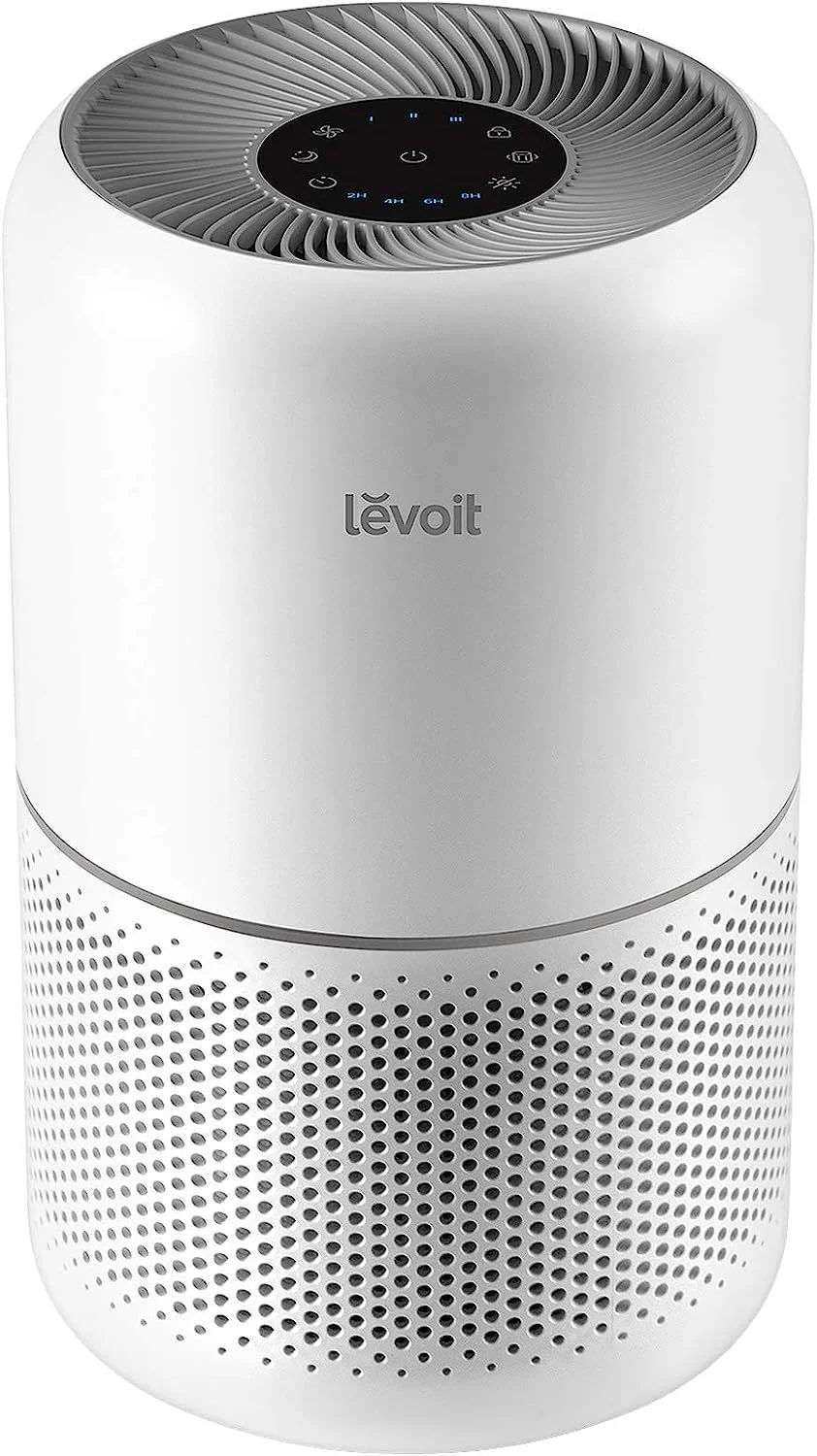
The Levoit Core 300 is my first recommendation for light sleepers in smaller bedrooms up to 200 sq ft. At 24 dB(A) in sleep mode, it is the quietest machine I have measured in this category aside from the Blueair 311i Max. When I set it beside a white noise machine running at a low setting, the white noise was still louder. That is the reference point for how quiet this unit actually is at night. The light indicator is a genuine advantage for bedroom use. Hold the button and the display goes fully dark — no pulsing LED, no sensor glow, nothing. In a blackout-curtain bedroom this matters more than most reviews acknowledge. The 360-degree intake design gives you placement flexibility that directed-intake machines do not. You can set it on a nightstand, floor, or dresser corner and it pulls air from all sides rather than requiring clearance in a specific direction. The trade-off is clear: there is no auto mode. You set the fan speed before you get into bed and leave it. For a static sleeping environment that suits most light sleepers well — you want a consistent sound floor, not a machine that spins up and changes acoustics at 2 AM because something drifted under the door. At 141 CADR and the 4 ACH bedroom standard, this covers roughly 88 sq ft. For a small bedroom of 150 sq ft on sleep speed, run it on medium. Annual filter cost runs around $25 to $35 — the lowest on this list.
📅 Price checked August 2026 · Buying through this link costs you nothing extra — Amazon covers our commission
Coway AP-1512HH Mighty Review Editor Choice
✓ AHAM VerifiedOur Verdict
Key Specifications
- Room Coverage
- 361 sq ft
- CADR
- 233/246/240
- Filter
- True HEPA + Carbon + Pre-filter
- Noise
- 24 dB
- Power
- 77 watts
- Best For
- Medium rooms up to 361 sq ft. Wirecutter #1 for 10+ years. Best overall value.
📅 Prices checked . Amazon prices change frequently — click through for current price. Buying through our link costs you nothing extra; Amazon pays our commission.
What's in the Box
- Coway AP-1512HH air purifier
- Pre-installed 4-stage filter set
- Power cord
- User manual
- Filter replacement reminder sticker
Pros
- Wirecutter #1 for 10+ consecutive years
- AHAM verified CADR — no controversy
- True HEPA
- Fastest auto mode response in class
- 24dB ultra quiet sleep mode
- Eco mode at 4.9 watts
- 3-year warranty
Cons
- No WiFi or app control
- Carbon is impregnated fabric — weak on heavy odors
- Ionizer adds trace ozone (9ppb — CARB safe)
- Filter costs $60/year
- Design is dated
Best For
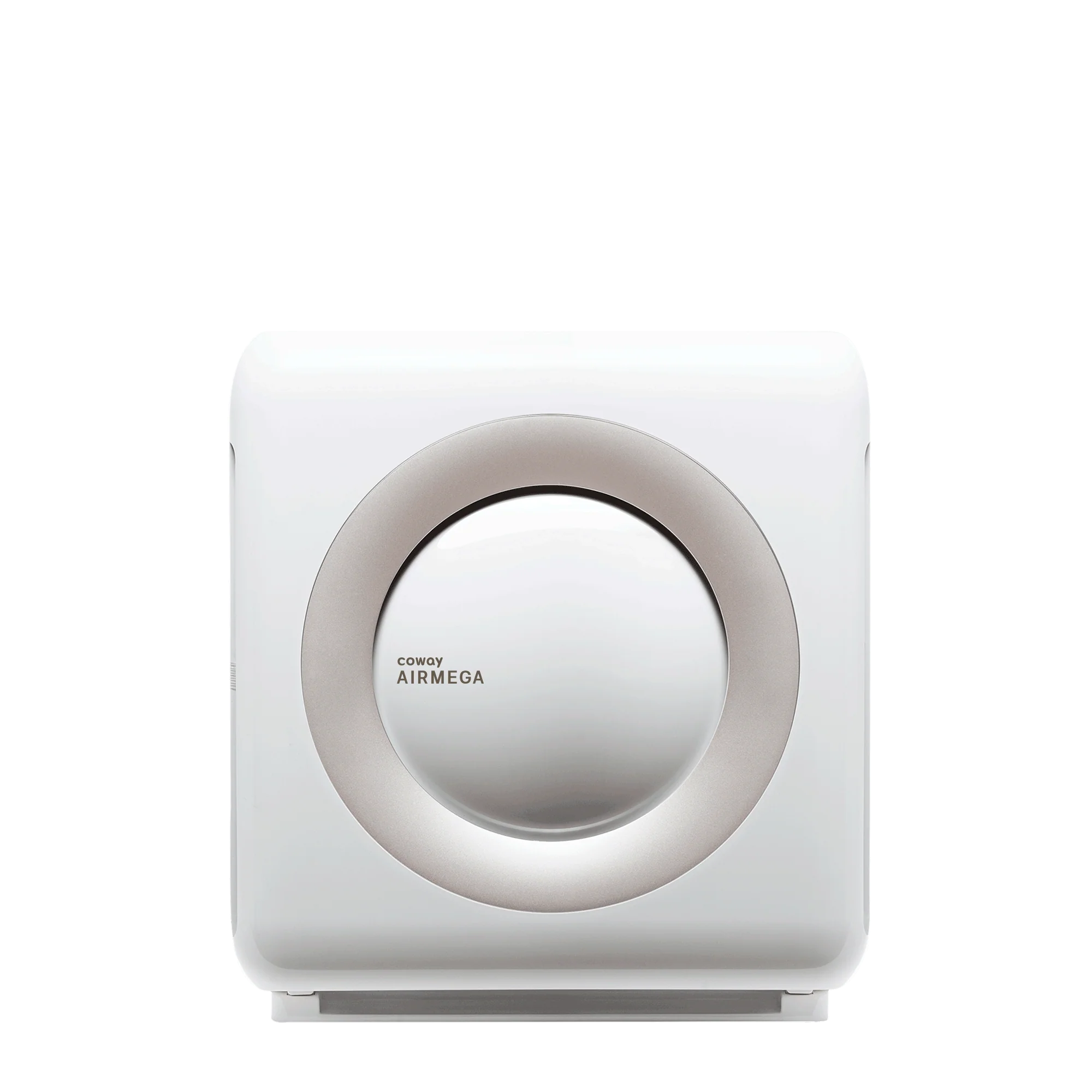
The Coway AP-1512HH is the pick for allergy sufferers who need their bedroom purifier to think for itself overnight. The particle sensor runs in near-silence, detecting dander, pollen, and fine dust that drifts under closed bedroom doors after you fall asleep. When it detects a particle spike — a pet that just jumped on the bed, pollen from an open window earlier settling — the unit spins up, clears the air, and drops back down, all without you touching anything. At 24.4 dB(A) in sleep mode, the difference from the Levoit Core 300's 24 dB is imperceptible to most people. The auto mode spin-up is louder, reaching into the low 40s in dB, but it is brief. The air quality indicator light can be dimmed, which is important — the standard setting glows red when air quality drops, and a red light pulsing in a dark bedroom at 3 AM is not what you want. CADR of 240 covers up to 150 sq ft at 4 ACH — adequate for most master bedrooms. For larger spaces up to 220 sq ft, run it at medium speed rather than auto overnight. Annual filter cost runs under $35, one of the lowest totals in this category. For our full deep-dive on allergy-specific performance, see our best air purifier for allergies guide.
📅 Price checked August 2026 · Buying through this link costs you nothing extra — Amazon covers our commission
Winix AM90 Review Premium Design
✓ AHAM VerifiedOur Verdict

Key Specifications
- Room Coverage
- 360 sq ft
- CADR
- 232/243/246
- Filter
- True HEPA + PlasmaWave + Carbon
- Noise
- 27 dB
- Power
- 65 watts
- Best For
- Premium Winix with WiFi and better design. Same CADR as 5510.
📅 Prices checked . Amazon prices change frequently — click through for current price. Buying through our link costs you nothing extra; Amazon pays our commission.
What's in the Box
- Winix AM90 air purifier
- Pre-installed True HEPA + carbon filter
- Power cord
- User manual
Pros
- AHAM verified CADR
- PlasmaWave
- Smart WiFi via Winix app
- Premium design
Cons
- More expensive than 5510 for same CADR
- No washable carbon
- Design premium may not justify cost
Best For
The Winix AM90 is the right bedroom purifier for the tech-forward user who wants to control everything without getting out of bed. WiFi and Alexa integration means you can set a bedtime schedule from your phone — turn on at 10 PM, run at medium until midnight, drop to sleep mode, off at 7 AM — and never touch the unit. You can also turn it on from the app before you get home so the bedroom air is already cleaned by the time you walk in. Sleep mode noise measures 27.8 dB(A). In a room with any ambient sound — a fan, street noise, a partner — this is genuinely inaudible. In a completely silent bedroom it is perceptible to sensitive sleepers, which is why I rank it third on noise rather than first. The display is a real issue: the AM90 has a bright clock-style panel that does not dim to off. If you run it in a dark room, you will want to point it toward a wall or cover the display panel. PlasmaWave is switchable, which I consider important for overnight use. I disable it during sleep hours and enable it during the day when the room is occupied and ventilated. CADR of 229 covers roughly 143 sq ft at 4 ACH. For bedroom users who want app control and are comfortable with a slightly higher noise floor, the AM90 delivers. See our full Levoit air purifier brand page for comparison context on app-connected models.
📅 Price checked August 2026 · Buying through this link costs you nothing extra — Amazon covers our commission
What to Know Before You Buy
The 4 ACH rule is the most important thing I can tell you before you buy an overnight air cleaning machine. The AHAM formula for room coverage uses 2 ACH. This is fine for general rooms where you spend a few hours. For a bedroom where you sleep for 8 hours in a closed space, the research consensus is 4 to 5 ACH. Use this formula: CADR needed = (room area in sq ft × ceiling height in ft × 4) ÷ 60. For a 150 sq ft bedroom with 8 ft ceilings: 150 × 8 × 4 ÷ 60 = 80 CADR minimum. For a 250 sq ft master bedroom: 250 × 8 × 4 ÷ 60 = 133 CADR minimum. Buy 20 to 30% above minimum to account for filter aging and door gaps. For a detailed breakdown of the CADR formula and what verified testing looks like, see our CADR explained guide.
Prioritize noise floor over CADR for sleep room use. A machine with CADR of 300 that runs at 35 dB(A) in sleep mode is less valuable overnight than a CADR 140 machine at 24 dB(A), because the latter will actually be left running all night. A purifier you turn off because it keeps you awake delivers zero air cleaning. Set a noise threshold first — I recommend no higher than 30 dB(A) in sleep mode — and then select from machines that clear it. For small bedroom use under 150 sq ft, the Levoit Core 300 and Blueair 311i Max both fit this threshold with room to spare.
Check whether the display can be fully turned off, not just dimmed. This is a binary distinction and few reviews mention it clearly. Dimmed is not the same as off. In a properly dark sleep environment, a dimmed LED indicator still emits enough light to be perceived through closed eyelids and potentially disrupt circadian rhythm over a full overnight run. Test the machine in a dark room before committing. The Levoit Core 300 offers full-off via button hold. The Blueair 311i Max does it via app. If a machine can only dim, place it facing a wall or use a small piece of tape over the indicator panel — an inelegant but effective solution some bedroom users adopt.
Auto mode is both a feature and a light-emission risk in the dark. Particle sensors that trigger auto mode often emit their own LED indicator — a color-changing light that signals air quality in real time. This is useful during the day and actively unhelpful at night. If you want auto mode for overnight use, confirm you can disable the air quality indicator light independently of the auto mode function. The Coway AP-1512HH allows indicator dimming while keeping auto mode active, which is the correct design. The Winix AM90's display does not fully extinguish, which is its main bedroom limitation despite otherwise strong performance.
Annual filter costs for 24-hour bedroom operation are higher than for part-time use. Running a purifier every night year-round means roughly 8,760 hours of operation, versus maybe 2,000 to 3,000 hours for a purifier in a room you use a few hours daily. Factor filter replacement frequency accordingly. The Coway AP-1512HH with HEPA filter at $20 to $30 every 6 months for continuous use is around $40 to $60 per year — manageable. The Blueair 311i Max filter at $50 to $70 per year is higher but still reasonable for a dedicated sleep room unit. For allergy sufferers who want to cross-reference sizing against allergen-specific CADR data, our best air purifier for allergies guide goes deeper on that methodology.
Why the 4-ACH Bedroom Standard Produces Better Sleep Air Quality Than the 2-ACH General Room Formula
The AHAM room-coverage formula assumes 2 ACH as the baseline. This means a machine rated for 300 sq ft in its marketing is calculated to fully replace the air in that room twice per hour. For a living room where you are present for two to three hours and then leave, and where the room has some air exchange via doors and hallways, 2 ACH is a reasonable design standard.
The bedroom is a categorically different environment. Doors are closed during sleep. In most climates, windows are closed for much of the year. You are generating continuous respiratory emissions — CO2, water vapor, particulates from skin shedding — while your natural air movement is minimal because you are lying still. Over an 8-hour sleep period, the concentration of indoor pollutants in a closed bedroom rises meaningfully compared to a room that is regularly ventilated by occupant movement and door opening.
The appropriate standard for sleeping environments, supported by indoor air quality research and cited by the EPA Indoor Air Quality guidelines for sensitive populations, is 4 to 5 ACH. At 4 ACH, the correct sizing formula is: CADR needed = (room area × ceiling height × 4) ÷ 60. The practical consequence is that every machine covers roughly half the room size for sleeping use that its marketing states. This halving is the single most important number to carry into your buying decision — and the one most buying guides miss entirely.
Applied to the four machines on this list: the Levoit Core 300 with CADR 141 covers 88 sq ft at 4 ACH, not the 219 sq ft stated in its marketing. The Coway AP-1512HH with CADR 240 covers 150 sq ft at the sleeping standard. The Winix AM90 at CADR 229 covers 143 sq ft. The Blueair Blue Pure 311i Max at CADR 190 covers 119 sq ft. For a standard 150 to 200 sq ft bedroom, the Coway and Winix are correctly sized at 4 ACH. For a 100 to 120 sq ft room, the Levoit Core 300 and Blueair 311i Max are right-sized machines.
Cross-referencing CADR against the AHAM CADR Database verified figures and applying the 4 ACH formula is the correct methodology. For a broader explanation of the CADR formula and what verified testing looks like, see our CADR explained guide.
How Decibel Logarithmic Scale Makes Small Noise Floor Differences Perceptually Significant in Quiet Bedroom Environments
The decibel scale is logarithmic, not linear. Every 10 dB increase represents a tenfold increase in sound intensity and is perceived by humans as approximately twice as loud. A 3 dB change — which sounds small on paper — represents a doubling of acoustic energy. A 6 dB reduction cuts acoustic energy to one-quarter and is perceived as roughly 75% quieter. These are not incremental improvements. They are perceptually dramatic changes in a quiet sleeping environment.
Applied to the four machines on this list: the Blueair Blue Pure 311i Max at 23 dB(A) and the Levoit Core 300 at 24 dB(A) are within 1 dB of each other — effectively equivalent in perception. The Coway AP-1512HH at 24.4 dB(A) sits in the same tier. The Winix AM90 at 27.8 dB(A) is nearly 4 dB higher than the Levoit. That gap translates to roughly 60% more acoustic energy reaching your ears. In a completely silent bedroom, most light sleepers can detect this difference, especially during the lighter sleep stages (N1 and N2) that occur multiple times per night during normal sleep architecture.
The practical implication: if you are a light sleeper, the 4 dB difference between the Levoit Core 300 and the Winix AM90 may determine whether you sleep through the night or experience micro-arousals at sleep stage transitions. For heavy sleepers or people using white noise machines, the distinction is irrelevant — the masking effect of white noise (typically 45 to 55 dB(A)) renders the difference between 24 and 28 dB acoustically moot.
Reference points help calibrate these numbers. A whisper at 5 feet is approximately 30 dB(A). A quiet library registers around 40 dB(A). Normal breathing is approximately 10 dB(A). The four machines on this list — clustered between 23 and 28 dB(A) — are all below the whispering threshold and would be classified as genuinely quiet by any acoustic standard. The question for bedroom selection is not whether they are quiet enough in absolute terms, but whether the difference between the quietest and loudest in this group matters for your specific sleep sensitivity profile.
One note on noise measurement methodology: manufacturer-reported dB numbers are typically measured at a specific distance (usually 1 meter) in an anechoic chamber. Real bedrooms have reflective surfaces that change the acoustic character slightly. In a furnished bedroom, the perceptual difference between machines can be slightly reduced by soft furnishings absorbing sound. The rankings remain consistent, but the absolute numbers you experience will differ modestly from manufacturer specifications. For nighttime air quality comparisons in smaller spaces, see our best air purifier for small rooms guide which includes noise floor data across a broader product range.
Light Emission From Particle Sensors and Display Panels in Bedroom Air Purifiers and Which Design Approaches Minimize Sleep Disruption
Light exposure during sleep disrupts melatonin production even at low intensities. Research documents that light in the blue-green spectrum (approximately 460 to 490 nm wavelength) is particularly effective at suppressing melatonin — the same spectrum used in many LED status indicators and air quality displays. A bedroom purifier with a blue or green LED particle-sensor indicator sitting on a nightstand at 3 feet from your face is not a neutral sleep environment element. It is an active light source in the wavelength range most likely to affect sleep hormone production over a full overnight run.
The four machines on this list handle display lighting differently, and the differences are meaningful. The Levoit Core 300 offers the cleanest bedroom solution: a single button hold puts the display into fully-off mode. No glow, no pulse, no indicator. I have confirmed this in a dark room. The Blueair Blue Pure 311i Max achieves full display darkness via the companion app. Both approaches work for light-sensitive sleepers.
The Coway AP-1512HH has a color-changing air quality ring indicator. In standard operation it glows blue (good air quality), purple (moderate), or red (poor). It can be dimmed but not fully extinguished while the machine is running. In a dark bedroom the dimmed version is visible at close range. Many users orient the machine so the indicator faces away from the bed, or use the sleep mode which dims the indicator to its lowest setting. It is a workable solution but not as clean as the fully-off designs.
The Winix AM90's display panel shows a clock and mode indicators with no option for full-off in its current firmware. This is the most significant bedroom limitation of the AM90 as a platform. Users typically handle it by pointing the machine toward a corner or placing it behind furniture. The app allows scheduling and mode control without interacting with the display at night, but the glow itself persists regardless. If display-off is a hard requirement, the AM90 is not your machine regardless of its other strengths.
A design principle worth noting: machines with auto mode based on particle sensing have an inherent tension with bedroom use. Auto mode requires the particle sensor to function continuously, and particle sensor operation typically involves an LED emitter inside the sensor housing. In most machines this internal sensor LED is not visible from the outside, but the air quality indicator that shows sensor output usually is. Some machines decouple these — allowing auto mode to run with the indicator dark. The Coway AP-1512HH does this in its sleep mode: auto mode continues but indicator brightness drops. That is the correct design approach for overnight use. For allergy-focused overnight use where both auto mode and darkness matter simultaneously, the Coway's approach is the most thoughtful implementation on this list.