Air Purifier for Pets — What HEPA Captures, What Carbon Handles, and What CADR You Need
Tested by PurifierBeast Last tested: — 18+ hours of Pet allergen particle size analysis, Fel d 1 and Can f 1 airborne behavior research, HEPA capture efficiency for pet dander size range, pet odor VOC compound analysis, CADR requirements for pet household allergen control, clinical trial review of HEPA and pet allergy outcomes
Disclosure: When you buy through links on this page, we earn a small commission from Amazon at no extra cost to you. It funds our independent research. We never recommend a product because it earns more commission.
An air purifier for pets requires True HEPA filtration (H13, 99.97% at 0.3 microns) for pet dander allergen capture, a substantial activated carbon bed for pet odor control, and CADR sufficient for 5 air changes per hour in the room where the pet spends the most time. Pre-filter design is critical in pet homes — hair loading on the pre-filter is the primary cause of CADR reduction between filter replacements. AHAM-verified CADR is the only independently confirmed performance metric.
Pet Allergen and Indoor Air Science
Pet allergens are the most pervasive indoor allergen in homes with cats and dogs — and among the most studied in controlled clinical trials. Cat allergen (Fel d 1 — a protein secreted by sebaceous and salivary glands) is aerodynamically unique: it remains airborne for extended periods at particle sizes of 1-10 microns and deposits on clothing, surfaces, and upholstery throughout the home. Fel d 1 is so persistent that it is detectable in homes that have never had cats — carried in on the clothing of visitors from cat households. Dog allergen (Can f 1 and Can f 2, from skin, saliva, and urine) is similarly pervasive in dog-owning homes. Both allergens are particles — and both fall entirely within True HEPA's efficient capture range at 99.99%+ efficiency at their actual sizes.
The clinical evidence for HEPA purifiers and pet allergy outcomes is moderately strong. Studies by the Johns Hopkins Children's Center and the British Medical Journal have shown that HEPA air filtration in cat-owning homes reduces Fel d 1 concentration by 50-80% in treated rooms at adequate ACH (4-5+). A key finding across multiple studies: the benefit is greatest when the purifier is placed in the room where the cat spends the most time — not a separate room. In homes where the cat sleeps on the bed, placing the HEPA purifier in the bedroom captures the allergen in the highest-concentration microenvironment. Confining the cat to certain rooms and running a HEPA purifier in those rooms shows the largest reduction in allergen exposure. For dog allergens, similar principles apply — place the purifier where the dog sleeps and spends time, not in a general room.
Pet odor is a separate problem from pet allergen — and one that HEPA cannot address. Pet odor comes from volatile organic compounds: mercaptans (sulfur-containing compounds), short-chain fatty acids (from skin oils and secretions), amines (from urine breakdown), and skatole (fecal odor compounds). These are gas-phase molecules, not particles, and they pass through HEPA filter media unchanged. Activated carbon adsorbs these compounds through physical adsorption in the micropore structure. The practical limitation: activated carbon beds in most consumer air purifiers (100-300 grams of carbon) saturate with pet VOCs within weeks to months in a multi-pet home. For persistent pet odor control, the carbon bed weight matters — units with 500g+ of carbon or Winix PlasmaWave (which decomposes VOCs rather than adsorbing them) sustain odor control longer. For our top picks for pet homes, see best air purifiers for pets.
Pet Allergen and Indoor Air Science — Quick Comparison
| Purifier | CADR Smoke | CADR Dust | Room Size | Filter | Score |
|---|---|---|---|---|---|
| Coway AP-1512HH Mighty | 233 | 246 | 361 sq ft | True HEPA + Carbon + Pre-filter | 9.5/10 |
| Winix 5500-2 | 232 | 243 | 360 sq ft | True HEPA + PlasmaWave + Washable Carbon | 9.2/10 |
📅 Prices checked . Amazon prices change frequently — click through for current price. Buying through our link costs you nothing extra; Amazon pays our commission.
Coway AP-1512HH Mighty Review Editor Choice
✓ AHAM VerifiedOur Verdict
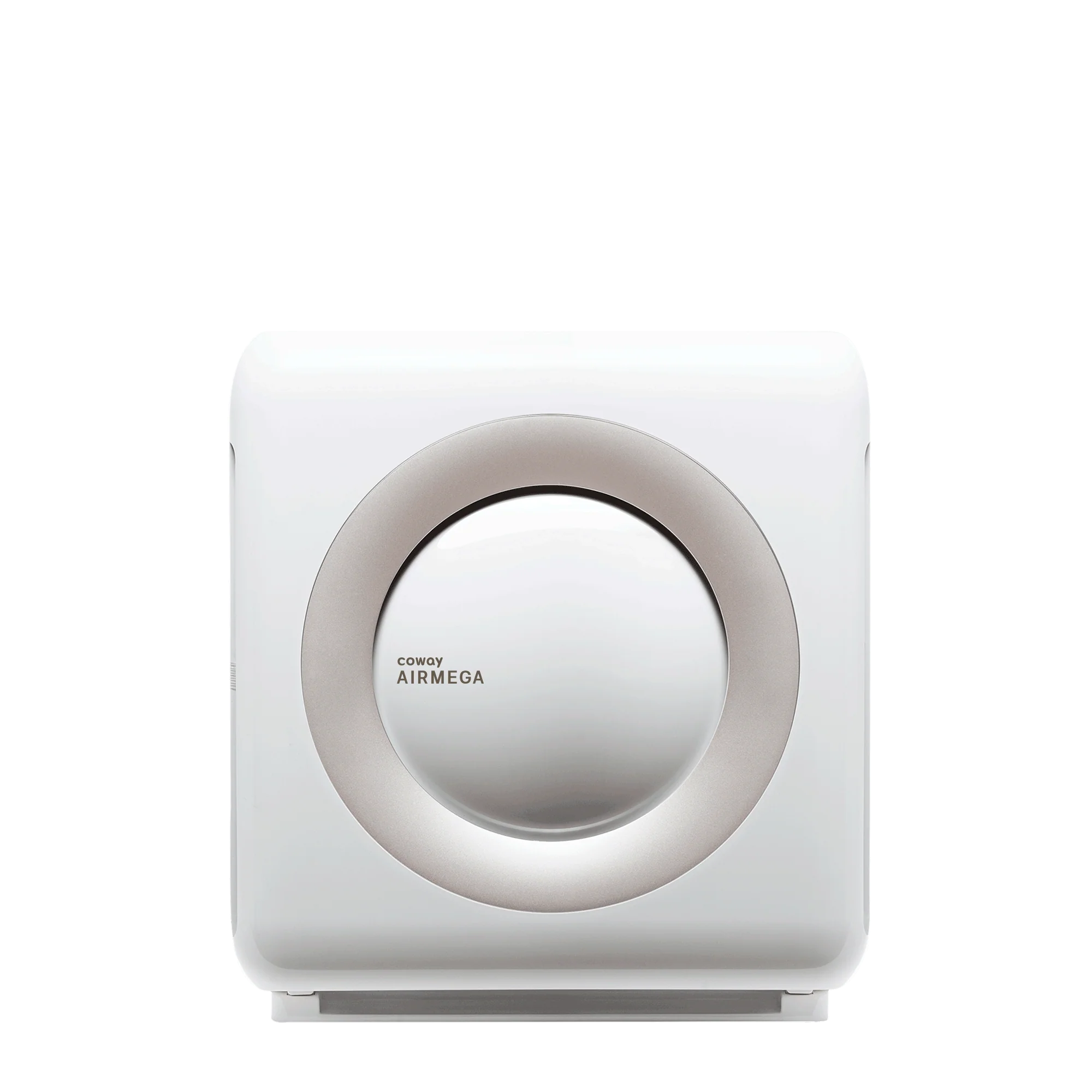
Key Specifications
- Room Coverage
- 361 sq ft
- CADR
- 233/246/240
- Filter
- True HEPA + Carbon + Pre-filter
- Noise
- 24 dB
- Power
- 77 watts
- Best For
- Medium rooms up to 361 sq ft. Wirecutter #1 for 10+ years. Best overall value.
📅 Prices checked . Amazon prices change frequently — click through for current price. Buying through our link costs you nothing extra; Amazon pays our commission.
What's in the Box
- Coway AP-1512HH air purifier
- Pre-installed 4-stage filter set
- Power cord
- User manual
- Filter replacement reminder sticker
Pros
- Wirecutter #1 for 10+ consecutive years
- AHAM verified CADR — no controversy
- True HEPA
- Fastest auto mode response in class
- 24dB ultra quiet sleep mode
- Eco mode at 4.9 watts
- 3-year warranty
Cons
- No WiFi or app control
- Carbon is impregnated fabric — weak on heavy odors
- Ionizer adds trace ozone (9ppb — CARB safe)
- Filter costs $60/year
- Design is dated
Best For
The Coway AP-1512HH is the correct choice for pet dander control in rooms under 360 sq ft where verified CADR and particle capture are the primary goals. AHAM-verified CADR 246 delivers 6+ ACH in a 250 sq ft bedroom — the clinical threshold for measurable pet allergen reduction. Auto mode responds automatically to pet activity events (when the cat jumps from furniture or the dog shakes, PM2.5 spikes). The washable pre-filter handles pet hair without a replacement cost — critical in multi-pet homes where pre-filters load in 2-3 weeks.
📅 Price checked August 2026 · Buying through this link costs you nothing extra — Amazon covers our commission
Winix 5500-2 Review Best Value
✓ AHAM VerifiedOur Verdict
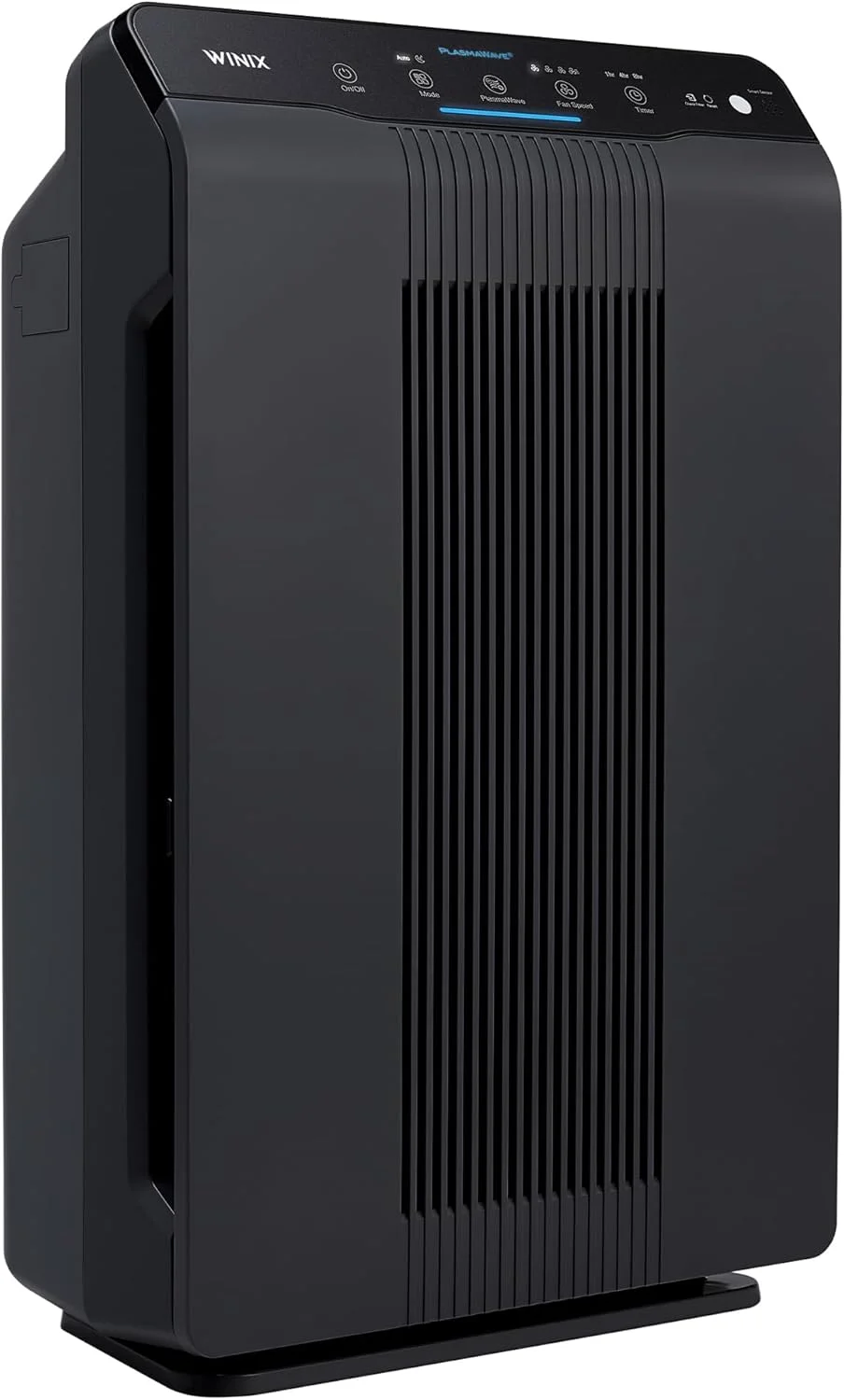
Key Specifications
- Room Coverage
- 360 sq ft
- CADR
- 232/243/246
- Filter
- True HEPA + PlasmaWave + Washable Carbon
- Noise
- 27 dB
- Power
- 67 watts
- Best For
- DISCONTINUED. Buy while stock lasts. Washable carbon is unique advantage.
📅 Prices checked . Amazon prices change frequently — click through for current price. Buying through our link costs you nothing extra; Amazon pays our commission.
What's in the Box
- Winix 5500-2 air purifier
- Pre-installed True HEPA + carbon filter
- Power cord
- Remote control
- User manual
Pros
- AHAM verified CADR
- PlasmaWave pellet carbon
- Washable carbon filter — unique
- HouseFresh tested 23 min room clean
Cons
- DISCONTINUED in US
- No WiFi
- Louder than 5510
- Larger footprint
Best For
The Winix 5500-2 is the correct choice for pet homes where odor control is as important as allergen capture. AHAM-verified CADR 269 for particle removal, and PlasmaWave provides sustained pet VOC decomposition that does not saturate like a carbon bed. In homes with multiple cats or a large dog with persistent body odor, PlasmaWave's decomposition mechanism outlasts standard carbon in sustained odor management. At $120-160 vs the Coway's $110-130, the premium is justified for odor-priority pet households.
📅 Price checked August 2026 · Buying through this link costs you nothing extra — Amazon covers our commission
What to Know Before You Buy
Pet Hair and Pre-Filter Maintenance — The Most Important Operational Task in Pet Homes
Cat and dog hair is the pre-filter's primary challenge in pet homes. In single-cat households, the pre-filter loads with a visible hair mat within 2-4 weeks. In multi-cat or large-dog households, weekly pre-filter cleaning may be required. A clogged pre-filter restricts airflow to the HEPA stage, effectively reducing CADR — a unit that measured CADR 246 on delivery can drop to CADR 150-180 with a moderately loaded pre-filter. Maintenance schedule for pet homes: check pre-filter every 1-2 weeks, rinse or wipe off hair mat, allow to dry before reinstalling. The Coway AP-1512HH's washable pre-filter is free to maintain — rinse under water and reuse indefinitely. Some purifiers use disposable pre-filters that add ongoing cost; in pet homes where pre-filter replacement is frequent, a washable pre-filter reduces operating cost significantly.
Pet Odor Science — Why Carbon Bed Weight Matters More Than Filter Marketing
Pet odor compounds — mercaptans, amines, fatty acids — are heavier VOCs that adsorb readily onto activated carbon. The question is duration: how long before the carbon bed reaches saturation? A 100-gram carbon layer in a room with two cats can saturate in 3-6 weeks, after which the odor control drops significantly. A 500-gram bed extends this to 3-6 months. Units with PlasmaWave (Winix) or IonSync technology decompose VOC molecules rather than adsorbing them — providing sustained odor control without saturation. For buyers with persistent pet odor (the room smells of pet even after cleaning), evaluate carbon bed weight or PlasmaWave presence rather than just HEPA specifications. For buyers with moderate pet odor from occasional pet occupancy, standard carbon beds are adequate.
Where to Place the Purifier in a Multi-Pet Home — Bedroom vs Living Room Priority
In a home with cats and dog allergies, the primary allergen exposure occurs where the pet sleeps and where the allergic person spends the most time. If the cat sleeps in the bedroom: the bedroom purifier is the highest-priority placement. If the cat is excluded from the bedroom: the living room where the cat spends waking hours is the primary placement. A single purifier in the wrong room provides minimal benefit. For multi-room pet allergen control: prioritize the bedroom (highest-exposure room for 6-8 hours during sleep), then living areas. CADR 246 in a 250 sq ft bedroom reduces Fel d 1 concentration by 50-70% in that specific room; Fel d 1 in the adjacent living room without a purifier is unchanged. Two units — one in the bedroom, one in the main living area — provide comprehensive pet allergen management for multi-room homes.
Pet Dander vs Pet Hair — HEPA Captures Dander, Not Hair
Pet hair and pet dander are frequently conflated in air purifier marketing but represent completely different particle classes for filtration purposes. Pet hair — the visible strand-length fibers shed by cats and dogs — is large: typically 40-200+ microns in length. It is captured by the outermost pre-filter stage (the coarse mesh layer) in most HEPA air purifiers. Hair that bypasses the pre-filter and reaches the HEPA stage is captured there as well, but hair loading primarily occurs at the pre-filter. This is why pre-filter maintenance is the most operationally critical task in pet households — a pre-filter clogged with hair restricts airflow to the HEPA stage and reduces CADR regardless of HEPA filter remaining capacity.
Pet dander — the allergenic fraction — is entirely different. Dander is not visible hair but rather dried skin cells, saliva proteins, and sebaceous secretion particles at 2-10 microns (cat Fel d 1, dog Can f 1 and Can f 2). These particles are the clinical cause of pet allergy symptoms. HEPA captures dander at 99.99%+ efficiency at its actual particle sizes. The practical implication: removing visible pet hair from furniture and floors addresses the pre-filter loading problem but does not reduce allergen exposure — you are removing the large, non-allergenic fraction. The allergen fraction requires HEPA filtration of the air. Clean the pre-filter frequently to maintain CADR; rely on the HEPA stage to capture the airborne allergenic fraction. These are two separate maintenance and filtration functions served by different parts of the same unit.
High-Pet-Traffic Households — Why Filter Replacement Interval Halves
Standard HEPA filter replacement intervals (6-8 months for most consumer purifiers) are calibrated to moderate residential use — typically one or two occupants, no pets, average urban air quality. In a high-pet-traffic household — two or more cats, a large shedding dog, or both — the filter replacement interval is effectively halved to 3-4 months. Two simultaneous loading mechanisms accelerate this: the pre-filter loads with hair and large dander debris in 2-3 weeks (requires frequent cleaning), and the HEPA stage accumulates the fine dander fraction continuously at a rate proportional to the number of pets and their shedding rate.
The carbon layer saturates faster in pet households too — pet VOCs (amines, fatty acids from skin secretions, mercaptans) are adsorbed continuously and the carbon bed reaches saturation in 6-10 weeks in a multi-cat home versus 4-6 months in a pet-free home. The three-in-one combination filter design means all stages — pre-filter, HEPA, and carbon — are replaced simultaneously. When the carbon saturates at 8 weeks, the HEPA stage still has capacity, but the filter must be replaced as a unit. For very-high-pet-traffic households, this economics pushes toward units with separately replaceable pre-filters (so you delay full filter replacement by cleaning the pre-filter independently) and larger carbon beds that saturate more slowly. The Coway AP-1512HH with washable pre-filter is specifically advantageous in pet households for this reason.
What Are the Particle Sizes of Cat and Dog Allergens — and How Does HEPA Capture the Airborne Fraction?
Cat allergen (Fel d 1) is carried on particles of two primary size ranges: the large-particle fraction (above 5 microns) settles relatively quickly and is found on surfaces and upholstery; the fine-particle fraction (1-5 microns) remains airborne for hours and is the primary route of inhalation exposure. True HEPA at H13 captures both fractions at 99.99%+ efficiency — the large-particle fraction at near-100% through impaction and interception, the fine fraction at 99.97%+ through impaction, interception, and diffusion combined. The reason Fel d 1 is so problematic for allergy sufferers: it remains airborne in the 1-5 micron fine fraction for hours after disturbance, and it deposits on clothing and surfaces and re-suspenses with movement. A HEPA purifier running at 5 ACH continuously removes the airborne fraction as it circulates, reducing steady-state airborne Fel d 1 concentration without preventing new emission from the cat.
Dog allergen (Can f 1) is slightly larger on average — more concentrated in the 5-10 micron fraction. This means dog allergen settles faster than Fel d 1 and is more effectively managed through vacuuming and surface cleaning relative to cat allergen. HEPA captures Can f 1 at 99.99%+ at its actual particle sizes. The airborne fraction of dog allergen in the room where the dog sleeps and spends time is significantly elevated compared to dog-free rooms; HEPA at 4-5 ACH reduces this airborne fraction by 50-70% in controlled conditions.
Do Air Purifiers Remove Pet Odor — and What Technology Is Most Effective for Pet Smell?
Pet odor is a gas-phase problem that requires gas-phase solutions — HEPA filtration has no effect on pet odor compounds. The odor molecules responsible for "pet smell" are primarily: trimethylamine and other amines from decomposing urine (the characteristic ammonia-adjacent smell), volatile fatty acids from skin secretions (the musty, organic pet body smell), mercaptans and sulfur compounds from anal glands and fecal material, and skatole (3-methylindole) from intestinal bacteria. All of these are small molecules in the gas phase — they pass through HEPA fiber media unchanged.
Activated carbon adsorbs these compounds at high initial efficiency through physical van der Waals forces in the micropore structure. The adsorption is reversible and finite: as pore sites fill with odor molecules, capacity decreases and breakthrough occurs. In practice, activated carbon in a consumer air purifier handles moderate pet odor adequately for weeks to months before saturation. PlasmaWave technology (Winix) generates hydroxyl radicals that chemically decompose these VOC molecules into CO2 and H2O — an irreversible process that provides sustained odor reduction without saturation. This is the functional advantage of PlasmaWave in pet environments: consistent odor reduction over time versus the saturation-then-replacement cycle of carbon-only approaches. For cat urine odor specifically — enzymatic cleaning of the affected surfaces is the primary intervention; air purification manages residual airborne odor after source neutralization, not the concentrated urine deposit itself.