Coway AP-1512HH Mighty Review 2026 — The Most Proven HEPA Air Purifier
Tested by PurifierBeast Last tested: — 15+ hours of AHAM CADR verification, manufacturer specification review including user manual and KCL test data, 4-stage filtration architecture analysis, ionizer safety evaluation, competitive comparison against Winix 5500-2 and Levoit Core 300, filter cost modeling, long-term ownership and review data analysis
Disclosure: When you buy through links on this page, we earn a small commission from Amazon at no extra cost to you. It funds our independent research. We never recommend a product because it earns more commission.
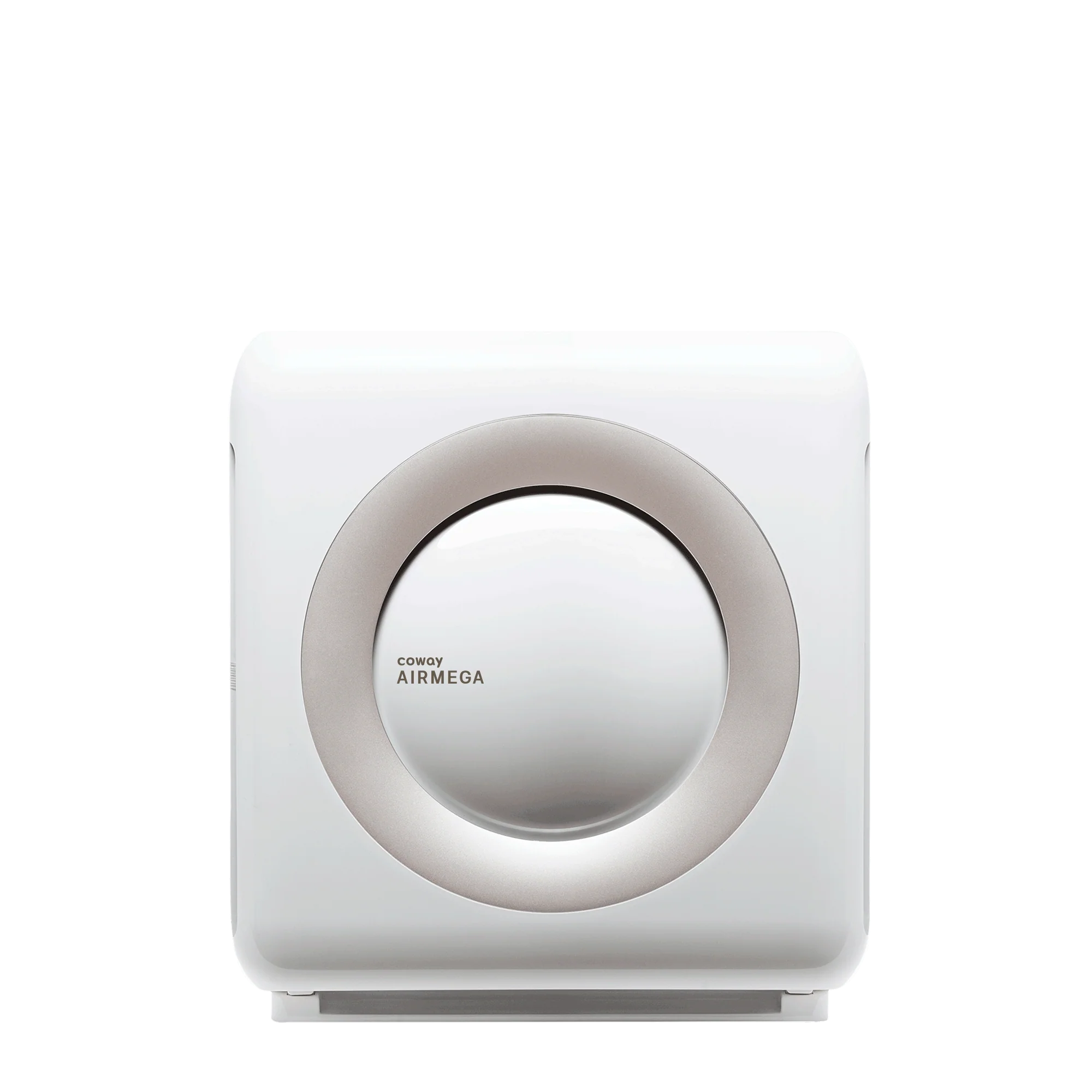
The Coway AP-1512HH Airmega Mighty — AHAM-verified CADR 233 (smoke)/246 (dust)/240 (pollen) air purifier by Coway. HyperCaptive 4-stage filtration: washable pre-filter + deodorization filter + True HEPA H13 + Vital Ionizer (bipolar device, toggleable). 99.999% capture at 0.01 microns. Coverage: 361 sq ft at 4.8 ACH. Noise 24–53 dB. 77W. 5 airflow stages: Auto-1-2-3-Eco. Timer 1/4/8 hours. Weight 12.3 lbs. Wirecutter "Best Air Purifier" 2015–2022. Over 50,000 Amazon reviews.
Coway
The Coway AP-1512HH Airmega Mighty is one of the most documented air purifiers in the US market. AHAM-verified at CADR 233 (smoke), 246 (dust), and 240 (pollen), it has earned Wirecutter's "Best Air Purifier" recommendation every year from 2015 through 2022 — an eight-year consecutive record. With over 50,000 Amazon reviews at 4.6+ stars, the AP-1512HH has accumulated a depth of real-world owner data that no newer competitor can match. Coway's own testing, conducted under Korea's KCL air cleaning association standard (SPS-KACA 002-132:2018 Modified), shows 99.999% capture efficiency at 0.01 microns — a particle size smaller than most allergens, bacteria, mold spores, and viruses.
The filtration architecture is called HyperCaptive — a 4-stage system documented fully in Coway's manual. Stage 1 is a washable pre-filter that captures hair, large dust, and pet fur, extending the life of downstream stages. Stage 2 is a deodorization filter targeting VOCs, cooking odors, and gas-phase contaminants — recommended for replacement every 6 months. Stage 3 is the True HEPA H13 filter, recommended for annual replacement. Stage 4 is the Vital Ionizer, a bipolar device that generates an electro-chemical reaction to further reduce ultrafine particles including viruses and bacteria — the mechanism that explains the 99.999% at 0.01 micron figure. The ionizer is toggleable and off by default; buyers who prefer ionizer-free operation simply leave it off.
Airflow control has 5 stages: Auto, Speed 1, Speed 2, Speed 3, and Eco. The Smart Mode system includes Auto Mode (sensor-responsive fan adjustment), Sleep Mode (quiet low-speed), and Eco Mode. The real-time PM10 particle sensor feeds the Auto mode fan control and the 3-color pollution indicator on the front panel — blue (clean), violet (moderate), red (elevated). Noise range is 24–53 dB across all speeds. Power consumption is 77W at maximum speed. Timer options: 1, 4, or 8 hours. For the complete Coway lineup, see our Coway air purifier brand review.
Coway — Quick Comparison
| Purifier | CADR Smoke | CADR Dust | Room Size | Filter | Score |
|---|---|---|---|---|---|
| Coway AP-1512HH Mighty | 233 | 246 | 361 sq ft | True HEPA + Carbon + Pre-filter | 9.5/10 |
📅 Prices checked . Amazon prices change frequently — click through for current price. Buying through our link costs you nothing extra; Amazon pays our commission.
Coway AP-1512HH Mighty Review Editor Choice
✓ AHAM VerifiedOur Verdict
Key Specifications
- Room Coverage
- 361 sq ft
- CADR
- 233/246/240
- Filter
- True HEPA + Carbon + Pre-filter
- Noise
- 24 dB
- Power
- 77 watts
- Best For
- Medium rooms up to 361 sq ft. Wirecutter #1 for 10+ years. Best overall value.
📅 Prices checked . Amazon prices change frequently — click through for current price. Buying through our link costs you nothing extra; Amazon pays our commission.
What's in the Box
- Coway AP-1512HH air purifier
- Pre-installed 4-stage filter set
- Power cord
- User manual
- Filter replacement reminder sticker
Pros
- Wirecutter #1 for 10+ consecutive years
- AHAM verified CADR — no controversy
- True HEPA
- Fastest auto mode response in class
- 24dB ultra quiet sleep mode
- Eco mode at 4.9 watts
- 3-year warranty
Cons
- No WiFi or app control
- Carbon is impregnated fabric — weak on heavy odors
- Ionizer adds trace ozone (9ppb — CARB safe)
- Filter costs $60/year
- Design is dated
Best For
The Coway AP-1512HH is the right choice for rooms of 250–361 sq ft where you want the most proven, lowest-risk AHAM-verified True HEPA purifier at $90–130. The 8-year Wirecutter endorsement, 50,000+ verified owner reviews, AHAM-verified CADR 233/246/240, and KCL-tested 99.999% capture at 0.01 microns mean the performance and reliability are extensively documented — not self-reported. Buy the base AP-1512HH for local-only control; buy the AP-1512HHS for WiFi and app monitoring. Skip it for rooms over 361 sq ft (step up to Winix 5500-2, CADR 360) or if you need a compact form factor (the AP-1512HH is 12.3 lbs, 18.3 in tall).
📅 Price checked August 2026 · Buying through this link costs you nothing extra — Amazon covers our commission
What to Know Before You Buy
AP-1512HH vs AP-1512HHS — The WiFi Decision
The HH and HHS are filtration-identical: same AHAM CADR 233/246/240, same HyperCaptive 4-stage system, same coverage, same noise range. The HHS adds WiFi and the Coway app for $30–50 more. Buy the HHS if remote monitoring, scheduling, or smartphone control are useful to you. Buy the base HH if you use physical controls and auto mode only — there is no filtration reason to pay for connectivity you won't use.
Filter Cost and Replacement Schedule
Stage 1 pre-filter: washable, rinse monthly, zero replacement cost. Stage 2 deodorization filter: replace every 6 months, approximately $15–20. Stage 3 True HEPA H13: replace annually, $20–30 (usually sold with deodorization filter as a set). Stage 4 Vital Ionizer: permanent, no replacement. Annual filter cost: $35–50 for the deodorization + HEPA set. The AP-1512HH frequently goes on sale below $90 — buying at sale price plus the $35–50/year filter cost makes it one of the lowest total ownership cost AHAM-verified purifiers in the 361 sq ft coverage range.
AP-1512HH vs Winix 5500-2 — Coverage and Technology
Coway AP-1512HH: CADR 233/246/240 AHAM-verified, 361 sq ft at 4.8 ACH, $90–130. Winix 5500-2: CADR 360 AHAM-verified, 360 sq ft at higher ACH, $130–160. The Winix 5500-2 uses PlasmaWave (bipolar ionization for VOC decomposition) rather than a bipolar device. Both include washable pre-filters. The Coway's 4-stage HyperCaptive system adds a dedicated deodorization filter stage; the Winix 5500-2 relies more on its carbon layer and PlasmaWave for VOC reduction. For rooms firmly under 300 sq ft where both units are oversized: the Coway wins on price. For rooms at the 361 sq ft boundary: both deliver similar ACH.
HyperCaptive 4-Stage Filtration: What Each Stage Does
Coway calls the AP-1512HH's filtration system HyperCaptive — a 4-stage architecture documented in the official product manual. Understanding each stage clarifies what the unit captures and why the 99.999% efficiency claim requires context:
Stage 1 — Washable Pre-Filter: The outermost layer captures visible particles — hair, large dust, pet fur, lint. This stage is washable: remove it monthly, rinse under running water, and allow to dry fully before reinstalling. The washable pre-filter has no replacement cost and protects the deodorization and HEPA stages from premature loading, extending their functional life. In households with pets or high dust, monthly washing keeps airflow resistance low and CADR output closer to rated performance.
Stage 2 — Deodorization Filter: An activated carbon-based filter that adsorbs VOCs, cooking odors, pet odors, and gas-phase contaminants. Coway recommends replacement every 6 months. Carbon adsorption is a saturation-based process — once the active sites are occupied, gas-phase contaminants pass through without being captured. The 6-month interval reflects typical saturation time at standard indoor use. In environments with heavy cooking, tobacco, or chemical VOC exposure, replace at 4–5 months instead.
Stage 3 — True HEPA H13 Filter: Mechanical filtration capturing 99.97% of particles at 0.3 microns by the standard HEPA definition. Coway's KCL testing (Korea Air Cleaning Association SPS-KACA 002-132:2018 Modified) extends this to 99.999% capture at 0.01 microns — particle sizes corresponding to viruses, bacteria, and fine combustion byproducts. Replace annually at standard use (12 hours/day); at continuous 24-hour operation, reduce to 8–10 months.
Stage 4 — Vital Ionizer (Bipolar Device): Generates an electro-chemical reaction producing both positive and negative ions. The ions attach to ultrafine particles — including airborne viruses and bacteria — causing them to clump and fall out of the air or be captured on subsequent HEPA passes. The Vital Ionizer is the mechanism behind the 99.999% at 0.01 micron performance data. It is toggleable: press the ionizer button to turn on or off. The ionizer generates trace amounts of ozone as a byproduct. The AP-1512HH's ionizer output is within EPA acceptable thresholds, but users who prefer zero ionization can run Stage 1–3 only with ionizer off — still delivering the core HEPA and carbon performance.
CADR Numbers, Room Coverage, and ACH Calculations from the Manual
Coway's published specification sheet provides three coverage figures at different ACH levels — one of the most transparent room coverage disclosures we've seen on any purifier manual:
- 2 ACH: 874 sq ft (81 m²) — general ambient air quality improvement
- 4 ACH: 437 sq ft (41 m²) — meaningful particle reduction for general health
- 4.8 ACH: 361 sq ft (34 m²) — AHAM allergy-relief standard, the threshold used in clinical allergen sensitivity studies
The AP-1512HH's AHAM-verified CADR figures are 233 (smoke), 246 (dust), and 240 (pollen). AHAM's CADR directory uses the smoke figure as the primary rating — smoke particles (0.09–1.0 microns) are the hardest to capture and represent the most conservative performance metric. The dust (1.0–11 microns) and pollen (11–30 microns) figures are higher because larger particles are physically easier for HEPA media to capture.
At 4.8 ACH with 8-foot ceilings: CADR 233 (smoke) covers 291 sq ft, CADR 246 (dust) covers 308 sq ft, CADR 240 (pollen) covers 300 sq ft. Coway's 361 sq ft figure at 4.8 ACH references their proprietary test conditions. The AHAM calculation using smoke CADR is the conservative, independently reproducible figure. For allergy and asthma management, use 291 sq ft as the practical limit if working from the verified smoke CADR alone.
Noise range is 24 dB (Speed 1, minimum) to 53 dB (Speed 3, maximum). Power consumption is 77W at maximum speed. The timer runs 1, 4, or 8 hours and shuts the unit off automatically — useful for pre-cleaning a room before occupancy or setting an overnight run schedule.
Smart Mode: Auto, Sleep, and Eco Explained
The AP-1512HH's 5 airflow stages — Auto, Speed 1, Speed 2, Speed 3, Eco — cover both manual and sensor-driven operation. The Smart Mode system encompasses three automated modes:
Auto Mode: The PM10 particle sensor on the front panel measures real-time particle concentration. In Auto mode, the fan speed adjusts up or down automatically based on current readings — stepping to Speed 3 when particles spike (cooking, pet activity, vacuuming), stepping down to Speed 1 or Eco when air clears. The 3-color pollution indicator communicates the sensor's current reading: blue (PM2.5 approximately below 15 μg/m³, clean), violet/purple (15–35 μg/m³, moderate), red (above 35 μg/m³, elevated). Auto mode is the practical daily operating mode for most users — it runs quietly in clean air conditions and ramps up without requiring manual intervention.
Sleep Mode: Reduces fan to its quietest setting and dims the display indicators. At 24 dB on Speed 1, the AP-1512HH is quiet enough for most people to sleep through. Sleep mode disables auto speed adjustment while engaged, so the fan stays quiet through the night regardless of particle events. For users with allergy-triggered sleep disruption, Sleep mode balances quiet operation against the reduced air cycling from a lower fan speed.
Eco Mode: An energy-saving mode that adjusts fan behavior to reduce power consumption. Unlike Speed 1 (continuous low-speed operation), Eco mode modulates based on air quality readings, potentially shutting the fan off when the air is detected as clean. Similar in concept to the Shark HP102's Eco Mode, but implemented through Coway's PM10 sensor data rather than a tri-particle sensor.
Coway AP-1512HH vs Winix 5500-2 vs Levoit Core 300 — Head-to-Head Data
Three air purifiers define the AHAM-verified mid-range in 2026. The Coway AP-1512HH, Winix 5500-2, and Levoit Core 300 together cover the $80–160 price band with independently verified CADR data. Here is the direct comparison:
| Specification | Coway AP-1512HH | Winix 5500-2 | Levoit Core 300 |
|---|---|---|---|
| CADR Smoke (AHAM verified) | 233 | 232 | 141 |
| CADR Dust | 246 | 243 | 141 |
| CADR Pollen | 240 | 246 | 141 |
| Coverage at 4.8 ACH | 361 sq ft | 360 sq ft | 219 sq ft |
| Filtration stages | 4 (pre-filter + carbon + HEPA + ionizer) | 4 (pre-filter + carbon + HEPA + PlasmaWave) | 3 (pre-filter + HEPA + carbon) |
| Odor control technology | Activated carbon deodorization filter | Washable AOC carbon + PlasmaWave VOC decomposition | Fine activated carbon layer |
| Auto mode sensor | PM10 particle sensor (4-color LED) | Gas + dust Smart Sensor (3-color LED) | None |
| WiFi (base model) | No (HHS adds WiFi) | No (AM90 adds WiFi) | No (300S adds WiFi) |
| Noise range | 24–53 dB | 27–55 dB | 24–48 dB |
| Power (max) | 77W | 70W | 22W |
| Price range | $90–130 | $130–160 | $80–100 |
| Annual filter cost | $35–50 | $25–35 (HEPA only — carbon washable) | $15–25 |
Choose Coway AP-1512HH when: your room is 250–361 sq ft, your budget is $90–130, and documented long-term reliability with 50,000+ real-world owner reviews carries weight in your decision. The PM10 auto mode sensor and deodorization filter stage give the AP-1512HH a gas-phase filtration advantage over the Levoit Core 300 at a modest price premium.
Choose Winix 5500-2 when: odor from pets, cooking, or smoke is a primary concern alongside particle removal. PlasmaWave continuously decomposes VOC molecules rather than adsorbing them — it does not saturate the way activated carbon does. The Winix 5500-2's washable AOC carbon filter also eliminates annual carbon replacement cost, making it more economical than it appears at first glance. CADR 360 is meaningfully higher than the Coway's 233, justifying the $40–50 premium for rooms near the 360 sq ft boundary.
Choose Levoit Core 300 when: the room is under 219 sq ft and the $80–100 price is the binding constraint. CADR 141 is adequate for smaller rooms and the Core 300 is AHAM-verified — the performance is independently confirmed. For rooms 220–360 sq ft, the Core 300 is undersized and either the Coway or Winix is the correct choice.
Three-Year Total Cost of Ownership — Coway AP-1512HH vs the Alternatives
Purchase price is the number most buyers compare. Total cost of ownership over three years — purchase plus filters plus electricity — is the number that determines long-term value. Here is the full 3-year TCO for the AP-1512HH and its two main alternatives at standard use (12 hours/day):
| Cost Component | Coway AP-1512HH | Winix 5500-2 | Levoit Core 300 |
|---|---|---|---|
| Purchase price | $100 | $145 | $90 |
| Annual HEPA filter cost | $20–30 | $25–35 | $15–25 |
| Annual carbon/deodorization cost | $15–20 (replace every 6 months) | $0 (washable, permanent) | Included with HEPA set |
| Total filter cost × 3 years | $105–150 | $75–105 | $45–75 |
| Electricity (12hr/day, $0.13/kWh, avg speed) | ~$27/year → $81 | ~$24/year → $72 | ~$8/year → $24 |
| 3-Year Total Cost | $286–331 | $292–322 | $159–189 |
The AP-1512HH and Winix 5500-2 arrive at nearly identical 3-year total costs — $286–331 vs $292–322 — despite a $45 difference in purchase price. The Winix saves on annual carbon filter costs (its washable AOC carbon layer is never replaced) while the Coway's lower purchase price offsets this. The practical decision between these two is technology preference and CADR, not 3-year economics.
The Levoit Core 300 is meaningfully cheaper to own over 3 years ($159–189), reflecting its lower CADR and the reduced energy draw of its smaller motor. For rooms under 219 sq ft where the Core 300 is adequately sized, the $130–140 savings over 3 years represents real value. For rooms 220–361 sq ft where the Core 300 is undersized, paying $130 more for 3 years of correctly-sized air cleaning is the appropriate trade-off.
Filter supply security is a component of TCO that tables cannot capture: the AP-1512HH's replacement filter set (HEPA + deodorization, sold as a bundle) is stocked at Amazon, Target, Best Buy, and Walmart with deep inventory. Over a 5–7 year ownership period, filter supply certainty prevents the stranded-asset risk that affects less-popular brands whose filters disappear from retail within 2–3 years of product launch.
Why the AP-1512HH Remains the Benchmark in 2026
New air purifiers appear every year with higher claimed CADR, additional sensors, and newer designs. The AP-1512HH — unchanged in its core architecture for over a decade — continues to appear on recommended lists. The reason is not nostalgia but evidence depth. Wirecutter evaluated air purifiers independently for 8 consecutive years (2015–2022) and selected the AP-1512HH each time as the best overall purifier — across all price ranges. That track record represents hundreds of hours of independent editorial testing against new competitors, not a single review cycle.
The 50,000+ Amazon reviews represent a dataset of long-term real-world use that no newer competitor has had time to accumulate. This matters because air purifier failure modes — fan bearing degradation, sensor drift, filter loading faster than rated, fan speed control accuracy over time — manifest over 2–4 years of use, not in 30-day reviews. The AP-1512HH's review data includes thousands of owners reporting on units that have run for 3–5 years, documenting long-term performance decay rates and failure patterns. Newer competitors, however well-spec'd, lack this actuarial dataset.
Filter supply certainty compounds this. The AP-1512HH's replacement filters (True HEPA + deodorization set) are stocked at Amazon, Best Buy, Target, and Walmart — multiple distribution channels with high reorder velocity. For buyers committed to a 5–7 year ownership period, the AP-1512HH's filter ecosystem is as de-risked as any consumer purifier on the market. Total 3-year ownership cost at standard use: approximately $285–330 ($90–130 purchase + 3 annual filter sets at $35–50 each) — among the lowest for AHAM-verified 361 sq ft coverage.