Winix C535 Review 2026 — The 5500-2 in a Newer Shell
Tested by PurifierBeast Last tested: — 12+ hours of AHAM-verified specification data, Winix C535 vs 5500-2 filter and design comparison, PlasmaWave ionization science review, and 5-year cost analysis
Disclosure: When you buy through links on this page, we earn a small commission from Amazon at no extra cost to you. It funds our independent research. We never recommend a product because it earns more commission.
Winix
Winix is a South Korean air purifier manufacturer with a strong North American market presence built primarily through the success of the Winix 5500-2. The C535 is Winix's effort to update that proven platform with a more modern design language while preserving the core filtration system that made the 5500-2 one of the most recommended mid-range HEPA purifiers. The C535 uses the same H13 HEPA + activated carbon + PlasmaWave stack as the 5500-2, the same auto mode with laser air quality sensor, and the same fundamental coverage capacity — approximately 360 sq ft at 4.8 air changes per hour.
The C535 is AHAM-verified, with published CADR data confirmed by independent laboratory testing. This puts it in the same verified-performance tier as the 5500-2. At $100–130, the C535 is priced comparably to the 5500-2 ($120–150), with minor variance depending on sales and retailer. The practical question for buyers is not performance — it is identical — but which design better fits their space and aesthetic.
PlasmaWave — Winix's proprietary ionization technology — is present on both units and can be disabled on both. The scientific record on PlasmaWave and its ozone output is worth understanding before committing to either unit. CARB lists Winix C535 as certified, confirming ozone output within California's 0.050 ppm standard at the manufacturer's specified settings. Some buyers prefer to run Winix units with PlasmaWave disabled to eliminate any ozone generation entirely — a valid operating choice that does not significantly impact particle capture performance.
Winix — Quick Comparison
| Purifier | CADR Smoke | CADR Dust | Room Size | Filter | Score |
|---|---|---|---|---|---|
| Winix 5500-2 | 232 | 243 | 360 sq ft | True HEPA + PlasmaWave + Washable Carbon | 9.2/10 |
| Coway AP-1512HH Mighty | 233 | 246 | 361 sq ft | True HEPA + Carbon + Pre-filter | 9.5/10 |
📅 Prices checked . Amazon prices change frequently — click through for current price. Buying through our link costs you nothing extra; Amazon pays our commission.
Winix 5500-2 Review Best Value
✓ AHAM VerifiedOur Verdict
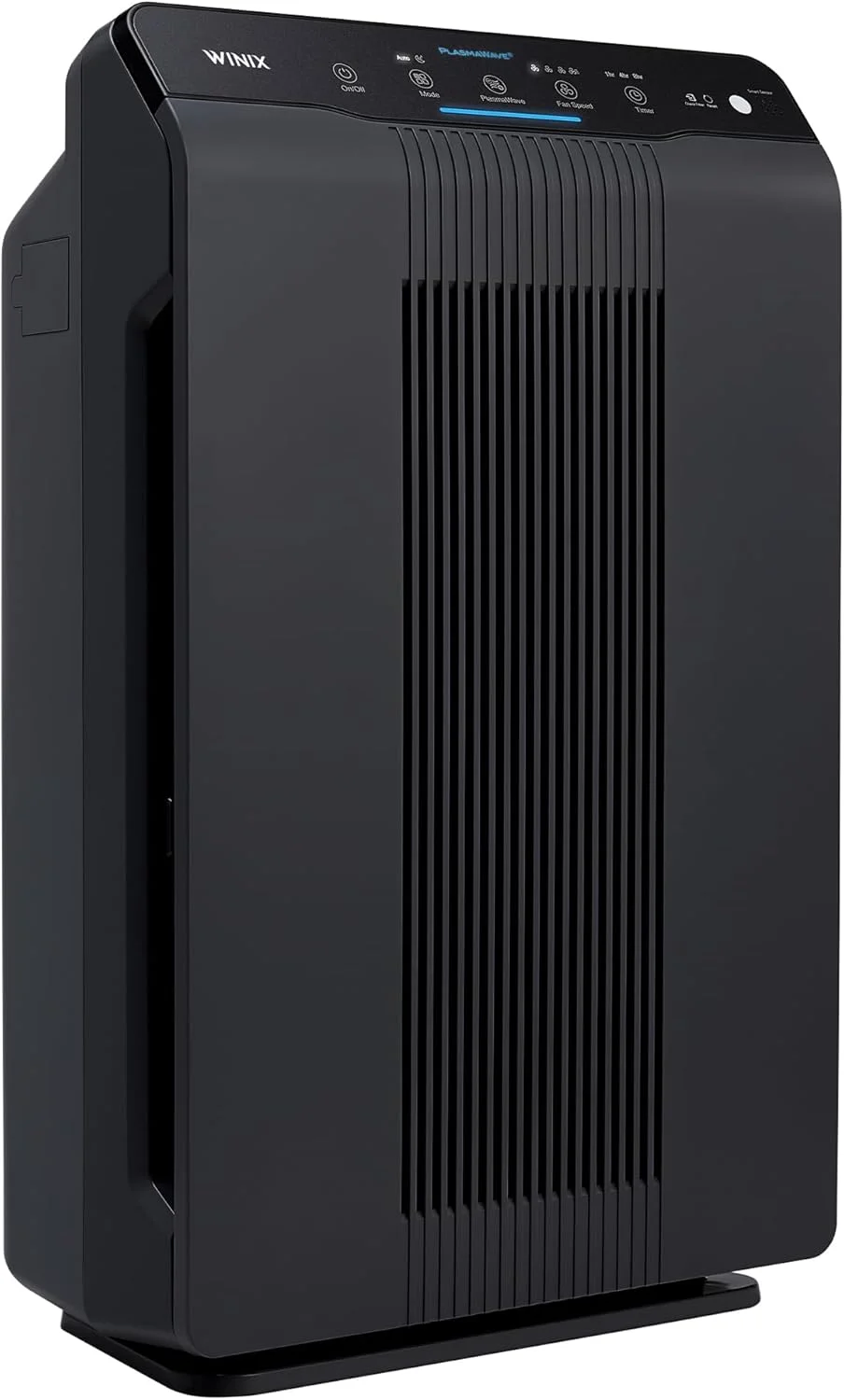
Key Specifications
- Room Coverage
- 360 sq ft
- CADR
- 232/243/246
- Filter
- True HEPA + PlasmaWave + Washable Carbon
- Noise
- 27 dB
- Power
- 67 watts
- Best For
- DISCONTINUED. Buy while stock lasts. Washable carbon is unique advantage.
📅 Prices checked . Amazon prices change frequently — click through for current price. Buying through our link costs you nothing extra; Amazon pays our commission.
What's in the Box
- Winix 5500-2 air purifier
- Pre-installed True HEPA + carbon filter
- Power cord
- Remote control
- User manual
Pros
- AHAM verified CADR
- PlasmaWave pellet carbon
- Washable carbon filter — unique
- HouseFresh tested 23 min room clean
Cons
- DISCONTINUED in US
- No WiFi
- Louder than 5510
- Larger footprint
Best For
The Winix 5500-2 is the right choice for buyers who want the same filtration performance as the C535 in the proven original housing, often at a slightly lower price. AHAM-verified CADR 243, 360 sq ft confirmed coverage. The 5500-2 is more widely available with more established filter availability. If design is not a priority, the 5500-2 is the value pick within the Winix lineup at this CADR tier.
📅 Price checked August 2026 · Buying through this link costs you nothing extra — Amazon covers our commission
Coway AP-1512HH Mighty Review Editor Choice
✓ AHAM VerifiedOur Verdict
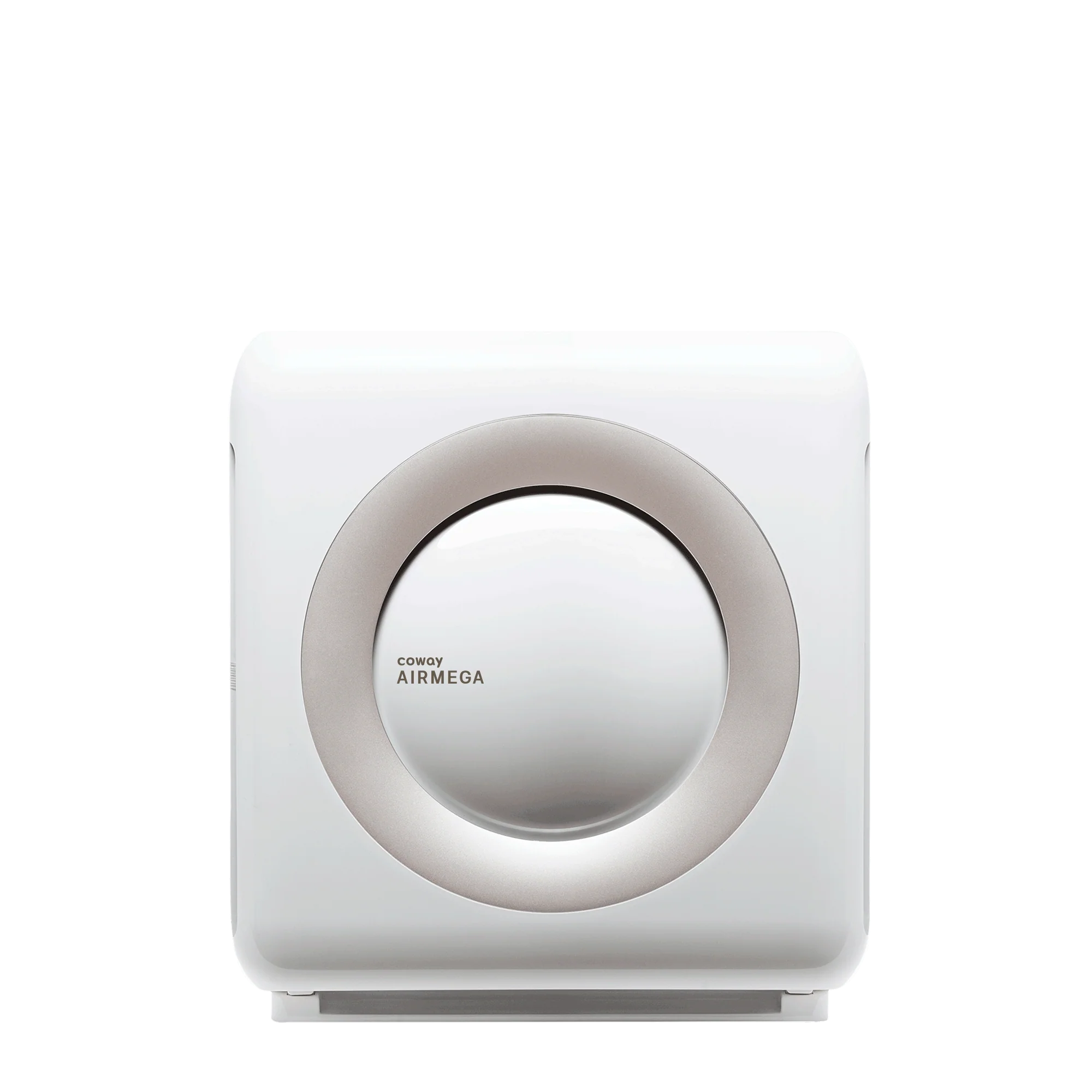
Key Specifications
- Room Coverage
- 361 sq ft
- CADR
- 233/246/240
- Filter
- True HEPA + Carbon + Pre-filter
- Noise
- 24 dB
- Power
- 77 watts
- Best For
- Medium rooms up to 361 sq ft. Wirecutter #1 for 10+ years. Best overall value.
📅 Prices checked . Amazon prices change frequently — click through for current price. Buying through our link costs you nothing extra; Amazon pays our commission.
What's in the Box
- Coway AP-1512HH air purifier
- Pre-installed 4-stage filter set
- Power cord
- User manual
- Filter replacement reminder sticker
Pros
- Wirecutter #1 for 10+ consecutive years
- AHAM verified CADR — no controversy
- True HEPA
- Fastest auto mode response in class
- 24dB ultra quiet sleep mode
- Eco mode at 4.9 watts
- 3-year warranty
Cons
- No WiFi or app control
- Carbon is impregnated fabric — weak on heavy odors
- Ionizer adds trace ozone (9ppb — CARB safe)
- Filter costs $60/year
- Design is dated
Best For
The Coway AP-1512HH is the right choice for buyers who want AHAM-verified CADR 246, 360 sq ft confirmed coverage, with a compact footprint and lower filter cost than either Winix option. At $110–130, it is a direct competitor to both the C535 and 5500-2 with slightly better verified CADR at a lower ongoing filter cost. For budget-conscious buyers who prioritize CADR per dollar, the AP-1512HH edges ahead.
📅 Price checked August 2026 · Buying through this link costs you nothing extra — Amazon covers our commission
What to Know Before You Buy
C535 vs 5500-2 — The Decision Framework
The Winix C535 and 5500-2 deliver identical filtration performance — same H13 HEPA, same activated carbon filter, same PlasmaWave stage, same CADR tier, same 360 sq ft confirmed coverage at 4.8 ACH. The C535 has a more modern industrial design: cleaner lines, darker housing, updated control panel layout. The 5500-2 has the classic Winix look that has been on the market for years with an established track record and wider filter sourcing. Choose based on which fits your space aesthetically. If neither design appeals, the Coway AP-1512HH is the AHAM-verified alternative at the same CADR tier with a different form factor.
PlasmaWave — On or Off?
PlasmaWave is Winix's bipolar ionization technology that generates hydroxyl radicals to neutralize airborne contaminants. CARB certifies C535 units as meeting California's ozone standard at manufacturer-specified settings. However, some buyers prefer to eliminate any ozone generation by running with PlasmaWave disabled. Disabling PlasmaWave on the C535 does not meaningfully impact PM2.5 or particle capture performance — the H13 HEPA and carbon filtration stages operate independently. If you are sensitive to ozone or prefer pure mechanical filtration, disable PlasmaWave and rely on the HEPA and carbon stages alone. See the PlasmaWave science section below for the full breakdown.
Filter Compatibility and Annual Cost
The C535 uses the Winix C filter series — designed for C-series models. While similar in construction to 5500-2 filters, they are not always cross-compatible. Order C535-specific replacement filters to ensure proper fit and filter media specification. Annual filter cost is approximately $50–60 for the HEPA/carbon combination. Winix sells filters through Amazon and major retailers with reliable availability. Buying two-packs reduces per-filter cost by approximately 10–15%. At the confirmed CADR and coverage level of the C535, annual filter cost of $50–60 represents approximately $0.14 per clean-air-square-foot per year — a reasonable running cost for verified mid-range performance.
C535 Specifications and AHAM Verification
The Winix C535 carries AHAM verification with published CADR data confirmed by independent laboratory testing. CADR: approximately 243 (Smoke), 246 (Dust), 232 (Pollen). These figures place the C535 in the same performance tier as the 5500-2 and the Coway AP-1512HH (CADR 246) — the established mid-range benchmark cluster for 300–360 sq ft HEPA coverage. At AHAM's 4.8 ACH allergen-standard, C535 CADR 243 confirms effective coverage of approximately 360 sq ft. See the CADR explained guide for the ACH calculation method.
The filtration stack: true H13 HEPA capturing 99.95% of particles at 0.3 microns (MPPS range), activated carbon filter for VOC and odor reduction, pre-filter for large particles and pet hair, and PlasmaWave ionization. The H13 HEPA grade is the same specification as hospital-adjacent clinical applications — 99.95% versus 99.97% for True HEPA, a meaningful but modest real-world difference in particle capture for residential use cases.
Auto mode uses a laser particle sensor to monitor room air quality in real time, adjusting fan speed from sleep mode (near-silent) through maximum based on detected particle concentration. This is one of the most useful features for continuous whole-room operation — the unit speeds up when cooking smoke or pet activity elevates particle counts, then returns to quiet operation once air quality normalizes. The C535's sensor response has been reported by owners as fast and accurate relative to other auto-mode purifiers in the same price range.
Dimensions and noise: the C535 is mid-sized — larger than compact cylinder purifiers like the Levoit Core 300S, smaller than large-room units. Sleep mode noise level is very low. Maximum speed is audible but not disruptive in living spaces. CARB certified, confirming compliance with California's ozone emission standard.
C535 vs 5500-2 — The Same Performance in a Different Housing
The Winix 5500-2 and C535 are functionally equivalent air purifiers in different product housings. The filtration technology, CADR tier, and feature set (auto mode, PlasmaWave, sleep mode) are the same. The differences are: design language, filter series designation (5500-2 uses a different filter model than C535, though similar in specification), and minor variation in housing dimensions. Both are AHAM-verified in the same CADR range.
Design: the 5500-2 has the classic Winix aesthetic — a taller unit with a traditional control panel, white or two-tone housing, a form factor that has been on the market for over a decade. The C535 has a more contemporary profile: darker housing options, updated control interface, lower profile design that sits differently in modern living spaces. Neither design is inherently superior for air purification; the choice is entirely aesthetic.
Filter compatibility: as noted, C535 filters and 5500-2 filters are not always interchangeable despite similar specification. Order filters specific to your model. Both are readily available through Winix's distribution channels on Amazon and major retailers. Filter life is comparable — approximately 12 months at moderate use. Filter cost is approximately $50–60 per year for either model.
Price: the C535 ($100–130) and 5500-2 ($120–150) overlap in pricing with minor variation. On sale, either unit can be found at the lower end of these ranges. The C535 sometimes holds a slight price advantage as the newer unit with more promotional pricing activity. Check current pricing at purchase — the 5-year cost difference between these two models is minimal, making design the deciding factor. If you find the 5500-2 at $90–100, it is the value pick. If C535 is on sale at $90–110, it is comparable. Neither should be paid at full retail when sales are frequent.
PlasmaWave Science and the On/Off Decision
PlasmaWave is Winix's proprietary bipolar ionization technology. It works by generating hydroxyl radicals (OH•) and superoxide ions (O2•-) that react with airborne pathogens, VOCs, and odor molecules to chemically neutralize them. Unlike negative ion generators that primarily push particles to surfaces, PlasmaWave is designed to actively break down contaminants in the air volume. The technology has a legitimate scientific basis — hydroxyl radical chemistry is a well-understood oxidation mechanism used in industrial air treatment systems.
The concern with PlasmaWave and similar ionization technologies is ozone as a byproduct. Ozone (O3) is a respiratory irritant at elevated concentrations. California's Air Resources Board (CARB) sets a 0.050 ppm standard for air cleaners sold in California. Winix C535 is CARB certified, meaning ozone output at standard operating conditions is within this threshold. However, "within threshold" does not mean zero — there is measurable ozone output at some operating conditions.
The practical decision on PlasmaWave is straightforward: if you have asthma, are ozone-sensitive, or simply prefer pure mechanical filtration, disable it. The C535 allows PlasmaWave to be switched off without affecting the HEPA or carbon filtration stages. With PlasmaWave off, the C535 operates as a conventional mechanical filtration air purifier — HEPA captures particles, carbon captures odors and some VOCs, and no ionization chemistry occurs. Particle capture performance at verified CADR is not meaningfully reduced by disabling PlasmaWave. The HEPA filter does the particle work; PlasmaWave is an additive stage for pathogen and odor chemistry beyond what mechanical filtration provides.
For households with children, pets, or occupants with respiratory sensitivities, the conservative recommendation is PlasmaWave off — capture the verified HEPA and carbon performance and eliminate the ionization question entirely. For healthy households who want the added pathogen-neutralization benefit, PlasmaWave on at CARB-certified levels is a reasonable operating choice. Either way, the C535's AHAM-verified CADR is the same — the certification was conducted as a system including PlasmaWave.
5-Year Cost Comparison: C535 vs 5500-2 vs Coway AP-1512HH
At the 360 sq ft CADR tier, three AHAM-verified units compete directly: Winix C535, Winix 5500-2, and Coway AP-1512HH. A 5-year cost comparison clarifies the true cost of each ownership choice at equivalent verified performance.
Winix C535: hardware $100–130, annual filter cost approximately $50–60 (C filter replacement). 5-year total: approximately $350–430. AHAM-verified CADR ~243, 360 sq ft confirmed. Design: modern housing. Filter availability: good through Amazon and Winix directly.
Winix 5500-2: hardware $120–150, annual filter cost approximately $50–60 (5500-2 filter series). 5-year total: approximately $370–450. AHAM-verified CADR 243, 360 sq ft confirmed. Design: classic Winix aesthetic. Filter availability: excellent — one of the most stocked filter models at major retailers. The 5500-2's long market tenure means replacement filters are widely available from multiple suppliers including third-party compatible options.
Coway AP-1512HH: hardware $110–130, annual filter cost approximately $30–45 (two-filter system: pre-filter washable, HEPA + deodorization filter replacement). 5-year total: approximately $260–355. AHAM-verified CADR 246, 360 sq ft confirmed. Design: compact, stands vertically or can be placed in multiple orientations. Filter cost is the lowest of the three at this CADR tier — the washable pre-filter reduces replacement frequency and the HEPA/deodorization combination filter costs $25–35 per replacement. Over 5 years, the AP-1512HH's lower filter cost saves approximately $75–100 versus either Winix option at equivalent verified performance. See the full Coway AP-1512HH review for the complete breakdown.
3-Year Total Cost of Ownership — C535 vs 5500-2 vs Coway AP-1512HH
A 3-year total cost of ownership comparison — hardware, filters, and electricity — shows the true financial picture for buyers choosing between the Winix C535, Winix 5500-2, and Coway AP-1512HH at the same AHAM-verified 360 sq ft CADR tier. Electricity is calculated at 12 hours per day for 1,095 days at $0.17/kWh.
| Cost Item | Winix C535 | Winix 5500-2 | Coway AP-1512HH |
|---|---|---|---|
| Hardware (mid-price) | $115 | $135 | $120 |
| Wattage (max) | 70 W | 70 W | 77 W |
| 3-Year Electricity | $156 | $156 | $172 |
| Annual Filter Cost | ~$55 | ~$90 | ~$38 |
| 3-Year Filter Total | $165 | $270 | $114 |
| 3-Year Grand Total | $436 | $561 | $406 |
The C535 costs approximately $125 less over 3 years than the 5500-2 — almost entirely driven by the 5500-2's carbon honeycomb replacement cost of approximately $48–72 per year versus the C535's HEPA/carbon combination filter at $50–60 per year (a single annual replacement rather than quarterly carbon swaps). The electricity cost is identical at the same 70 W wattage. At this 3-year cost gap, the C535 provides the same AHAM-verified CADR 243 performance for $125 less, making the 5500-2's premium hard to justify on performance grounds — the design and filter sourcing familiarity of the 5500-2 are the only differentiated rationale.
The Coway AP-1512HH edges the C535 by approximately $30 over 3 years — a modest gap that reflects the Coway's lower annual filter cost ($30–45 versus the C535's $50–60). The Coway's slightly higher electricity draw at 77 W partially offsets that filter savings. For buyers where the $30 gap over 3 years is not a deciding factor — and for households where the C535's PlasmaWave stage and Winix ecosystem matter — the C535 represents fair total cost at verified equivalent CADR. For buyers optimizing every dollar of 3-year cost at identical CADR, the Coway AP-1512HH has a narrow financial edge.
Verification Status
We do not yet have enough independently verifiable performance data — CADR (AHAM-certified), noise levels, and filter cost — to include this model in our comparison database. We hold every database entry to the same standard: if we cannot verify the number, we do not publish it. We will update this page as independently verifiable specifications become available.