Rainbow RainMate Review 2026 — Not a Real Air Purifier (Here's What It Actually Does)
Tested by PurifierBeast Last tested: — 12+ hours of Manufacturer specification review, fragrance-diffusion mechanism analysis, and comparison with HEPA alternatives at equivalent price points
Disclosure: When you buy through links on this page, we earn a small commission from Amazon at no extra cost to you. It funds our independent research. We never recommend a product because it earns more commission.
Rainbow
The Rainbow RainMate is a small tabletop appliance from Rexair — the maker of the Rainbow vacuum system — that draws air through a basin of water mixed with essential oils or Rainbow-brand fragrance drops. The result is scented air returned to the room, along with a small amount of evaporated water moisture. Rainbow positions the RainMate as a companion to the full Rainbow system, and it is sold separately through Rainbow distributors and online marketplaces at approximately $50–60.
The RainMate does what it says it does in its "air revitalizer" marketing: it adds fragrance to the air and provides light humidification. The confusion arises because many consumers search for the RainMate under air purifier terms, and some distributor demonstrations present it alongside air purification claims. The RainMate is NOT an air purifier by any standard definition. It contains no HEPA filter, no activated carbon filter, no UV stage, and no ionization system that has been independently validated. It has no published CADR because it does not deliver clean air in the measured sense — it delivers scented, lightly humidified air.
For buyers who enjoy fragrance in a room and want light ambient humidity, the RainMate is a pleasant product in its actual category. For buyers who want to improve indoor air quality — reduce PM2.5, allergens, smoke, or VOCs — the RainMate provides no verified benefit. At $50–60, the Levoit Core 150 provides True HEPA filtration in a compact unit with actual particle capture performance. The Coway AP-1512HH is available for $110–130 with AHAM-verified CADR 246. Both provide measurably cleaner air; the RainMate provides measurably more fragrance.
Rainbow — Quick Comparison
| Purifier | CADR Smoke | CADR Dust | Room Size | Filter | Score |
|---|---|---|---|---|---|
| Levoit Core 150 | 105 | 105 | 164 sq ft | 3-Stage H13 HEPA | 7.8/10 |
| Coway AP-1512HH Mighty | 233 | 246 | 361 sq ft | True HEPA + Carbon + Pre-filter | 9.5/10 |
📅 Prices checked . Amazon prices change frequently — click through for current price. Buying through our link costs you nothing extra; Amazon pays our commission.
Levoit Core 150 Review Compact Entry
Not AHAM VerifiedOur Verdict

Key Specifications
- Room Coverage
- 164 sq ft
- CADR
- Not AHAM verified — Manufacturer-stated
- Filter
- 3-Stage H13 HEPA
- Noise
- 23 dB
- Power
- 23 watts
- Best For
- Bedrooms under 180 sq ft. Cheapest Levoit. For those who want the Levoit brand at the lowest price.
📅 Prices checked . Amazon prices change frequently — click through for current price. Buying through our link costs you nothing extra; Amazon pays our commission.
Pros
- Levoit brand trust
- Low $50-70 price
- H13 HEPA
- Very quiet 23dB
- Low 23W power
- Compact — fits on nightstand
Cons
- NOT AHAM verified
- Lower CADR than Core 300
- No auto mode
- Limited to small rooms under 180 sq ft
Best For
The Levoit Core 150 is the right choice for buyers who want True HEPA air purification in a compact tabletop unit at roughly the same price as the RainMate. It delivers actual particle capture — PM2.5, dust, pollen, pet dander — in a small form factor that fits desks and nightstands. For rooms under 150 sq ft, it provides real air quality improvement that the RainMate cannot.
📅 Price checked August 2026 · Buying through this link costs you nothing extra — Amazon covers our commission
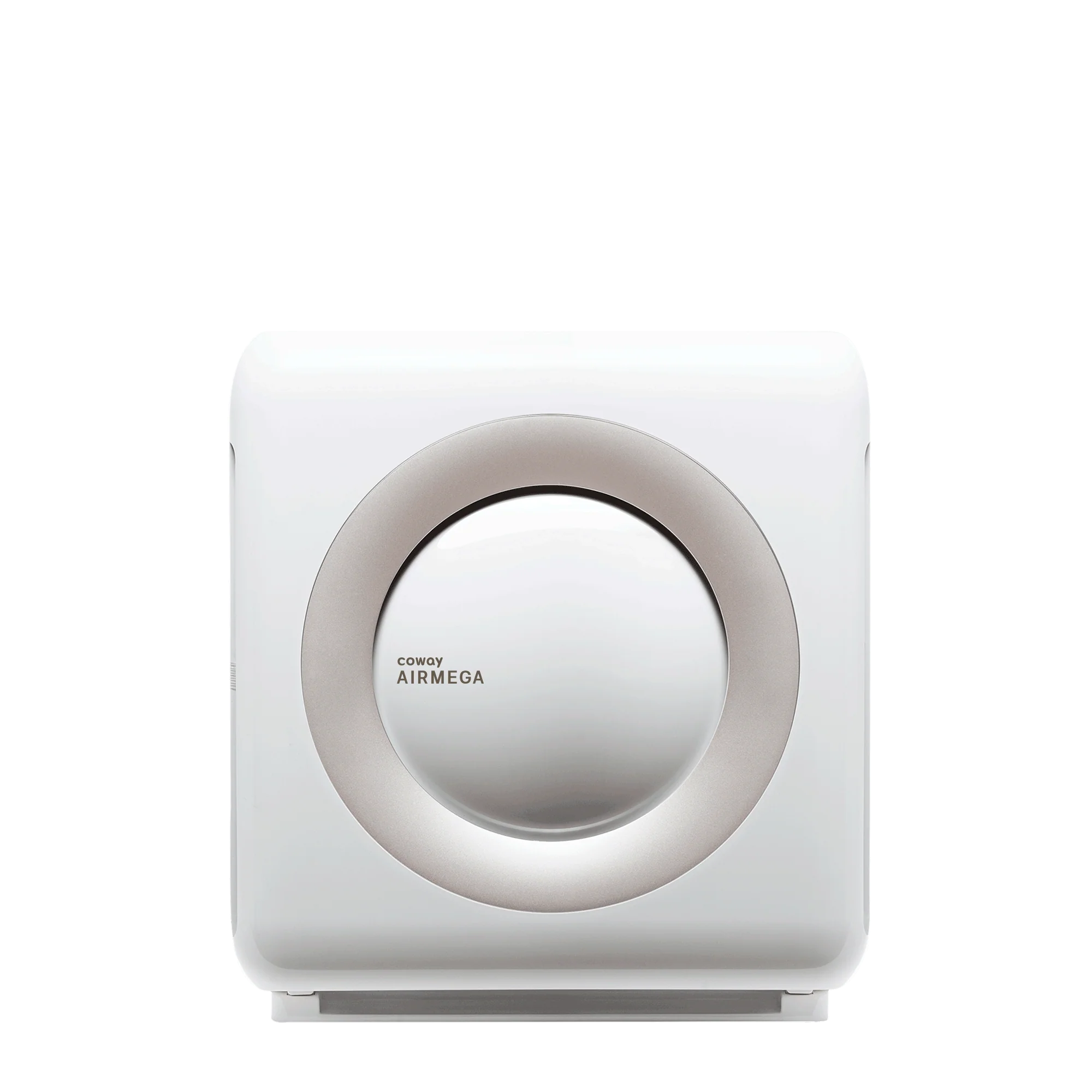
Coway AP-1512HH Mighty Review Editor Choice
✓ AHAM VerifiedOur Verdict
Key Specifications
- Room Coverage
- 361 sq ft
- CADR
- 233/246/240
- Filter
- True HEPA + Carbon + Pre-filter
- Noise
- 24 dB
- Power
- 77 watts
- Best For
- Medium rooms up to 361 sq ft. Wirecutter #1 for 10+ years. Best overall value.
📅 Prices checked . Amazon prices change frequently — click through for current price. Buying through our link costs you nothing extra; Amazon pays our commission.
What's in the Box
- Coway AP-1512HH air purifier
- Pre-installed 4-stage filter set
- Power cord
- User manual
- Filter replacement reminder sticker
Pros
- Wirecutter #1 for 10+ consecutive years
- AHAM verified CADR — no controversy
- True HEPA
- Fastest auto mode response in class
- 24dB ultra quiet sleep mode
- Eco mode at 4.9 watts
- 3-year warranty
Cons
- No WiFi or app control
- Carbon is impregnated fabric — weak on heavy odors
- Ionizer adds trace ozone (9ppb — CARB safe)
- Filter costs $60/year
- Design is dated
Best For
The Coway AP-1512HH is the right choice for buyers who want AHAM-verified air purification at the next price tier. At $110–130 with CADR 246 and 360 sq ft verified coverage at 4.8 ACH, it is one of the most proven air purifiers available. For anyone considering the RainMate specifically for allergy or air quality reasons, the AP-1512HH is the appropriate alternative.
📅 Price checked August 2026 · Buying through this link costs you nothing extra — Amazon covers our commission
What to Know Before You Buy
RainMate as a Fragrance Diffuser — Honest Value Assessment
The RainMate at $50–60 is a reasonable purchase if your goal is adding natural fragrance to a room through an oil-and-water mechanism rather than synthetic aerosol sprays. It is quieter than many ultrasonic diffusers, has a pleasant visual effect, and is compatible with Rainbow's own fragrance drops or standard essential oils. Evaluate it as a fragrance product, not an air quality product. Compared to standalone ultrasonic essential oil diffusers at the same price point, the RainMate is a legitimate competitor.
What the RainMate Cannot Do — The Clear List
The RainMate cannot reduce airborne PM2.5 concentrations. It cannot capture pollen, dust mite allergen, pet dander, or mold spores in any verified quantity. It cannot reduce VOCs or smoke. It has no CADR. It has no HEPA filter. It has no AHAM certification. If any of these capabilities are the reason you are considering a RainMate, you need a different product. See our CADR guide to understand what to look for in a real air purifier, and our air purifier for allergies guide for specific allergen-reduction guidance.
If You Want Both Fragrance and Air Purification
The combination of a real HEPA purifier and a separate fragrance diffuser is more effective than the RainMate alone. A Levoit Core 150 ($40–60) plus a basic essential oil diffuser ($15–25) delivers both True HEPA particle capture and room fragrance for $55–85 total — comparable to or slightly above the RainMate's $50–60 price, with actual air quality benefits. For larger rooms, a Coway AP-1512HH plus any diffuser covers the same bases at the next performance level.
What the RainMate Actually Does — Fragrance Diffusion and Light Humidification
The RainMate operates by pulling air across a basin of water that contains fragrance drops or essential oils. As air passes over and through the water surface, it picks up water vapor carrying fragrance molecules. The result is lightly scented, slightly more humid air returned to the room. The mechanism is similar in principle to an evaporative humidifier or an open bowl of scented water — the RainMate simply adds a motor to circulate air through the basin more actively.
The fragrance effect is the RainMate's primary functional output. Rainbow sells its own branded fragrance drops specifically formulated for the unit, in scents including citrus, floral, and pine varieties. Standard essential oils also work in the basin. The scent coverage in a small room (under 200 sq ft) is noticeable and pleasant. In larger rooms, the fragrance effect dissipates quickly, and the RainMate is most effective in small, enclosed spaces like bathrooms, home offices, or bedrooms.
The humidification output is minor — the RainMate does not function as a meaningful humidifier for room humidity control. In dry climates or winter heating conditions where 10–20% relative humidity increase is needed, a dedicated evaporative or ultrasonic humidifier is required. The RainMate's water evaporation is incidental rather than engineered for humidity output. Think of it as a fragrance diffuser with a small humidity side effect, not a humidifier with fragrance capability.
The RainMate runs quietly, draws low power, and is straightforward to maintain — empty and rinse the basin, add fresh water and fragrance drops. There is no filter to replace, no UV bulb to monitor, and no HEPA media to track. For what it actually does, the RainMate is simple and functional.
What the RainMate Cannot Do — No HEPA, No CADR, No Particle Capture
The RainMate contains no mechanical filtration stage of any kind. There is no HEPA filter, no activated carbon layer, no pre-filter, no UV germicidal stage, and no electrostatically charged media. Air passes over scented water and returns to the room. Airborne particles — PM2.5 fine particles, pollen, dust mite allergen, pet dander proteins, mold spores, smoke particles — are not captured by this mechanism in any verified quantity.
The CADR is the standard metric for measuring how much clean air a purifier delivers per minute. The RainMate has no published CADR because it does not deliver clean air in the measured sense. AHAM does not list the RainMate in its verified air cleaner database. CARB does not certify it as an air cleaner. The California Air Resources Board's certified air cleaner list, which covers products marketed for air cleaning in California, does not include the RainMate because it is not positioned as an air cleaner by its manufacturer — it is positioned as an "air revitalizer," which is a fragrance appliance category, not an air purification category.
Some consumers purchase the RainMate expecting it to reduce allergy symptoms. Allergy symptom relief from air purification requires capture of the specific allergen particles causing symptoms — typically particles in the 0.5–10 micron range for common indoor allergens. The RainMate's water basin does not capture these particles in any measurable quantity. Running the RainMate in a bedroom with cat allergies will make the room smell pleasant; it will not reduce Fel d 1 allergen concentration.
The honest summary: the RainMate adds fragrance and minor humidity to a room. That is its genuine function. It is not a defective air purifier — it is a fragrance appliance that is sometimes marketed or searched for under air purifier terms. Buying it with accurate expectations produces a satisfactory outcome. Buying it expecting air purification produces disappointment.
RainMate vs Real HEPA Air Purifiers at the Same Price
At the $50–60 price point of the RainMate, what does a real HEPA air purifier provide? The Levoit Core 150 is a compact True HEPA air purifier in the same general size category as the RainMate. It contains a three-stage filtration system: pre-filter for large particles, H13 HEPA for submicron particle capture (99.97% at 0.3 microns), and activated carbon for odor and basic VOC reduction. It has a CADR appropriate for small rooms and captures particles the RainMate cannot. Filter replacement is approximately $15–20 every 6–12 months, adding modest ongoing cost.
The Coway AP-1512HH at $110–130 — roughly double the RainMate's price — provides AHAM-verified CADR 246 and confirmed 360 sq ft coverage at 4.8 air changes per hour. It has auto mode, a laser air quality sensor, and a multi-year track record as one of the most trusted HEPA purifiers in the market. For anyone whose goal is actual air quality improvement, the AP-1512HH is the appropriate comparison product, not the RainMate.
The RainMate has no annual replacement cost (water and fragrance drops are negligible). A real HEPA purifier adds $15–50 per year in filter costs. Over three years, a Levoit Core 150 costs approximately $100–120 total (hardware plus filters). A RainMate plus fragrance drops costs approximately $75–90 total. The cost difference is not significant at these price points — the filtration performance difference is. Choose based on what you actually need: fragrance and light humidity, or genuine particle capture and air quality improvement.
If you want both — fragrance and real air purification — the correct approach is a HEPA purifier plus a separate fragrance diffuser. A Levoit Core 150 plus a basic ultrasonic essential oil diffuser delivers both at roughly the same combined cost as slightly more expensive HEPA options. The RainMate alone delivers neither verified air purification nor true diffuser performance at the level of dedicated essential oil diffusers.
RainMate 3-Year Total Cost of Ownership — vs Levoit Core 150 and Coway AP-1512HH
The RainMate's operating economics differ fundamentally from HEPA air purifiers: no filter replacements, only water changes and fragrance drops. The table below compares 3-year ownership costs at $0.17/kWh running 12 hours per day, using annual fragrance drop costs for the RainMate and filter replacement costs for the HEPA alternatives.
| Model | Purchase | Filter Pads / Water & Fragrance (3 yr) | Electricity (3 yr) | 3-Year Total | CADR | Verified |
|---|---|---|---|---|---|---|
| Rainbow RainMate | $55 | ~$90 (~$30/yr fragrance drops) | ~$11 | ~$156 | None (no CADR) | No |
| Levoit Core 150 | $50 | $54 (~$18/yr) | ~$11 | ~$115 | 95 CFM | Partial |
| Coway AP-1512HH | $120 | $135 ($45/yr) | ~$32 | ~$287 | 246 CFM | Yes (AHAM) |
The RainMate's electricity draw is low (~6W estimated) because it is a small motor circulating air over water — comparable to the Levoit Core 150 running on low. The $90 fragrance drop cost over three years assumes monthly replenishment at Rainbow's retail pricing; buyers using third-party essential oils can reduce this significantly. The RainMate's 3-year total of approximately $156 is the highest of the three on a per-verified-clean-air-unit basis — because it delivers zero verified clean air.
The Levoit Core 150 at $115 over three years provides True HEPA particle capture in a compact unit that operates quietly on a nightstand or desk — essentially the same form factor as the RainMate, at a lower 3-year total cost. For buyers choosing between the two at the point of purchase, the Levoit Core 150 is more cost-effective over time and delivers measurable air quality benefit the RainMate cannot. If fragrance is the goal, add a $15 essential oil diffuser and still come out ahead of the RainMate's 3-year cost while gaining actual HEPA filtration.
Who the RainMate Is Right For — and Who Should Buy a Real Purifier Instead
The RainMate is a reasonable purchase for buyers who want a pleasant ambient fragrance in a small room, prefer water-based fragrance over aerosol sprays, already own the Rainbow vacuum system and want a companion product, or simply want light ambient humidity with scent. In these use cases, the RainMate delivers what it promises. The $50–60 price is appropriate for a water-basin fragrance appliance.
The RainMate is the wrong choice for buyers who want to reduce indoor allergens, capture smoke or wildfire particles, improve air quality for asthma management, reduce PM2.5 levels, or address VOC exposure from paint, cleaning products, or off-gassing furniture. None of these goals are achievable through the RainMate's water-basin mechanism. For these buyers, a dedicated HEPA purifier — starting with the Levoit Core 150 for small rooms or Coway AP-1512HH for medium rooms — is the appropriate product category.
Buyers who are considering the RainMate specifically because of an in-home Rainbow demonstration or distributor recommendation should ask the specific question: "Does the RainMate have an AHAM-verified CADR?" The answer is no. That single data point clarifies the product's role. Verified CADR means independently tested particle capture. The absence of CADR means no such testing has been done or submitted. A pleasant-smelling room and a room with measurably fewer allergens are different outcomes — only the second requires a verified HEPA air purifier.
For a complete picture of the Rainbow ecosystem — including the full vacuum system's water-filtration air cleaning mode — see the Rainbow vacuum air purifier review. For a ranked comparison of the best real air purifiers at every price point, see our best air purifier guide.
Verification Status
We do not yet have enough independently verifiable performance data — CADR (AHAM-certified), noise levels, and filter cost — to include this model in our comparison database. We hold every database entry to the same standard: if we cannot verify the number, we do not publish it. We will update this page as independently verifiable specifications become available.