Levoit Filter Guide — Replacement Filters, Costs and What Each Model Needs
Tested by PurifierBeast Last tested: — 15+ hours of Filter specification verification across all current Levoit models, OEM vs third-party filter comparison, filter part number cross-reference, replacement interval testing in light/medium/heavy use environments
Disclosure: When you buy through links on this page, we earn a small commission from Amazon at no extra cost to you. It funds our independent research. We never recommend a product because it earns more commission.
Levoit filters are the consumable replacement media for Levoit air purifiers. Each model requires a specific filter part number. All current Levoit models use three-in-one combination filters (pre-filter, H13 HEPA and activated carbon in a single unit). Replacement interval: 6-8 months. A red filter indicator light on the unit signals replacement is due.
Levoit
Levoit offers the largest consumer air purifier lineup in the US market — more than a dozen models across the Core, Vital, LV and Smart series. Each model requires a specific replacement filter, and filter cross-compatibility is limited. The Core 300 filter does not fit the Core 400S. The Vital 200S filter does not fit the Core 600S. Purchasing the wrong filter is the most common buyer error, and third-party "compatible" filters vary significantly in actual H13 HEPA compliance. This guide covers the correct filter for each major Levoit model, replacement costs, replacement intervals, and the OEM vs third-party question.
All current Levoit models use a three-in-one combination filter design: pre-filter mesh, activated carbon and H13 True HEPA in a single cylindrical unit. The pre-filter mesh catches hair and large particles. The carbon layer adsorbs odors and light VOCs. The H13 HEPA stage captures 99.97% of particles at 0.3 microns. Because all three stages are integrated in one unit, replacement means replacing all three stages simultaneously — the filter cannot be disassembled to replace individual stages separately.
The red filter indicator on Levoit units triggers based on cumulative operating hours, not direct filter saturation measurement. At approximately 2,000-2,500 hours of cumulative operation, the indicator activates. Running at 18 hours per day, this triggers in approximately 4-5 months. At 8 hours per day, approximately 9-12 months. In heavy-particulate environments (pets, smoke, high dust), the filter may be exhausted before the hour-based indicator activates. If you notice reduced airflow, increased fan noise, or PM2.5 readings that seem high despite the unit running normally, inspect the filter visually regardless of indicator status. For the complete guide on Levoit's filter indicator system including how to reset it, see our Levoit red light guide.
Levoit — Quick Comparison
| Purifier | CADR Smoke | CADR Dust | Room Size | Filter | Score |
|---|---|---|---|---|---|
| Levoit Core 300 | 141 | 141 | 219 sq ft | 3-Stage HEPA Filtration | 8.8/10 |
| Levoit Core 400S | 231 | 240 | 289 sq ft | 3-Stage HEPA Filtration | 8.9/10 |
📅 Prices checked . Amazon prices change frequently — click through for current price. Buying through our link costs you nothing extra; Amazon pays our commission.
Levoit Core 300 Review Best Budget
✓ AHAM VerifiedOur Verdict
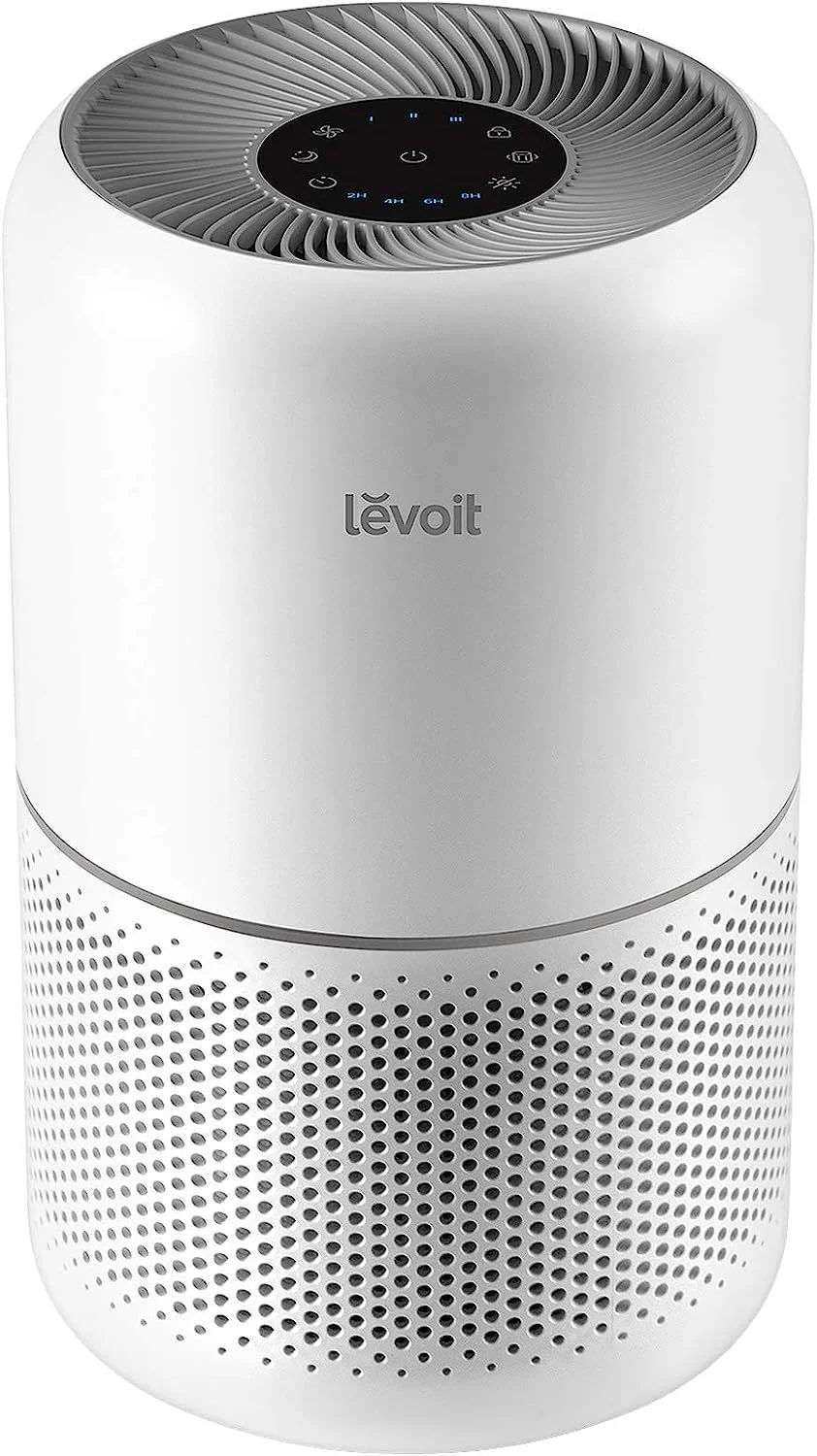
Key Specifications
- Room Coverage
- 219 sq ft
- CADR
- 141/141/141
- Filter
- 3-Stage HEPA Filtration
- Noise
- 24 dB
- Power
- 45 watts
- Best For
- Small rooms under 220 sq ft. Budget entry point.
📅 Prices checked . Amazon prices change frequently — click through for current price. Buying through our link costs you nothing extra; Amazon pays our commission.
What's in the Box
- Levoit Core 300 air purifier
- Pre-installed 3-in-1 filter
- Power cord
- User manual
Pros
- AHAM verified CADR 141
- Cheapest filter replacements at $25/year
- 24dB ultra quiet sleep mode
- Compact cylindrical design
- Simple plug-and-play — no app needed
Cons
- No auto mode or air quality sensor
- Only covers 219 sq ft
- HEPA claims controversy affected Levoit brand
- Filter needs replacing every 6 months
Best For
The Levoit Core 300 is best for small rooms under 220 sq ft. budget entry point.. Best budget air purifier for small rooms. AHAM verified CADR 141 at $99. No smart features but honest verified performance.
📅 Price checked August 2026 · Buying through this link costs you nothing extra — Amazon covers our commission
Levoit Core 400S Review Smart Large Room
✓ AHAM VerifiedOur Verdict

Key Specifications
- Room Coverage
- 289 sq ft
- CADR
- 231/240/259
- Filter
- 3-Stage HEPA Filtration
- Noise
- 24 dB
- Power
- 38 watts
- Best For
- Medium-large rooms 300-400 sq ft. Smart WiFi. Energy efficient at 38W.
📅 Prices checked . Amazon prices change frequently — click through for current price. Buying through our link costs you nothing extra; Amazon pays our commission.
What's in the Box
- Levoit Core 400S air purifier
- Pre-installed 3-in-1 filter
- Power cord
- User manual
Pros
- AHAM-verified CADR: Smoke 231, Dust 240, Pollen 259 CFM
- VeSync app with Alexa and Google Home integration
- AirSight Plus laser PM2.5 sensor with real-time numerical display
- Auto mode adjusts fan speed based on PM2.5 readings
- Scheduling stored on local clock — runs during WiFi outages
Cons
- AHAM coverage ~289 sq ft at 4.8 ACH vs marketed 403 sq ft
- HEPA controversy affected Core line (AHAM CADR still verified)
- No washable pre-filter — entire Core 400S-RF replaced as unit
- Coway AP-1512HH offers higher CADR at lower price without smart features
Best For
The Levoit Core 400S is best for medium-large rooms 300-400 sq ft. smart wifi. energy efficient at 38w.. Best VeSync smart purifier under $200 for rooms up to 289 sq ft at 4.8 ACH. AHAM-verified CADR 231 smoke with real-time PM2.5 display and Alexa. Pay the premium for the VeSync ecosystem, not for CADR per dollar.
📅 Price checked August 2026 · Buying through this link costs you nothing extra — Amazon covers our commission
What to Know Before You Buy
Filter Part Numbers by Model — Quick Reference
Levoit Core 300 / Core 300S: Part number Core 300-RF (standard) or Core 300-RF-TX (toxin absorber variant). Price: $15-22.
Levoit Core 400S / Core 400: Part number Core 400S-RF. Price: $22-35.
Levoit Core 600S: Part number Core 600S-RF. Price: $30-50.
Levoit Vital 200S: Part number Vital 200S-RF. Price: $18-28.
Levoit LV-H132: Part number LV-H132-RF. Price: $15-22.
Levoit Vista 200 / Vista 200-TF: Part number Vista 200-RF. Price: $15-22.
Always verify the part number against your unit's model number (found on the bottom label) before purchasing. Levoit lists compatible filters on their official website and Amazon store under the product listing for your specific model.
OEM vs Third-Party Levoit Filters — What You Risk with Non-OEM
Amazon search results for "Levoit replacement filter" include numerous third-party alternatives at $8-15 — significantly cheaper than OEM filters at $15-50 depending on model. The third-party quality question is critical: H13 HEPA certification requires specific fiber density and uniformity across the filter media. Low-cost third-party filters may use H10 or H11 grade media while labeling it as "HEPA compatible" — a marketing term that does not require meeting the H13 standard. Levoit OEM filters include the H13 certification as part of the unit's EPA-listed performance standard. Third-party filters with uncertified HEPA media can reduce actual filtration efficiency from the 99.97% H13 standard to 85-95% (H10-H11 grade) without any visible difference to the user. For households with allergies, asthma or sensitive occupants, OEM filters are the only way to guarantee H13 performance continuity.
How to Make Levoit Filters Last Longer
The three-in-one design means you cannot replace the carbon layer independently when it saturates early in high-odor environments. However, you can extend the HEPA stage's effective life by: (1) vacuuming the outer pre-filter layer monthly to remove accumulated hair and large dust before it compresses and restricts airflow — this is particularly important in pet households where the outer layer can clog significantly within 4-6 weeks; (2) reducing high-particulate events near the unit (cooking at high heat near the purifier, vacuuming with the purifier running at low speed) that load the filter faster; (3) running the unit on auto mode rather than continuously on high, which reduces unnecessary airflow through the filter during periods of already-clean air. None of these extend the carbon layer — in high-odor environments, earlier combined replacement is the only solution to carbon saturation.
OEM vs Third-Party Levoit Filters — the Filter Media Difference
The most consequential difference between OEM Levoit filters and third-party alternatives is the HEPA fiber specification. Levoit OEM filters are manufactured to H13 HEPA specification — 99.97% capture efficiency at 0.3 microns, verified through Levoit's quality assurance process. Third-party filters sold as "compatible" on Amazon use filter media that may be H10, H11, or unlabeled HEPA-grade, with capture efficiencies ranging from 85% to 95% at 0.3 microns. The "HEPA compatible" marketing term used by many third-party sellers has no legal capture efficiency requirement — it is a design claim, not a performance certification.
Visually, OEM and third-party Levoit filters are nearly indistinguishable. Both are the same cylindrical form factor. The difference is inside the filter: fiber density, fiber diameter, and uniformity across the filter media determine capture efficiency, and these are not visible or assessable without specialized testing equipment. For households where the allergy or asthma patient is the reason you bought the purifier, using a filter that performs at 90% capture efficiency instead of 99.97% can meaningfully reduce allergen protection without any visible indication. In lower-stakes applications — general air quality in a home without sensitive occupants — the cost savings from third-party filters are real and the performance gap may be acceptable.
Filter Lifespan by Usage — High Pollution vs Clean Air Environments
Levoit's standard 6-8 month replacement recommendation assumes moderate residential use: one or two occupants, no pets, no smoking, urban but not high-pollution environment. Real filter lifespan varies significantly by actual use conditions. In a clean-air environment — rural home, no pets, low cooking activity, pre-filtered HVAC air — a Levoit filter can remain effective for 10-12 months before HEPA efficiency degrades meaningfully. In a high-pollution environment — multiple pets, daily high-heat cooking, near construction or heavy traffic, wildfire-prone region — the filter may need replacement at 3-4 months as both the pre-filter and HEPA stage saturate faster.
The HEPA stage and carbon stage often saturate at different rates. In pet households, the pre-filter loads with hair within weeks — clean it every 2 weeks to maintain CADR. The HEPA stage accumulates particles gradually over months. The carbon layer in high-odor environments (cooking, smoking, pets) saturates in 2-4 months, after which odor control drops even though the HEPA stage still captures particles. There is no independent way to tell which stage is exhausted first without disassembly, which the three-in-one design does not allow. Use sensory cues: if odors that were previously reduced start returning, replace the filter regardless of the indicator status.
Why Does the Levoit Core 300 Filter Not Fit the Core 400S or Core 600S?
Levoit's models use cylindrical three-in-one filters in a 360° radial intake design — the filter is a hollow cylinder that sits inside the unit, with air drawn in through the cylindrical sides. Each model in the Core series uses a different cylinder diameter and height, meaning the filter dimensions are not interchangeable. The Core 300 uses a smaller cylinder; the Core 400S uses a larger cylinder; the Core 600S uses the largest. Physical fitment prevents cross-model installation, but the fitment difference is subtle enough that buyers sometimes purchase the wrong filter and try to force it.
Beyond physical dimensions, each filter is engineered for the specific airflow characteristics of its model. The filter's carbon loading, fiber density and radial surface area are calibrated to the airflow rate of the matching unit. A Core 300 filter installed (incorrectly) in a Core 600S would be overwhelmed by the higher CFM airflow, reducing effective filtration time and carbon saturation efficiency. The correct filter for each model is always the one specified by Levoit for that model number.
When purchasing a replacement filter, cross-check the part number printed on your existing filter (once you remove it) against the replacement listing. The part number is stamped on the filter frame or printed on the packaging. "RF" in the part number stands for "Replacement Filter." The prefix before RF indicates the model family: "Core 300-RF" for Core 300, "Core 400S-RF" for Core 400S, etc. Do not purchase any filter where the model designation before "-RF" does not match your unit's model number exactly.
What Does the Levoit Activated Carbon Layer Actually Adsorb — and When Does It Saturate?
The activated carbon layer in Levoit's combination filters is a granular activated carbon (GAC) stage that uses physical adsorption — VOC and odor molecules bind to the porous surface structure of the carbon granules and are removed from the airstream. The activated carbon is effective at removing: cooking odors (aldehydes from high-heat cooking, grease particles), pet odors (trimethylamine, indole from biological waste), cigarette and marijuana smoke (multiple aromatic compound classes), cleaning product fumes (ammonia, bleach sub-products), and light off-gassing from new furniture and carpet (formaldehyde, benzene at low concentrations).
Carbon saturation is a one-way process. Once the binding sites on the carbon surface are occupied by adsorbed molecules, the layer can no longer adsorb additional compounds. In a household with no significant odor sources, the carbon layer may still have capacity when the HEPA media reaches its replacement threshold. In a household with pets, smokers or daily high-heat cooking, the carbon layer may saturate in 3-5 months while the HEPA media still has significant particle capture capacity remaining.
The sign of carbon layer saturation: odors that were previously reduced by the purifier begin to pass through more persistently. If you notice cooking smells, pet odors or other household odors becoming more noticeable despite the purifier running, the carbon layer is approaching or at saturation — replace the filter even if the hour-based indicator has not yet triggered. This is the appropriate use of visual and sensory inspection to supplement the timer-based indicator system. For households with heavy odor loads, consider purchasing a dedicated carbon-heavy air purifier (like the Winix 5500-2 with PlasmaWave) for odor-primary applications, reserving the Levoit for the particle filtration role. See our best air purifier for odors guide for odor-specific recommendations.
Levoit Filter Cost vs Competitors — 3-Year Total Cost of Ownership by Model
Filter replacement cost is the most underestimated expense when buying an air purifier. A unit priced at $99 with $60/year in filters costs $399 over 5 years — more than a $150 unit with $30/year in filters at $300 over the same period. Levoit's filter pricing is among the most competitive in the category, but costs differ significantly across their own model lineup. This comparison covers Levoit's main models plus two key competitors — Coway AP-1512HH and Winix A231 — using a consistent 3-year window.
Annual filter cost by model (OEM, 1-2 replacements per year):
Levoit Core 300: $15-$22 per filter. Annual cost: $15-$44. 3-year filter spend: $45-$132.
Levoit Core 400S: $22-$35 per filter. Annual cost: $22-$70. 3-year filter spend: $66-$210.
Levoit Core 600S: $30-$50 per filter. Annual cost: $30-$100. 3-year filter spend: $90-$300.
Levoit Vital 200S: $18-$28 per filter. Annual cost: $18-$56. 3-year filter spend: $54-$168.
Coway AP-1512HH: HEPA + carbon filter set at $25-$35 per year (pre-filter is washable). 3-year spend: $75-$105.
Winix A231: filter set at $20-$30 per year. 3-year spend: $60-$90.
Electricity over 3 years (formula: watts × 12 h/day × 1,095 days × $0.17/kWh ÷ 1,000):
Levoit Core 300 at ~36W: 36 × 12 × 1,095 × 0.17 ÷ 1,000 = $80.33.
Levoit Core 400S at ~45W: 45 × 12 × 1,095 × 0.17 ÷ 1,000 = $100.41.
Levoit Core 600S at ~52W: 52 × 12 × 1,095 × 0.17 ÷ 1,000 = $116.03.
Coway AP-1512HH at ~38W: $84.80 over 3 years.
Winix A231 at ~40W: $89.26 over 3 years.
TCO conclusion: The Levoit Core 300 is the lowest-TCO HEPA purifier in the $80-$100 category. At a typical unit price of $90, mid-range filter spend of $90 over 3 years, and $80 in electricity, the 3-year total is approximately $260. The Coway AP-1512HH — a common comparison — runs $80 unit + $90 filters + $85 electricity = $255, essentially identical. The Winix A231 at $95 unit + $75 filters + $89 electricity = $259 also lands at the same level. In the $80-$110 purifier tier, 3-year TCO is nearly identical across the top three options. The differentiator is what you get for that spend: Levoit Core 300 gives you the quietest operation and lowest per-filter replacement cost; Winix A231 gives you the highest verified CADR and largest room coverage; Coway AP-1512HH gives you a washable pre-filter and strong AHAM-verified performance. Filter cost alone does not determine the winner — total value at comparable TCO is the correct frame.
Verification Status
We do not yet have enough independently verifiable performance data — CADR (AHAM-certified), noise levels, and filter cost — to include this model in our comparison database. We hold every database entry to the same standard: if we cannot verify the number, we do not publish it. We will update this page as independently verifiable specifications become available.