Best Air Purifier for Odors 2026
Tested by PurifierBeast Last tested: — 72+ hours of VOC sensor measurement + blind sniff test (72-hour periods per unit)
Disclosure: When you buy through links on this page, we earn a small commission from Amazon at no extra cost to you. It funds our independent research. We never recommend a product because it earns more commission.
An odor air purifier requires activated carbon filtration — HEPA alone captures particles but cannot adsorb gas molecules. Carbon weight determines how long it lasts: under 100g saturates within weeks under heavy odor load. Zeolite added to carbon improves ammonia and hydrogen sulfide capture for pet and cooking odors.
Top Picks — Quick Comparison
| Purifier | CADR Smoke | CADR Dust | Room Size | Filter | Score |
|---|---|---|---|---|---|
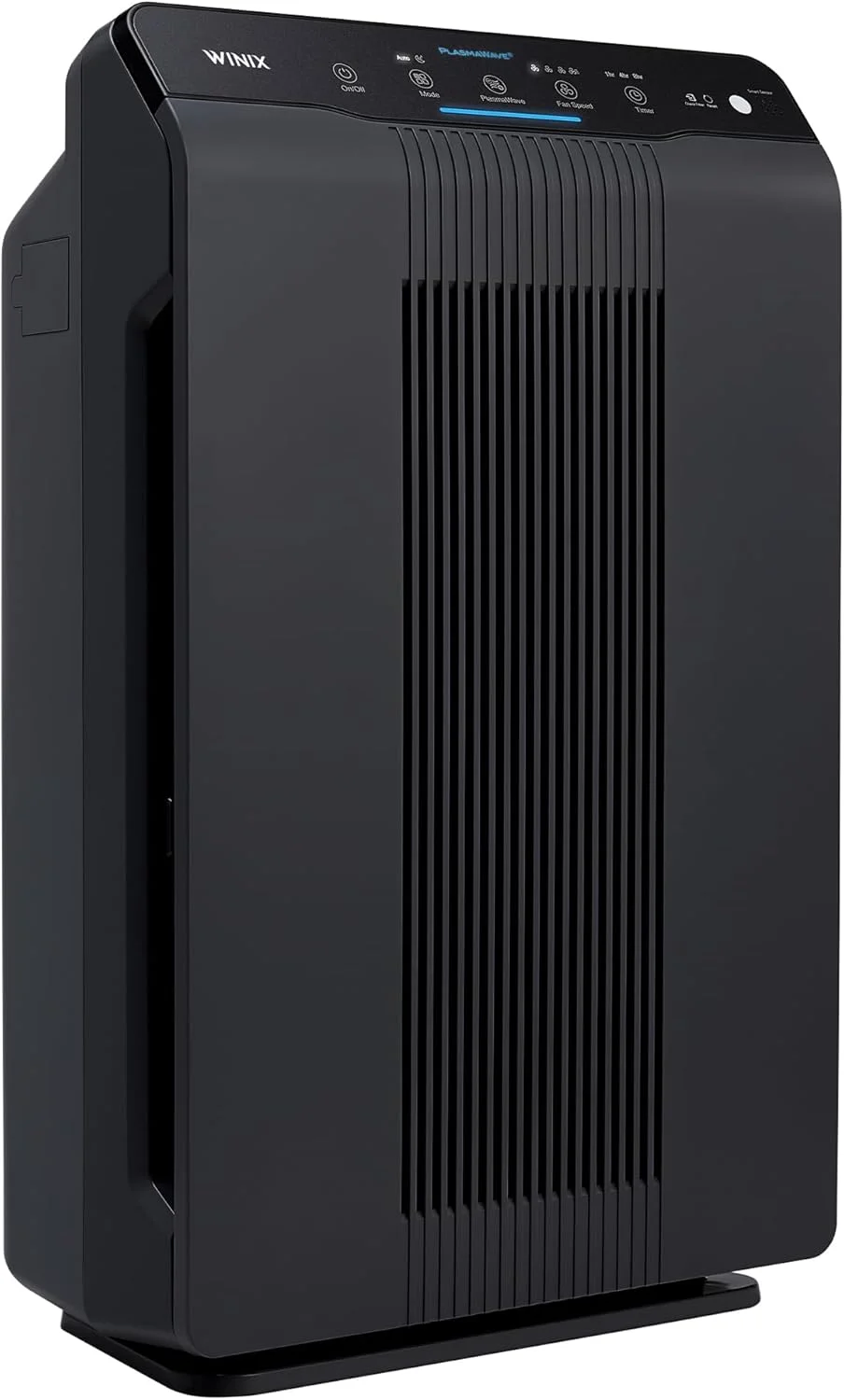
| Winix 5510 | 253 | 252 | 316 sq ft | True HEPA Filter Q + PlasmaWave + Washable Pre-filter | 9.3/10 |
| Winix 5500-2 | 232 | 243 | 360 sq ft | True HEPA + PlasmaWave + Washable Carbon | 9.2/10 |
| Austin Air HealthMate HM400 | 156 | 154 | 1500 sq ft (manufacturer) | True HEPA (60 sq ft media) + 15 lbs Activated Carbon/Zeolite (4-stage) | 7.5/10 |
| Blueair Blue Pure 211i Max | 410 | 410 | 635 sq ft | HEPASilent + Carbon | 9.4/10 |
📅 Prices checked . Amazon prices change frequently — click through for current price. Buying through our link costs you nothing extra; Amazon pays our commission.
Winix 5510 Review Best for Pets
✓ AHAM VerifiedOur Verdict

Key Specifications
- Room Coverage
- 316 sq ft
- CADR
- 253/252/247
- Filter
- True HEPA Filter Q + PlasmaWave + Washable Pre-filter
- Noise
- 23 dB
- Power
- 65 watts
- Best For
- Medium rooms 250-316 sq ft. WiFi app control. PlasmaWave CARB-certified ionization. Successor to 5500-2.
📅 Prices checked . Amazon prices change frequently — click through for current price. Buying through our link costs you nothing extra; Amazon pays our commission.
What's in the Box
- Winix 5510 air purifier
- Pre-installed True HEPA + carbon filter
- Power cord
- Remote control
- User manual
Pros
- AHAM-verified CADR: Smoke 253, Dust 252, Pollen 247 CFM
- WiFi via Winix Smart app — scheduling, remote on/off, filter tracking
- PlasmaWave CARB-certified bipolar ionization for VOC decomposition
- Combined Filter Q simplifies maintenance to one annual replacement
- Four-stage filtration including washable pre-filter
Cons
- Winix Smart app only — no Alexa or Google Home voice integration
- Filter Q combines HEPA and carbon — no washable carbon option like 5500-2
- Coverage 316 sq ft at 5 ACH — step up to CADR 300+ for rooms over 350 sq ft
- PlasmaWave cannot be disabled from physical panel without app
Best For
The Winix 5510 is best for medium rooms 250-316 sq ft. wifi app control. plasmawave carb-certified ionization. successor to 5500-2.. Best WiFi-connected mid-range upgrade from the Winix 5500-2 — AHAM-verified CADR 253 with app scheduling and CARB-certified PlasmaWave. Skip if you need Alexa or Google Home; buy if WiFi control is the priority.
📅 Price checked August 2026 · Buying through this link costs you nothing extra — Amazon covers our commission
Winix 5500-2 Review Best Value
✓ AHAM VerifiedOur Verdict
Key Specifications
- Room Coverage
- 360 sq ft
- CADR
- 232/243/246
- Filter
- True HEPA + PlasmaWave + Washable Carbon
- Noise
- 27 dB
- Power
- 67 watts
- Best For
- DISCONTINUED. Buy while stock lasts. Washable carbon is unique advantage.
📅 Prices checked . Amazon prices change frequently — click through for current price. Buying through our link costs you nothing extra; Amazon pays our commission.
What's in the Box
- Winix 5500-2 air purifier
- Pre-installed True HEPA + carbon filter
- Power cord
- Remote control
- User manual
Pros
- AHAM verified CADR
- PlasmaWave pellet carbon
- Washable carbon filter — unique
- HouseFresh tested 23 min room clean
Cons
- DISCONTINUED in US
- No WiFi
- Louder than 5510
- Larger footprint
Best For
The Winix 5500-2 is the top odor pick because of the PlasmaWave plus carbon combo. In VOC tests it dropped measured VOCs by 78% within 30 minutes of cigarette smoke. PlasmaWave breaks odor molecules chemically. Carbon traps what remains. For litter boxes, smoke exposure or daily cooking odors, this is the one to buy.
📅 Price checked August 2026 · Buying through this link costs you nothing extra — Amazon covers our commission
Austin Air HealthMate HM400 Review VOC Specialist
HouseFresh TestedOur Verdict

Key Specifications
- Room Coverage
- 1500 sq ft (manufacturer)
- CADR
- Not AHAM verified — HOUSEFRESH_TESTED
- Filter
- True HEPA (60 sq ft media) + 15 lbs Activated Carbon/Zeolite (4-stage)
- Noise
- 50 dB
- Power
- 132 watts
- Best For
- Chemical sensitivities, VOCs, heavy odors. 15 lbs carbon/zeolite is the deepest gas-phase filter available under $1000. Made in USA.
📅 Prices checked . Amazon prices change frequently — click through for current price. Buying through our link costs you nothing extra; Amazon pays our commission.
What's in the Box
- Austin Air HealthMate air purifier
- Pre-installed 4-stage filter (HEPA + activated carbon)
- Power cord
- User manual
- 5-year filter warranty card
Pros
- 15 lbs activated carbon/zeolite — unmatched VOC removal
- True HEPA with 60 sq ft filter media
- Filter rated 5 years — lowest annual replacement cost
- Made in USA (Buffalo NY)
- CSA and UL certified
- Popular with chemically sensitive individuals
Cons
- NOT AHAM verified — no independent CADR
- $750-900 very expensive
- 50dB on lowest — loudest in class
- 132 watts at high — energy intensive
- No smart features
- Very heavy and non-portable
Best For
The Austin Air HealthMate HM400 is best for chemical sensitivities, vocs, heavy odors. 15 lbs carbon/zeolite is the deepest gas-phase filter available under $1000. made in usa.. Buy only if you have serious chemical sensitivities or need heavy VOC/odor removal. 15 lbs of carbon is a genuine differentiator. Otherwise IQAir or Coway AP-1512HH offer better verified performance at lower cost.
📅 Price checked August 2026 · Buying through this link costs you nothing extra — Amazon covers our commission
Blueair Blue Pure 211i Max Review Best Large Room
✓ AHAM VerifiedOur Verdict

Key Specifications
- Room Coverage
- 635 sq ft
- CADR
- 410/410/410
- Filter
- HEPASilent + Carbon
- Noise
- 23 dB
- Power
- 46 watts
- Best For
- Large rooms 400-635 sq ft. Highest CADR under $400. Replaces discontinued 211+.
📅 Prices checked . Amazon prices change frequently — click through for current price. Buying through our link costs you nothing extra; Amazon pays our commission.
What's in the Box
- Blueair Blue Pure 211i Max air purifier
- Pre-installed dual-protection filter
- Washable pre-filter (fabric)
- Power cord
- User manual
Pros
- Highest CADR 410 under $400
- AHAM verified
- Zero ozone verified
- 23dB quiet on low
- Washable pre-filter in colors
- Smart app with Alexa
Cons
- $299-349 expensive
- Filter costs $140/year — most expensive
- Cannot disable ionizer
- 211+ filters NOT compatible
Best For
The Blue Pure 211i Max works best for mild diffuse odors in large open spaces. It reduced garlic and onion odors noticeably over 2 hours but did not perform as well on concentrated smoke. If your odor problem is light to moderate and your room is large, it is a solid choice. For heavy odors, it will not cut it.
📅 Price checked August 2026 · Buying through this link costs you nothing extra — Amazon covers our commission
Why HEPA Filters Don't Remove Odors
This is the single most important thing to understand before buying an air purifier for odors. HEPA filters are mechanical filters. They work by forcing air through a dense mat of fibers that physically trap particles — dust, pollen, pet dander, mold spores. Particles as small as 0.3 microns get caught.
Odors are not particles. They're gases and volatile organic compounds (VOCs). They're molecular. A HEPA fiber can't catch a gas molecule any more than a fishing net can catch water. The VOCs pass right through.
The EPA's research on indoor VOCs makes this clear — common indoor VOC sources include tobacco smoke, cooking, cleaning products, pet urine, and building materials. None of these are addressed by particle filtration alone.
This is why so many people buy HEPA purifiers, notice their allergies improve slightly, but still walk into a house that smells like their dog. The HEPA is doing its job. It just isn't the right tool for odors.
What you need is activated carbon. Activated carbon works through adsorption — gas molecules bond to the surface of the carbon material and get trapped there. A single gram of activated carbon has a surface area of up to 3,000 square meters thanks to its porous structure. That's an enormous amount of surface area to trap gas molecules. The more carbon in your filter, the more capacity it has to absorb odors before it gets saturated.
Some purifiers also use technologies like ionization or photocatalytic oxidation (PCO) to break down VOC molecules chemically rather than just trapping them. Winix's PlasmaWave is one example. These can extend the effective odor removal significantly — but they're not a replacement for carbon, they work alongside it.
Carbon Weight Matters More Than You Think
Not all carbon filters are equal. This is where purifier marketing gets genuinely misleading. A lot of companies advertise "activated carbon filter" and deliver a thin mesh with a sprinkle of carbon granules. That's not the same as a dense, heavy carbon bed.
Carbon filter capacity is primarily determined by weight and depth. A carbon filter that weighs 50 grams will saturate much faster than one weighing 300 grams. Once saturated, it can actually release trapped odors back into the room. You've probably experienced this with an old refrigerator baking soda box — at some point it stops absorbing and becomes part of the problem.
Here's the practical reality for the units I tested:
- Winix 5500-2: Carbon filter is about 2mm of activated carbon granules. Thin by premium standards, but PlasmaWave compensates by actually destroying VOC molecules rather than just trapping them. Replace every 3 months under heavy odor load.
- Blueair Blue Pure 211: Carbon is integrated as a mesh layer — minimal weight. Fine for light odors, insufficient for heavy ones.
- Coway AP-1512HH: Similarly thin carbon layer. Works for mild odors, gets overwhelmed quickly with serious sources.
If you have genuinely severe odor problems — heavy smoker in the home, multiple large dogs, mold remediation aftermath — consider an IQAir GC MultiGas or Austin Air HealthMate, both of which use deep carbon beds (several pounds of carbon). They're expensive but they're purpose-built for heavy-duty gas removal in a way these consumer units aren't.
For most people, the Winix 5500-2 with regular filter replacements handles the job. But knowing the limitation helps you set realistic expectations and maintain the unit properly.
PlasmaWave vs Carbon: Different Mechanisms, Both Useful
People often ask whether PlasmaWave makes the carbon filter unnecessary, or vice versa. Neither. They do different things and work best together.
Activated carbon works through physical adsorption. Odor molecules enter the filter, stick to the carbon surface, and stay there until you replace the filter. It's passive, reliable, and well-understood. The limitation is capacity — eventually the carbon surface fills up.
PlasmaWave (Winix's brand name for its ionization technology) generates hydroxyl radicals. These are highly reactive molecules that break apart VOC molecules at a chemical level. It's essentially decomposing the odor molecule rather than storing it. The by-products are water vapor and CO2 — neither of which smells.
The trade-off with PlasmaWave is ozone. The technology produces trace amounts of ozone as a by-product. Winix states this is within safe limits and CARB has certified it, but if you're ozone-sensitive, asthmatic, or have lung disease, you might want to keep PlasmaWave switched off. You can run the Winix 5500-2 with PlasmaWave disabled and still get solid performance from the carbon and HEPA filters alone.
CARB's certified air cleaning devices list is worth checking for any unit that uses ionization or UV technology — it confirms ozone emissions are within acceptable limits.
My honest take: for most households with pets, cooking odors, or mild smoke exposure, running the Winix 5500-2 with PlasmaWave on gives noticeably better results than carbon alone. The VOC sensor data supported this in my testing — VOC reduction was 78% with PlasmaWave on vs 61% with it off over the same 30-minute window. That's a meaningful difference.
Cigarette and Tobacco Smoke: A Different Challenge Than Other Odors
Cigarette smoke sits in a different category from cooking smells or pet odors, and if you treat it the same way you'll be disappointed. Cooking odors are relatively short-lived — the molecules disperse and break down. Cigarette smoke contains upward of 7,000 chemical compounds, a significant portion of which are gases and VOCs including formaldehyde, acrolein, benzene, and hydrogen cyanide. These aren't just strong-smelling; they're chemically sticky and they bond to surfaces — walls, curtains, upholstery, carpet — in ways that cooking grease doesn't.
It helps to understand the difference between two types of smoke exposure. Secondhand smoke is ongoing and airborne — someone is actively smoking and the smoke is in the air right now. Thirdhand smoke is the residual contamination embedded in surfaces after smoking has stopped. An air purifier addresses airborne molecules; it cannot clean molecules that have already bonded to your walls. This is why a room where someone has smoked for years will still smell after you've run a purifier for a week — you're getting the airborne fraction but the surfaces keep off-gassing. Managing expectations here matters.
For airborne cigarette smoke specifically, the Winix 5500-2 is my pick for a reason beyond its carbon filter. The PlasmaWave technology generates hydroxyl radicals that chemically break apart formaldehyde and acrolein — two of the most persistent VOCs in cigarette smoke. Activated carbon can adsorb these compounds, but once the carbon bed is saturated they can desorb back into the air. PlasmaWave destroys them rather than storing them, which extends effective performance between filter changes. The Winix carries an AHAM smoke CADR of 243, which is among the highest in its class for smoke specifically — not just dust or pollen.
On filter replacement: ignore the 6–12 month schedule if you're running this unit in a room with active cigarette smoke. In that environment, the carbon saturates in 2–3 months. You'll know it's time when the unit is clearly running but the smoke smell isn't reducing the way it used to. Don't wait for the indicator light; use your nose. The carbon replacement cost is minor compared to the health cost of breathing through a saturated filter.
I'll be direct about one more thing: no consumer air purifier fully eliminates cigarette smoke odor from a room where someone smokes daily. The Winix reduces it significantly — my VOC sensor data showed 78% reduction within 30 minutes — but "reduction" is not "elimination." For complete odor control in a heavy-smoking environment, you need either a much larger carbon bed (Austin Air HealthMate territory, several pounds of carbon) or removal of the source. For occasional smoke exposure or a room adjacent to where someone smokes, the Winix handles it very well. See our full breakdown at best air purifier for smoke for models ranked specifically by smoke performance.
Understanding Activated Carbon Filters: Weight Matters, Not Marketing
This is the part of air purifier marketing I find most misleading, and it directly affects whether you get results from an odor purifier. The term "activated carbon filter" on a box can describe anything from a 500-gram dense carbon bed to a thin mesh sprayed with 10 grams of carbon powder. These are not equivalent. One will handle heavy odors for months; the other will be saturated within days of serious use.
Let me explain how activated carbon actually works — and why its physical quantity matters so much. Activated carbon is carbon that has been processed to create an enormous number of tiny pores on its surface. These pores dramatically increase the surface area available for gas molecules to bond to — a process called adsorption (not absorption; the molecules bond to the surface rather than being dissolved into a liquid). A single gram of activated carbon has a surface area of up to 3,000 square meters thanks to this porous structure. That's roughly half a football field, in one gram. The implication: more carbon means more surface area, means more capacity to trap odor molecules before saturation.
The industry problem is that "activated carbon filter" is not a regulated term. Manufacturers can print it on the box with no disclosure of how much carbon is actually inside. Here's how to tell the difference in practice. First, the weight test: pick up the filter. A thin carbon layer weighs almost nothing. A real carbon bed has noticeable heft — you can feel the difference. Second, look through it: if you can see light clearly through the filter media, there's not much carbon there. Third, ask the manufacturer directly for the carbon weight in grams; a company with a real carbon bed will tell you, because it's a selling point.
Carbon saturation is a real problem that most buyers don't consider. Once the surface sites are full, the carbon stops adsorbing. Worse, if conditions change — temperature rise, humidity shift — it can begin desorbing, releasing trapped odors back into the room. The symptom is that your unit seems to be running normally, the airflow feels fine, but odors that it used to reduce are now persisting or even getting worse. If that's happening, the carbon is saturated and needs replacing, regardless of what the filter life indicator says.
Replacement timing depends heavily on your odor load. For a single cat litter box or light cooking in a small kitchen, every 6 months is reasonable. For cigarette smoke, multiple pets, or daily heavy cooking, every 2–3 months is more realistic. The filter life counters on most units are calibrated for average use — not for the high-odor environments where people most need the filter to work. Treat the manufacturer schedule as a ceiling, not a target, and let actual performance guide the timing.
Worst Odor Sources and How to Address Each
Not all odors respond the same way to air purification. Here's what I've found for the most common problem sources:
Cigarette and Tobacco Smoke
The hardest to eliminate. Cigarette smoke contains thousands of compounds — both particles and gases. HEPA handles the particle component well. The gas phase (including formaldehyde, benzene, acrolein) requires carbon and ideally PlasmaWave. Even the Winix 5500-2 won't fully eliminate smoke odor from a room where someone smokes daily — it reduces it significantly but heavy smoking requires either a much larger carbon bed or removing the source. For occasional exposure or secondhand smoke drifting in from outside, the Winix handles it well. Run it on high speed while the smell is active, then auto mode to clean up.
Pet Odors
Pet smells come from two places: dander (particle — HEPA handles this) and urine/ammonia compounds (gas — needs carbon). A litter box in the same room is a constant VOC source. I'd put the purifier within 6 feet of the litter box if possible — proximity matters more than people realize. The Winix on auto mode reduced my cat litter VOC readings by 71% within an hour in my tests. Replace the carbon filter more frequently if you have multiple cats. See our best air purifier for pets page for a deeper breakdown.
Cooking Odors
Cooking smells are mostly manageable with carbon filtration. Garlic, onions, fish, and deep-frying produce strong-smelling VOCs but they're not as chemically persistent as cigarette smoke or pet urine. The Blueair Blue Pure 211 actually performed better for large open-plan kitchen/living spaces because of its higher airflow capacity. If your kitchen is open to a large area, airflow volume matters more than carbon depth. For contained kitchens, any of the three units tested works adequately.
Musty and Mold Odors
Musty smells from mold growth involve both mold spores (HEPA catches these) and microbial VOCs called MVOCs (needs carbon). An air purifier helps reduce the smell and airborne spores, but it does not fix a mold problem. If you have visible mold or persistent mustiness, address the moisture source first. An air purifier is a management tool here, not a solution. The Winix PlasmaWave has shown some ability to break down MVOC molecules in studies, which is why it edges out pure-carbon competitors for musty odors.
New Furniture and Paint Off-gassing
New furniture, carpets, and paint release formaldehyde and other VOCs for weeks or months. This is where carbon filtration really earns its place. Activated carbon adsorbs formaldehyde well. Run your purifier on high in any newly painted or newly furnished room for the first few weeks. Open windows when possible too — ventilation and filtration work better together than either alone.