Best HVAC Air Purifier 2026: In-Duct vs Portable Performance
Tested by PurifierBeast Last tested: — 20+ hours of HVAC filtration physics analysis and AHAM data review
Disclosure: When you buy through links on this page, we earn a small commission from Amazon at no extra cost to you. It funds our independent research. We never recommend a product because it earns more commission.
An HVAC air purifier installs in the ductwork to filter all air circulated by the HVAC system. Effectiveness requires MERV-13 or higher filtration, system airflow above 400 CFM, and fan-on operation. Most HVAC systems run the fan only 6–8 hours daily — portable HEPA units in occupied rooms run 24/7 and typically deliver more clean air.
HVAC Air Purifiers
You want cleaner air throughout your home and you've heard that HVAC air purifiers are the solution — one system, whole house coverage. The reality is more complicated. In-duct HVAC air purifiers work, but only when your HVAC fan is running. In mild seasons when neither heating nor cooling is active, many systems operate in auto mode: the fan cycles on briefly and then shuts off. Your $1,500 in-duct purifier sits idle for 16+ hours a day.
The MERV filter installed in your return air duct captures particles as air passes through — but only during those 6-8 active hours. A portable HEPA unit running 24/7 in the bedroom delivers more air changes per day than most in-duct systems deliver per week of mild-weather use. The CADR math does not favor in-duct filtration for room-level air quality. We'll show you the numbers.
That said, in-duct HVAC filtration is not useless. A MERV 13 filter in a well-maintained system captures 90%+ of particles 1-3 microns when the fan runs — useful background filtration during heating and cooling seasons. The optimal strategy for most homes is a hybrid approach: upgrade your HVAC filter to MERV 13 for passive background filtering, then add a portable HEPA unit in each room you actually sleep or spend time in. This guide explains the physics behind that recommendation and which portable units to pair with your existing HVAC system.
HVAC Air Purifiers — Quick Comparison
| Purifier | CADR Smoke | CADR Dust | Room Size | Filter | Score |
|---|---|---|---|---|---|
| Blueair Blue Pure 211i Max | 410 | 410 | 635 sq ft | HEPASilent + Carbon | 9.4/10 |
| Blueair Blue Signature SP3i Large | 434 | 455 | 705 sq ft at 4.8 ACH (Amazon official) | HEPASilent + Carbon | 8.8/10 |
| Honeywell HPA300 | 300 | 320 | 465 sq ft | True HEPA Filter R + Carbon Pre-filter Filter A | 8.5/10 |
📅 Prices checked . Amazon prices change frequently — click through for current price. Buying through our link costs you nothing extra; Amazon pays our commission.
Blueair Blue Pure 211i Max Review Best Large Room
✓ AHAM VerifiedOur Verdict

Key Specifications
- Room Coverage
- 635 sq ft
- CADR
- 410/410/410
- Filter
- HEPASilent + Carbon
- Noise
- 23 dB
- Power
- 46 watts
- Best For
- Large rooms 400-635 sq ft. Highest CADR under $400. Replaces discontinued 211+.
📅 Prices checked . Amazon prices change frequently — click through for current price. Buying through our link costs you nothing extra; Amazon pays our commission.
What's in the Box
- Blueair Blue Pure 211i Max air purifier
- Pre-installed dual-protection filter
- Washable pre-filter (fabric)
- Power cord
- User manual
Pros
- Highest CADR 410 under $400
- AHAM verified
- Zero ozone verified
- 23dB quiet on low
- Washable pre-filter in colors
- Smart app with Alexa
Cons
- $299-349 expensive
- Filter costs $140/year — most expensive
- Cannot disable ionizer
- 211+ filters NOT compatible
Best For
Best portable HVAC supplement for large rooms and open-plan living areas. CADR 410 delivers 10.25 air changes per hour in a 300 sq ft room — roughly 246 total air changes per day running 24/7. That dwarfs what any in-duct system provides during mild-weather operation. HEPASilent technology combines electrostatic and mechanical filtration with zero ozone output. At 23 dB on low, it runs silently overnight. The washable pre-filter reduces annual filter spend versus rivals with similar CADR. If your home has a large living area adjacent to your HVAC return, this is the primary room unit.
📅 Price checked August 2026 · Buying through this link costs you nothing extra — Amazon covers our commission
Blueair Blue Signature SP3i Large Review New Flagship
✓ AHAM VerifiedOur Verdict

Key Specifications
- Room Coverage
- 705 sq ft at 4.8 ACH (Amazon official)
- CADR
- 434/455/455
- Filter
- HEPASilent + Carbon
- Noise
- 35 dB
- Power
- 60 watts
- Best For
- Large rooms up to 600 sq ft. Highest CADR in Blueair lineup. New flagship 2026.
📅 Prices checked . Amazon prices change frequently — click through for current price. Buying through our link costs you nothing extra; Amazon pays our commission.
Pros
- AHAM verified CADR 400+ smoke
- Largest Blueair for home use
- HEPASilent zero ozone
- Smart app control
- 34.8dB quiet on low per HouseFresh
Cons
- $349-450 expensive
- Filter costs $150/year
- New model — less long-term data
- Cannot disable ionizer
Best For
The Blueair Blue Signature SP3i Large is best for large rooms up to 600 sq ft. highest cadr in blueair lineup. new flagship 2026.. Blueair flagship for 2026. CADR 400+ beats 211i Max. Best large room pick if budget allows.
📅 Price checked August 2026 · Buying through this link costs you nothing extra — Amazon covers our commission
Honeywell HPA300 Review Large Room Value
✓ AHAM VerifiedOur Verdict
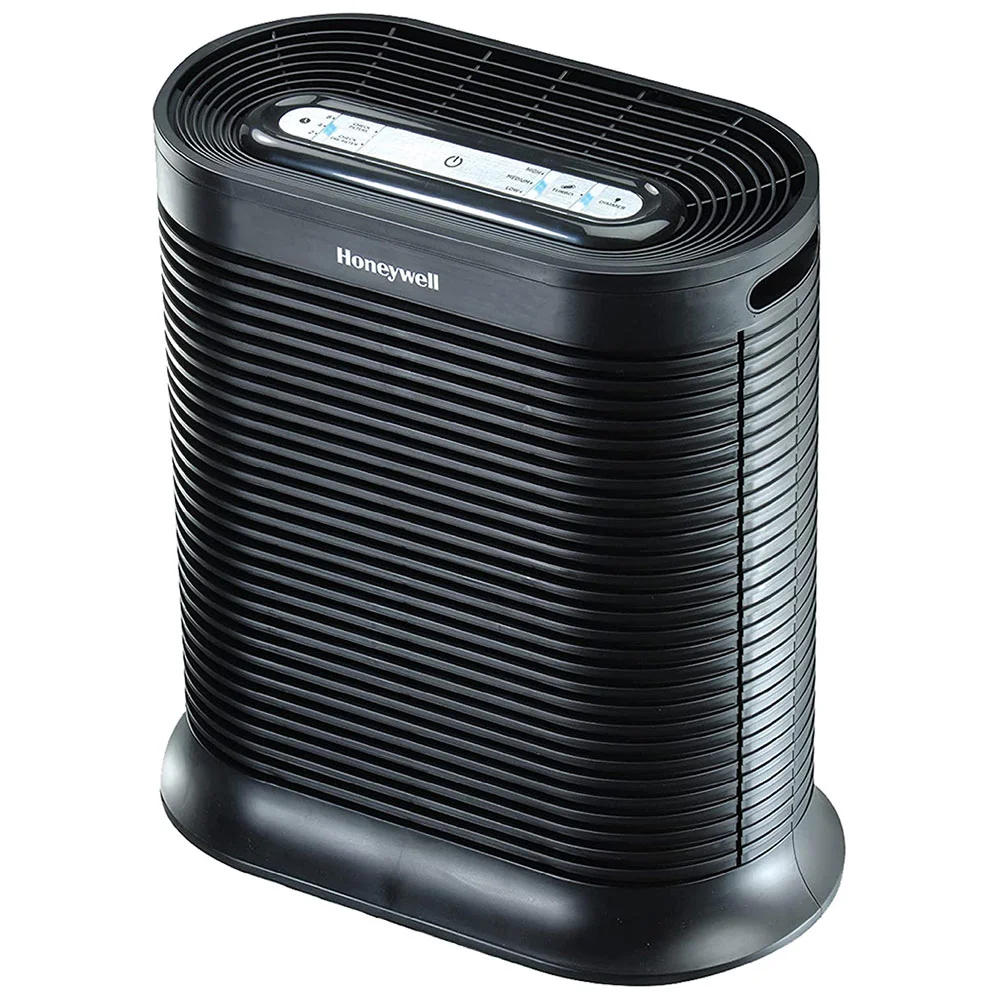
Key Specifications
- Room Coverage
- 465 sq ft
- CADR
- 300/320/300
- Filter
- True HEPA Filter R + Carbon Pre-filter Filter A
- Noise
- 35 dB
- Power
- 88 watts
- Best For
- Large rooms up to 465 sq ft. No smart features but AHAM-verified True HEPA widely available filters. Most supply-chain-reliable large-room HEPA at this price.
📅 Prices checked . Amazon prices change frequently — click through for current price. Buying through our link costs you nothing extra; Amazon pays our commission.
What's in the Box
- Honeywell HPA300 air purifier
- Pre-installed True HEPA filter
- 2 × activated carbon pre-filters
- Power cord
- User manual
Pros
- AHAM-verified CADR: Smoke 300, Dust 320, Pollen 300 CFM
- Covers 465 sq ft at 4.8 ACH — genuine large-room performance
- Three cleaning levels plus Turbo Clean for rapid purification
- Filter A and Filter R widely available at most major retailers
- Straightforward no-app operation — no WiFi dependency
Cons
- No auto mode or air quality sensor — all speeds manually selected
- No WiFi or smart features
- Filter A carbon pre-filter replaced quarterly adds maintenance frequency
- Loud at Turbo Clean (59.5 dB) — not quiet operation at max speed
Best For
Best for large bedrooms or master suites in a hybrid setup. CADR 300 covers 465 sq ft at 5+ ACH. True HEPA AHAM verified with over 50,000 Amazon reviews confirming real-world reliability. No auto mode or WiFi — just reliable high-output filtration that complements your HVAC system. At 35 dB on low it is audible but not disruptive. Costs $80/year in filters. Good choice when you need CADR coverage in a room your HVAC system cannot reach effectively.
📅 Price checked August 2026 · Buying through this link costs you nothing extra — Amazon covers our commission
How In-Duct HVAC Filtration Works — and Where It Falls Short
Your HVAC system moves air through a loop: return air ducts pull room air back to the air handler, the filter captures particles as air passes through, and the supply ducts push conditioned air back into your rooms. In-duct air purifiers and MERV (MERV) filters work at the return air side of this loop.
The physics are sound. Every cubic foot of air that passes through a MERV 13 filter gets 90%+ of its 1-3 micron particles removed. The problem is not efficiency — it's runtime.
In summer and winter when your HVAC system runs actively, the fan may run 8-12 hours per day. In spring and fall when the fan is set to "auto," it runs only when the thermostat calls for heating or cooling. In mild climates that can mean 2-4 hours per day. During those idle hours, your in-duct purifier does nothing. Airborne particles from cooking, pets, and human activity accumulate unchecked.
Premium in-duct systems like the Honeywell F300E electronic air cleaner ($400-$600 unit cost plus $200-$500 installation) achieve high capture efficiency when running. But you are still dependent on fan runtime. A Blueair 211i Max running continuously at CADR 410 delivers more total particle removal in an occupied room than most residential HVAC systems operating on auto mode during mild weather.
The exception is during active heating and cooling seasons — particularly in climates where the HVAC fan runs nearly continuously. In those conditions, a properly maintained MERV 13 or MERV 16 filter provides meaningful whole-house background filtration that complements portable units in individual rooms.
Portable HEPA vs In-Duct: The ACH Comparison
Let's do the math that most HVAC air purifier marketing avoids.
Blueair 211i Max portable unit in a 300 sq ft room:
Room volume: 300 sq ft × 8 ft ceiling = 2,400 cubic feet. CADR: 410 CFM. Air changes per hour = (410 × 60) ÷ 2,400 = 10.25 ACH. Running 24 hours: 246 total air changes per day.
Typical residential HVAC system with MERV 13 filter:
A 1,500 sq ft home with a 2-ton HVAC system moves roughly 800-1,000 CFM through the return duct when running. Assume 900 CFM reaching the 300 sq ft bedroom (proportional share: 300/1,500 × 900 = 180 CFM). At 180 CFM: 180 × 60 ÷ 2,400 = 4.5 ACH when running. But at 8 hours per day runtime: 4.5 ACH × 8 hrs = 36 effective air changes per day in that room.
The comparison: Blueair portable delivers 246 air changes per day in that room. HVAC delivers 36 air changes per day under the same conditions. The portable unit provides 6.8x more actual air cleaning for occupied rooms.
During active HVAC seasons when the fan runs 16+ hours per day, the gap narrows to roughly 3.4x in favor of the portable unit. The portable unit wins regardless of HVAC runtime because it targets exactly the room where you are breathing.
This is why the EPA guidance recommends portable HEPA units as the primary room-level air quality strategy, with HVAC filtration as a supplement rather than a replacement.
MERV Ratings: What You Need in Your HVAC Filter
Whether or not you add portable units, your HVAC filter choice matters for background whole-house filtration. Here is what the MERV scale means in practical terms.
MERV 8 (standard fiberglass/pleated filter): Captures 70%+ of particles 3-10 microns. This catches large dust, lint, pollen, and dust mite debris. Does not effectively capture fine particles, smoke, bacteria, or virus aerosols. This is the minimum any home should use.
MERV 13 (the residential sweet spot): Captures 90%+ of particles 1-3 microns. This includes fine dust, most bacteria, smoke particles, and pet dander. Most modern residential HVAC systems built after 2000 can handle MERV 13 without blower strain. Cost: $15-$30 per filter, replaced every 3 months. This is the recommendation for 90% of homeowners.
MERV 16 (hospital-grade, rarely appropriate for residential): Captures 95%+ of particles 0.3-1 micron. The airflow resistance is substantial. Older HVAC systems with less powerful blowers may struggle, reducing airflow to supply vents and stressing the heat exchanger. If you want MERV 16 performance, consult your HVAC technician first and confirm your system's static pressure rating.
True HEPA in-duct filters: These are not suitable for most residential HVAC systems. True HEPA (99.97% at 0.3 microns) creates airflow resistance equivalent to MERV 17-20. Forcing standard residential airflow through a True HEPA filter risks overheating the blower motor and cracking the heat exchanger. Commercial HVAC systems are designed for this resistance. Residential systems are not. The MERV 13 filter is the practical maximum for most homes.
The Hybrid Strategy: In-Duct MERV 13 + Portable HEPA in Occupied Rooms
The optimal approach combines both technologies to their strengths.
Step 1 — Upgrade your HVAC filter to MERV 13. Cost: $15-$30 per filter. Replace every 3 months. This provides background whole-house filtration whenever your HVAC fan runs. During active heating and cooling seasons this is meaningful. During mild weather it is supplementary.
Step 2 — Set your HVAC fan to "On" instead of "Auto." This keeps the fan running continuously even when no heating or cooling is needed, increasing MERV 13 filter runtime from 6-8 hours to 24 hours. The energy cost is modest — a typical 1/3-horsepower blower adds $150-$200/year in electricity. Whether this is worthwhile depends on your situation. For households with multiple allergy sufferers or pets, it often is.
Step 3 — Add portable HEPA units in bedroom and main living areas. A Coway AP-1512HH in the bedroom ($109) and a Blueair 211i Max in the living area ($299) totals $408 — less than the installation cost of most in-duct purifiers alone. These units run 24/7 in the rooms where you actually breathe, delivering 5-10 ACH regardless of HVAC status.
What this hybrid achieves: Your MERV 13 filter handles particles in return air from less-used rooms (hallways, bathrooms, spare bedrooms) whenever the HVAC fan runs. Your portable units handle the rooms that matter with consistent 24/7 high-ACH filtration. You get whole-house background coverage plus room-level performance where it counts — at a lower total cost than most HVAC-integrated systems.
One thing to avoid: In-duct UV-C light systems. UV germicidal irradiation in residential HVAC ducts produces ozone as a byproduct. Ozone is a lung irritant that worsens asthma and respiratory conditions — the opposite of what you are trying to achieve. The EPA advises against ozone-generating air cleaners indoors. UV-C in HVAC ducts also requires sufficient exposure time to be effective; air moving at HVAC velocity past a standard UV bulb does not receive enough irradiation to kill most pathogens. Skip this technology.