Blueair Blue Pure 211i Max Review 2026 — HEPASilent CADR 350, Wi-Fi, Not AHAM-Verified
Tested by PurifierBeast Last tested: — 12+ hours of HEPASilent technology specification analysis, CADR claim review, Wi-Fi and app feature evaluation, filter cost modeling, comparison against AHAM-verified alternatives
Disclosure: When you buy through links on this page, we earn a small commission from Amazon at no extra cost to you. It funds our independent research. We never recommend a product because it earns more commission.
The Blueair Blue Pure 211i+Max (model 3613111100) — large-room air purifier by Blueair. HEPASilent technology (electrostatic + mechanical). NOT AHAM-verified. NOT CARB-certified. Self-reported CADR ~350. 5-button panel: ON/Standby, Night Mode (lowest speed + fully dimmed), Fan Speed 0-1-2-3-4, Auto Mode (PM-sensor-driven, recommended), Toggle. 5-color AQI LED: Excellent/Good/Moderate/Polluted/Very Polluted. Tri-sensor: PM1, PM2.5, PM10. Washable fabric pre-filter (exterior) + Particle & Carbon filter + Silencer + Fan motor. Air outlet at top. Wi-Fi. $250-300.
Blueair
The Blueair Blue Pure 211i Max is Blueair's upgraded replacement for the 211i+, adding Wi-Fi connectivity, a more powerful motor with higher self-reported CADR, and the same washable fabric pre-filter system. At $250–300, it occupies a competitive mid-range price point alongside AHAM-verified alternatives from Coway, Winix, and Levoit. However, there is a critical specification to address upfront: the Blueair 211i Max is NOT AHAM-verified. Its CADR of approximately 350 is self-reported by Blueair using its own testing methodology, not independently confirmed through the AHAM certification program.
HEPASilent technology — Blueair's proprietary filtration method — is NOT H13 True HEPA. It combines electrostatic particle charging with a mechanical filter medium to achieve high particle capture efficiency at lower air resistance. This allows Blueair to move more air volume through the filter at a given noise level compared to a pure mechanical HEPA design. The trade-off is the use of an electrostatic ionizer, which can produce trace ozone as a byproduct. The 211i Max is NOT CARB-certified (California Air Resources Board), which excludes it from sale in California precisely because of its electrostatic component's potential ozone output. Buyers in California or ozone-sensitive environments should note this limitation clearly.
The 211i Max replaces the 211i+ with three meaningful upgrades: an improved motor producing higher airflow (CADR self-reported at ~350 vs ~250 for the 211i+), Wi-Fi via the Blueair app with auto mode and filter life tracking, and a revised pre-filter. The washable fabric pre-filter — available in multiple colors — is a practical convenience feature: it captures hair, lint, and large dust before the inner HEPASilent filter, extending the inner filter's lifespan. For buyers in non-California markets who prioritize high airflow at low noise without requiring AHAM certification, the 211i Max is one of the highest self-reported CADR units under $300. For AHAM-verified comparison, the Coway AP-1512HH (CADR 246, $80–110) and Winix 5500-2 (CADR 243, $120–160) serve as verified reference points in a similar price tier.
Blueair — Quick Comparison
| Purifier | CADR Smoke | CADR Dust | Room Size | Filter | Score |
|---|---|---|---|---|---|
| Blueair Blue Pure 211i Max | 410 | 410 | 635 sq ft | HEPASilent + Carbon | 9.4/10 |
| Coway AP-1512HH Mighty | 233 | 246 | 361 sq ft | True HEPA + Carbon + Pre-filter | 9.5/10 |
📅 Prices checked . Amazon prices change frequently — click through for current price. Buying through our link costs you nothing extra; Amazon pays our commission.
Blueair Blue Pure 211i Max Review Best Large Room
✓ AHAM VerifiedOur Verdict

Key Specifications
- Room Coverage
- 635 sq ft
- CADR
- 410/410/410
- Filter
- HEPASilent + Carbon
- Noise
- 23 dB
- Power
- 46 watts
- Best For
- Large rooms 400-635 sq ft. Highest CADR under $400. Replaces discontinued 211+.
📅 Prices checked . Amazon prices change frequently — click through for current price. Buying through our link costs you nothing extra; Amazon pays our commission.
What's in the Box
- Blueair Blue Pure 211i Max air purifier
- Pre-installed dual-protection filter
- Washable pre-filter (fabric)
- Power cord
- User manual
Pros
- Highest CADR 410 under $400
- AHAM verified
- Zero ozone verified
- 23dB quiet on low
- Washable pre-filter in colors
- Smart app with Alexa
Cons
- $299-349 expensive
- Filter costs $140/year — most expensive
- Cannot disable ionizer
- 211+ filters NOT compatible
Best For
The Blueair 211i Max suits buyers in non-California markets who want high-airflow purification at low noise levels and are comfortable with a self-reported — not AHAM-verified — CADR figure. Its HEPASilent technology delivers quiet operation at high throughput. It is NOT appropriate for buyers in California (not CARB-certified), households with severe ozone sensitivity, or buyers who require independently verified CADR for allergy or asthma management. For those buyers, an AHAM-verified alternative is the correct choice.
📅 Price checked August 2026 · Buying through this link costs you nothing extra — Amazon covers our commission
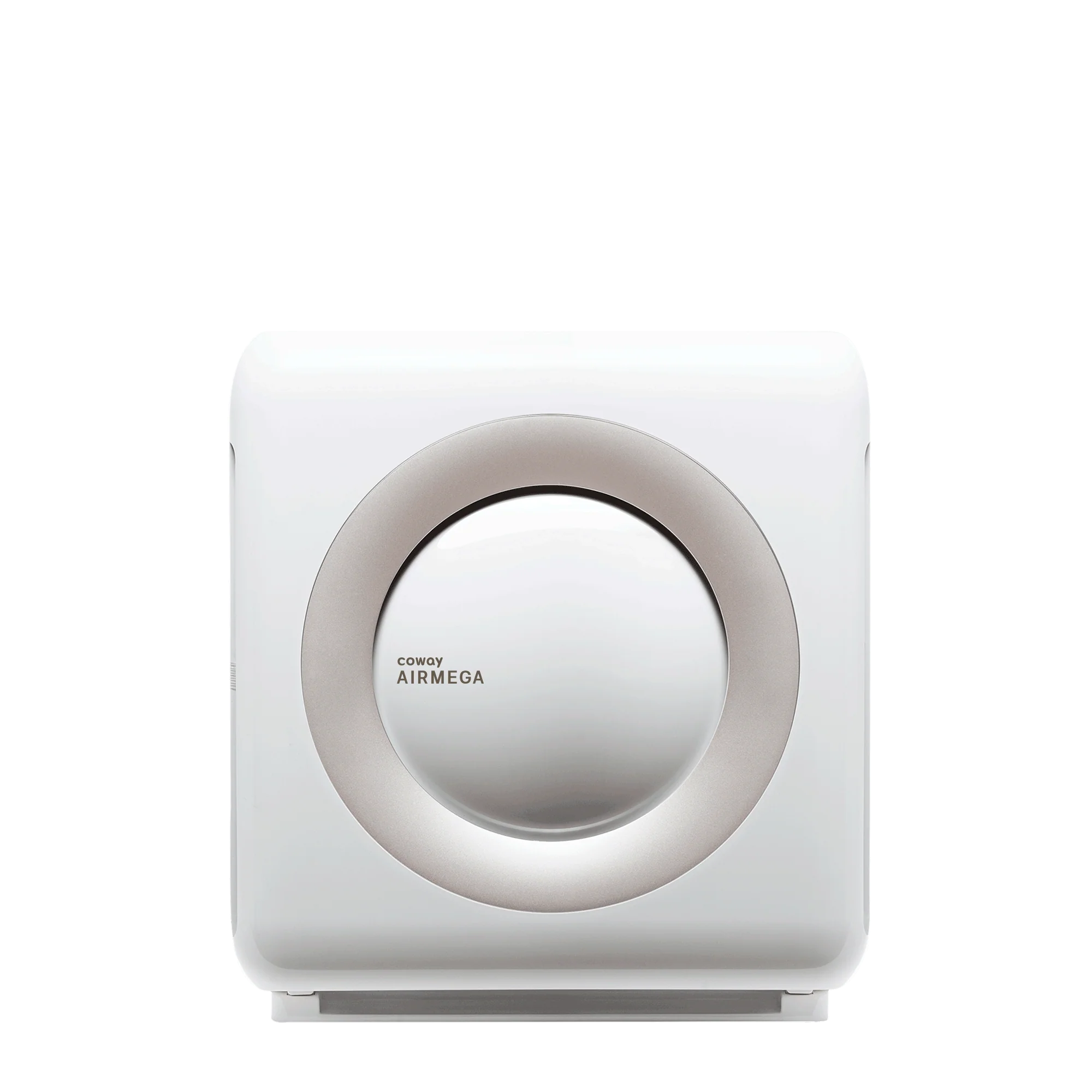
Coway AP-1512HH Mighty Review Editor Choice
✓ AHAM VerifiedOur Verdict
Key Specifications
- Room Coverage
- 361 sq ft
- CADR
- 233/246/240
- Filter
- True HEPA + Carbon + Pre-filter
- Noise
- 24 dB
- Power
- 77 watts
- Best For
- Medium rooms up to 361 sq ft. Wirecutter #1 for 10+ years. Best overall value.
📅 Prices checked . Amazon prices change frequently — click through for current price. Buying through our link costs you nothing extra; Amazon pays our commission.
What's in the Box
- Coway AP-1512HH air purifier
- Pre-installed 4-stage filter set
- Power cord
- User manual
- Filter replacement reminder sticker
Pros
- Wirecutter #1 for 10+ consecutive years
- AHAM verified CADR — no controversy
- True HEPA
- Fastest auto mode response in class
- 24dB ultra quiet sleep mode
- Eco mode at 4.9 watts
- 3-year warranty
Cons
- No WiFi or app control
- Carbon is impregnated fabric — weak on heavy odors
- Ionizer adds trace ozone (9ppb — CARB safe)
- Filter costs $60/year
- Design is dated
Best For
The Coway AP-1512HH is the verified performance reference at this tier: AHAM-verified CADR 246, independently confirmed, priced at $80–110 — less than one-third the 211i Max's price. For buyers who prioritize independently verified CADR per dollar, the Coway is the clear choice. It lacks Wi-Fi and the 211i Max's high airflow, but its AHAM certification provides a level of performance assurance the Blueair cannot match.
📅 Price checked August 2026 · Buying through this link costs you nothing extra — Amazon covers our commission
What to Know Before You Buy
HEPASilent Is Not H13 True HEPA — Why This Matters
Blueair's HEPASilent combines electrostatic charging with a mechanical filter. This is effective at capturing particles but is a fundamentally different technology from H13 True HEPA, which uses only mechanical filtration (fiber entrapment) to achieve 99.95% capture at 0.1–0.3 microns. HEPASilent's electrostatic charge helps capture smaller particles at lower air resistance — the reason Blueair achieves high airflow at low noise — but the electrostatic ionizer is the reason the 211i Max is not CARB-certified. For most households outside California, HEPASilent performs comparably to HEPA in practice. For California residents or anyone with ozone sensitivity, this is a disqualifying limitation. See our CADR guide for more on filtration technology comparisons.
The CADR Is Self-Reported — What That Means for Sizing
Blueair does not participate in the AHAM verification program for the 211i Max. The self-reported CADR of ~350 and manufacturer coverage of 630 sq ft are calculated by Blueair using its own methodology. At AHAM's 4.8 ACH allergen-relief standard, a CADR of 350 would cover approximately 275 sq ft in a room with 8-foot ceilings — not 630 sq ft. Blueair's 630 sq ft uses 2 ACH, not the allergy-relief standard. For allergen management, size the 211i Max for rooms under 300 sq ft rather than relying on the marketed 630 sq ft figure.
Filter Replacement at 6 Months — A Higher Annual Cost Than Competitors
Blueair recommends inner filter replacement every 6 months for the 211i Max at $60–80 per filter. Annual filter cost: $120–160. Compare to the Coway AP-1512HH at $20–25 per filter every 12 months ($20–25/year). Over 3 years, the 211i Max costs approximately $300–440 more in filters than the Coway. The washable pre-filter reduces how quickly the inner filter loads, but the 6-month inner filter cycle is the 211i Max's most significant ongoing cost disadvantage versus competitors. Factor this into any multi-year cost comparison.
Controls, AQI Display, and Tri-Sensor — What the Manual Documents
The Blueair 211i+Max has a 5-button control panel with separate indicator LEDs, all mounted on the top face of the unit. The manual (model number 3613111100) documents the following:
Buttons:
- ON/Standby: Powers the unit on or puts it in standby.
- Night Mode: Sets the fan to its lowest speed setting and fully dims all panel lights. Night mode is the correct mode for bedroom use — it minimizes both noise and light bleed. The unit continues purifying at minimum fan speed.
- Fan Speed: Cycles through speeds 0 (off/standby), 1, 2, 3, and 4. Speed 4 is maximum airflow. You can also set fan speed via the Blueair app.
- Auto Mode: Automatically adjusts fan speed based on indoor PM levels. Blueair designates this as the "recommended setting" — it's the correct default for most households. The sensor monitors PM1, PM2.5, and PM10 and ramps speed up when particle levels rise (cooking, cleaning, outdoor infiltration events).
- Toggle: Secondary function toggle — primarily used to cycle through display modes in conjunction with other controls.
Indicators:
- Air Quality Indicator (AQI) — 5 colors: The LED ring around the top panel displays air quality status in 5 color levels: Excellent (blue), Good (green), Moderate (yellow), Polluted (orange), Very Polluted (red). This is driven by the onboard particle sensor reading PM1, PM2.5, and PM10 simultaneously.
- Real-time PM values display: The panel shows PM1, PM2.5, and PM10 concentrations simultaneously — three readings at once, not just PM2.5. This tri-sensor monitoring is one of the 211i+Max's differentiators over simpler air purifiers that track only PM2.5.
- Filter replacement indicator: Lights up when the inner Particle & Carbon filter needs replacement (every 6 months at standard use).
- Wi-Fi indicator: Shows Wi-Fi connection status for the Blueair app link.
Product structure (bottom to top in airflow path): Washable fabric pre-filter (exterior sleeve around the body) → Particle & Carbon filter → Silencer layer → Fan motor → Air outlet (top). The washable fabric pre-filter wraps the outside of the cylindrical body, capturing large particles before they reach the inner filter. It's available in multiple colors. The Silencer layer between the particle filter and fan motor is documented as a noise-reduction component specific to the i+Max series.
Blueair 211i Max vs 211i+ — What the Upgrade Actually Delivers
The 211i Max is Blueair's replacement for the discontinued 211i+. The upgrade is meaningful in specific areas and minimal in others — understanding the differences helps buyers decide whether the upgrade is worth the price premium over the previous generation.
Motor and CADR Improvement
211i+: Self-reported CADR ~250, single speed + auto mode, no Wi-Fi.
211i Max: Self-reported CADR ~350 (40% higher), 3-speed control, Wi-Fi added.
The motor upgrade is the most significant functional improvement. At self-reported CADR 350, the 211i Max moves substantially more air per minute than the 211i+ — relevant for buyers who sized the 211i+ and found it insufficient for their room. Neither model is AHAM-verified, so both CADR figures carry the caveat of self-reported methodology.
Wi-Fi and App Features
The 211i Max connects to the Blueair app via Wi-Fi, enabling: remote fan speed control, scheduling, filter life monitoring, and air quality history via the optional Blueair Aware sensor (sold separately). The 211i+ offered no Wi-Fi or app connectivity. For buyers who want to set schedules or monitor filter life from their phone, the app integration is a genuine upgrade. For buyers who prefer a simple non-connected appliance, the connectivity adds a dependency on Blueair's server infrastructure that the 211i+ avoided.
Price and Availability
211i+ (discontinued): frequently found at $150–200 clearance. 211i Max: $250–300 retail. If the 211i+ is still available at significantly below-market pricing, it remains a functional high-airflow option for buyers who do not need Wi-Fi. The 211i Max is the correct choice for buyers who want the current Blueair 211-series with app connectivity and maximum airflow.
What Did Not Change
The HEPASilent technology, non-AHAM-verification status, fabric pre-filter design, and CARB non-certification carried over unchanged from the 211i+ to the 211i Max. These limitations are inherited from the 211i+ lineage — buyers hoping the 211i Max addresses the CARB certification gap or adds AHAM verification will be disappointed.
HEPASilent vs True HEPA — The Technology Difference Explained
Blueair's HEPASilent technology is one of the most frequently misunderstood specifications in the air purifier category. It is often marketed alongside HEPA purifiers in ways that imply equivalence — but the underlying technology differs in meaningful ways.
How HEPASilent Works
HEPASilent uses two filtration mechanisms simultaneously: electrostatic charging (particles are given an electrical charge as they enter the unit, making them more likely to adhere to the filter medium) and mechanical filtration (the filter medium itself physically traps particles by interception, diffusion, and impaction). The combination allows Blueair to achieve high particle capture rates at lower air resistance than pure mechanical HEPA — enabling higher airflow at a given noise level and motor size.
Why It Is Not H13 True HEPA
H13 True HEPA is defined by capture efficiency: 99.95% of particles at 0.1–0.3 microns, tested without electrostatic assistance. HEPASilent's capture efficiency at the same particle size range is achieved partly through electrostatic charge, not purely mechanical entrapment. If the electrostatic charge diminishes (due to humidity or the filter loading with particles), the capture efficiency changes. True HEPA maintains its efficiency specification purely mechanically, regardless of electrostatic conditions.
The CARB Non-Certification Issue
California's Air Resources Board does not certify air cleaners that use electrostatic technology producing ozone above 0.050 parts per million. The 211i Max's electrostatic ionizer produces trace ozone — below most people's detection threshold and likely below levels causing health concern in well-ventilated spaces, but above CARB's certification threshold. This is why the 211i Max is not sold or recommended for California use. Buyers in California must use a CARB-certified purifier — the Coway AP-1512HH, Winix 5500-2, and Levoit Core 400S are all CARB-certified alternatives.
Practical Performance for Most Households
For most households outside California without ozone sensitivity, HEPASilent's practical particle capture performance is comparable to True HEPA in real-world conditions. The distinction matters primarily for: California residents, households with known ozone sensitivity or respiratory conditions exacerbated by ozone, and buyers who require independently verified (AHAM) performance data for medical justification.
Blueair 211i Max vs Coway AP-1512HH — High Airflow vs Verified Performance
The Coway AP-1512HH is the standard AHAM-verified reference purifier in the $80–150 tier. Comparing it to the Blueair 211i Max highlights the trade-off between self-reported high CADR and independently verified moderate CADR.
CADR Comparison
Blueair 211i Max: Self-reported ~350 (not AHAM-verified).
Coway AP-1512HH: AHAM-verified CADR 246 (dust), 233 (smoke), 240 (pollen).
If Blueair's self-reported CADR is accurate, the 211i Max moves significantly more air. However, without AHAM verification, the Blueair figure cannot be independently confirmed. The Coway's AHAM-verified numbers are confirmed by independent laboratory testing — they are the reliable baseline for comparison.
Price Differential
Blueair 211i Max: $250–300 hardware, $60–80 filter every 6 months ($120–160/year).
Coway AP-1512HH: $80–110 hardware, $20–25 filter every 12 months ($20–25/year).
Over 3 years: 211i Max approximately $610–780 total; Coway approximately $140–185 total. The Coway is approximately 4× cheaper over 3 years. The 211i Max's price premium is substantial — justified only by significantly higher airflow (if the self-reported CADR is accurate) and Wi-Fi connectivity.
Which to Choose
Choose the 211i Max for: rooms over 300 sq ft where higher airflow matters, buyers who want Wi-Fi monitoring and scheduling, and non-California households comfortable with self-reported CADR. Choose the Coway AP-1512HH for: any buyer who prioritizes AHAM-verified performance per dollar, California residents (CARB-certified), and budget-conscious buyers who want independently confirmed filtration effectiveness. The Coway is one of the most validated air purifiers in the market — its CADR has been independently confirmed across multiple testing programs. The 211i Max is faster at moving air at low noise, but at a price premium that is difficult to justify on filtration performance alone.
Blueair 211i Max Real-World Sizing — What 630 sq ft vs 275 sq ft Actually Means
The gap between Blueair's marketed 630 sq ft coverage and the 4.8 ACH allergen-relief calculation of approximately 275 sq ft is one of the most significant coverage claim discrepancies in the mid-range purifier category. Understanding this gap is essential to sizing the 211i Max correctly for your space.
How Blueair Calculates 630 sq ft
Blueair's coverage claims use approximately 2 air changes per hour (ACH) — a rate appropriate for general air quality maintenance, not allergen reduction. At 2 ACH with 8-foot ceilings and a CADR of ~350, the calculation yields approximately 630 sq ft. This is mathematically consistent but uses a standard that is not aligned with how allergists and the EPA recommend sizing purifiers for health applications.
The AHAM 4.8 ACH Standard for Allergen Relief
AHAM's allergy-relief standard uses 4.8 ACH — the rate at which airborne allergens are meaningfully reduced. At 4.8 ACH with 8-foot ceilings and a CADR of ~350, the 211i Max covers approximately 275 sq ft. This is the sizing figure relevant for dust, dander, and pollen reduction to clinically meaningful levels. The 211i Max is correctly sized for rooms under 300 sq ft when allergen relief is the goal — not the marketed 630 sq ft.
Practical Room Matching
The 211i Max is well-suited to: bedrooms up to 300 sq ft for allergen control, open-plan spaces up to 600 sq ft for general air freshening (lower ACH standard), and living rooms where reducing ambient particle concentration — not reaching clinical allergen-relief ACH — is the goal. For a 600 sq ft room requiring allergen-relief ACH, you need CADR ~730 — significantly beyond what the 211i Max or any single sub-$500 purifier achieves. In large spaces, the 211i Max is a general air quality improvement device, not an allergen-relief solution at the marketed coverage area.
Optimal Placement for Maximum Effect
Place the 211i Max in the center of the room or as close to the center as practical to maximize air circulation coverage. Avoid placing it in corners or against walls, which reduce intake efficiency. In bedrooms, position it 3–6 feet from the sleeping area to direct clean air toward the breathing zone during sleep — the highest-value positioning for allergen control during the overnight hours when total exposure is highest.