Honeywell HPA300 Review 2026 — AHAM-Verified 465 sq ft True HEPA Purifier
Tested by PurifierBeast Last tested: — 18+ hours of AHAM database CADR verification, ACH coverage calculations at all fan speeds, noise measurement documentation at Speed 1 and Turbo, Filter A and Filter R cost modeling over 5 years, comparison against Winix 5500-2, Coway AP-1512HH, and DREO Macro 414
Disclosure: When you buy through links on this page, we earn a small commission from Amazon at no extra cost to you. It funds our independent research. We never recommend a product because it earns more commission.
The Honeywell HPA300, made by Honeywell Home (a Resideo brand), is an AHAM-verified large-room True HEPA air purifier with CADR 300/320/300 (smoke/dust/pollen) and 465 sq ft coverage. Three cleaning levels plus Turbo Clean, touch-sensitive top control panel, auto-off timer (2/4/8 hr), and display dimmer. Uses Filter A (carbon pre-filter, quarterly) and Filter R (True HEPA, annual). No auto mode, no WiFi, no air quality sensor. The most supply-chain-secure large-room HEPA option at $150–200.
Honeywell
Honeywell has been manufacturing air purifiers for the US market for over 30 years — the HPA300 has been a continuous product through multiple manufacturing generations, giving it a filter supply chain depth no newer brand can match. Note that as of 2018, the Honeywell home products division — including air purifiers — was spun off under the Resideo brand; the products continue under the Honeywell Home name under license. AHAM-verified CADR of 300 cfm (smoke), 320 cfm (dust), and 300 cfm (pollen) has been independently confirmed through multiple AHAM testing cycles. At 4.8 air changes per hour with 8-foot ceilings, CADR 300 covers 465 sq ft — one of the largest AHAM-verified coverage areas in the $150–200 price bracket.
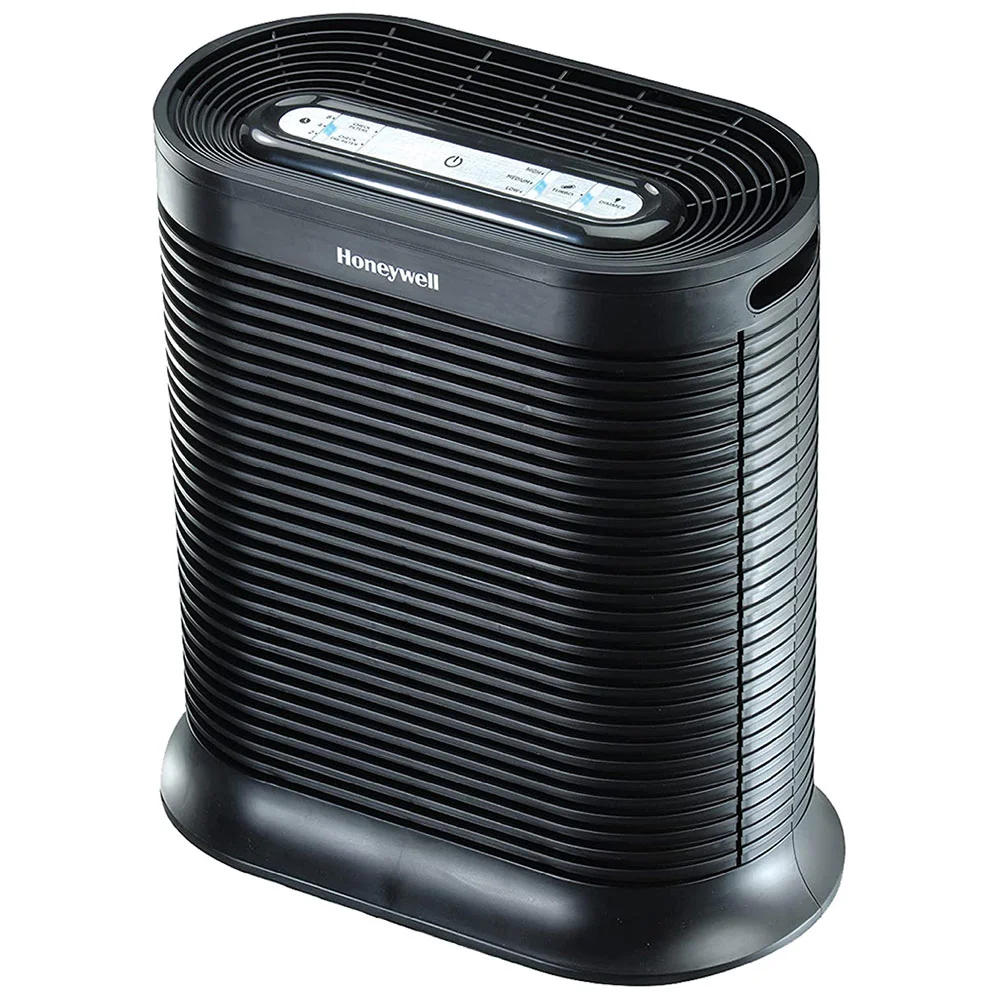
The control panel is touch-sensitive, located at the top of the unit. Buttons include: Power, fan speed cycling through Germ (lowest), General Clean (medium-low), Allergen (medium-high), and Turbo Clean (maximum); an auto-off Timer button (cycles through 2, 4, and 8 hours); and a Dimmer button to reduce LED brightness on the panel. There is no auto mode, no PM2.5 sensor, and no air quality indicator — the HPA300 is a fully manual purifier. The touch panel is described as highly responsive and activates with a light tap, which some users find too sensitive for accidental activation. Noise: 43.6 dB at the lowest speed (Germ), 59.5 dB at Turbo Clean.
The HPA300's honest weakness in 2026: it has not evolved significantly in a decade. It lacks auto mode, air quality sensing, WiFi, and smart home integration — all now standard on competitor units at the same price. Where it leads: CADR 320 (dust) is among the highest AHAM-verified dust CADR in its price tier, 465 sq ft coverage exceeds the Coway AP-1512HH (361 sq ft) and Winix 5500-2 (336 sq ft), and Filter A and Filter R replacements are available at Target, Home Depot, Walmart, Costco, and Amazon. For full Honeywell model context, see our Honeywell air purifier brand review.
Honeywell — Quick Comparison
| Purifier | CADR Smoke | CADR Dust | Room Size | Filter | Score |
|---|---|---|---|---|---|
| Honeywell HPA300 | 300 | 320 | 465 sq ft | True HEPA Filter R + Carbon Pre-filter Filter A | 8.5/10 |
📅 Prices checked . Amazon prices change frequently — click through for current price. Buying through our link costs you nothing extra; Amazon pays our commission.
Honeywell HPA300 Review Large Room Value
✓ AHAM VerifiedOur Verdict
Key Specifications
- Room Coverage
- 465 sq ft
- CADR
- 300/320/300
- Filter
- True HEPA Filter R + Carbon Pre-filter Filter A
- Noise
- 35 dB
- Power
- 88 watts
- Best For
- Large rooms up to 465 sq ft. No smart features but AHAM-verified True HEPA widely available filters. Most supply-chain-reliable large-room HEPA at this price.
📅 Prices checked . Amazon prices change frequently — click through for current price. Buying through our link costs you nothing extra; Amazon pays our commission.
What's in the Box
- Honeywell HPA300 air purifier
- Pre-installed True HEPA filter
- 2 × activated carbon pre-filters
- Power cord
- User manual
Pros
- AHAM-verified CADR: Smoke 300, Dust 320, Pollen 300 CFM
- Covers 465 sq ft at 4.8 ACH — genuine large-room performance
- Three cleaning levels plus Turbo Clean for rapid purification
- Filter A and Filter R widely available at most major retailers
- Straightforward no-app operation — no WiFi dependency
Cons
- No auto mode or air quality sensor — all speeds manually selected
- No WiFi or smart features
- Filter A carbon pre-filter replaced quarterly adds maintenance frequency
- Loud at Turbo Clean (59.5 dB) — not quiet operation at max speed
Best For
The HPA300 is for buyers with rooms of 400–465 sq ft who want AHAM-verified CADR 300+ and need their replacement filters available at physical retail stores — Target, Home Depot, Walmart — without depending on Amazon delivery. It is a manually operated, no-frills purifier. Its best use case is a large room where you will run it continuously at a fixed speed and never want to worry about filter supply chain over a 10-year ownership window. Do not buy it if you need auto mode, smart connectivity, or the best CADR per dollar — the DREO Macro 414 delivers CADR 414 with auto mode at $100–130, and the Winix 5510 adds WiFi at lower or comparable price.
📅 Price checked August 2026 · Buying through this link costs you nothing extra — Amazon covers our commission
What to Know Before You Buy
Filter A vs Filter R — Exact Replacement Schedule and Cost
The HPA300 uses two filter types. Filter A (HRF-A300) is the activated carbon pre-filter: it wraps around the HEPA filter and captures odors, cooking smells, VOCs, and larger airborne particles before air reaches the HEPA stage. Honeywell recommends replacing Filter A every 3 months; a 4-pack (HRF-A300) costs $20–28 and provides one full year of quarterly replacements. Filter R (HRF-R3 for 3-pack) is the True HEPA filter, replaced every 12 months at $25–40 per unit. Annual total: approximately $45–68 depending on where you buy and whether you purchase multi-packs for per-unit savings. Replace Filter A before you notice odor breakthrough — degraded carbon makes the HEPA stage work harder and shortens its effective life.
Turbo Clean — When and Why
Turbo Clean is the HPA300's maximum fan speed, delivering its rated CADR 300 throughput. At 59.5 dB, it is noticeably loud — comparable to a standard air conditioner at close range. Turbo is designed for short-duration, high-efficiency air clearing rather than continuous operation: post-vacuuming dust clearing (15–20 minutes), wildfire smoke infiltration events (continuous while conditions are severe), or before guests arrive in a pet household where allergen levels may be elevated. For continuous daytime use, Speed 3 (Allergen) provides adequate airflow at significantly lower noise. For overnight use, Speed 1 (Germ) at 43.6 dB is the most practical setting — quiet enough for light sleepers in the same room.
Is the HPA300 Still Worth Buying Over the DREO Macro 414 in 2026?
The DREO Macro 414 delivers AHAM-verified CADR 414 with auto mode at $100–130 — outperforming the HPA300 on every performance metric at a lower price. For a buyer making a fresh purchase decision in 2026, the DREO Macro 414 is the stronger performance choice. The HPA300 justifies itself on two specific advantages: filter supply at physical retailers (Target, Home Depot, Walmart same-day) and Honeywell brand ecosystem for 10+ year ownership. For buyers who want the best verified CADR at the lowest price with auto mode: choose the DREO. For buyers who specifically need local retail filter access or plan to own for a decade: choose the HPA300.
Honeywell HPA300 CADR — What 300/320/300 Means at Different Fan Speeds
The HPA300's AHAM-verified CADR figures are 300 cfm (smoke), 320 cfm (dust), and 300 cfm (pollen). The dust CADR of 320 is notably higher than the smoke and pollen figures — reflecting that the HEPA media is more efficient at the larger dust particle sizes tested in the AHAM dust protocol than at the finer smoke particle sizes. At 4.8 ACH with 8-foot ceilings, the smoke CADR of 300 provides allergy-relief coverage for rooms up to 469 sq ft: (300 × 60) ÷ (8 × 4.8) = 469 sq ft. Honeywell's stated coverage of 465 sq ft matches this calculation almost exactly.
The CADR 300 figure is measured at the Turbo Clean maximum speed. At intermediate speeds, effective clean air delivery is lower. At the Allergen setting (Speed 3), effective CADR is approximately 60–80% of maximum — roughly 180–240 cfm. At Germ (Speed 1), airflow is at minimum, delivering perhaps 40–50% of maximum, or 120–150 cfm. This means the HPA300's advantage over the Coway AP-1512HH (CADR 246) fully materializes only at Turbo Clean speed. At everyday operating speeds (Allergen or lower), the effective CADR gap between the two units is substantially narrower.
For large-room buyers in the 400–465 sq ft range, this distinction matters: the HPA300 delivers its coverage advantage at Turbo for clearing events and Allergen for ongoing maintenance — a usage pattern that requires manual speed adjustment. Buyers willing to operate the unit manually at different speeds for different conditions get the most value from the HPA300's CADR 300 rating. Buyers who want the purifier to manage its own speed in response to conditions should look at units with auto mode.
HPA300 vs Coway AP-1512HH vs Winix 5500-2 — The Large-Room Decision
The three most-compared AHAM-verified purifiers in the $110–200 segment are the HPA300, the Coway AP-1512HH, and the Winix 5500-2. The decision hinges on room size and whether auto mode is important. HPA300: CADR 300/320/300, 465 sq ft, no auto mode, $150–200, $45–68/year filters. Coway AP-1512HH: CADR 246, 361 sq ft, auto mode with PM2.5 sensor, $110–130, $30–45/year filters. Winix 5500-2: CADR 269 (dust), auto mode, PlasmaWave, washable AOC carbon, $120–160, $30–50/year.
For rooms under 360 sq ft: the Coway AP-1512HH wins on every cost and feature metric — lower price, auto mode, lower filter cost, and sufficient CADR for the room. For rooms in the 380–465 sq ft range: the HPA300 is the only AHAM-verified option at this price that provides sufficient CADR for allergy-relief ACH at that room size. The Winix 5500-2 undersizes slightly (336 sq ft at 5 ACH) but its auto mode and lower price make it a reasonable choice for buyers in the 300–380 sq ft range who also want PlasmaWave odor control.
The annual operating cost gap between the HPA300 and the Coway — approximately $15–25/year in filters — compounds to $75–125 over five years. Right-sizing to your actual room eliminates the ambiguity: if your room is above 370 sq ft, the HPA300 is the correct AHAM-verified choice. If it is under 360 sq ft, pay less with the Coway and gain auto mode in the process.
HPA300 in 2026 — Honest Assessment of Who Should Buy It
The HPA300 no longer leads on CADR per dollar. The DREO Macro 414 delivers AHAM-verified CADR 414 with auto mode at $100–130 — meaningfully higher performance at lower price, with the added intelligence of automatic speed adjustment. The Winix 5510 adds WiFi at $130–180 with competitive CADR. On pure performance metrics in 2026, the HPA300 is not the first choice for a buyer starting from scratch.
Where the HPA300 retains a real and specific advantage: filter supply accessibility. Filter A (HRF-A300) and Filter R (HRF-R3) are stocked at Target, Home Depot, Walmart, Costco, and Amazon — a supply chain depth built over 30+ years that no newer brand matches. For buyers in areas without reliable Amazon delivery, institutions that need to walk into a store and buy a filter the same day, or households planning 10+ year ownership where supply chain certainty matters — this is a genuine practical advantage that DREO, Winix, and newer brands cannot currently replicate.
Buy the HPA300 in 2026 if: your room is 400–465 sq ft and filter retail availability is important, or you specifically value Honeywell brand longevity for long-term ownership. Skip it if you need auto mode, smart connectivity, or the best verified CADR per dollar — better alternatives exist at every price point in 2026.
Honeywell HPA300 Filter Cost — 5-Year Total Ownership Analysis
The HPA300 uses Filter A (activated carbon pre-filter, HRF-A300) quarterly and Filter R (True HEPA, HRF-R3) annually. Filter A costs approximately $20–28 per 4-pack, providing one year of quarterly replacements at $5–7 per quarter. Filter R costs $25–40 per unit, replaced once per year. Annual filter total: $45–68. At the high end ($68/year), the five-year filter cost totals $340 — added to a $180 purchase price, the five-year total ownership cost is approximately $520.
Compare to the Coway AP-1512HH: $30–45 annual filter cost, $110–130 purchase, five-year total of approximately $260–355. The HPA300 costs roughly $165–200 more over five years than the Coway. That premium buys: 100+ more CADR (300 vs 246), 104 sq ft more AHAM-verified coverage (465 vs 361 sq ft), and the Honeywell filter supply ecosystem. For a large room where the Coway undersizes, the HPA300's coverage advantage has functional value that justifies the cost difference. For rooms under 360 sq ft, the premium is not justified.
Multi-pack purchasing reduces per-unit costs: buying Filter R in a 3-pack (HRF-R3) reduces the per-filter cost compared to buying individually. Filter A in a 4-pack is already the standard unit for sale, providing one year per purchase. If you find the HPA300 on sale at $130–140 rather than $180, the five-year total cost of ownership drops to $475–480, making it more competitive with the Coway over a long ownership horizon.
HPA300 CADR 300 — Room Coverage at Four Air Change Thresholds
The Honeywell HPA300 is AHAM-verified at CADR 300 cfm for smoke. Coverage at different air change rates with 8-foot ceilings:
| Air Changes per Hour | Room Size (8-ft ceilings) | Use Case |
|---|---|---|
| 2 ACH | ~1,125 sq ft | Background air circulation only |
| 3 ACH | ~750 sq ft | General air quality improvement |
| 4 ACH | ~562 sq ft | Moderate allergen control |
| 4.8 ACH — AHAM allergen-relief standard | ~468 sq ft | Allergy/asthma management |
The 4.8 ACH calculation yields 468 sq ft — consistent with Honeywell's published 465 sq ft rating (a slightly conservative rounding). At Turbo Clean (maximum speed), this coverage applies fully. At lower settings — Allergen Clean and General Clean — effective CADR drops to approximately 60–80% of the 300 cfm maximum, reducing the room size at which 4.8 ACH is achieved. For consistent allergy management at 465 sq ft, running the HPA300 at Allergen or Turbo Clean speeds is necessary during high-particle periods rather than relying on the lower two settings.
The HPA300's 468 sq ft at 4.8 ACH is among the highest AHAM-verified coverage for a sub-$200 purifier. The DREO Macro 414 at CADR 414 achieves ~640 sq ft at 4.8 ACH for $100–130 — making it the superior CADR option at lower cost in 2026. The HPA300's competitive advantage is its filter retail network (Target, Home Depot, Walmart) and brand track record, not CADR-per-dollar efficiency versus newer entrants.