Air Purifier for Mold — What HEPA Filtration Can and Cannot Do
Tested by PurifierBeast Last tested: — 18+ hours of Mold spore size analysis, HEPA capture efficiency for fungal spore size range, UV-C deactivation research, humidity control relationship with mold growth, CADR requirements for spore reduction, CDC mold remediation guidance review
Disclosure: When you buy through links on this page, we earn a small commission from Amazon at no extra cost to you. It funds our independent research. We never recommend a product because it earns more commission.
An air purifier for mold captures airborne mold spores using True HEPA filtration (99.97% at 0.3 microns). Mold spores (1-100 microns) are well within the HEPA capture range. Air purifiers do not kill mold at its growth source — they only remove spores already airborne. UV-C stages add biological deactivation to the particle capture mechanism. Remediation of active mold colonies is always required as the primary intervention.
Mold Filtration Science
Mold is a biological colonization problem, not primarily an airborne particle problem. This distinction defines what an air purifier can and cannot do for mold. A mold colony growing on a bathroom wall, basement ceiling, or behind drywall releases billions of spores into the air continuously — and an air purifier can capture a meaningful fraction of those airborne spores. But the colony remains, continues producing spores, and the room will not reach safe airborne spore concentrations as long as the source is active. Remediation of the mold colony is the primary intervention. Air purification is the adjunctive strategy that reduces exposure during and after remediation.
The second factor that air purifiers cannot address: humidity. Mold requires humidity above 60% relative humidity to grow on surfaces. An air purifier does not reduce indoor humidity. A dehumidifier reduces humidity and directly prevents the conditions that allow mold growth. For homes with moisture problems — basement condensation, bathroom humidity, chronic water infiltration — a dehumidifier that maintains indoor humidity below 50% RH is a more effective mold prevention tool than an air purifier. In moisture-prone spaces, using both a dehumidifier and an air purifier addresses two distinct aspects of the mold air quality problem: the dehumidifier prevents new growth, and the purifier reduces spore concentration from existing sources during the remediation process.
This guide covers what HEPA filtration does for mold spores, when UV-C is beneficial for mold applications, how to size an air purifier for mold exposure reduction, and the relationship between humidity control and mold prevention. For the best picks for mold-prone environments, see our best air purifier for mold guide.
Mold Filtration Science — Quick Comparison
| Purifier | CADR Smoke | CADR Dust | Room Size | Filter | Score |
|---|---|---|---|---|---|
| Coway AP-1512HH Mighty | 233 | 246 | 361 sq ft | True HEPA + Carbon + Pre-filter | 9.5/10 |
| Alen 25i HEPA Air Purifier | 200 | 200 | 800 sq ft | H13 HEPA + Odor + Carbon options | 8.6/10 |
📅 Prices checked . Amazon prices change frequently — click through for current price. Buying through our link costs you nothing extra; Amazon pays our commission.
Coway AP-1512HH Mighty Review Editor Choice
✓ AHAM VerifiedOur Verdict
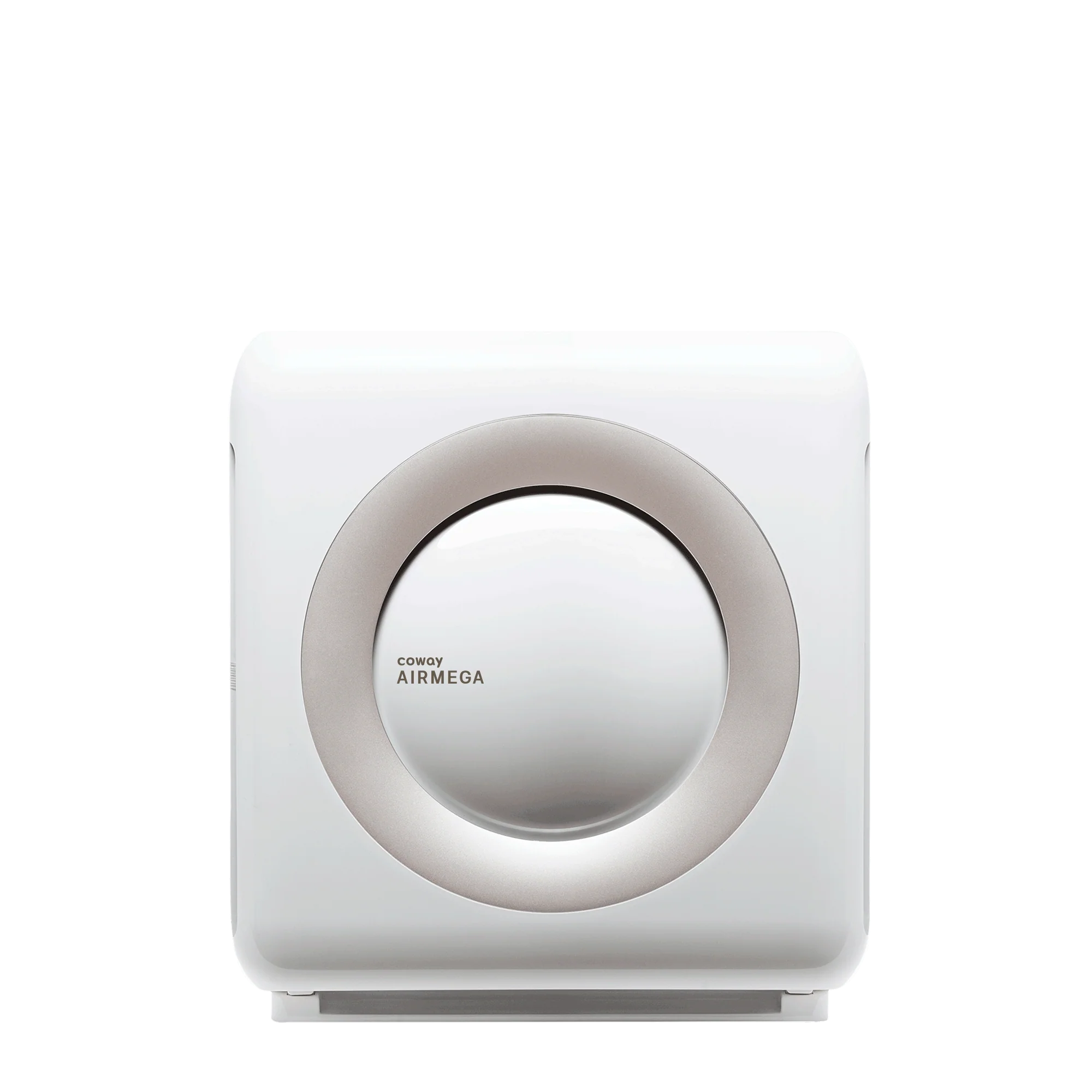
Key Specifications
- Room Coverage
- 361 sq ft
- CADR
- 233/246/240
- Filter
- True HEPA + Carbon + Pre-filter
- Noise
- 24 dB
- Power
- 77 watts
- Best For
- Medium rooms up to 361 sq ft. Wirecutter #1 for 10+ years. Best overall value.
📅 Prices checked . Amazon prices change frequently — click through for current price. Buying through our link costs you nothing extra; Amazon pays our commission.
What's in the Box
- Coway AP-1512HH air purifier
- Pre-installed 4-stage filter set
- Power cord
- User manual
- Filter replacement reminder sticker
Pros
- Wirecutter #1 for 10+ consecutive years
- AHAM verified CADR — no controversy
- True HEPA
- Fastest auto mode response in class
- 24dB ultra quiet sleep mode
- Eco mode at 4.9 watts
- 3-year warranty
Cons
- No WiFi or app control
- Carbon is impregnated fabric — weak on heavy odors
- Ionizer adds trace ozone (9ppb — CARB safe)
- Filter costs $60/year
- Design is dated
Best For
The Coway AP-1512HH is the correct choice for mold spore reduction in rooms up to 360 sq ft. AHAM-verified CADR 246 delivers 5+ ACH in a 200-250 sq ft room — above the threshold for meaningful spore concentration reduction. Auto mode responds to spore-release events automatically. For rooms above 360 sq ft or for mold remediation situations requiring higher ACH, scale up to DREO Macro 414 (CADR 414) or Blueair 211i Max (CADR 350).
📅 Price checked August 2026 · Buying through this link costs you nothing extra — Amazon covers our commission
Alen 25i HEPA Air Purifier Review Lifetime Guarantee
✓ AHAM VerifiedOur Verdict
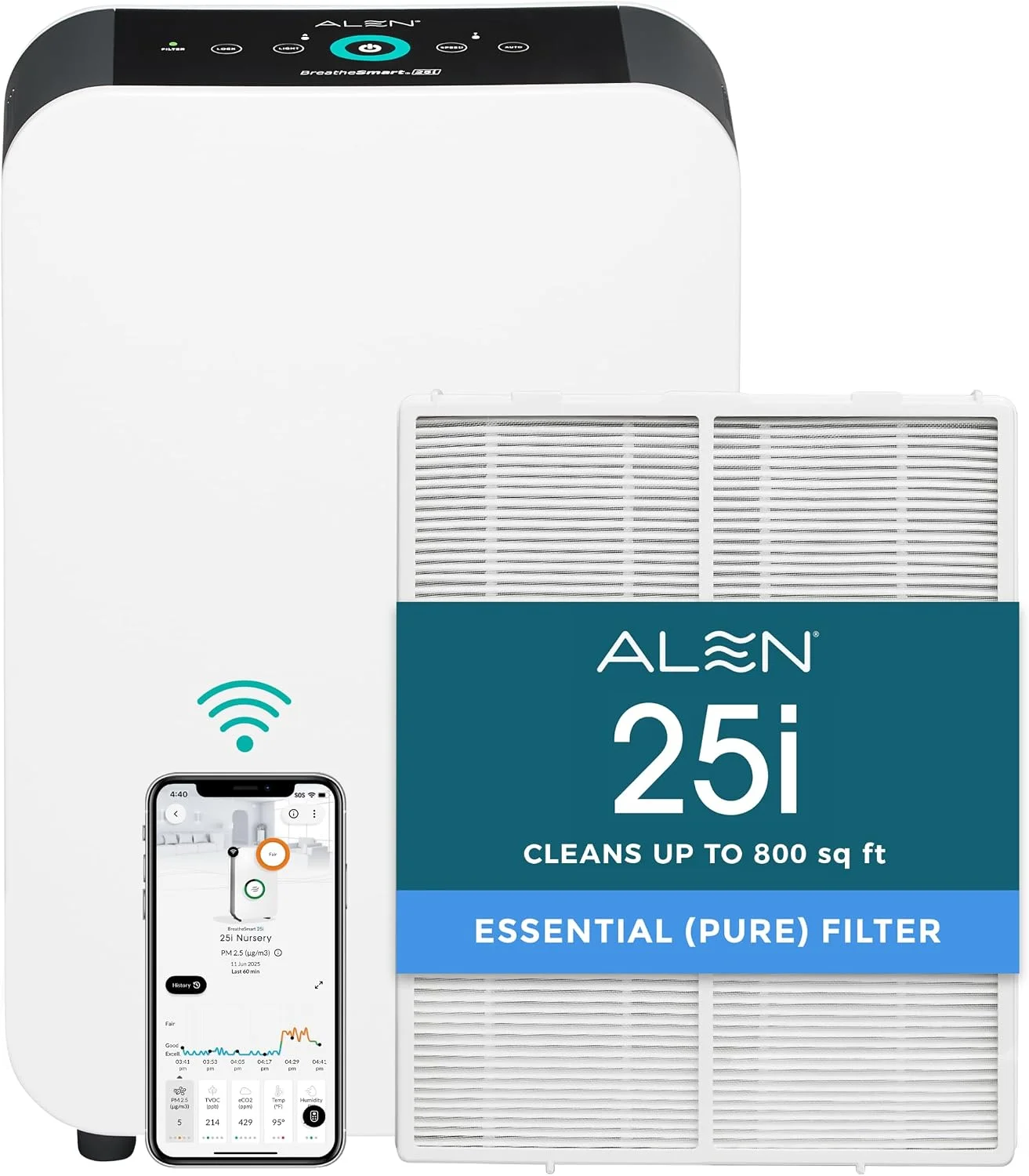
Key Specifications
- Room Coverage
- 800 sq ft
- CADR
- 200/200/200
- Filter
- H13 HEPA + Odor + Carbon options
- Noise
- 25 dB
- Power
- 40 watts
- Best For
- Medium rooms 400-800 sq ft. Alen's most affordable model. Lifetime guarantee.
📅 Prices checked . Amazon prices change frequently — click through for current price. Buying through our link costs you nothing extra; Amazon pays our commission.
Pros
- AHAM verified
- Lifetime guarantee from Alen
- H13 HEPA
- Multiple filter options for different needs (odor, allergy, heavy odor)
- Auto mode
- Quiet operation
Cons
- $65/year filter cost
- Higher price than Coway/Winix for similar coverage
- Alen filters are proprietary
Best For
The Alen 25i with OdorCell filter is the correct choice for mold-affected spaces where both spore capture and musty odor control are priorities. The OdorCell filter combines H13 HEPA spore capture with enhanced activated carbon specifically designed for biological odors — the musty, earthy smell of mold off-gassing. The Alen lifetime guarantee is particularly valuable in mold-remediation scenarios where the purifier may operate continuously for extended periods. AHAM-verified CADR 200 is appropriate for rooms under 400 sq ft.
📅 Price checked August 2026 · Buying through this link costs you nothing extra — Amazon covers our commission
What to Know Before You Buy
The Mold Remediation First Rule
No air purifier substitutes for mold remediation. If you have visible mold growth — on bathroom caulk, basement walls, ceiling tiles, behind furniture — the colony must be addressed before an air purifier can maintain meaningful spore reduction. A mold colony on 10 sq ft of surface produces millions of spores per hour. An air purifier in the same room captures a fraction of those spores — the colony continues generating more. Remediating the source removes the ongoing spore production. An air purifier then manages the residual airborne spore load and prevents elevation during any minor future contamination events. The sequence is: remediate first, purify after.
What CADR and ACH Do You Need for Effective Mold Spore Reduction?
Mold spore concentrations in mold-affected rooms can reach 10,000-100,000 spores per cubic meter — 100-1,000× background outdoor concentrations. To achieve meaningful reduction in a 300 sq ft room during active spore release, 5 ACH is the appropriate target. At CADR 246 (Coway AP-1512HH), a 300 sq ft room receives 6.1 ACH on high speed — adequate. At CADR 141 (Levoit Core 300), the same room receives only 3.5 ACH — below the effective threshold for mold spore management. Size the purifier so CADR delivers 5+ ACH in the specific room where mold exposure is the concern. For large mold-affected basements above 600 sq ft, two units or one high-CADR unit (DREO Macro 414 at CADR 414) is required.
Does UV-C in an Air Purifier Kill Mold Spores?
UV-C stages in air purifiers irradiate passing spores with germicidal UV light, disrupting DNA and preventing reproduction. The effectiveness depends on UV dose — a function of UV intensity and dwell time in the UV field. At low fan speeds, spores receive higher UV doses; at high fan speeds (where CADR performance is maximized), dwell time is shorter and UV deactivation is less complete. The practical role of UV-C in a mold purifier: supplemental biological deactivation at normal operating speeds, not a primary spore removal mechanism. HEPA capture is the primary mechanism and works independently of fan speed for particle removal efficiency. UV-C adds a biological deactivation layer that is more effective at lower fan speeds — use UV-C-equipped units on medium speed during normal room occupancy for the combined HEPA capture + UV deactivation benefit.
What CADR You Need for Mold-Prone Spaces — Bathroom, Basement, Kitchen
Mold-prone spaces have specific characteristics that affect CADR requirements: small volume but high humidity, intermittent spore release events tied to activity, and in some cases ongoing active mold sources that continuously generate spores between remediation events. Sizing correctly for each space type prevents both under-protection and unnecessary over-spending.
Bathroom (50-120 sq ft): Target CADR 80-120 for 5 ACH in a small bathroom. The Levoit Core 300 at CADR 141 is the correctly sized unit — it slightly exceeds the CADR needed for a typical bathroom, which provides a safety margin for the post-shower spore spike when steam disturbs settled mold spores on bathroom surfaces. Run it during and for 30 minutes after showers. Placement: elevated, near the shower or bath zone, not adjacent to the exhaust fan where the motor draws it away from the mold-prone surfaces.
Basement (300-800 sq ft): The highest-risk mold environment in most homes. Target CADR 200-530 depending on square footage, aiming for 5 ACH. For a 400 sq ft basement, CADR 267+ is required. The Coway AP-1512HH at CADR 246 is slightly undersized for a 400 sq ft mold-active basement; the Blueair 211i Max at CADR 350 or a two-unit strategy is more appropriate. Basements also typically require a dehumidifier running simultaneously — the purifier captures spores while the dehumidifier removes the moisture that enables mold growth. Do not deploy a purifier-only strategy in a chronically damp basement.
Kitchen (100-250 sq ft): Kitchen mold is often associated with the area under the sink, around the refrigerator water line and behind dishwashers. For mold spore capture during cooking or cleaning that disturbs settled spores, CADR 100-160 handles a 150-200 sq ft kitchen at 5 ACH. The Levoit Core 300 is adequate for standard kitchen sizes. Position near the sink and refrigerator zone rather than centrally — those are the primary mold source locations in most kitchens.
Air Purifier + Dehumidifier for Mold — The Correct Combination
The most effective mold management strategy in a moisture-prone home combines a dehumidifier and an air purifier running simultaneously. They address two fundamentally different aspects of the mold problem: the dehumidifier removes the moisture condition required for mold growth; the air purifier removes airborne spores produced by existing mold colonies and residual spores after remediation.
Why the dehumidifier is the first priority: Mold requires moisture above the minimum water activity threshold to grow. Most common indoor molds — Cladosporium, Aspergillus, Penicillium — cannot establish new colonies at surface moisture below the level corresponding to approximately 75% RH in the surrounding air. Stachybotrys (black mold) requires even higher sustained moisture. A dehumidifier that maintains room RH below 50% eliminates the moisture conditions for new growth on most materials. Without humidity control, a mold colony continues to produce spores at a rate that exceeds what any HEPA purifier can practically capture — the purifier is racing against an active spore generator that keeps producing faster than the filter clears.
The HEPA purifier's role in the combination: Once humidity is controlled, the existing mold colony stops active sporulation and the airborne spore concentration decreases. A HEPA purifier at 5 ACH in the space captures residual airborne spores during and after remediation — accelerating the reduction to background spore levels. During physical mold remediation (scrubbing, removing moldy materials), spore release spikes dramatically. Running the HEPA purifier on high continuously during remediation captures the disturbed spore load and protects occupants and workers from peak exposure.
Sizing both devices for the same space: For a 400 sq ft basement — a common mold scenario — size the dehumidifier for basement conditions: typically 30-50 pint/day capacity is recommended for damp to moderately wet basements per EPA guidance. Size the air purifier for 5 ACH: a 400 sq ft room at 8-foot ceilings needs CADR 267. The Coway AP-1512HH at CADR 246 is slightly below this target; the DREO Macro Max S at CADR 280 or Blueair 211i Max at CADR 350 are better matches for a 400 sq ft basement with active mold concern.
Positioning: Place the dehumidifier centrally in the basement for maximum moisture control coverage. Place the air purifier in the zone with the highest mold concentration or highest human occupancy. They do not interfere with each other — the dehumidifier's exhaust air movement actually helps circulate basement air toward the purifier's intake, improving effective CADR utilization. Run both continuously during and after remediation. Once the mold source is addressed and RH is stable below 50%, the air purifier can be dialed back to auto mode for maintenance operation.
What Mold Spore Sizes Does True HEPA Capture and Which Species Are Most Common Indoors?
Mold spores are particles — biological particles with a specific size range by species. True HEPA at H13 grade captures 99.97% of particles at 0.3 microns and higher efficiency for particles above and below that size due to the four capture mechanisms (impaction, interception, diffusion, electrostatic). Mold spore sizes fall well within the efficient capture range:
Cladosporium: 3-7 microns. The most common outdoor and indoor mold in North America. Spores captured at 99.99%+ efficiency by True HEPA at these sizes. Primary seasonal allergen responsible for summer and fall mold allergy symptoms.
Aspergillus: 2-5 microns. Second most common indoor mold. Medical concern primarily for immunocompromised individuals where aspergillosis infection risk is elevated. HEPA capture at 99.99%+ at this size range.
Penicillium: 2-5 microns. Common in water-damaged buildings, food storage areas and paper. HEPA capture comparable to Aspergillus.
Stachybotrys chartarum (black mold): 6-12 microns. Larger spore size means extremely high HEPA capture efficiency (near 100%). The larger size paradoxically makes it easier to capture mechanically than smaller spore species. The toxin concerns associated with Stachybotrys relate to mycotoxins associated with spore surfaces — HEPA capture of the spore captures associated mycotoxins as well.
All common indoor mold species produce spores well above 1 micron — significantly above the 0.3-micron efficiency test point for True HEPA. This means True HEPA at H13 grade captures mold spores at efficiencies above the rated 99.97% minimum — typically 99.99%+ for most species at their actual spore sizes. The HEPA stage is highly effective for mold spore capture when the purifier runs continuously at adequate CADR for the room volume.
What Is the Relationship Between Indoor Humidity and Mold — and What Does an Air Purifier Not Solve?
Mold requires three conditions to grow: organic material (food source), sufficient temperature (5-38°C for most common species), and moisture above the minimum water activity threshold. The critical condition that an air purifier cannot address is moisture. Indoor relative humidity above 60% creates conditions where condensation on cool surfaces provides the moisture mold colonies require. Indoor humidity above 70% supports rapid mold proliferation.
An air purifier operates on airborne particles after spores are released. It does not remove moisture from surfaces. It does not reduce the relative humidity that allows mold to grow. A dehumidifier that maintains indoor humidity below 50% RH eliminates the moisture condition necessary for mold growth on surfaces — preventing new colony establishment more effectively than any air purifier strategy. In chronically damp environments (basements, crawl spaces, bathrooms with poor ventilation), a dehumidifier is the first priority over an air purifier.
The combined strategy: dehumidifier to control moisture and prevent new mold growth, air purifier to reduce airborne spore concentration from existing sources and during remediation. The two devices address fundamentally different aspects of the mold problem and work synergistically when deployed together. Running an air purifier in a 70% RH basement without humidity control will reduce spore concentration somewhat, but the mold colony will continue growing and releasing more spores than the purifier can adequately capture at realistic CADR levels. Fix the moisture source first. See our air purifier vs dehumidifier guide for the complete comparison.