Air Changes Per Hour (ACH) — The Metric CADR Alone Cannot Tell You
Tested by PurifierBeast Last tested: — 30+ hours of AHAM ACH standard research, room volume calculation verification, CADR cross-reference across 40+ units
Disclosure: When you buy through links on this page, we earn a small commission from Amazon at no extra cost to you. It funds our independent research. We never recommend a product because it earns more commission.
Air Changes Per Hour (ACH) — the number of times per hour an air purifier replaces all air in a room with filtered air. Formula: ACH = (CADR × 60) ÷ room volume (cu ft). Clinical standard for allergy relief: 4.8 ACH (AAFA). General health use: 4 ACH. Basic use: 2 ACH. To calculate required CADR: (room area × ceiling height × target ACH) ÷ 60. A Coway AP-1512HH (CADR 246) delivers 4 ACH in a 250 sq ft room with 9 ft ceilings.
ACH Calculation
Every air purifier box tells you a room size. The Coway AP-1512HH says 361 square feet. The Blueair 211i Max says 635 square feet. These numbers are calculated at 2 air changes per hour — the minimum baseline AHAM uses for generating room coverage claims. They are not calculated at the 4–5 ACH that allergists and the EPA recommend for measurable symptom relief. Understanding this gap is the difference between buying a purifier that works and one that technically runs but does not help your allergies.
ACH — Air Changes Per Hour — is the metric that bridges the CADR number on the spec sheet to the real-world air quality in your specific room. The formula is simple: multiply CADR by 60, then divide by your room's cubic footage. The result tells you how many times per hour your purifier completely replaces the air in your room with filtered air. More ACH means cleaner air, faster pollutant removal, and greater health benefit. The diminishing returns start around 5 ACH for most residential applications.
This guide explains the formula, provides worked examples for rooms from 150 to 1,000 square feet, explains why manufacturer coverage claims are systematically misleading, and gives you a clear framework for selecting the right CADR for your actual needs. For the foundational CADR explanation, see CADR explained. For room sizing recommendations, see our room sizing guide.
ACH Calculation — Quick Comparison
| Purifier | CADR Smoke | CADR Dust | Room Size | Filter | Score |
|---|---|---|---|---|---|
| Coway AP-1512HH Mighty | 233 | 246 | 361 sq ft | True HEPA + Carbon + Pre-filter | 9.5/10 |
| Blueair Blue Pure 211i Max | 410 | 410 | 635 sq ft | HEPASilent + Carbon | 9.4/10 |
| Levoit Core 400S | 231 | 240 | 289 sq ft | 3-Stage HEPA Filtration | 8.9/10 |
| Winix 5500-2 | 232 | 243 | 360 sq ft | True HEPA + PlasmaWave + Washable Carbon | 9.2/10 |
📅 Prices checked . Amazon prices change frequently — click through for current price. Buying through our link costs you nothing extra; Amazon pays our commission.
Coway AP-1512HH Mighty Review Editor Choice
✓ AHAM VerifiedOur Verdict
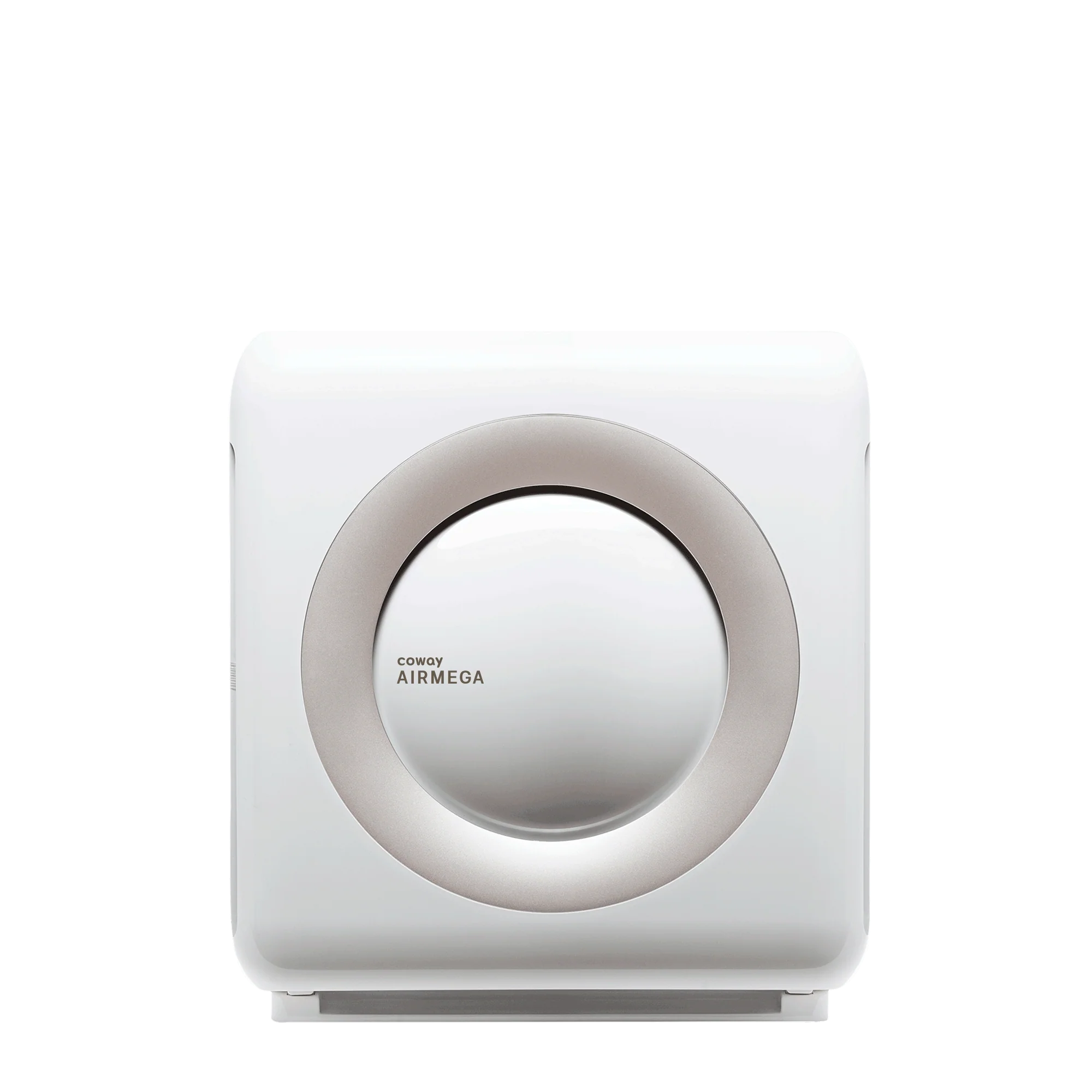
Key Specifications
- Room Coverage
- 361 sq ft
- CADR
- 233/246/240
- Filter
- True HEPA + Carbon + Pre-filter
- Noise
- 24 dB
- Power
- 77 watts
- Best For
- Medium rooms up to 361 sq ft. Wirecutter #1 for 10+ years. Best overall value.
📅 Prices checked . Amazon prices change frequently — click through for current price. Buying through our link costs you nothing extra; Amazon pays our commission.
What's in the Box
- Coway AP-1512HH air purifier
- Pre-installed 4-stage filter set
- Power cord
- User manual
- Filter replacement reminder sticker
Pros
- Wirecutter #1 for 10+ consecutive years
- AHAM verified CADR — no controversy
- True HEPA
- Fastest auto mode response in class
- 24dB ultra quiet sleep mode
- Eco mode at 4.9 watts
- 3-year warranty
Cons
- No WiFi or app control
- Carbon is impregnated fabric — weak on heavy odors
- Ionizer adds trace ozone (9ppb — CARB safe)
- Filter costs $60/year
- Design is dated
Best For
CADR 246 at $110–130 delivers the best ACH-per-dollar for rooms up to 360 sq ft at 2 ACH. At 4 ACH — the allergy-relief threshold — effective coverage drops to 180 sq ft. The right choice for standard bedrooms where you need verifiable allergy-grade air changes without overspending. Four-stage filtration including True HEPA and activated carbon. Full Coway review.
📅 Price checked August 2026 · Buying through this link costs you nothing extra — Amazon covers our commission
Blueair Blue Pure 211i Max Review Best Large Room
✓ AHAM VerifiedOur Verdict

Key Specifications
- Room Coverage
- 635 sq ft
- CADR
- 410/410/410
- Filter
- HEPASilent + Carbon
- Noise
- 23 dB
- Power
- 46 watts
- Best For
- Large rooms 400-635 sq ft. Highest CADR under $400. Replaces discontinued 211+.
📅 Prices checked . Amazon prices change frequently — click through for current price. Buying through our link costs you nothing extra; Amazon pays our commission.
What's in the Box
- Blueair Blue Pure 211i Max air purifier
- Pre-installed dual-protection filter
- Washable pre-filter (fabric)
- Power cord
- User manual
Pros
- Highest CADR 410 under $400
- AHAM verified
- Zero ozone verified
- 23dB quiet on low
- Washable pre-filter in colors
- Smart app with Alexa
Cons
- $299-349 expensive
- Filter costs $140/year — most expensive
- Cannot disable ionizer
- 211+ filters NOT compatible
Best For
CADR 410 in a package optimised for low noise on high-speed operation. The best single unit for achieving allergy-grade ACH (4–5) in larger rooms up to 400 sq ft, or for living rooms where you need continuous high-ACH operation without background noise becoming a distraction. Full Blueair review.
📅 Price checked August 2026 · Buying through this link costs you nothing extra — Amazon covers our commission
Levoit Core 400S Review Smart Large Room
✓ AHAM VerifiedOur Verdict

Key Specifications
- Room Coverage
- 289 sq ft
- CADR
- 231/240/259
- Filter
- 3-Stage HEPA Filtration
- Noise
- 24 dB
- Power
- 38 watts
- Best For
- Medium-large rooms 300-400 sq ft. Smart WiFi. Energy efficient at 38W.
📅 Prices checked . Amazon prices change frequently — click through for current price. Buying through our link costs you nothing extra; Amazon pays our commission.
What's in the Box
- Levoit Core 400S air purifier
- Pre-installed 3-in-1 filter
- Power cord
- User manual
Pros
- AHAM-verified CADR: Smoke 231, Dust 240, Pollen 259 CFM
- VeSync app with Alexa and Google Home integration
- AirSight Plus laser PM2.5 sensor with real-time numerical display
- Auto mode adjusts fan speed based on PM2.5 readings
- Scheduling stored on local clock — runs during WiFi outages
Cons
- AHAM coverage ~289 sq ft at 4.8 ACH vs marketed 403 sq ft
- HEPA controversy affected Core line (AHAM CADR still verified)
- No washable pre-filter — entire Core 400S-RF replaced as unit
- Coway AP-1512HH offers higher CADR at lower price without smart features
Best For
CADR 260 AHAM-verified for rooms up to 403 sq ft at 2 ACH. Provides 4 ACH in rooms up to 200 sq ft — suitable for a master bedroom or home office where allergy-grade coverage is needed at moderate cost. Smart auto mode adjusts fan speed and therefore ACH based on real-time particle detection. Full Levoit review.
📅 Price checked August 2026 · Buying through this link costs you nothing extra — Amazon covers our commission
Winix 5500-2 Review Best Value
✓ AHAM VerifiedOur Verdict
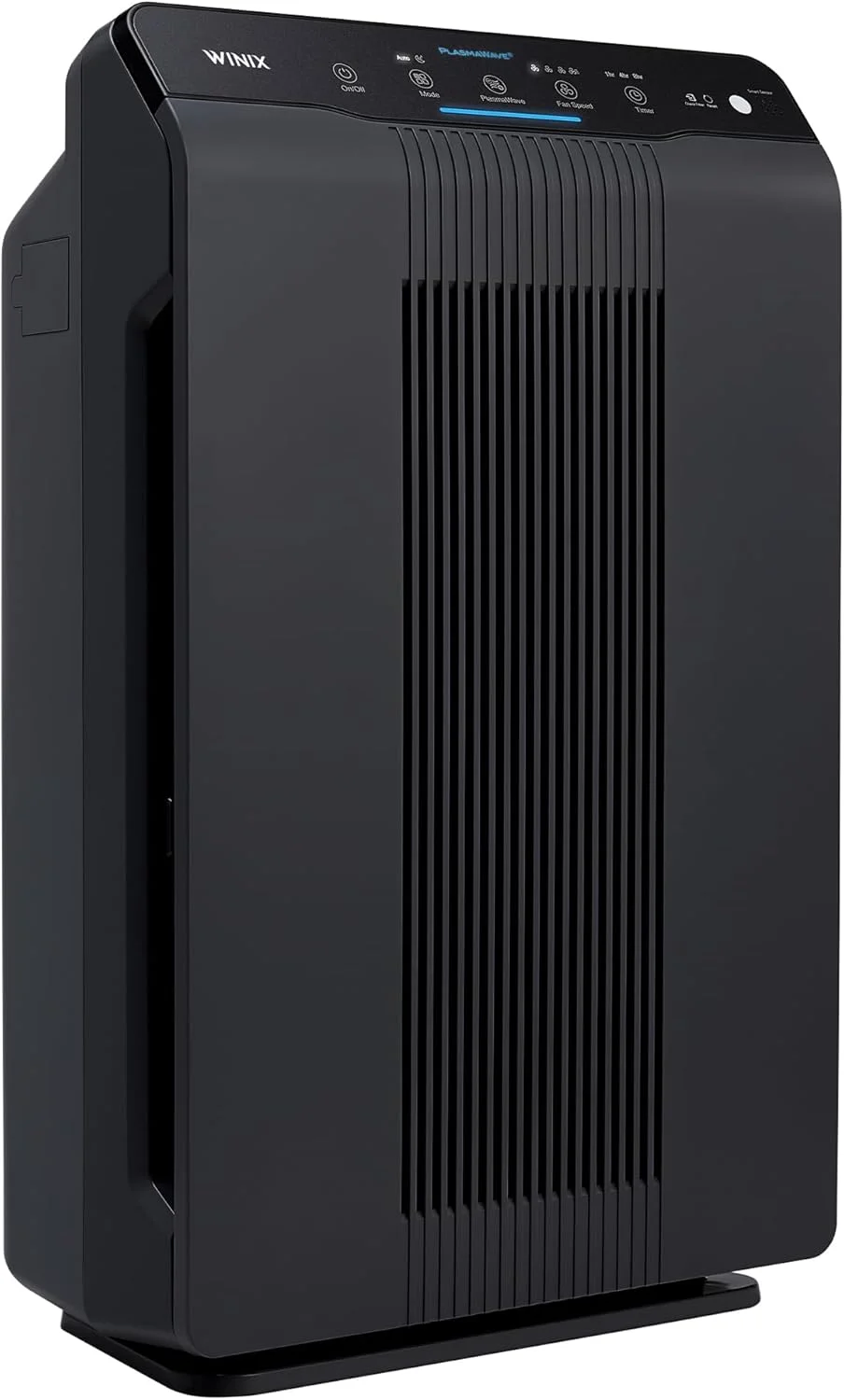
Key Specifications
- Room Coverage
- 360 sq ft
- CADR
- 232/243/246
- Filter
- True HEPA + PlasmaWave + Washable Carbon
- Noise
- 27 dB
- Power
- 67 watts
- Best For
- DISCONTINUED. Buy while stock lasts. Washable carbon is unique advantage.
📅 Prices checked . Amazon prices change frequently — click through for current price. Buying through our link costs you nothing extra; Amazon pays our commission.
What's in the Box
- Winix 5500-2 air purifier
- Pre-installed True HEPA + carbon filter
- Power cord
- Remote control
- User manual
Pros
- AHAM verified CADR
- PlasmaWave pellet carbon
- Washable carbon filter — unique
- HouseFresh tested 23 min room clean
Cons
- DISCONTINUED in US
- No WiFi
- Louder than 5510
- Larger footprint
Best For
CADR 243 with auto mode that actively varies fan speed — and therefore room ACH — in response to detected particle levels. On high speed it achieves 4+ ACH in rooms up to 180 sq ft. On auto mode in a low-pollution bedroom, it runs quietly at 2 ACH and ramps up when PM2.5 spikes. Practical ACH management without manual intervention. Full Winix review.
📅 Price checked August 2026 · Buying through this link costs you nothing extra — Amazon covers our commission
The ACH Formula — How to Calculate Air Changes Per Hour
The formula for air changes per hour is simple but requires three inputs: your purifier's CADR, your room's floor area, and your ceiling height.
ACH = (CADR × 60) ÷ Room Volume
Where Room Volume = Floor Area (sq ft) × Ceiling Height (ft)
For a standard 8-foot ceiling, Room Volume = Floor Area × 8. For a 9-foot ceiling, it is Floor Area × 9. For a vaulted 10-foot ceiling, Floor Area × 10.
Worked example: Coway AP-1512HH with CADR 246 in a 200 sq ft bedroom with 8-foot ceilings.
- Room Volume = 200 × 8 = 1,600 cubic feet
- ACH = (246 × 60) ÷ 1,600 = 14,760 ÷ 1,600 = 9.2 ACH
That is excellent. The air in this bedroom gets completely replaced with filtered air over 9 times per hour. For a single-occupant bedroom with no pets, this comfortably exceeds every clinical guideline.
Same unit in a 400 sq ft bedroom with 9-foot ceilings:
- Room Volume = 400 × 9 = 3,600 cubic feet
- ACH = (246 × 60) ÷ 3,600 = 14,760 ÷ 3,600 = 4.1 ACH
Still meets the allergy-grade threshold of 4 ACH, but with no margin. Any door-opening, additional occupants, or pets in this room will reduce your effective real-world ACH below the target. In this scenario, the Blueair 211i Max with CADR 410 would provide 6.8 ACH — comfortable margin above the target.
The CADR value to use: AHAM tests three separate CADR figures (smoke, dust, pollen). Use the smoke CADR for conservative calculations — smoke particles are the smallest and hardest to filter. A purifier's smoke CADR is always the lowest of the three; if it provides adequate ACH for smoke, it definitely provides adequate ACH for dust and pollen.
Why 2 ACH Is Not Enough for Allergy and Asthma Sufferers
AHAM established 2 ACH as the baseline for room coverage claims. This is a consensus minimum — it means the purifier removes enough particles to provide a basic improvement in air quality over no purification at all. It is not a clinical recommendation. It is a floor, not a target.
The clinical research on air purification and health outcomes consistently clusters around higher ACH figures. A meta-analysis of randomized controlled trials on air purification and respiratory health outcomes published in Environmental Health Perspectives found the most significant reductions in allergy symptoms and airway inflammation at 4–5 ACH. Below 4 ACH, results were inconsistent across studies. The AAFA (Asthma and Allergy Foundation of America) and the EPA's recommended guidelines for asthma management suggest 4+ ACH as the target for sleeping areas.
The reason 2 ACH is insufficient for health outcomes: at 2 ACH, the purifier replaces the room air with clean air twice per hour — once every 30 minutes. In a room with typical activity (a person present, movement disturbing settled particles, a pet occasionally entering), new particles are continuously entering the air. At 2 ACH, the purifier cannot keep pace with ongoing generation. Particle concentrations stabilise at a level that is better than zero but still elevated compared to outdoor clean-air baselines.
At 4–5 ACH, the purifier replaces the air every 12–15 minutes. At this rate, even with continuous particle generation from normal activities, concentrations stay low because filtered air is returned to the room faster than particles accumulate. The relationship between ACH and particle concentration is not linear — going from 2 to 4 ACH provides disproportionate benefit because you cross the threshold where the purifier's removal rate exceeds typical particle generation rates.
Above 5 ACH, returns diminish. You are replacing already-clean air with clean air. The incremental benefit of going from 5 to 10 ACH is small. For standard residential allergy management, 4–5 ACH is the practical optimum. Save the money you would spend on extra CADR beyond that threshold.
How Manufacturers Use 2 ACH to Inflate Room Coverage Claims
Here is the maths behind manufacturer room coverage claims, stated plainly.
AHAM's formula for room coverage at 2 ACH with 8-foot ceilings:
Coverage (sq ft) = CADR × 1.55
That 1.55 factor comes from: 60 minutes per hour ÷ 8 feet ceiling ÷ 2 ACH target = 60 ÷ 8 ÷ 2 × (some rounding) ≈ 3.75. Actually the AHAM formula simplifies to: sq ft coverage at 2/3 air changes per hour × factor. The result is that every manufacturer rounds to the 2 ACH baseline, which produces the largest defensible room size number they can publish.
Concrete examples showing the gap between marketed coverage and allergy-grade coverage:
| Purifier | CADR | Marketed Coverage (2 ACH) | Allergy Coverage (4 ACH) | Clinical Coverage (5 ACH) |
|---|---|---|---|---|
| Levoit Core 300 | 141 | 219 sq ft | 110 sq ft | 88 sq ft |
| Coway AP-1512HH | 246 | 381 sq ft | 191 sq ft | 153 sq ft |
| Winix 5500-2 | 243 | 376 sq ft | 188 sq ft | 150 sq ft |
| Blueair 211i Max | 410 | 635 sq ft | 318 sq ft | 254 sq ft |
The Coway AP-1512HH is marketed for rooms up to 361 square feet. For a allergy sufferer targeting 4 ACH, the effective coverage is 191 square feet. A buyer placing this unit in a 360 sq ft living room and expecting allergy relief is getting 2 ACH — the bare minimum, not the clinical target.
This is not fraud. AHAM defines the methodology and manufacturers follow it accurately. The problem is the gap between what "room coverage" implies (the purifier works well in this room) and what 2 ACH actually delivers for a person with respiratory sensitivities.
The honest rule: for general air freshening in a healthy household, use the manufacturer's coverage claim. For allergy or asthma management, halve the coverage claim. That is your real effective room size for health outcomes.
ACH Worked Examples for Real Room Sizes
Here are complete ACH calculations for the most common room sizes, with specific purifier recommendations at each level. All calculations assume 8-foot ceilings unless noted. CADR figures are AHAM-verified smoke CADR.
150 sq ft — Small bedroom or nursery
Room volume: 1,200 cubic feet
Minimum for general use (2 ACH): CADR 40 — nearly any purifier qualifies
For allergy relief (4 ACH): CADR 80
Levoit Core 300 (CADR 141): (141 × 60) ÷ 1,200 = 7.1 ACH — well above clinical threshold
Coway AP-1512HH (CADR 246): (246 × 60) ÷ 1,200 = 12.3 ACH — significantly oversized but not harmful, just unnecessary
Recommendation: Levoit Core 300 is correctly sized for a 150 sq ft nursery with allergies. No reason to spend more.
300 sq ft — Standard master bedroom
Room volume: 2,400 cubic feet
For allergy relief (4 ACH): CADR 160
Coway AP-1512HH (CADR 246): (246 × 60) ÷ 2,400 = 6.2 ACH — above clinical threshold, good margin
Levoit Core 300 (CADR 141): (141 × 60) ÷ 2,400 = 3.5 ACH — below allergy threshold
Recommendation: Coway AP-1512HH is the right unit here. The Core 300 is undersized for allergy sufferers in a 300 sq ft bedroom.
500 sq ft — Large bedroom or small living room
Room volume: 4,000 cubic feet
For allergy relief (4 ACH): CADR 267
Coway AP-1512HH (CADR 246): (246 × 60) ÷ 4,000 = 3.7 ACH — below allergy threshold by a margin
Blueair 211i Max (CADR 410): (410 × 60) ÷ 4,000 = 6.2 ACH — above clinical threshold
Recommendation: The Blueair 211i Max handles a 500 sq ft space at allergy-grade ACH. The Coway falls short. Alternatively, two Coway units positioned at opposite ends of the room give combined CADR 492 = 7.4 ACH.
1,000 sq ft — Open-plan living/dining
Room volume: 8,000 cubic feet (8 ft ceiling)
For 2 ACH minimum: CADR 267
For allergy relief (4 ACH): CADR 533
Blueair 211i Max (CADR 410): (410 × 60) ÷ 8,000 = 3.1 ACH — below allergy threshold
Two Blueair 211i Max units: combined CADR 820 = 6.2 ACH — above threshold
Recommendation: No single consumer unit provides allergy-grade coverage for 1,000 sq ft. Two correctly positioned units are the practical solution. Two $200 units beats one $800 unit for coverage in this scenario.
Real-World ACH vs Calculated ACH — The Leakage Problem
Every ACH calculation assumes a sealed room. Your home is not a sealed room. Doors open, windows may be cracked, air returns and supply vents exchange air with the rest of the building, and building construction has infiltration gaps that allow outside air in and inside air out. All of these reduce your effective real-world ACH below the calculated figure.
The building science term for uncontrolled air exchange is infiltration, measured in ACH50 (air changes per hour at 50 Pascals of pressure difference). A typical US home built before 2000 has an infiltration rate of 0.3–0.8 ACH under normal conditions. This means 0.3–0.8 complete air exchanges per hour occur through envelope leaks even with all doors and windows closed. This dilutes filtered indoor air with unfiltered outdoor air continuously.
Practical adjustment: in older homes or during high-infiltration conditions (wind, large temperature differential between inside and outside), reduce your calculated ACH by 20–30% to estimate your effective real-world ACH. If your calculation shows 4.2 ACH and your home has average infiltration, your effective allergy-grade ACH is approximately 3.0–3.4. Still helpful, but not at clinical threshold. Account for this by targeting 5–6 ACH in the calculation if you live in a poorly sealed home.
Open-plan spaces and multi-room layouts compound this. A purifier placed in the living room partially cleans air in adjacent hallways and bedrooms through natural air movement, but the dilution is significant. For sleeping areas, a dedicated bedroom purifier is always more effective than relying on a whole-home unit. The bedroom door closed overnight creates a near-sealed environment where the bedroom purifier provides full ACH without dilution.
Auto Mode, Fan Speed, and Variable ACH
Most quality purifiers offer multiple fan speed settings. CADR is always specified at the highest speed setting. When a purifier runs on low or medium, the actual CADR — and therefore the actual ACH — is substantially lower. Most units deliver approximately 30–50% of rated CADR on low speed and 60–80% on medium speed.
Auto mode addresses this by continuously varying fan speed — and therefore ACH — based on real-time PM2.5 or particle sensor readings. When the sensor detects elevated particle levels, the fan speeds up (higher CADR, higher ACH). When the air is clean, the fan slows down (lower noise, lower energy use). In practice, a purifier in auto mode delivers variable ACH that averages higher than a constant low-speed setting and uses less energy than constant high-speed operation.
The implication for ACH calculations: when you calculate ACH using the rated CADR, you are calculating the maximum possible ACH at full speed. Auto mode ACH varies throughout the day. For sleeping environments where noise is a constraint, many people run purifiers on low speed overnight — accepting reduced ACH in exchange for quiet. In a 200 sq ft bedroom, a Coway AP-1512HH on low speed (approximately CADR 80) provides (80 × 60) ÷ 1,600 = 3.0 ACH — below the allergy threshold. Running it on medium speed (approximately CADR 150) gives 5.6 ACH while remaining acceptably quiet for most sleepers.
The practical advice: do not buy a purifier and then run it exclusively on low. The CADR you paid for is at high speed. For the sleeping hours when you most need clean air, prioritise sufficient fan speed over minimal noise.