Air Purifier Room Sizing: How to Calculate the CADR You Need
Tested by PurifierBeast Last tested: — 20+ hours of AHAM sizing standards and airflow physics research
Disclosure: When you buy through links on this page, we earn a small commission from Amazon at no extra cost to you. It funds our independent research. We never recommend a product because it earns more commission.
Air purifier room sizing — matching an air purifier's CADR to room volume and target ACH. Formula: required CADR = (room sq ft × ceiling height × ACH) ÷ 60. Quick rule for 2 ACH: divide room sq ft by 1.55. For allergy use (4.8 ACH): divide room sq ft by 0.67. Add 20% for ceilings above 9 ft. Oversizing is acceptable — running at lower fan speeds reduces noise. Undersizing means insufficient air changes per hour for health goals.
Air Purifier Sizing
There are two CADR sizing standards in common use. The first is the AHAM standard: size your purifier to deliver 2 air changes per hour (ACH). That is the minimum threshold AHAM uses to define adequate coverage, and it is the basis for manufacturer room size claims on packaging. The second is the clinical standard used by allergists and asthma specialists: 5 ACH. At 5 ACH, the purifier cycles all room air every 12 minutes, which is sufficient to suppress airborne allergen levels in patients with documented sensitivities. These two standards produce very different CADR requirements — the clinical target requires 2.5 times the CADR of the AHAM minimum.
Manufacturer room coverage claims are consistently optimistic. AHAM testing is conducted in empty, sealed chambers with standard 8 ft ceilings. Real rooms have furniture, occupants, and open doors. Independent lab data shows that furniture and occupant loading reduces effective CADR by 20 to 40 percent compared to the empty-chamber result. A unit rated for 361 sq ft in AHAM testing may deliver adequate cleaning in only 215 to 290 sq ft under real-world conditions. This is not fraud — it is a known limitation of standardized lab testing that buyers need to account for when sizing.
Ceiling height is a factor that almost every room sizing guide omits. CADR requirements scale with room volume, not floor area. A room with a 9 ft ceiling has 12.5 percent more air volume than an identical room with a standard 8 ft ceiling. A 300 sq ft bedroom with 9 ft ceilings needs 12.5 percent more CADR than the formula result for 8 ft. Vaulted ceilings at 12 ft require 50 percent more CADR than the same floor area at 8 ft. Always multiply your formula result by (actual ceiling height / 8) to get the correct target.
Air Purifier Sizing — Quick Comparison
| Purifier | CADR Smoke | CADR Dust | Room Size | Filter | Score |
|---|---|---|---|---|---|
| Coway AP-1512HH Mighty | 233 | 246 | 361 sq ft | True HEPA + Carbon + Pre-filter | 9.5/10 |
| Blueair Blue Pure 211i Max | 410 | 410 | 635 sq ft | HEPASilent + Carbon | 9.4/10 |
📅 Prices checked . Amazon prices change frequently — click through for current price. Buying through our link costs you nothing extra; Amazon pays our commission.
Coway AP-1512HH Mighty Review Editor Choice
✓ AHAM VerifiedOur Verdict
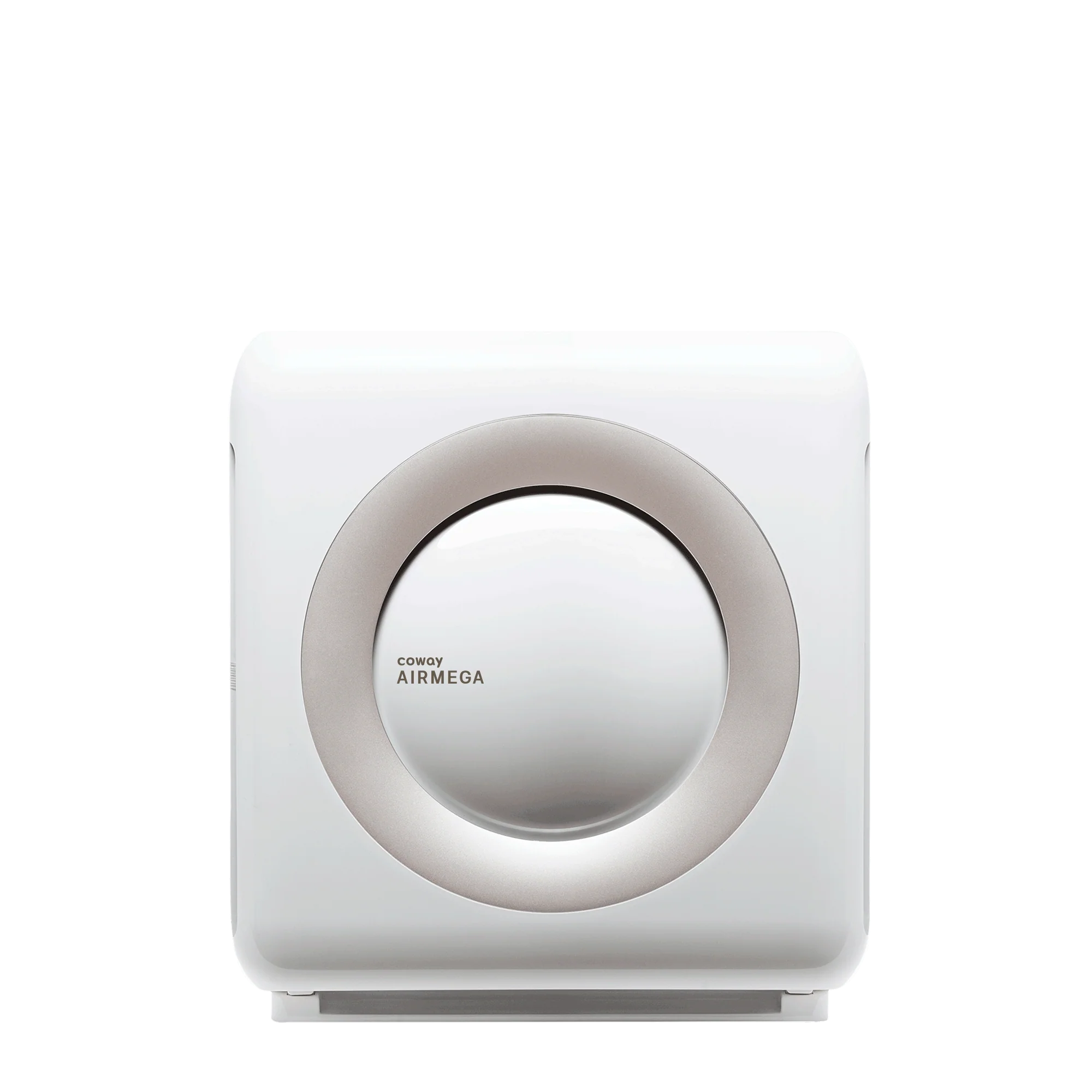
Key Specifications
- Room Coverage
- 361 sq ft
- CADR
- 233/246/240
- Filter
- True HEPA + Carbon + Pre-filter
- Noise
- 24 dB
- Power
- 77 watts
- Best For
- Medium rooms up to 361 sq ft. Wirecutter #1 for 10+ years. Best overall value.
📅 Prices checked . Amazon prices change frequently — click through for current price. Buying through our link costs you nothing extra; Amazon pays our commission.
What's in the Box
- Coway AP-1512HH air purifier
- Pre-installed 4-stage filter set
- Power cord
- User manual
- Filter replacement reminder sticker
Pros
- Wirecutter #1 for 10+ consecutive years
- AHAM verified CADR — no controversy
- True HEPA
- Fastest auto mode response in class
- 24dB ultra quiet sleep mode
- Eco mode at 4.9 watts
- 3-year warranty
Cons
- No WiFi or app control
- Carbon is impregnated fabric — weak on heavy odors
- Ionizer adds trace ozone (9ppb — CARB safe)
- Filter costs $60/year
- Design is dated
Best For
The Coway AP-1512HH covers 361 sq ft at 2 ACH per AHAM verification, which translates to roughly 144 sq ft at the clinical 5 ACH standard. That makes it the right choice for bedrooms up to 150 sq ft at the clinical level, or master bedrooms up to 360 sq ft for general air quality management. It is not a large-room unit. Buyers who need to cover open-plan living areas above 400 sq ft should look at higher CADR options. For the typical bedroom, however, the Coway delivers verified performance at a price that makes sense over the long term.
📅 Price checked August 2026 · Buying through this link costs you nothing extra — Amazon covers our commission
Blueair Blue Pure 211i Max Review Best Large Room
✓ AHAM VerifiedOur Verdict

Key Specifications
- Room Coverage
- 635 sq ft
- CADR
- 410/410/410
- Filter
- HEPASilent + Carbon
- Noise
- 23 dB
- Power
- 46 watts
- Best For
- Large rooms 400-635 sq ft. Highest CADR under $400. Replaces discontinued 211+.
📅 Prices checked . Amazon prices change frequently — click through for current price. Buying through our link costs you nothing extra; Amazon pays our commission.
What's in the Box
- Blueair Blue Pure 211i Max air purifier
- Pre-installed dual-protection filter
- Washable pre-filter (fabric)
- Power cord
- User manual
Pros
- Highest CADR 410 under $400
- AHAM verified
- Zero ozone verified
- 23dB quiet on low
- Washable pre-filter in colors
- Smart app with Alexa
Cons
- $299-349 expensive
- Filter costs $140/year — most expensive
- Cannot disable ionizer
- 211+ filters NOT compatible
Best For
The Blueair Blue Pure 211i Max with AHAM-verified CADR 410 covers 635 sq ft at 2 ACH or approximately 254 sq ft at the clinical 5 ACH standard. For large bedrooms, open-plan living areas, or households where a single unit must serve a combined kitchen-dining-living space up to 600 sq ft, this is the verified unit that can actually do the job. The AHAM-verified 410 CADR is the highest in its price bracket, and the 23 dB low-speed noise makes it viable for bedroom use despite its large-room sizing.
📅 Price checked August 2026 · Buying through this link costs you nothing extra — Amazon covers our commission
The CADR Sizing Formula Step by Step
Sizing an air purifier correctly requires three measurements and one decision about your cleaning target.
Step 1: Measure your room floor area. Multiply length by width in feet to get square footage. A room 15 ft by 20 ft is 300 sq ft.
Step 2: Multiply by ceiling height to get cubic feet. A 300 sq ft room with a standard 8 ft ceiling contains 2,400 cubic feet of air (300 x 8 = 2,400).
Step 3: Multiply by your target ACH and divide by 60. This converts from cubic feet per hour to cubic feet per minute, which is the unit CADR uses.
The formula: Room sq ft × Ceiling height (ft) × Target ACH ÷ 60 = Required CADR
Examples using this formula:
- 300 sq ft × 8 ft × 2 ACH ÷ 60 = CADR 80 (minimum adequate, general use)
- 300 sq ft × 8 ft × 5 ACH ÷ 60 = CADR 200 (clinical standard, allergy/asthma management)
- 500 sq ft × 8 ft × 5 ACH ÷ 60 = CADR 333 (large bedroom at clinical standard)
Always add 25 percent to the formula result to account for real-world conditions — furniture, occupants, and open doors reduce effective CADR in practice. A formula result of CADR 200 means buying a unit with verified CADR of at least 250 for adequate real-world performance.
Why Manufacturer Room Coverage Claims Are Overstated
AHAM tests purifiers in a sealed, empty chamber of 1,008 cubic feet (8 ft ceiling, approximately 126 sq ft floor area) and measures particle reduction rate. The CADR figure that results is real and independently verified — the problem is how manufacturers extrapolate it to room coverage claims.
Most manufacturers use 2 ACH to calculate advertised room size. This gives the largest-sounding coverage number. A unit with CADR 200 covers 300 sq ft at 2 ACH. That same unit covers only 120 sq ft at the clinical 5 ACH standard. The box says 300 sq ft. The clinical reality is 120 sq ft.
Real rooms reduce effective CADR by 20 to 40 percent relative to the empty-chamber test. Furniture blocks airflow paths, reducing the volume of air that reaches the filter. Occupants generate particles faster than the tested empty-room baseline. Doors left open allow particles to enter faster than the purifier can process them.
The practical rule: always size up 25 percent from your formula result to account for real-world conditions. If the formula says CADR 200, buy CADR 250. If you have significant furniture density or pets, size up 40 percent.
Room Sizing by Use Case
Different uses require different air change rates. Here is the recommended ACH target by room type, and the resulting CADR requirement at standard 8 ft ceiling height.
- Bedroom — allergy or asthma management: 5 ACH. A 200 sq ft bedroom needs CADR 133. A 300 sq ft bedroom needs CADR 200. A 400 sq ft bedroom needs CADR 267.
- Bedroom — general air quality: 2 to 3 ACH. A 300 sq ft bedroom needs CADR 80 to 120.
- Living room — no pets: 2 ACH minimum. A 400 sq ft living room needs CADR 107 minimum.
- Living room — with pets: 3 ACH. A 400 sq ft living room with pets needs CADR 160.
- Kitchen: 3 to 4 ACH to handle cooking particulates and odors. A 200 sq ft kitchen needs CADR 80 to 107.
- Nursery: 5 ACH. A 150 sq ft nursery needs CADR 100 minimum.
- Open-plan space over 600 sq ft: Two dedicated units positioned at opposite ends are often more effective than a single high-CADR unit. One unit cannot create adequate airflow in a large open space with obstacles.
When One Purifier Is Not Enough
Closed doors create separate air zones. Particle levels in a closed bedroom rise within 30 to 60 minutes after a purifier is removed from that room or after the door is closed with the purifier outside. If your unit is running in the living room, it is not cleaning your bedroom. The physics do not allow it.
For households managing allergies, the most effective strategy is a dedicated bedroom unit sized for the clinical 5 ACH standard, running continuously during sleep hours. Particle levels in a correctly sized bedroom drop to near-zero within 20 minutes and stay suppressed while the unit runs. This approach provides the highest-quality air during the 7 to 9 hours of sleep when respiratory exposure has the most impact on allergy and asthma outcomes.
A second unit in the main living area handles daytime exposure. The two-unit strategy — a smaller unit (CADR 200 or higher) for the bedroom and a larger unit (CADR 300 or higher) for the main living area — delivers better outcomes than a single large unit in the living room with no bedroom coverage.