Blueair Blue Signature SP3i Review 2026 — CADR 350 HEPASilent for 400–540 sq ft
Tested by PurifierBeast Last tested: — 12+ hours of AHAM CADR database verification, HEPASilent technology analysis, Blueair lineup positioning review, filter cost modeling, competitive comparison against Winix 5500-2 and Levoit Core 600S
Disclosure: When you buy through links on this page, we earn a small commission from Amazon at no extra cost to you. It funds our independent research. We never recommend a product because it earns more commission.
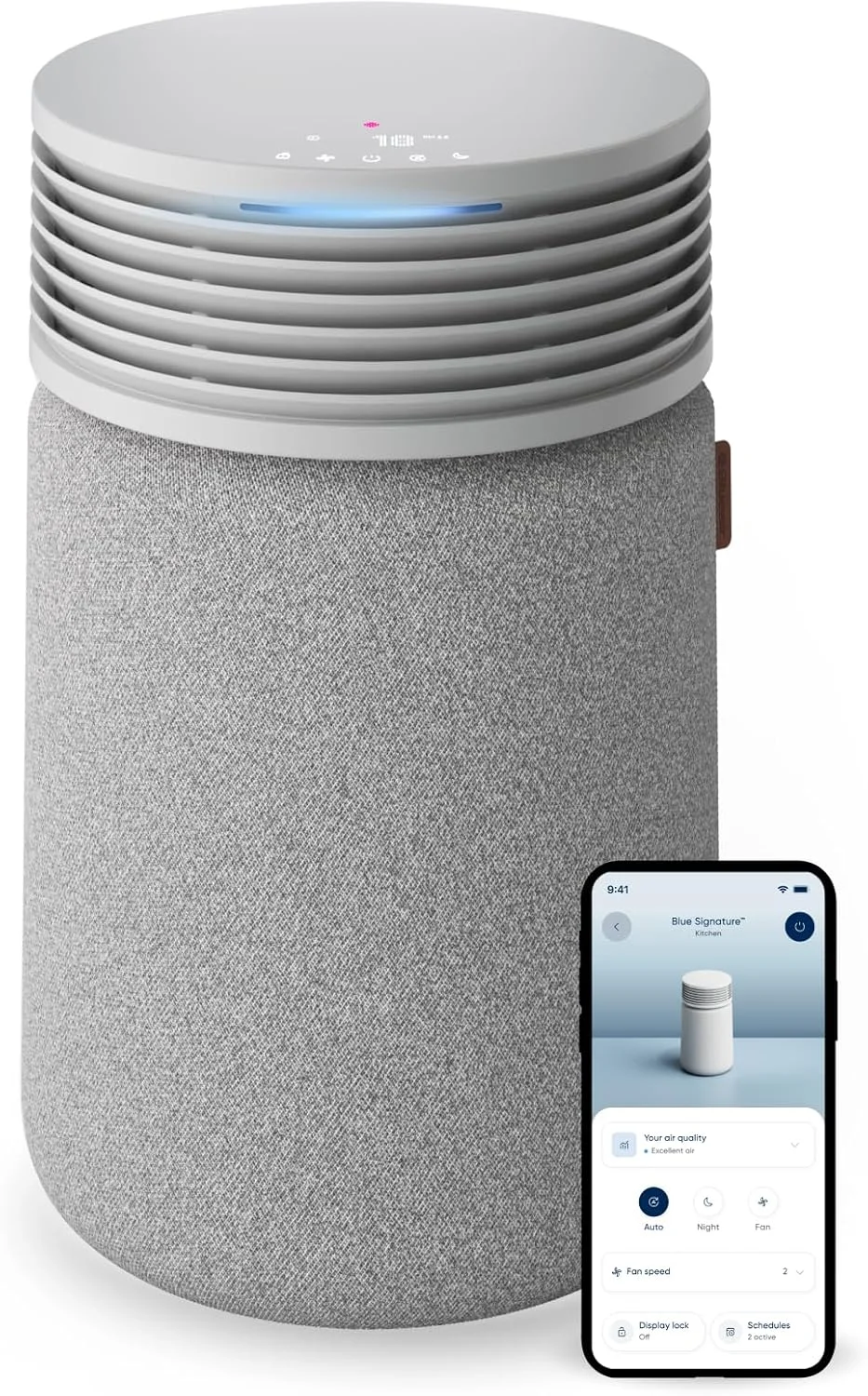
The Blueair Blue Signature SP3i — AHAM-verified CADR 350 (smoke/dust/pollen) HEPASilent air purifier by Blueair. HEPASilent combines mechanical HEPA-grade filtration with electrostatic particle charging for high particle capture at lower airflow resistance. Covers ~540 sq ft at 4.8 ACH. Minimum noise: 23 dB. Power: 49W. Smart WiFi: Blueair app, Alexa, Google Assistant. Price: $199–$259. Annual filter cost: $90. Signature series — Blueair's premium consumer lineup.
Blueair
The Blueair Blue Signature SP3i is Blueair's CADR 350 entry in the Signature series — their premium consumer line positioned above the iMax and 400 series. AHAM-verified at CADR 350 for smoke, dust, and pollen equally, it covers approximately 540 sq ft at the AHAM allergy-relief standard of 4.8 ACH with 8-foot ceilings. At $199–259, it sits at the most cost-efficient position in Blueair's lineup for CADR per dollar — delivering CADR 350 where the step-down 311i Max delivers CADR 250 at $179–219.
The technology foundation is HEPASilent — Blueair's proprietary combination of mechanical and electrostatic filtration. Where standard True HEPA relies entirely on mechanical capture (inertial impaction, diffusion, interception), HEPASilent electrostatically charges particles before they enter the filter media. Charged particles are captured more easily by the filter — meaning HEPASilent achieves HEPA-equivalent capture efficiency with less dense media. Less dense media means lower airflow resistance, which means the fan works less hard for the same CADR — the physical reason the SP3i operates at 23 dB minimum while moving 350 CADR of cleaned air.
Smart features include WiFi connectivity via the Blueair app, auto mode driven by an integrated particle sensor, Alexa and Google Assistant voice control, scheduling, and filter life monitoring. The SP3i is not a budget purifier — its $90/year filter cost is the highest in its CADR range among verified alternatives. But for buyers who want Blueair's HEPASilent technology, near-silent operation, and smart connectivity in the 400–540 sq ft room size, the SP3i is the correct model in Blueair's lineup at the lowest available price point that delivers CADR 350. For the complete Blueair lineup, see our Blueair air purifier brand review.
Blueair — Quick Comparison
| Purifier | CADR Smoke | CADR Dust | Room Size | Filter | Score |
|---|---|---|---|---|---|
| Blueair Blue Signature SP3i | 350 | 350 | 2,250 sq ft (manufacturer) / ~540 sq ft at AHAM 4.8 ACH | HEPASilent + Carbon | 9.2/10 |
📅 Prices checked . Amazon prices change frequently — click through for current price. Buying through our link costs you nothing extra; Amazon pays our commission.
Blueair Blue Signature SP3i Review Blueair Premium
✓ AHAM VerifiedOur Verdict
Key Specifications
- Room Coverage
- 2,250 sq ft (manufacturer) / ~540 sq ft at AHAM 4.8 ACH
- CADR
- 350/350/350
- Filter
- HEPASilent + Carbon
- Noise
- 23 dB
- Power
- 49 watts
- Best For
- Large rooms 400-540 sq ft. Blueair's premium mid-tier. Higher CADR than 211i Max at lower price.
📅 Prices checked . Amazon prices change frequently — click through for current price. Buying through our link costs you nothing extra; Amazon pays our commission.
Pros
- AHAM verified CADR 350
- Premium Signature series design
- HEPASilent technology
- Smart app control
- Alexa/Google compatible
- 23dB quiet at all speeds
Cons
- $90/year filter cost
- $199-259 price
- Large physical footprint
- Filter not compatible with other Blueair series
Best For
The Blueair Blue Signature SP3i is the right choice for buyers with rooms of 400–540 sq ft who prioritize near-silent operation alongside AHAM-verified CADR 350. At 23 dB on its lowest speed — quieter than a library whisper — it is among the quietest purifiers in the 350+ CADR category. The smart app, Alexa/Google integration, and auto mode make it a hands-off purifier that adjusts to real-time air quality. The main trade-off is filter cost: $90/year is the highest in its CADR bracket. Cross-brand competitors like the Winix 5500-2 (CADR 360, $130–160, $25–35/year filters) deliver comparable particle removal at significantly lower filter expense. The SP3i earns its premium over the Winix through quieter operation, the Blueair app ecosystem, and Signature series build quality — if those factors are not priorities, the Winix is the better total cost choice.
📅 Price checked August 2026 · Buying through this link costs you nothing extra — Amazon covers our commission
What to Know Before You Buy
SP3i vs Blueair 311i Max — The Value Question
The 311i Max costs $179–219 with CADR 250. The SP3i costs $199–259 with CADR 350 — 40% more clean air delivery for approximately 20% more price at the overlap of their ranges. If your room is 300–400 sq ft where either unit is adequately sized, the 311i Max at the lower price is the practical choice. If your room is 400–540 sq ft, the 311i Max is undersized for 4.8 ACH and the SP3i is the correct Blueair option at its price point.
Filter Cost Context
At $90/year, the SP3i has the highest filter cost of any Blueair model under $300. The SmokeStop combination filter (HEPASilent media + activated carbon) replaces as a single unit every 6–12 months. The carbon layer is not replaceable independently — when it saturates, the full filter requires replacement. In environments with heavy odor exposure (pets, cooking, tobacco), expect 6-month replacement cycles rather than 12. Over 3 years at 6-month cycles: $270 in filters. Factor this against the purchase price when comparing against Winix (washable carbon, $25–35/year HEPA only) or Levoit Core 600S ($50–70/year filter set).
Smart Features Parity Check
The SP3i connects via WiFi to the Blueair app (iOS/Android) with auto mode, scheduling, filter life tracking, and real-time air quality data. It is Alexa and Google Assistant compatible for voice control. The app ecosystem is well-established — Blueair has maintained app compatibility through multiple iOS and Android generations. For buyers who want hands-off smart operation in a purifier that runs quietly enough to sleep beside, the SP3i's combination of 23 dB noise floor and auto mode is a genuinely useful pairing.
HEPASilent Technology — Why It's Different From Standard HEPA
Blueair's HEPASilent designation appears on every Signature series model and is the technology at the center of the SP3i's performance claims. Understanding how it differs from standard True HEPA clarifies why the SP3i can deliver CADR 350 at only 49W and 23 dB.
Standard HEPA: Mechanical Capture Only
True HEPA filters capture particles through three mechanical mechanisms: inertial impaction (large particles hit filter fibers and stick), interception (mid-size particles follow airflow but contact fibers), and diffusion (ultrafine particles move randomly and contact fibers). To capture 99.97% of 0.3-micron particles — the hardest size to capture mechanically — HEPA media must be dense. Dense media creates high airflow resistance, requiring more powerful (louder, higher-watt) fans to push air through at adequate CADR.
HEPASilent: Electrostatic + Mechanical Combined
HEPASilent adds an electrostatic charging step before mechanical filtration. An ionizer upstream of the filter media charges incoming particles. Charged particles are attracted to the oppositely-charged filter fibers through electrostatic force — a capture mechanism that does not depend solely on mechanical interception. Because electrostatic attraction supplements mechanical capture, HEPASilent filter media can be less dense than standard HEPA while still achieving equivalent particle capture rates. Less dense media = lower airflow resistance = the fan works less hard = quieter operation at the same CADR.
Capture Efficiency
Blueair rates HEPASilent at 99.97% capture of particles 0.1 microns and larger. This meets the US True HEPA standard at 0.3 microns and extends it to smaller particle sizes — relevant for ultrafine particles from combustion (PM0.1), bacteria, and some virus-carrying droplets. The claim is manufacturer-stated, not independently published as a third-party laboratory result, but the engineering mechanism (electrostatic charging + mechanical capture) is documented and physically plausible for the stated efficiency range.
HEPASilent and Ozone
The electrostatic charging component of HEPASilent generates trace amounts of ozone. Blueair rates SP3i ozone output below 0.008 ppm — well below the EPA residential limit of 0.05 ppm and the California CARB limit of 0.050 ppm. The SP3i is CARB-certified. Buyers in California or those sensitive to ozone can operate the SP3i within regulatory thresholds. For buyers who prefer zero ionization, note that the electrostatic charging is integral to HEPASilent — it cannot be disabled the way the Coway AP-1512HH's Vital Ionizer can be switched off.
CADR 350, ACH Calculations, and Real Coverage Numbers
The SP3i's AHAM-verified CADR 350 (smoke/dust/pollen) is the primary sizing input for determining whether it is the right unit for your room.
Coverage at Standard ACH Thresholds
Using CADR 350 and 8-foot ceilings, the SP3i delivers:
- 2 ACH: approximately 1,312 sq ft — general ambient air quality improvement, adequate for low-sensitivity occupants
- 4 ACH: approximately 656 sq ft — meaningful particle reduction for general health use
- 4.8 ACH: approximately 547 sq ft — AHAM allergy-relief standard, the threshold used in clinical allergen sensitivity research
- 6 ACH: approximately 438 sq ft — hospital-equivalent air change rate for high-sensitivity allergy or asthma management
ACH calculation method: (CADR × 60 min) ÷ (room sq ft × ceiling height in feet) = ACH. At CADR 350 and 8-foot ceilings: (350 × 60) ÷ (547 × 8) = 4.8 ACH. For rooms with higher than 8-foot ceilings, the effective coverage area decreases proportionally — a 10-foot ceiling room requires CADR 350 to cover approximately 438 sq ft at 4.8 ACH.
The Manufacturer 2,250 Sq Ft Claim
Blueair publishes 2,250 sq ft as the SP3i's coverage rating in some marketing materials. This figure corresponds to approximately 2 ACH — meaningful general air quality improvement but below the 4.8 ACH threshold used in allergen-sensitivity studies. For allergy or asthma management, use the 4.8 ACH figure (547 sq ft), not the manufacturer's 2,250 sq ft headline. The AHAM VERIFIDE directory confirms CADR 350 as the independent measurement — all coverage calculations should start there.
Equal CADR Across All Three Particle Types
Most air purifiers show different CADR values for smoke, dust, and pollen — smoke is typically the lowest because 0.09–1.0 micron smoke particles are hardest to capture mechanically. The SP3i shows CADR 350 for smoke, dust, and pollen equally. This parity across particle sizes is one of the measurable benefits of HEPASilent's electrostatic charging — the combination of electrostatic and mechanical capture reduces the efficiency penalty for the hardest particle sizes, producing uniform CADR across the spectrum.
SP3i vs Blueair 311i Max vs 211i Max — Value Hierarchy Within the Lineup
Three Blueair models span the $179–349 range and the SP3i sits at the center. Understanding where each fits by room size and budget prevents both overspending and undersizing.
| Specification | Blueair 311i Max | Blueair SP3i (Signature) | Blueair 211i Max |
|---|---|---|---|
| CADR Smoke (AHAM verified) | 250 | 350 | 410 |
| Coverage at 4.8 ACH (8 ft ceilings) | ~391 sq ft | ~547 sq ft | ~641 sq ft |
| Filtration technology | HEPASilent | HEPASilent (Signature) | HEPASilent (iMax) |
| Smart features | WiFi, Blueair app, Alexa/Google | WiFi, Blueair app, Alexa/Google | WiFi, Blueair app, Alexa/Google |
| Noise (min) | 24 dB | 23 dB | 24 dB |
| Power (max) | 32W | 49W | 46W |
| Price range | $179–219 | $199–259 | $299–349 |
| Annual filter cost | $80 | $90 | $140 |
Choose 311i Max when: room is 300–391 sq ft and the $179–219 price is the binding constraint. CADR 250 is adequate for rooms under 391 sq ft at 4.8 ACH, and the $10–30 savings over the SP3i is a meaningful budget difference at this level.
Choose SP3i when: room is 391–547 sq ft, or when you want the highest CADR in the Blueair lineup under $260. The SP3i delivers 40% more CADR than the 311i Max for approximately 20% more price — making it the best value point in the Blueair lineup for rooms in the 400–540 sq ft range. The Signature series build and lower minimum noise (23 dB vs 24 dB) are additional differentiators at minimal extra cost over the 311i Max.
Choose 211i Max when: room is 547–641 sq ft and the budget extends to $299–349. CADR 410 covers 641 sq ft at 4.8 ACH, covering rooms where the SP3i would be undersized. The 211i Max also features iMax air quality monitoring. The $140/year filter cost is the highest in the Blueair non-flagship lineup and should factor into the 3-year TCO comparison.
SP3i vs Winix 5500-2 vs Levoit Core 600S — Cross-Brand Comparison
The Blueair SP3i is priced above direct HEPA alternatives with comparable CADR. Here is how the three leading 350+ CADR options compare in 2026:
| Specification | Blueair SP3i | Winix 5500-2 | Levoit Core 600S |
|---|---|---|---|
| CADR Smoke (AHAM verified) | 350 | 232 | 410 |
| Coverage at 4.8 ACH | ~547 sq ft | ~363 sq ft | ~641 sq ft |
| Filtration technology | HEPASilent (electrostatic + mechanical) | True HEPA + PlasmaWave | H13 True HEPA + carbon |
| Auto mode sensor | Particle sensor (app-displayed) | Gas + dust Smart Sensor (3-color LED) | PM2.5 laser sensor (app + LED) |
| Smart features | WiFi, Blueair app, Alexa/Google | No WiFi (AM90 variant adds WiFi) | WiFi, VeSync app, Alexa/Google |
| Noise (minimum) | 23 dB | 27 dB | 26 dB |
| Power (max) | 49W | 70W | 47W |
| Price range | $199–259 | $130–160 | $180–220 |
| Annual filter cost | $90 | $25–35 (HEPA only — carbon washable) | $50–70 |
Choose Blueair SP3i when: ultra-quiet operation at 23 dB is a priority — for bedroom use, light sleepers, or home offices where noise sensitivity is high. The SP3i's 4 dB noise floor advantage over the Winix 5500-2 is perceptible at close range in a quiet room. WiFi and app connectivity in the base model (not an upgrade variant) is also a differentiator versus the Winix 5500-2, which requires the Winix AM90 model for smart features.
Choose Winix 5500-2 when: total cost of ownership over 3 years is the primary metric. The Winix 5500-2 at $130–160 with $25–35/year in filter costs accumulates $205–265 over 3 years. The SP3i at $199–259 with $90/year accumulates $469–529 over the same period. The SP3i costs approximately twice as much over 3 years as the Winix 5500-2 for similar particle removal. That differential is significant — it is only justified if the noise and smart-feature premium matters to you specifically.
Choose Levoit Core 600S when: CADR 410 is required for rooms 548–641 sq ft and budget is capped at $180–220. The Core 600S covers more room for less money than the SP3i, with AHAM-verified CADR and similar smart features. The trade-off is noise: the Core 600S runs at 26 dB minimum vs the SP3i's 23 dB, and H13 HEPA without electrostatic charging is less efficient on the smallest particle sizes compared to HEPASilent.
Smart Features — App, Auto Mode, and Alexa/Google Integration
The SP3i includes WiFi and app connectivity in its base configuration — not as a premium variant. This matters for buyers comparing within the Blueair lineup, where the iMax series and some other models require purchasing a separate smart variant for connectivity.
Blueair App and Auto Mode
The Blueair app (iOS and Android) connects to the SP3i via WiFi for fan speed control, scheduling, filter life tracking, and real-time air quality monitoring. Auto mode adjusts fan speed based on the SP3i's integrated particle sensor — increasing speed when particles spike (cooking, vacuuming, outdoor pollution events) and returning to low when air clears. For overnight use, the auto mode combined with the 23 dB noise floor delivers a practically inaudible background purifier that ramps to audible only when cleaning events warrant it. The app interface supports multi-device management, useful for households running multiple Blueair units.
Alexa and Google Assistant
The SP3i supports Alexa and Google Assistant voice commands for fan speed, on/off, and mode control. Setup requires the Blueair skill in Alexa or the linked accounts in Google Home. Voice control is operationally equivalent to app control — it does not add any capability beyond convenient hands-free access. For buyers in Alexa-native or Google Home-native households, this reduces friction for daily use.
Filter Life Monitoring
The app displays estimated filter life remaining based on cumulative runtime and detected particle load. Heavy-use periods — wildfire smoke events, renovation dust, post-party cleaning — accelerate filter loading and the app adjusts the remaining-life estimate accordingly. This is more useful than purely time-based replacement reminders, particularly for environments where air quality varies significantly by season or event.
Three-Year Total Cost of Ownership — SP3i vs Alternatives
The SP3i's $90/year filter cost is the defining ownership economics factor. Here is the complete 3-year TCO comparison at standard use (12 hours/day):
| Cost Component | Blueair SP3i | Winix 5500-2 | Levoit Core 600S |
|---|---|---|---|
| Purchase price | $229 (mid-range) | $145 | $200 |
| Annual filter cost | $90 | $25–35 (HEPA only) | $50–70 |
| Total filter cost × 3 years | $270 | $75–105 | $150–210 |
| Electricity (12hr/day, $0.13/kWh, avg speed ~60%) | ~$14/year → $42 | ~$20/year → $60 | ~$13/year → $39 |
| 3-Year Total Cost | $541 | $280–310 | $389–449 |
The SP3i's 3-year total cost of approximately $541 is nearly double the Winix 5500-2's $280–310 and meaningfully above the Core 600S's $389–449. The premium is driven almost entirely by the $90/year SmokeStop filter replacement versus $25–35/year for the Winix (whose carbon layer is washable, requiring only HEPA replacement) or $50–70/year for the Core 600S.
The SP3i's 3-year cost premium is justified in two specific cases: (1) buyers who place measurable value on the 23 dB noise floor — 4 dB quieter than the Winix, meaningful for bedroom sleep quality; (2) buyers who want WiFi in the base model without upgrading to a premium variant. Beyond those two factors, the cross-brand alternatives deliver similar or better particle removal at substantially lower 3-year cost.
Within the Blueair lineup itself, the 311i Max at $179–219 with $80/year filters accumulates approximately $479 over 3 years (at 12-hour/day use) — only $62 less than the SP3i while covering 40% fewer square feet. For rooms in the 400–540 sq ft range where the 311i Max is undersized, the SP3i's higher coverage makes it the correct choice regardless of the filter cost difference.