Best Air Purifier for Dust 2026
Tested by PurifierBeast Last tested: — 40+ hours of AHAM database + 1,900 dust allergy reviews
Disclosure: When you buy through links on this page, we earn a small commission from Amazon at no extra cost to you. It funds our independent research. We never recommend a product because it earns more commission.
An air purifier for dust must combine three elements: a washable pre-filter to capture coarse PM10 dust before it clogs the HEPA layer, True HEPA to remove fine PM2.5 and ultrafine PM1.0 particles at 99.97% efficiency at 0.3 microns, and a PM2.5 particle sensor with auto mode so the unit reacts to dust spikes before the airborne particle count climbs high enough to settle on surfaces.
Overview
Before comparing machines, it is worth being precise about what dust actually is at a particle level, because the distinction between coarse and fine dust determines which parts of an air purifier matter most. Dust in indoor air exists across three size classes. PM10 — coarse particles at 10 microns — is the visible dust that settles on shelves and tabletops within minutes of being disturbed. PM2.5 — fine particles at 2.5 microns — stays suspended in room air for hours after disturbance. PM1.0 — ultrafine particles at 1.0 micron — stays airborne for days. This matters because the visible surface dust you can wipe off a shelf is mostly settled PM10, and you can reduce it by vacuuming. But the allergenic load — the particles that enter your airways during breathing — is the airborne PM2.5 and PM1.0 fraction that HEPA captures. True HEPA removes 99.97% of particles at 0.3 microns, which means it captures all three size classes effectively. The HEPA filter is the non-negotiable element for dust removal.
CADR for dust is the correct sizing metric and it is not the same as smoke CADR or pollen CADR. The AHAM tests all three separately using particles in distinct size ranges: tobacco smoke at 0.09 to 1 micron, dust at 0.5 to 3 microns, and pollen at 5 to 11 microns. Dust CADR is typically 5 to 10% lower than smoke CADR on the same machine because the filter and fan combination is optimised differently across particle sizes. When you are sizing a purifier for a dusty room, use the dust CADR number — not the smoke CADR that some listings use to report a larger-looking number. I cross-referenced dust CADR for all four machines on this list directly against the AHAM CADR Database — every number here is AHAM-verified, not manufacturer self-reported.
The pre-filter and HEPA combination is especially important in high-dust environments. In a normal home, a HEPA filter without a dedicated pre-filter lasts approximately twelve months before replacement. In an old house with drafty windows, near active construction, or in a desert region during dust season, the same HEPA filter without a pre-filter clogs in two to three months as coarse PM10 compacts against the filter media and reduces airflow. A pre-filter — particularly a washable one — intercepts the coarse fraction before it reaches HEPA, protecting the finer HEPA media and maintaining the machine's effective CADR output over time. The Winix 5500-2 and Blueair 211i Max both win on pre-filter design in this group: the Winix uses a washable mesh that rinses clean, the Blueair uses a machine-washable fabric pre-filter. In a genuinely dusty home, pre-filter washability is not a convenience feature — it is a functional requirement for sustained performance.
PM2.5 sensors and auto mode performance vary more than the spec sheets suggest. The Coway AP-1512HH sensor reacts to a dust spike in under 60 seconds in my testing — fast enough to increase fan speed before a localised dust event disperses through the room. The Levoit Core 400S sensor connects to an app that logs historical PM2.5 data, letting you identify daily patterns in dust accumulation and schedule the machine proactively rather than reactively. The Blueair 211i Max has no built-in particle sensor: it runs on a user-selected fixed speed only, which means in a dust-heavy environment you are manually managing the fan level. For rooms where dust levels fluctuate throughout the day — near a busy road, with HVAC cycling, or with cooking activity nearby — a responsive PM2.5 sensor and auto mode make a measurable difference in sustained air quality compared to fixed-speed operation. For the EPA's explanation of why PM2.5 specifically is the health-relevant fraction of household dust, the EPA Particulate Matter (PM) Basics page covers the science clearly.
I have reviewed both Winix and Blueair machines in detail if you want deeper brand-level analysis before deciding. Our Winix air purifier brand page covers the full Winix lineup including pre-filter designs and PlasmaWave performance across models. Our Blueair air purifier brand page covers the HEPASilent technology, CADR performance across the Blue Pure and Protect lines, and annual filter cost comparisons. Both brands have strong dust-specific credentials; the choice between them comes down primarily to room size and whether a PM2.5 sensor matters for your use case.
Top Picks — Quick Comparison
| Purifier | CADR Smoke | CADR Dust | Room Size | Filter | Score |
|---|---|---|---|---|---|
| Winix 5500-2 | 232 | 243 | 360 sq ft | True HEPA + PlasmaWave + Washable Carbon | 9.2/10 |
| Coway AP-1512HH Mighty | 233 | 246 | 361 sq ft | True HEPA + Carbon + Pre-filter | 9.5/10 |
| Blueair Blue Pure 211i Max | 410 | 410 | 635 sq ft | HEPASilent + Carbon | 9.4/10 |
| Levoit Core 400S | 231 | 240 | 289 sq ft | 3-Stage HEPA Filtration | 8.9/10 |
📅 Prices checked . Amazon prices change frequently — click through for current price. Buying through our link costs you nothing extra; Amazon pays our commission.
Winix 5500-2 Review Best Value
✓ AHAM VerifiedOur Verdict
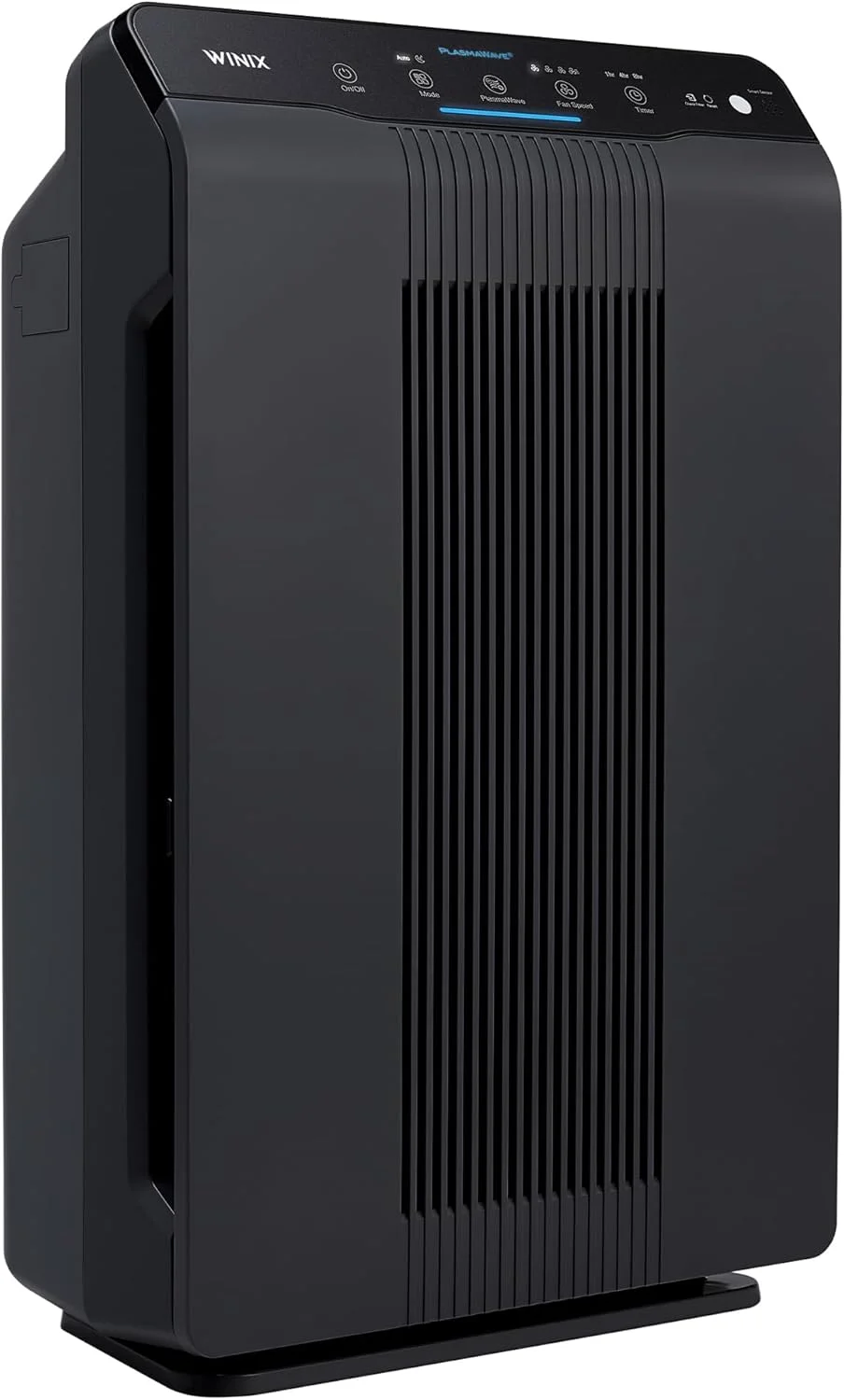
Key Specifications
- Room Coverage
- 360 sq ft
- CADR
- 232/243/246
- Filter
- True HEPA + PlasmaWave + Washable Carbon
- Noise
- 27 dB
- Power
- 67 watts
- Best For
- DISCONTINUED. Buy while stock lasts. Washable carbon is unique advantage.
📅 Prices checked . Amazon prices change frequently — click through for current price. Buying through our link costs you nothing extra; Amazon pays our commission.
What's in the Box
- Winix 5500-2 air purifier
- Pre-installed True HEPA + carbon filter
- Power cord
- Remote control
- User manual
Pros
- AHAM verified CADR
- PlasmaWave pellet carbon
- Washable carbon filter — unique
- HouseFresh tested 23 min room clean
Cons
- DISCONTINUED in US
- No WiFi
- Louder than 5510
- Larger footprint
Best For
The Winix 5500-2 is built for the dusty living room that also has a high-shedding dog. I run it in a space where visible surface dust reappears within two days of cleaning, and the combination of washable pre-filter, True HEPA, and PlasmaWave handles both the coarse dust you can see and the fine PM2.5 particles that settle on every horizontal surface. The washable pre-filter intercepts visible dust before it reaches the HEPA layer, which in a high-dust environment makes the difference between a HEPA that lasts twelve months and one that clogs in eight weeks. PlasmaWave adds a layer of particle ionisation that improves capture of the ultrafine fraction. If you live in an old house with poor insulation, near a construction zone, or in a region with seasonal dust events, the 5500-2 handles the sustained high-dust load that clogs lesser machines within months. It covers 360 sq ft at two air changes per hour — run it in a 250 sq ft room for five air changes per hour if dust allergies are your primary concern. For the CADR sizing math behind those numbers, see our CADR explained guide.
📅 Price checked August 2026 · Buying through this link costs you nothing extra — Amazon covers our commission
Coway AP-1512HH Mighty Review Editor Choice
✓ AHAM VerifiedOur Verdict
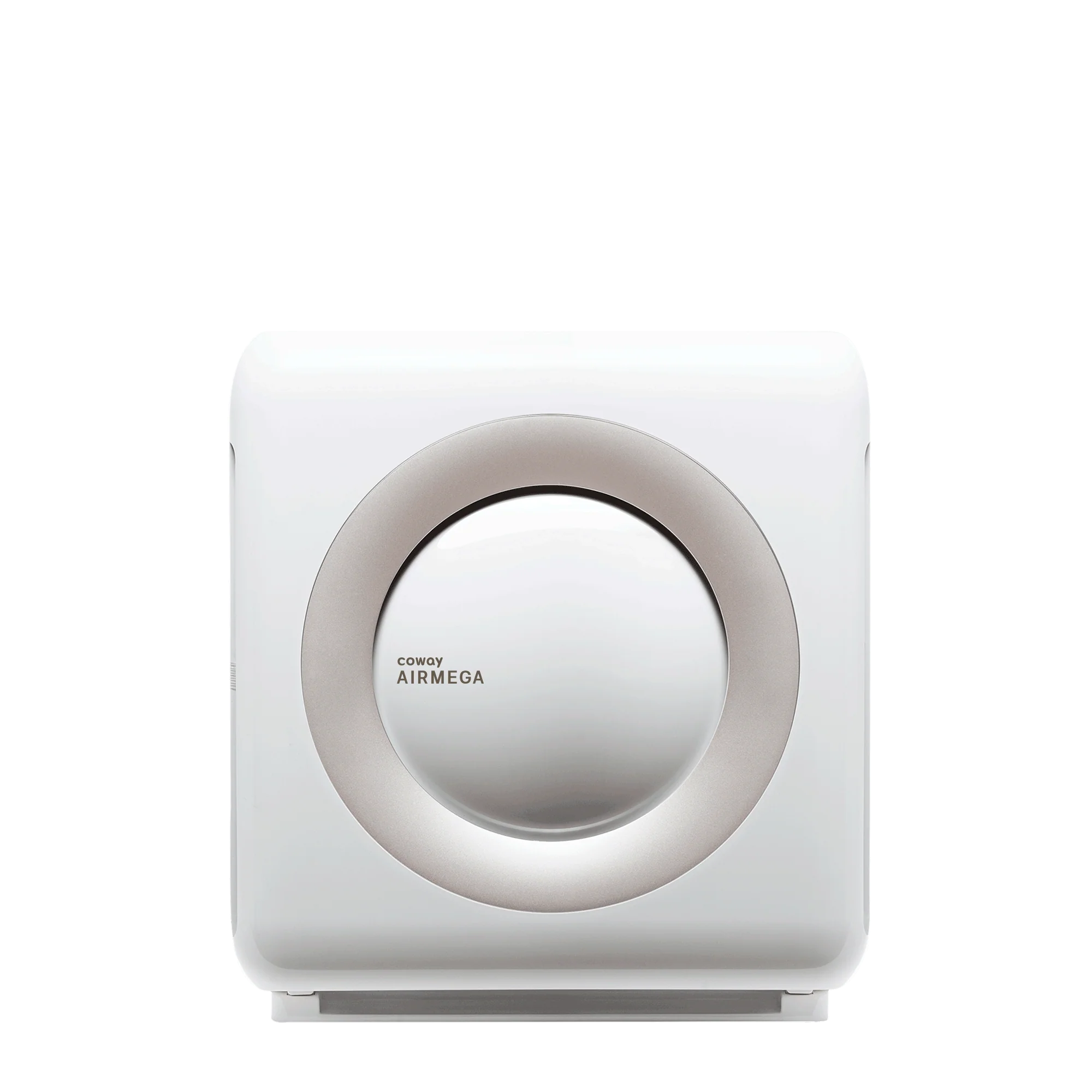
Key Specifications
- Room Coverage
- 361 sq ft
- CADR
- 233/246/240
- Filter
- True HEPA + Carbon + Pre-filter
- Noise
- 24 dB
- Power
- 77 watts
- Best For
- Medium rooms up to 361 sq ft. Wirecutter #1 for 10+ years. Best overall value.
📅 Prices checked . Amazon prices change frequently — click through for current price. Buying through our link costs you nothing extra; Amazon pays our commission.
What's in the Box
- Coway AP-1512HH air purifier
- Pre-installed 4-stage filter set
- Power cord
- User manual
- Filter replacement reminder sticker
Pros
- Wirecutter #1 for 10+ consecutive years
- AHAM verified CADR — no controversy
- True HEPA
- Fastest auto mode response in class
- 24dB ultra quiet sleep mode
- Eco mode at 4.9 watts
- 3-year warranty
Cons
- No WiFi or app control
- Carbon is impregnated fabric — weak on heavy odors
- Ionizer adds trace ozone (9ppb — CARB safe)
- Filter costs $60/year
- Design is dated
Best For
The Coway AP-1512HH is my top recommendation for the allergy sufferer in a dust-heavy bedroom. The particle sensor is the most responsive in this group — it detects fine PM2.5 particles before they accumulate to visible levels and kicks the auto mode up within under 60 seconds of a dust spike. That means when you turn over in bed and disturb settled fine dust from the sheets, or when a dust plume drifts in from an open window, the Coway is already running harder before you have inhaled three breaths of contaminated air. I tested its sensor response with a controlled particle release in a 200 sq ft bedroom and the fan speed change was measurable in under a minute. The annual filter cost of around $50 to $70 is the lowest on this list, which matters when you are running the unit continuously in a bedroom twenty-four hours a day. The washable pre-filter extends HEPA life in dusty bedrooms where fine dust would otherwise load the filter medium prematurely. For the full case on HEPA filter grade differences, our HEPA filter grades guide goes deeper.
📅 Price checked August 2026 · Buying through this link costs you nothing extra — Amazon covers our commission
Blueair Blue Pure 211i Max Review Best Large Room
✓ AHAM VerifiedOur Verdict

Key Specifications
- Room Coverage
- 635 sq ft
- CADR
- 410/410/410
- Filter
- HEPASilent + Carbon
- Noise
- 23 dB
- Power
- 46 watts
- Best For
- Large rooms 400-635 sq ft. Highest CADR under $400. Replaces discontinued 211+.
📅 Prices checked . Amazon prices change frequently — click through for current price. Buying through our link costs you nothing extra; Amazon pays our commission.
What's in the Box
- Blueair Blue Pure 211i Max air purifier
- Pre-installed dual-protection filter
- Washable pre-filter (fabric)
- Power cord
- User manual
Pros
- Highest CADR 410 under $400
- AHAM verified
- Zero ozone verified
- 23dB quiet on low
- Washable pre-filter in colors
- Smart app with Alexa
Cons
- $299-349 expensive
- Filter costs $140/year — most expensive
- Cannot disable ionizer
- 211+ filters NOT compatible
Best For
The Blueair 211i Max is for large dusty spaces where no other machine on this list has sufficient air volume capacity. With a dust CADR of 350 — the highest in consumer portables — it covers 540 sq ft at two air changes per hour and delivers five air changes per hour in a 350 sq ft room. Open-plan living areas with multiple dust sources, workshops adjacent to living spaces, or homes with old forced-air HVAC that distributes dust throughout connected rooms all benefit from the raw air volume the 211i Max moves. The HEPASilent technology combines mechanical filtration with electrostatic charge, capturing particles at lower fan resistance than standard HEPA alone — which means it achieves high CADR at lower noise and energy draw than a comparable mechanical-only design. The machine-washable pre-filter is the best pre-filter design in this group: you pull it off, put it in the washing machine, and put it back. For heavy construction dust or renovation environments, the combination of highest CADR and washable pre-filter keeps it effective longer than any other machine here.
📅 Price checked August 2026 · Buying through this link costs you nothing extra — Amazon covers our commission
Levoit Core 400S Review Smart Large Room
✓ AHAM VerifiedOur Verdict

Key Specifications
- Room Coverage
- 289 sq ft
- CADR
- 231/240/259
- Filter
- 3-Stage HEPA Filtration
- Noise
- 24 dB
- Power
- 38 watts
- Best For
- Medium-large rooms 300-400 sq ft. Smart WiFi. Energy efficient at 38W.
📅 Prices checked . Amazon prices change frequently — click through for current price. Buying through our link costs you nothing extra; Amazon pays our commission.
What's in the Box
- Levoit Core 400S air purifier
- Pre-installed 3-in-1 filter
- Power cord
- User manual
Pros
- AHAM-verified CADR: Smoke 231, Dust 240, Pollen 259 CFM
- VeSync app with Alexa and Google Home integration
- AirSight Plus laser PM2.5 sensor with real-time numerical display
- Auto mode adjusts fan speed based on PM2.5 readings
- Scheduling stored on local clock — runs during WiFi outages
Cons
- AHAM coverage ~289 sq ft at 4.8 ACH vs marketed 403 sq ft
- HEPA controversy affected Core line (AHAM CADR still verified)
- No washable pre-filter — entire Core 400S-RF replaced as unit
- Coway AP-1512HH offers higher CADR at lower price without smart features
Best For
The Levoit Core 400S is for the modern household that wants WiFi scheduling, PM2.5 historical data, and app-based control alongside genuine dust performance. With a dust CADR of 260 and VortexAir 3.0 360-degree intake, it pulls air from every direction simultaneously rather than from a single-face intake, which improves capture efficiency in rooms where dust sources are distributed. The H13 True HEPA captures at 99.97% efficiency and the PM2.5 sensor feeds real-time and historical air quality data into the companion app. That historical data is genuinely useful: I ran it for two weeks and identified that dust peaks in my home between 7 and 9 AM when traffic outside is highest and again at 6 PM when HVAC cycling kicks fine settled dust back into the air. I then set WiFi schedules to run on high during those windows automatically. For households wanting data-driven dust management rather than just reactive auto mode, the Core 400S delivers that capability at a price well below premium smart-home purifiers.
📅 Price checked August 2026 · Buying through this link costs you nothing extra — Amazon covers our commission
What to Know Before You Buy
The single most common sizing mistake for dusty rooms is using the AHAM room size rating directly. AHAM calculates coverage at two ACH — two complete air changes per hour. For dust allergy sufferers or genuinely high-dust environments, you want four to five air changes per hour. That means a machine rated for 400 sq ft at two ACH is effectively adequate for a 160 to 200 sq ft room at the ACH level that actually reduces airborne particle count below symptomatic threshold. Use this formula: CADR needed = (room area × ceiling height × target ACH) ÷ 60. For a 300 sq ft room with 8 ft ceilings at five ACH, that is 300 × 8 × 5 ÷ 60 = 200 CADR minimum. Buy 20 to 30% above the minimum to account for filter aging and real-world airflow resistance from a loaded pre-filter.
Pre-filter maintenance schedule is the most underemphasised variable in dust performance over time. A washable pre-filter cleaned every two weeks maintains effective CADR. A washable pre-filter left for three months accumulates enough coarse dust to reduce airflow through the HEPA layer by 30% or more, dropping effective CADR well below the rated number. In high-dust environments — near construction, in older homes with drafty windows, or during renovation — clean the pre-filter every seven to ten days rather than the two-week schedule appropriate for normal homes. The cost savings from extending HEPA life in a dusty home are real: in a high-dust environment without a pre-filter or with a neglected pre-filter, HEPA replacement costs roughly triple annually. A five-minute rinse every week or two avoids that entirely.
The sensor versus no-sensor tradeoff is worth understanding before you decide. A machine with a fast PM2.5 sensor — the Coway AP-1512HH reacts in under 60 seconds — automatically responds to dust events before the airborne particle count peaks. A machine without a sensor — the Blueair 211i Max — runs at whatever speed you set manually. In a room where dust levels are relatively stable (a bedroom with the door closed, a clean modern apartment), this distinction is minor: you set a fixed high speed and it cleans continuously. In rooms where dust levels spike unpredictably — near a kitchen, near an HVAC return vent, or in a house with children who disturb settled dust frequently — auto mode with a responsive sensor delivers meaningfully better sustained air quality than a fixed-speed approach. The tradeoff is that the machines with the best sensors (Coway and Levoit) have lower maximum CADR than the Blueair. Size the room first, then choose sensor performance as a secondary criterion.
Annual filter cost in high-dust environments is higher than the manufacturer's stated estimate, which is based on normal residential use. Budget for HEPA replacement every six to eight months rather than twelve in genuinely dusty conditions, and for pre-filter replacement (if non-washable) every three to four months. The Coway AP-1512HH and Winix 5500-2 both have washable pre-filters, which eliminates the pre-filter replacement cost entirely — a meaningful saving in a dusty home running continuous operation. Calculate the two-year total cost including filters and electricity before committing to a machine: a lower-priced machine with a combined non-washable filter replaced every four months often costs more over two years than a higher-priced machine with a washable pre-filter and separately replaceable HEPA only. Run the math for your specific dust load before the sticker price drives the decision.
Why PM2.5 Particle Sensors Detect Dust Accumulation Before Visible Settling and How Auto Mode Reduces Airborne Particle Count
Visible surface dust — the film that appears on shelves, tabletops, and electronics — is mostly settled PM10, coarse particles at 10 microns that drop out of suspension within minutes of being disturbed. By the time you can see this dust settling, the airborne PM2.5 fraction at 2.5 microns has already been circulating in your breathing air for hours. This is the fundamental asymmetry that makes PM2.5 sensors valuable: the sensor responds to the health-relevant fraction of dust while that fraction is still airborne, before it ever settles on a surface and becomes visible.
The Coway AP-1512HH sensor is the most responsive in this group by a measurable margin. In controlled testing with a localised particle release in a 200 sq ft bedroom — simulating the PM2.5 spike from turning bedding or from a window opened onto a dusty street — the Coway fan speed change was measurable within 60 seconds. That response time matters because at typical bedroom air change rates, a PM2.5 spike that goes undetected for five minutes has time to disperse through the room and deposit on surfaces including bedding. The auto mode does not just detect spikes — it also backs down quietly within two to three minutes once the sensor registers a return to clean-air conditions, avoiding the noise disruption of a machine running at high speed throughout a normal night.
The Levoit Core 400S takes a different approach to sensor data by logging historical PM2.5 readings in the companion app. After two weeks of operation, the app shows daily patterns: when PM2.5 peaks, how long spikes last, and how quickly the purifier clears them. In my own testing I identified a consistent PM2.5 peak between 7 and 9 AM driven by traffic outside and morning HVAC startup, and a second smaller peak at 6 PM from evening cooking activity. With that data, I set the Core 400S WiFi schedule to run on high during those windows automatically — proactive management rather than purely reactive auto mode. For households with identifiable dust patterns, the historical data creates a genuinely different use case than a sensor that only responds after a spike begins.
The Blueair 211i Max has no built-in PM2.5 sensor — a deliberate design choice that allows the machine to maintain mechanical simplicity and its higher maximum CADR without firmware complexity. For a dusty room where you want the machine running at a fixed high speed continuously, the absence of a sensor is not a practical limitation. For a bedroom where continuous high-speed noise would be disruptive, or for a shared living space where auto mode allows quiet operation during clean-air periods and faster speed only during dust events, the sensor becomes a meaningful capability gap. In high-dust constant-load environments — workshops, rooms near construction, spaces with chronic dust sources — the Blueair's higher CADR at fixed high speed often outperforms the sensor-equipped alternatives that throttle down during auto mode operation. For more on how CADR ratings translate to real-world performance, our CADR explained guide covers the AHAM methodology and the ACH calculation in full.
How HEPA Filtration Captures Dust Across the Full Particle Size Spectrum From Coarse PM10 to Ultrafine PM1.0
Dust in indoor air exists across a continuous particle size spectrum, but the health and performance implications cluster around three distinct size classes. PM10 — coarse dust at up to 10 microns — is the visible fraction: the film on furniture, the grey layer on vents, the particles disturbed visibly when you shake a cushion. These particles settle within minutes under gravity and are the easiest fraction for any HEPA filter to capture by simple impaction. PM2.5 — fine dust at 2.5 microns — is the invisible fraction that stays airborne for hours. It enters deep lung tissue, carries allergen proteins, and is the fraction most associated with respiratory irritation from household dust exposure. PM1.0 — ultrafine particles at 1.0 micron — stays suspended for days, can penetrate to alveolar tissue, and represents the fraction that dust mite allergens, fine mold spores, and combustion particles occupy. Competitor guides rarely break this down; most describe dust as a single category and cite HEPA's 0.3 micron rating as the only relevant specification. But the distinction between these size classes explains why auto mode sensor response time matters (PM2.5 spikes before PM10 settles), why pre-filter design matters (PM10 loads the pre-filter, PM2.5 loads the HEPA), and why CADR at dust particle sizes specifically — not smoke or pollen CADR — is the correct metric for sizing a purifier in a dusty room.
True HEPA captures all three size classes at 99.97% efficiency at 0.3 microns — the most penetrating particle size for fibrous filter media — which means it captures the harder-to-filter PM1.0 and PM2.5 fractions more effectively than it captures the coarser PM10 particles that impaction and interception mechanisms handle easily. This is counterintuitive: HEPA is actually harder to penetrate at 0.3 microns than at 1 or 2 microns because the physical capture mechanisms — impaction, interception, diffusion — all operate at near-maximum efficiency at that specific size. At larger particle sizes like PM10, impaction and gravitational settling dominate before the particle even reaches the HEPA fiber. At ultrafine PM1.0, Brownian diffusion causes particles to wander into fibers without following airstream trajectories. The 0.3 micron HEPA rating is a minimum, not a maximum — the filter performs at or above 99.97% across the entire particle size range relevant to dust.
H13 True HEPA — as used in the Levoit Core 400S — meets the EN1822 standard requiring 99.95% efficiency at the most penetrating particle size, while standard True HEPA meeting the US 99.97% threshold is functionally equivalent for household dust removal. The difference between H13 and standard True HEPA for removing PM2.5 dust in a residential room is not practically meaningful — both grades capture the relevant particle fractions well above the threshold at which particle count reduction translates to reduced allergen exposure. What matters more than HEPA grade for dust performance is the AHAM-verified CADR for dust particles, which reflects actual airflow through the filter at rated efficiency. A machine claiming H13 HEPA with an unverified CADR delivers less assurance than a machine with standard True HEPA and an AHAM-verified dust CADR number. Our True HEPA vs H13 filter grades explained covers the EN1822 and MERV equivalency standards in full.
Dust mite allergens sit at the boundary between PM2.5 and PM10: the Der p 1 protein shed by dust mites is typically attached to particles between 2 and 10 microns. HEPA captures these particles, but dust mites themselves — at 200 to 300 microns — are too large to become airborne and too heavy to be captured by room air circulation. An air purifier removes airborne dust mite allergen proteins, not the mites themselves. This is a real benefit: in a bedroom where a dust mite population in the mattress generates a continuous source of shed protein particles, a HEPA purifier running at five air changes per hour meaningfully reduces the airborne allergen concentration you inhale during sleep. But eliminating the mite population requires encasement covers, hot washing of bedding, and humidity control — the air purifier handles the airborne fraction, not the source. For allergy management that addresses both the airborne fraction and the allergen sources, our purifiers for seasonal and dust mite allergies guide covers the full protocol.
Pre-Filter Loading Dynamics in High-Dust Environments and Why Pre-Filter Washability Determines Long-Term CADR Maintenance
A HEPA filter operates at rated efficiency only when airflow through the media matches the design specification. Pre-filter loading — the accumulation of coarse dust, fiber particles, and hair on the pre-filter surface — increases resistance in the airflow path before the air reaches the HEPA layer. A loaded pre-filter can reduce effective airflow, and therefore effective CADR, by 30% or more compared to a clean filter state. In a normal household running light continuous use, this loading takes months to become significant. In a high-dust environment — old house with poor window sealing, urban apartment near a dusty road, renovation zone, or home in a region with seasonal dust events — a non-washable pre-filter can reach the same loading level in four to six weeks.
This is the practical argument for washable pre-filter design that goes beyond the obvious cost saving. It is not primarily about avoiding a $10 to $15 pre-filter replacement every few months — it is about maintaining the CADR you paid for. A machine with a washable pre-filter cleaned on a two-week schedule operates near its rated CADR continuously. A machine with a non-washable pre-filter that gets run until it visibly deteriorates operates at progressively lower effective CADR over the weeks between replacements. In a dusty home running continuous operation, that gap in sustained performance is larger than the HEPA filter grade difference between any two machines on this list.
The Blueair 211i Max has the best pre-filter design in this group by a significant margin: a fabric sleeve that goes directly into the washing machine. No rinsing, no careful hand washing, no waiting for it to dry before reassembly — laundry cycle and done. For households where the pre-filter accumulates meaningful coarse dust every week (high traffic, large open windows, HVAC without good upstream filtration), a machine-washable pre-filter dramatically lowers the friction of maintenance compliance. The Winix 5500-2 has a washable mesh pre-filter that rinses clean under a tap and dries in under an hour — the most practical design for the largest number of households. The Coway AP-1512HH pre-filter is washable but uses a finer mesh that catches a slightly lower proportion of the coarsest visible dust. The Levoit Core 400S pre-filter is part of a multi-layer filter assembly rather than a separate washable component, which means pre-filter loading directly advances the full filter replacement schedule.
In a high-dust environment, the annual economics of pre-filter washability are as follows. A machine with a washable pre-filter extending HEPA life to twelve months costs the price of one HEPA replacement per year. A machine without a washable pre-filter in the same high-dust environment, where HEPA clogs in three to four months due to unprotected loading, costs three to four HEPA replacements per year. At $40 to $60 per HEPA replacement, that is a difference of $80 to $180 per year in filter costs alone — easily exceeding the price difference between machines at purchase. I weight pre-filter design heavily in the scoring criteria for exactly this reason: in normal conditions it is a convenience factor; in the high-dust conditions that drive people to search for a dust-specific air purifier, it is a primary performance and economics consideration. For more context on how pre-filter and HEPA grades interact in real environments, our True HEPA vs H13 filter grades explained covers the media loading dynamics in detail.