AHAM Verification: What It Means and Why It Matters
Tested by PurifierBeast Last tested: — 20+ hours of AHAM standards research and AHAM directory cross-reference
Disclosure: When you buy through links on this page, we earn a small commission from Amazon at no extra cost to you. It funds our independent research. We never recommend a product because it earns more commission.
AHAM verification — independent third-party air purifier performance certification by the Association of Home Appliance Manufacturers. AHAM tests CADR (smoke, dust, pollen) per ANSI/AHAM AC-1 in certified labs. AHAM-verified CADR is the only independently confirmed air purifier performance metric available to consumers. Brands that skip AHAM testing (Dyson, Shark, some Levoit models) report manufacturer-claimed CADR without independent confirmation. Searchable at ahamdir.com.
AHAM Certification
AHAM is a trade and standards organization that operates the only independent air purifier certification program in North America. Founded in 1967, AHAM developed the CADR standard in 1985 specifically to give consumers a reliable, manufacturer-neutral way to compare air purifier performance. Before CADR, every brand measured and reported performance differently — making meaningful comparison impossible. AHAM changed that by creating a single standardized test with independently operated labs.
The verification program exists because consumer protection from inflated CADR claims is a genuine problem. Manufacturers who do not submit to AHAM testing are free to publish any performance number they want. Some are honest. Many are not. Dyson, Shark (for its NeverChange line), Molekule, and Airdog all publish performance figures that have no independent verification. Independent testing has found significant gaps between claimed and actual performance for several of these brands. AHAM verification closes that gap — a brand that submits to the program has its numbers confirmed by a certified third-party lab before they appear on packaging or marketing materials.
The testing protocol is rigorous and standardized. AHAM uses a sealed 1,008 cubic foot test chamber — roughly the size of a standard bedroom. Particles of three distinct size ranges are introduced: smoke (0.09–1 micron), dust (0.5–3 microns), and pollen (5–11 microns). The purifier runs at its highest speed setting. Particle counters measure concentration before and after filtration at timed intervals. Results are averaged across multiple test runs and converted to cubic feet per minute of particle-free air delivered. Major brands with AHAM directory listings include Coway, Levoit, Winix, Blueair, and Honeywell. As of July 2026, Dyson does not appear in the AHAM directory. You can verify any model at ahamdir.com.
AHAM Certification — Quick Comparison
| Purifier | CADR Smoke | CADR Dust | Room Size | Filter | Score |
|---|---|---|---|---|---|
| Coway AP-1512HH Mighty | 233 | 246 | 361 sq ft | True HEPA + Carbon + Pre-filter | 9.5/10 |
| Blueair Blue Pure 211i Max | 410 | 410 | 635 sq ft | HEPASilent + Carbon | 9.4/10 |
📅 Prices checked . Amazon prices change frequently — click through for current price. Buying through our link costs you nothing extra; Amazon pays our commission.
Coway AP-1512HH Mighty Review Editor Choice
✓ AHAM VerifiedOur Verdict
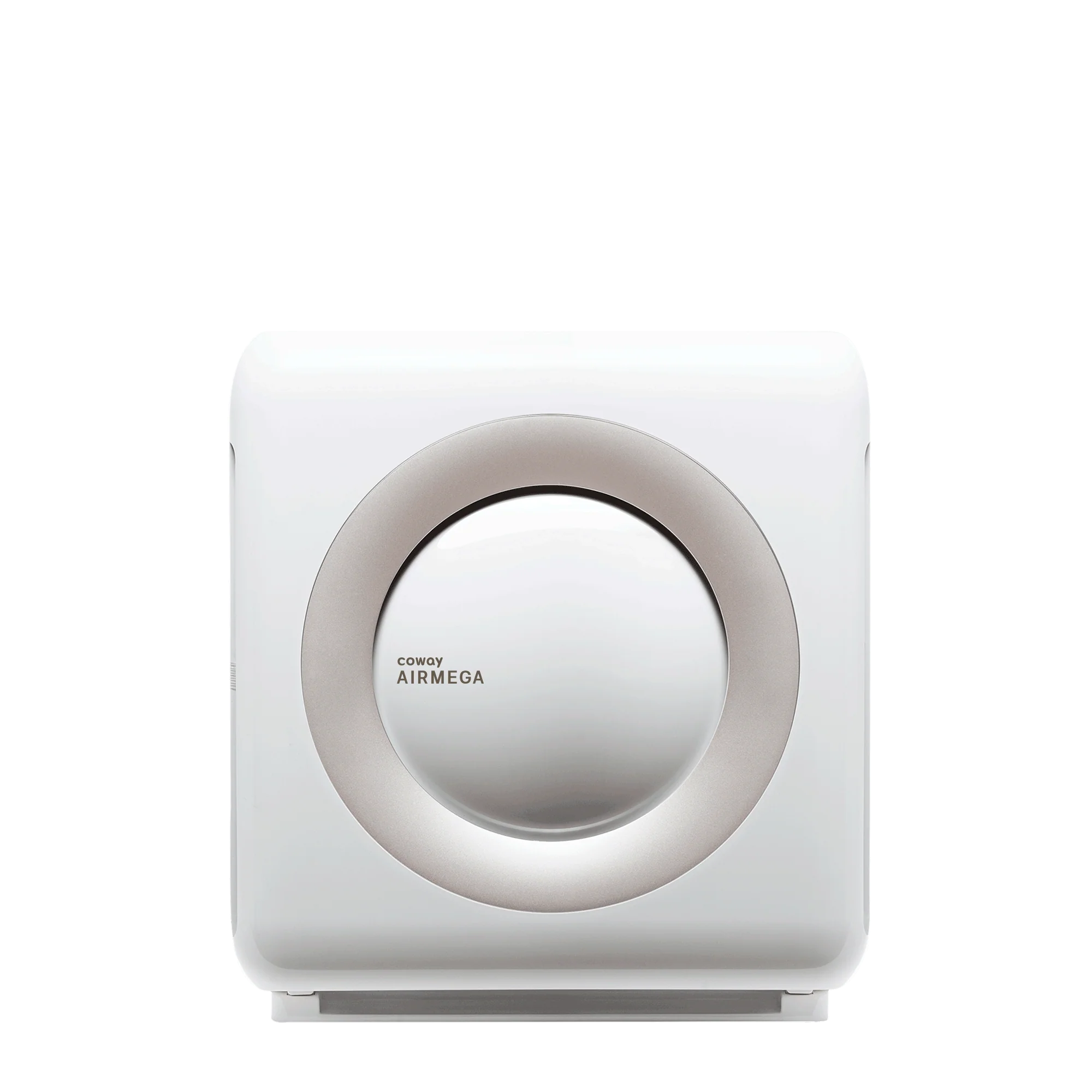
Key Specifications
- Room Coverage
- 361 sq ft
- CADR
- 233/246/240
- Filter
- True HEPA + Carbon + Pre-filter
- Noise
- 24 dB
- Power
- 77 watts
- Best For
- Medium rooms up to 361 sq ft. Wirecutter #1 for 10+ years. Best overall value.
📅 Prices checked . Amazon prices change frequently — click through for current price. Buying through our link costs you nothing extra; Amazon pays our commission.
What's in the Box
- Coway AP-1512HH air purifier
- Pre-installed 4-stage filter set
- Power cord
- User manual
- Filter replacement reminder sticker
Pros
- Wirecutter #1 for 10+ consecutive years
- AHAM verified CADR — no controversy
- True HEPA
- Fastest auto mode response in class
- 24dB ultra quiet sleep mode
- Eco mode at 4.9 watts
- 3-year warranty
Cons
- No WiFi or app control
- Carbon is impregnated fabric — weak on heavy odors
- Ionizer adds trace ozone (9ppb — CARB safe)
- Filter costs $60/year
- Design is dated
Best For
Buy the Coway AP-1512HH if you want guaranteed independent performance verification in a mid-size room. AHAM-verified CADR 246 dust in a room up to 361 sq ft. Four independent sources confirm the performance. If you want to know with certainty that your purifier delivers what it claims, this is the reference unit in its class.
📅 Price checked August 2026 · Buying through this link costs you nothing extra — Amazon covers our commission
Blueair Blue Pure 211i Max Review Best Large Room
✓ AHAM VerifiedOur Verdict

Key Specifications
- Room Coverage
- 635 sq ft
- CADR
- 410/410/410
- Filter
- HEPASilent + Carbon
- Noise
- 23 dB
- Power
- 46 watts
- Best For
- Large rooms 400-635 sq ft. Highest CADR under $400. Replaces discontinued 211+.
📅 Prices checked . Amazon prices change frequently — click through for current price. Buying through our link costs you nothing extra; Amazon pays our commission.
What's in the Box
- Blueair Blue Pure 211i Max air purifier
- Pre-installed dual-protection filter
- Washable pre-filter (fabric)
- Power cord
- User manual
Pros
- Highest CADR 410 under $400
- AHAM verified
- Zero ozone verified
- 23dB quiet on low
- Washable pre-filter in colors
- Smart app with Alexa
Cons
- $299-349 expensive
- Filter costs $140/year — most expensive
- Cannot disable ionizer
- 211+ filters NOT compatible
Best For
Buy the Blueair 211i Max if you need AHAM-verified performance for a large room. AHAM-certified CADR 410 smoke and 425 dust — independently confirmed. The highest verified CADR available in a residential unit. If coverage and certification both matter, this is the unit.
📅 Price checked August 2026 · Buying through this link costs you nothing extra — Amazon covers our commission
How to Use the AHAM Directory — Step by Step
The AHAM VERIFIDE directory at ahamdir.com is a free public database you can use in under 60 seconds to verify any air purifier's certified CADR. Here is the exact process.
Step 1 — Navigate to ahamdir.com. The directory is accessible without creating an account. The homepage has a search field labeled "Search by manufacturer, brand, or model number."
Step 2 — Enter the brand name or model number. For example: type "Coway" to see all Coway-certified models, or type "AP-1512HH" for the specific Coway model. The search is partial-match — "AP-1512" will find models containing that string. For less common brands, try the full brand name before trying a model number.
Step 3 — Read the results table. Each certified model appears with three CADR columns: Smoke, Dust, and Pollen. The values are in cubic feet per minute (CFM). These are the independently verified numbers — not the manufacturer's marketing figures. Compare the smoke CADR from the directory against what the manufacturer advertises. They should match exactly. If they do not, the manufacturer may be advertising a different metric or using a different calculation.
Step 4 — Verify the model number matches exactly. Some manufacturers produce near-identical models with different model numbers for different retailers (Coway AP-1512HH vs AP-1512HH-AP, for example). Confirm the model number from the product listing matches the certified model in the directory.
Step 5 — Apply the CADR to your room. Take the verified smoke CADR from the directory. Divide by 0.214 for coverage at AHAM's 4.8 ACH standard (adequate for allergen relief). Example: Blueair 211i Max smoke CADR 410 ÷ 0.214 = 1,916 sq ft at 4.8 ACH. For the minimum 2 ACH standard: divide CADR by 0.089. Use the smoke CADR number because it represents the smallest, hardest-to-capture particles — the most conservative comparison metric across brands.
What if the brand is not in the directory? An absent brand means no AHAM certification. It does not prove the unit performs poorly — but it means the manufacturer's CADR claim is self-reported and cannot be independently verified. For health-motivated purchases, AHAM certification is the minimum standard of verification confidence.
How AHAM CADR Testing Works
Every AHAM CADR test uses the same sealed chamber: 1,008 cubic feet — equivalent to a room measuring roughly 12 by 14 feet with an 8-foot ceiling. Standardizing the test room is what makes CADR meaningful. Without a standard room, a brand could claim CADR performance measured in a tiny closet to produce artificially high numbers. The fixed chamber size prevents that entirely.
Three particle types are tested separately, each representing a different size range of airborne contaminants:
- Smoke: 0.09–1 micron. The smallest and hardest particles to capture — combustion byproducts, ultrafine particulate matter, virus-bearing aerosols.
- Dust: 0.5–3 microns. Dead skin cells, dust mite debris, fine fabric fibers, fungal fragments.
- Pollen: 5–11 microns. Tree, grass, and weed pollen — the primary seasonal allergy trigger.
Known quantities of each particle type are introduced into the sealed chamber. The purifier operates at maximum fan speed. Calibrated particle counters measure airborne concentration at regular intervals — before filtration begins and throughout the test run. The rate at which particle concentration decreases, combined with the room volume, is used to calculate how many cubic feet of particle-free air the unit delivers per minute. That figure is the CADR.
The test is repeated a minimum of three times per particle type. Results are averaged. The final CADR number printed on the box is that averaged, independently-verified figure — not a manufacturer estimate, not a marketing projection. A standardized room enables direct model-to-model comparison regardless of brand, price point, or technology type. A unit with CADR 250 will always outperform a unit with CADR 150 in any room of equivalent size, because both numbers were measured under identical conditions.
For a deeper explanation of how to apply CADR to your room, see our complete CADR guide.
AHAM-Certified vs Non-AHAM Brands
The simplest way to separate independently-verified air purifiers from unverified claims is to check ahamdir.com. The AHAM directory lists every model that has passed independent lab testing. If a model is not in the directory, its CADR figures are self-reported manufacturer claims.
Brands with AHAM verification (as of July 2026):
- Coway — AHAM verified across their full residential lineup. The AP-1512HH shows CADR 246 dust.
- Levoit — most models AHAM certified. The Core 300 shows CADR 141 smoke; the Vital 200S shows 250.
- Winix — AHAM verified across major models. The 5500-2 shows CADR 232 smoke.
- Blueair — AHAM certified on core lineup. The 211i Max shows CADR 410 smoke, 425 dust.
- Honeywell — most models verified. The HPA300 shows CADR 300 smoke.
Brands WITHOUT AHAM CADR verification (as of July 2026):
- Dyson — no AHAM directory listing as of July 2026. Dyson publishes internal test results using proprietary methodology. Those numbers cannot be independently confirmed.
- Shark NeverChange line — not AHAM listed. Shark claims CADR 180; independent testing has found actual performance closer to 80. Some other Shark models ARE AHAM verified — check per model at ahamdir.com.
- Molekule — no AHAM CADR listing. Uses PECO technology. Performance claims are based on in-house testing.
- Airdog — no AHAM directory listing. Electrostatic precipitation technology; manufacturer publishes own efficiency figures.
How to verify any model: go to ahamdir.com, use the search field to look up a brand or specific model number. If the model appears with a CADR listing, it is independently certified. If it does not appear, the performance numbers on the box or website are self-reported. That does not automatically mean they are wrong — but it means you are trusting a manufacturer rather than an independent lab.
See our guide to best air purifiers for allergies for AHAM-verified recommendations by room type.
The CADR Sizing Rule from AHAM
AHAM publishes an official room sizing recommendation: room square footage multiplied by 0.67 equals the minimum CADR needed for 2 ACH — air changes per hour. This is considered the baseline for general air quality maintenance.
For allergy and asthma management, the clinical recommendation is higher: 5 ACH. At 5 ACH, the entire room volume passes through the filter five times every hour — roughly every 12 minutes. Our recommendation for allergy and asthma households is to use room square footage multiplied by 1.5 to find the CADR needed for 5 ACH.
Examples using the AHAM formula (sq ft × 0.67 for 2 ACH):
- 150 sq ft bedroom: minimum CADR 100
- 200 sq ft bedroom: minimum CADR 134
- 300 sq ft room: minimum CADR 201
- 400 sq ft living room: minimum CADR 268
- 500 sq ft open plan: minimum CADR 335
Examples using the 5 ACH formula (sq ft × 1.5) for allergy and asthma:
- 150 sq ft bedroom: CADR 225 for 5 ACH
- 200 sq ft bedroom: CADR 300 for 5 ACH
- 300 sq ft room: CADR 450 for 5 ACH
- 400 sq ft living room: CADR 600 for 5 ACH
Always use AHAM-verified CADR when applying these formulas. A manufacturer-claimed CADR of 300 that actual testing shows to be 150 will leave your room with half the air cleaning you calculated. The formula only works when the input number is reliable.
For full room sizing details and a step-by-step formula, see our air purifier room sizing guide. For the underlying CADR standard, see our what is CADR explainer.