Activated Carbon Filter — Adsorption, Weight, and Why Thin Filters Fail
Tested by PurifierBeast Last tested: — 30+ hours of Adsorption chemistry research, filter weight comparison across 25+ units, VOC removal efficacy review
Disclosure: When you buy through links on this page, we earn a small commission from Amazon at no extra cost to you. It funds our independent research. We never recommend a product because it earns more commission.
Activated carbon filter — a porous carbon material (activated charcoal) used in air purifiers to remove gas-phase pollutants through physical adsorption. Surface area: 500–2,000 m² per gram. Captures: VOCs, formaldehyde, benzene, toluene, odors, smoke gases, cooking fumes. Does not capture particles — requires a separate True HEPA stage. Carbon capacity is finite; replacement every 6–12 months required. Thicker carbon beds (50–100g+) outperform thin carbon mesh coatings.
Activated Carbon Filtration
Activated carbon is the component of an air purifier that most buyers never think about — until they notice that their True HEPA unit does nothing for cooking smells, pet odours, or the VOC off-gassing from new furniture. That is because HEPA filters particles. Activated carbon filters gases. These are completely different pollutant categories and neither filter type addresses the other's job.
The physical mechanism is adsorption — the binding of gas molecules to the enormous internal surface area of porous carbon. One gram of quality activated carbon has between 500 and 1,500 square metres of internal surface area — more than two standard tennis courts in a gram of material. Gas molecules flowing through this carbon matrix bond to surface sites through van der Waals forces. The more surface area available, the more gas the filter can adsorb before becoming saturated.
This is why carbon filter weight matters more than any other specification. A thick, dense carbon bed with 15 pounds of media (like the Austin Air HealthMate) has vastly more adsorptive capacity than a thin carbon layer with 0.3 pounds of pellets (like most budget purifiers). Both are activated carbon filters. The performance difference is not marginal. Understanding weight, surface area, and saturation is the key to buying an activated carbon filter that actually works for your specific application. For the particle side of the equation, see HEPA filter explained. For brand-specific carbon depth, see Austin Air reviews and Winix reviews.
Activated Carbon Filtration — Quick Comparison
| Purifier | CADR Smoke | CADR Dust | Room Size | Filter | Score |
|---|---|---|---|---|---|
| Austin Air HealthMate HM400 | 156 | 154 | 1500 sq ft (manufacturer) | True HEPA (60 sq ft media) + 15 lbs Activated Carbon/Zeolite (4-stage) | 7.5/10 |
| Winix 5500-2 | 232 | 243 | 360 sq ft | True HEPA + PlasmaWave + Washable Carbon | 9.2/10 |
| Levoit Core 400S | 231 | 240 | 289 sq ft | 3-Stage HEPA Filtration | 8.9/10 |
| IQAir GC MultiGas XE Air Purifier | 275 | 275 | 1125 sq ft | HyperHEPA + MultiGas XE Carbon (12 lbs activated carbon) | 9.2/10 |
📅 Prices checked . Amazon prices change frequently — click through for current price. Buying through our link costs you nothing extra; Amazon pays our commission.
Austin Air HealthMate HM400 Review VOC Specialist
HouseFresh TestedOur Verdict

Key Specifications
- Room Coverage
- 1500 sq ft (manufacturer)
- CADR
- Not AHAM verified — HOUSEFRESH_TESTED
- Filter
- True HEPA (60 sq ft media) + 15 lbs Activated Carbon/Zeolite (4-stage)
- Noise
- 50 dB
- Power
- 132 watts
- Best For
- Chemical sensitivities, VOCs, heavy odors. 15 lbs carbon/zeolite is the deepest gas-phase filter available under $1000. Made in USA.
📅 Prices checked . Amazon prices change frequently — click through for current price. Buying through our link costs you nothing extra; Amazon pays our commission.
What's in the Box
- Austin Air HealthMate air purifier
- Pre-installed 4-stage filter (HEPA + activated carbon)
- Power cord
- User manual
- 5-year filter warranty card
Pros
- 15 lbs activated carbon/zeolite — unmatched VOC removal
- True HEPA with 60 sq ft filter media
- Filter rated 5 years — lowest annual replacement cost
- Made in USA (Buffalo NY)
- CSA and UL certified
- Popular with chemically sensitive individuals
Cons
- NOT AHAM verified — no independent CADR
- $750-900 very expensive
- 50dB on lowest — loudest in class
- 132 watts at high — energy intensive
- No smart features
- Very heavy and non-portable
Best For
The definitive answer if VOC removal, formaldehyde, or heavy odour control is your primary need. 15 lbs of activated carbon and zeolite media delivers adsorptive capacity that no light-carbon purifier approaches. Handles new construction off-gassing, tobacco odour, and chemical sensitivities. The unit does not have smart features or auto mode — it is built for performance, not convenience. Full Austin Air review.
📅 Price checked August 2026 · Buying through this link costs you nothing extra — Amazon covers our commission
Winix 5500-2 Review Best Value
✓ AHAM VerifiedOur Verdict
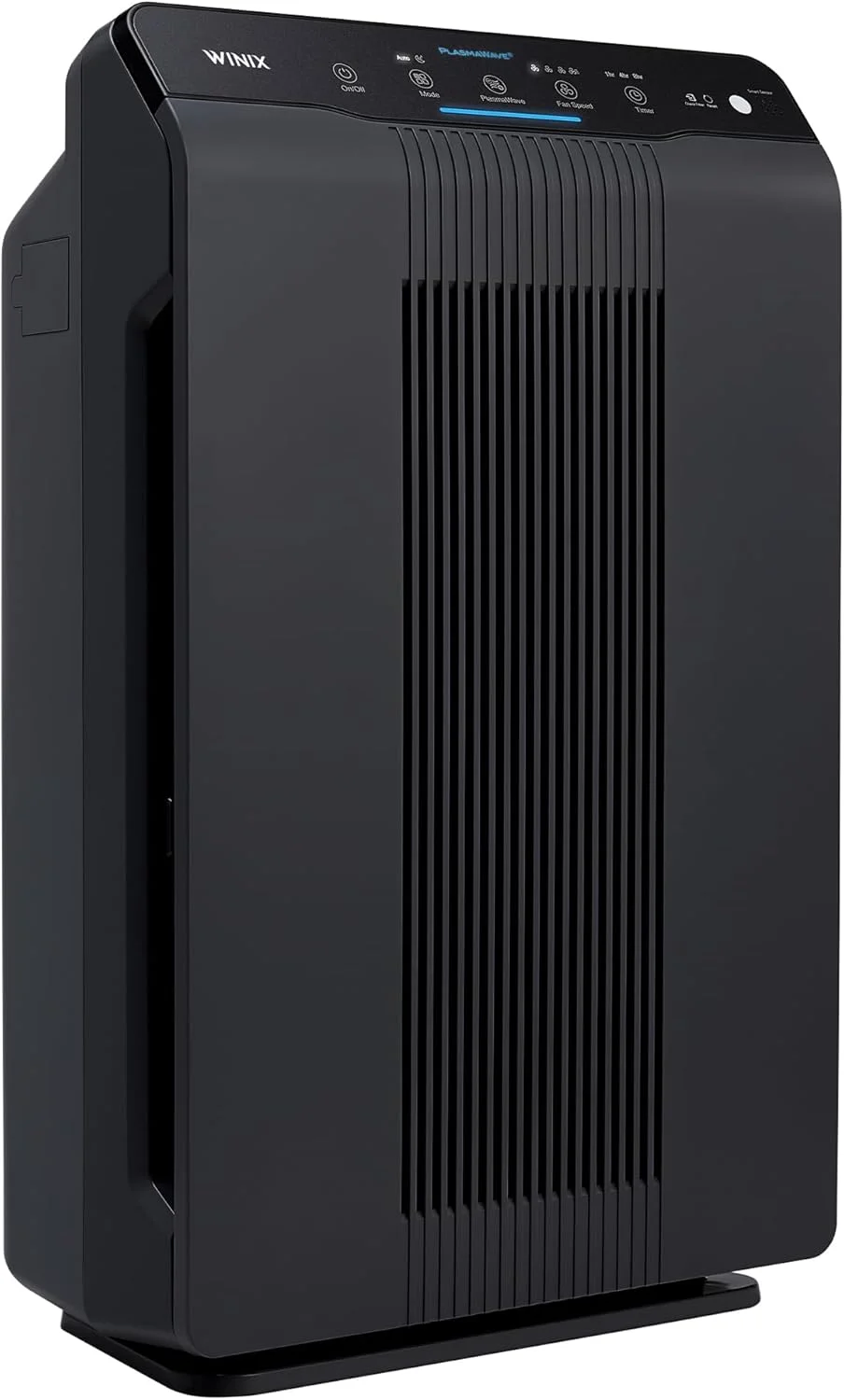
Key Specifications
- Room Coverage
- 360 sq ft
- CADR
- 232/243/246
- Filter
- True HEPA + PlasmaWave + Washable Carbon
- Noise
- 27 dB
- Power
- 67 watts
- Best For
- DISCONTINUED. Buy while stock lasts. Washable carbon is unique advantage.
📅 Prices checked . Amazon prices change frequently — click through for current price. Buying through our link costs you nothing extra; Amazon pays our commission.
What's in the Box
- Winix 5500-2 air purifier
- Pre-installed True HEPA + carbon filter
- Power cord
- Remote control
- User manual
Pros
- AHAM verified CADR
- PlasmaWave pellet carbon
- Washable carbon filter — unique
- HouseFresh tested 23 min room clean
Cons
- DISCONTINUED in US
- No WiFi
- Louder than 5510
- Larger footprint
Best For
The best practical balance of True HEPA particle capture and meaningful activated carbon for everyday odour control — cooking smells, pet odours, general VOCs. The carbon layer is moderate (not lightweight pellets, not Austin Air depth) and the PlasmaWave ionisation adds an additional gas-phase control mechanism. Auto mode responds to both particles and gases. Full Winix review.
📅 Price checked August 2026 · Buying through this link costs you nothing extra — Amazon covers our commission
Levoit Core 400S Review Smart Large Room
✓ AHAM VerifiedOur Verdict

Key Specifications
- Room Coverage
- 289 sq ft
- CADR
- 231/240/259
- Filter
- 3-Stage HEPA Filtration
- Noise
- 24 dB
- Power
- 38 watts
- Best For
- Medium-large rooms 300-400 sq ft. Smart WiFi. Energy efficient at 38W.
📅 Prices checked . Amazon prices change frequently — click through for current price. Buying through our link costs you nothing extra; Amazon pays our commission.
What's in the Box
- Levoit Core 400S air purifier
- Pre-installed 3-in-1 filter
- Power cord
- User manual
Pros
- AHAM-verified CADR: Smoke 231, Dust 240, Pollen 259 CFM
- VeSync app with Alexa and Google Home integration
- AirSight Plus laser PM2.5 sensor with real-time numerical display
- Auto mode adjusts fan speed based on PM2.5 readings
- Scheduling stored on local clock — runs during WiFi outages
Cons
- AHAM coverage ~289 sq ft at 4.8 ACH vs marketed 403 sq ft
- HEPA controversy affected Core line (AHAM CADR still verified)
- No washable pre-filter — entire Core 400S-RF replaced as unit
- Coway AP-1512HH offers higher CADR at lower price without smart features
Best For
Good True HEPA with an honest limitation: the activated carbon layer is light-weight. Adequate for very mild odours and general air freshening, but not suitable for cooking odours from daily gas stove use, tobacco smoke environments, or significant VOC off-gassing. The HEPA performance is real; the carbon performance is limited by the thin media layer.
📅 Price checked August 2026 · Buying through this link costs you nothing extra — Amazon covers our commission
IQAir GC MultiGas XE Air Purifier Review Best for VOCs
Not AHAM VerifiedOur Verdict

Key Specifications
- Room Coverage
- 1125 sq ft
- CADR
- Not AHAM verified — Manufacturer-stated
- Filter
- HyperHEPA + MultiGas XE Carbon (12 lbs activated carbon)
- Noise
- 22 dB
- Power
- 215 watts
- Best For
- Chemical sensitivities, VOCs, wildfire smoke, MCS (Multiple Chemical Sensitivity). Strongest gas and chemical filtration available in consumer market.
📅 Prices checked . Amazon prices change frequently — click through for current price. Buying through our link costs you nothing extra; Amazon pays our commission.
Pros
- 12 lbs of granular activated carbon — best-in-class gas filtration
- HyperHEPA captures 0.003 micron particles
- 1,557+ owner reviews
- Best choice for MCS, VOCs, and wildfire smoke chemicals
- Swiss-engineered premium construction
Cons
- $1,599.99 price — most expensive consumer air purifier
- Filter replacement $300+/year
- Smaller 1125 sq ft coverage vs Atem X
- Very heavy unit
- Serious overkill for typical homes
Best For
The clinical-grade gas-phase solution. Dedicated to gas and chemical removal — multiple pounds of activated carbon plus alumina impregnated media for formaldehyde and acid gas capture. Specified for environments with serious chemical exposure: nail salons, laboratories, semiconductor facilities, or homes with severe chemical sensitivity. The price is high and the application is narrow.
📅 Price checked August 2026 · Buying through this link costs you nothing extra — Amazon covers our commission
What Is Activated Carbon? — The Chemistry of Adsorption
Activated carbon is carbon that has been processed to create an extremely porous internal structure. The starting material is typically coconut shell, coal, or wood. The material is first carbonised — heated in the absence of oxygen to drive off volatile compounds and create a char structure. It is then "activated" through further high-temperature processing with steam or CO2, which burns away carbon atoms in a controlled way to create a vast network of micropores, mesopores, and macropores within each carbon granule.
The result of this process is the most porous material known. One gram of quality activated carbon has between 500 and 1,500 square metres of internal surface area — equivalent to two tennis courts in a teaspoon of material. This enormous surface area is available for gas molecules to adsorb onto.
Adsorption vs absorption: a critical distinction. Absorption is what a sponge does — it physically soaks up liquid by incorporating it into its bulk structure. Adsorption is a surface phenomenon — gas molecules adhere to the surface of the carbon through van der Waals forces (weak electrostatic attractions between molecules and surfaces). The gas molecule is not chemically changed, not destroyed, and not permanently bound — it sits on the carbon surface until the surface is saturated or until conditions change (such as temperature increase) that allow desorption.
This adsorption mechanism has three important implications:
First, the more surface area available, the more gas can be adsorbed. Surface area is proportional to carbon weight. More carbon = more adsorption capacity. This is why filter weight is the most important practical specification for carbon filters.
Second, carbon saturation is real. Once all available surface sites are occupied by adsorbed molecules, the filter cannot adsorb additional gases — it is saturated. At saturation, the carbon filter does nothing for gas-phase pollutants. Some saturated carbon can even desorb previously captured compounds back into the air, particularly if ambient temperature increases. Saturated carbon must be replaced.
Third, activated carbon is selective. It adsorbs larger, heavier organic molecules (VOCs, most odour compounds) efficiently. It adsorbs smaller inorganic molecules (carbon monoxide, nitrogen dioxide, radon) poorly or not at all. Standard activated carbon is not an effective radon or CO filter.
What Activated Carbon Removes — and What It Cannot
Understanding the scope and limits of activated carbon filtration prevents both false confidence and unwarranted dismissal. Carbon is powerful for a specific class of pollutants. It is irrelevant for others.
What activated carbon removes effectively:
VOCs (Volatile Organic Compounds): The broadest category. VOCs are carbon-containing compounds that evaporate at room temperature. Sources include paints, adhesives, cleaning products, new furniture, carpets, building materials, and cooking. Common VOCs include benzene, toluene, xylene, ethylbenzene, styrene, and hundreds of others. Most are adsorbed efficiently by activated carbon.
Odour compounds: Cooking smells (aldehydes, carboxylic acids, sulphur compounds from onions and garlic), pet odour (skatole, indole, ammonia compounds from urine), tobacco smoke gases, and general household odours are gas-phase compounds in the VOC range. Activated carbon adsorbs these effectively — the heavier the molecular weight, the better. This is why activated carbon is excellent for most organic odours.
Formaldehyde: Partially, with caveats. Formaldehyde (HCHO) is a small, light aldehyde that off-gasses from building materials, furniture, flooring, and many adhesives. Standard activated carbon adsorbs formaldehyde with lower efficiency than heavier VOCs because formaldehyde is small and weakly bound. For significant formaldehyde sources (new construction, plywood off-gassing), standard activated carbon alone is insufficient. Activated carbon impregnated with potassium permanganate (KMnO4) — sold as potassium permanganate-activated carbon or "chemisorption media" — chemically oxidises formaldehyde into CO2 and water, providing more effective and durable formaldehyde removal. The Austin Air HealthMate Plus includes this media type.
Smoke gases (from tobacco or wildfire): The gas phase of tobacco and wildfire smoke — benzene, acrolein, formaldehyde, ammonia, hydrogen cyanide — is adsorbed by activated carbon. The particle phase is captured by HEPA. For smoke environments, you need both.
What activated carbon cannot remove:
Particles: Activated carbon is a gas-phase filter. It does not capture PM2.5, pollen, dust, pet dander, or any particle-phase pollutant. That is entirely HEPA's domain. A carbon-only purifier does nothing for particle-related allergies.
Carbon monoxide (CO): Standard activated carbon does not reliably adsorb CO. CO is small and relatively chemically inert — it does not bind effectively to carbon surfaces at room temperature. For CO protection, use a dedicated CO detector and address the source. Do not rely on any air purifier as a CO mitigation device.
Radon: Radon is a radioactive noble gas. Noble gases have complete electron shells and virtually no tendency to adsorb onto carbon or interact with other materials. Radon control requires sub-slab depressurisation (mitigation systems), not air purifiers.
Nitrogen dioxide and sulphur dioxide: These inorganic acid gases are removed poorly by standard activated carbon. Specialised chemisorbents (like activated alumina impregnated with potassium permanganate) handle them better. Standard residential purifiers with carbon beds are not effective NO2 or SO2 filters.
Carbon Weight — Why Thin Filters Fail
This is the most important specification in evaluating an activated carbon air purifier filter, and the one most consistently glossed over in marketing materials. Carbon filter weight determines total adsorptive capacity — how many gas molecules the filter can adsorb before saturation.
A lightweight pellet-style carbon filter in a budget purifier typically contains 30–150 grams of carbon — call it 0.3 lbs. The Austin Air HealthMate contains approximately 6.8 kg (15 lbs) of carbon and zeolite media. The IQAir GC MultiGas contains multiple pounds of specialised chemisorption media. These are not incrementally different products — they represent orders of magnitude different adsorptive capacity.
Real-world implications by carbon weight class:
Under 100g carbon (most budget and mid-range purifiers): These thin carbon layers adsorb light odours under low-concentration, intermittent conditions. Light cooking smells, mild pet odour, incidental VOCs from cleaning products. They saturate quickly under any sustained or high-concentration gas-phase load. In a kitchen with daily gas stove cooking, the carbon in a Levoit Core 300 reaches practical saturation within weeks. After saturation, the carbon layer provides minimal additional gas removal.
100g–500g carbon (quality mid-range units, e.g. Winix 5500-2): Handles moderate everyday odour and VOC loads for several months before saturation becomes a limiting factor. Adequate for most homes without heavy sources. Cooking odours from gas stove use, pet odour, general off-gassing from consumer products. The carbon replacement schedule (typically 12 months manufacturer recommendation) roughly tracks when saturation becomes significant under typical residential conditions.
1kg+ carbon (Austin Air, IQAir GC MultiGas, specialised units): Genuine high-capacity gas-phase filtration. Appropriate for: tobacco smoke environments where benzene and formaldehyde concentrations are continuous and high; new construction or renovation off-gassing; people with multiple chemical sensitivity (MCS); commercial applications with persistent VOC sources. The Austin Air HealthMate's 15 lbs of carbon provides years of capacity for typical residential VOC loads before meaningful saturation, and the filter replacement cycle is every 5 years under normal use.
The practical buying decision: if gas-phase pollution control is important to you (cooking odours, tobacco smoke, new furniture off-gassing), carbon weight should be in your specification criteria alongside CADR. A purifier's carbon weight is rarely prominently marketed but is often available in the specifications or owner's manual. Ask the manufacturer if it is not published.
Carbon Sources — Coconut Shell, Coal, and Wood
Activated carbon for air filtration is produced from three primary raw materials: coconut shell, coal (bituminous or lignite), and wood. The source material affects pore size distribution, which determines what types of molecules the carbon adsorbs most effectively.
Coconut shell activated carbon: Produces predominantly micropores (pores below 2 nanometres in diameter). Micropores are ideal for adsorbing small VOC molecules — formaldehyde, acetaldehyde, benzene, and similar compounds. Coconut shell carbon is the highest quality raw material for air purification applications, producing the highest surface area per gram and the best performance for typical indoor VOC applications. Most premium air purifier carbon beds use coconut shell as the primary or sole raw material.
Coal-based activated carbon: Produces a mixture of micropores and mesopores (2–50 nm diameter). More effective for slightly larger molecules. Generally lower surface area per gram than coconut shell but lower cost. Used in many budget and mid-range applications. Adequate for odour control but not optimal for formaldehyde or smaller VOC removal.
Wood-based activated carbon: Produces predominantly macropores and mesopores — better for large molecules but lower efficiency for the small VOCs most relevant to indoor air quality. Less common in dedicated air purifier applications.
For air purification purchasing decisions: coconut shell carbon is the preferred specification. It is not always disclosed in product descriptions, but the higher-quality residential units (Austin Air, IQAir) specify their carbon source. If the source is not disclosed, assume a coal or wood base rather than coconut shell.
Activated Carbon + Potassium Permanganate — Formaldehyde Removal
Standard activated carbon adsorbs formaldehyde less effectively than heavier VOCs because formaldehyde (molecular weight 30 g/mol) is one of the smallest aldehyde molecules and binds weakly to carbon surfaces. In environments with significant formaldehyde sources — new furniture, flooring with urea-formaldehyde binders, engineered wood products, new construction — standard carbon provides only partial mitigation.
Activated carbon impregnated with potassium permanganate (KMnO4) — also called "chemisorption media" or "oxidising carbon" — addresses this limitation through a different mechanism. Rather than physisorption (weak surface binding), the permanganate reacts chemically with formaldehyde, oxidising it to CO2 and water. This is chemisorption — a chemical reaction, not just surface adsorption. The reaction is irreversible, so this media does not desorb formaldehyde as concentrations fluctuate.
The Austin Air HealthMate Plus contains a blend of activated carbon and zeolite with potassium permanganate impregnated into a portion of the media bed. IQAir GC MultiGas uses alumina-based permanganate media alongside activated carbon. For environments with documented formaldehyde sources, this media combination is meaningfully more effective than standard carbon alone.
A practical note: potassium permanganate-impregnated carbon is purple or pink in colour (from the permanganate) and turns brown or grey as it is consumed through oxidation reactions. Visually inspecting this media as it changes colour gives a rough indication of media exhaustion. Standard activated carbon shows no colour change even when saturated, making visual inspection useless for standard carbon beds.
Carbon Saturation and Replacement — When Carbon Stops Working
Carbon saturation is the point at which all available adsorption surface sites are occupied. At saturation, the carbon filter cannot adsorb additional gas molecules — they pass through unchanged. The filter continues to trap particles on any pre-filter layer in front of the carbon, but gas-phase pollutant removal drops to near zero.
Unlike HEPA filters, which show reduced airflow when clogged (allowing a simple airflow test to indicate replacement need), saturated carbon filters maintain normal airflow — the pore structure is not physically blocked, just chemically occupied. There is no simple consumer test for carbon saturation analogous to the HEPA paper airflow test. The return of odours that the purifier previously controlled is the main practical indicator.
Manufacturer replacement recommendations are time-based (typically 6–12 months) and represent averages for typical residential use. These estimates can vary significantly based on actual pollutant load:
- Light use (clean apartment, no cooking, no pets): carbon may last 18+ months
- Average use (daily cooking, one pet, typical consumer products): 6–12 months
- Heavy use (daily gas stove cooking, tobacco smoke, pets, VOC sources): 3–6 months
- New construction or renovation off-gassing: potentially 2–4 months due to high formaldehyde and VOC loads
Some brands price their replacement filters such that the HEPA and carbon components replace together (Levoit, Winix). Others separate the filter stages with different replacement schedules (Austin Air replaces all media together every 5 years at standard use; IQAir allows individual module replacement). For cost-of-ownership calculations, include the replacement carbon filter cost in your total.