Best Air Purifier for Cigarette Smoke 2026
Tested by PurifierBeast Last tested: — 30+ hours of AHAM CADR database verification; manufacturer carbon media weight specifications; EPA VOC compound toxicity classifications; IARC carcinogen list for tobacco smoke compounds; activated carbon adsorption rate literature
Disclosure: When you buy through links on this page, we earn a small commission from Amazon at no extra cost to you. It funds our independent research. We never recommend a product because it earns more commission.
A cigarette smoke air purifier requires both True HEPA for particulate matter and substantial activated carbon for gas-phase compounds. Cigarette smoke is chemically distinct from wildfire or cooking smoke: it delivers PM2.5 particles in the 0.1–1 micron range alongside nicotine vapour, tar aerosols, and over 4,000 chemical compounds including benzene and formaldehyde — both classified as IARC Group 1 carcinogens. HEPA alone cannot remove gas-phase nicotine or VOCs. Activated carbon alone cannot remove fine particles. Both layers are required, and the carbon mass must be sufficient — thin pre-filters under 100 g found in budget purifiers saturate within days in a smoking environment.
Overview
Cigarette smoke is chemically different from wildfire smoke, and that difference determines everything about what an air purifier must do. Wildfire smoke is primarily a particulate event — PM2.5 from burning vegetation and structures, with gas-phase compounds secondary to the particle load. Cigarette smoke is simultaneously a particle event and a sustained gas-phase event. A single cigarette releases nicotine as both a particle-bound aerosol and a free vapour. It releases benzene — an IARC Group 1 carcinogen — along with formaldehyde (also Group 1), acrolein, and over 4,000 other chemical compounds. Wildfire smoke requires primarily particle removal with some carbon support. Cigarette smoke requires substantial activated carbon as a co-equal priority alongside True HEPA filtration. If a purifier has a thin carbon pre-filter weighing 50–100 grams, it is not designed for cigarette smoke regardless of its marketing claims.
The carbon mass problem is the most consequential gap in most cigarette smoke air purifier reviews. Budget purifiers universally use thin carbon-impregnated foam sheets or carbon-sprayed fabric layers. These weigh under 100 grams. In a non-smoking home, that amount of carbon handles cooking odors and general VOC background for months before saturation. In a room where someone smokes daily, that same carbon layer is saturated within days. Once saturated, it stops adsorbing new compounds. Worse, under elevated temperature or airflow, a saturated carbon filter can desorb — releasing previously captured compounds back into the air you are trying to clean. Meaningful gas adsorption for cigarette smoke requires at minimum 3–5 lbs of activated carbon for light smoking environments. The Austin Air Healthmate at 15 lbs and the IQAir HealthPro Plus at 5.1 kg total media are the reference products for active smoking environments because they take carbon mass seriously.
Thirdhand smoke compounds the challenge significantly. When someone smokes indoors, nicotine and tobacco compounds do not simply disperse and disappear. They deposit on every surface in the room — walls, ceiling, furniture, upholstery, curtains, clothing. These deposits re-volatilize continuously at rates determined by surface temperature, humidity, and airflow. The half-life of deposited nicotine on indoor surfaces is approximately 8–13 hours. This means that even in a room where no active smoking has occurred for weeks, nicotine continues to off-gas from surfaces and re-enter the air. An air purifier in a thirdhand smoke environment is not addressing a one-time event — it is managing a continuous, persistent source. Intermittent use is ineffective. The unit must run continuously to keep pace with surface off-gassing, which also means the carbon filter saturates faster than in a standard smoking environment because the source never stops.
How to choose between the four units in this guide depends on smoking frequency and room size. For an active smoking room — someone smokes daily in the same space — the Austin Air Healthmate is the minimum adequate unit at 15 lbs of carbon. For a thirdhand smoke remediation environment (former smoking home), the IQAir HealthPro Plus adds submicron particle capture below 0.3 microns that standard HEPA misses. For a large room (400–600 sq ft) where smoke is intermittent — occasional visitors who smoke — the Blueair 211i Max delivers CADR 370 with a washable pre-filter and adequate carbon for secondary exposure. The Coway AP-1512HH at AHAM-verified CADR 233 is appropriate only for adjacent rooms, hallways, or spaces receiving incidental drift from a smoking area — not for rooms where active smoking occurs.
Top Picks — Quick Comparison
| Purifier | CADR Smoke | CADR Dust | Room Size | Filter | Score |
|---|---|---|---|---|---|
| IQAir HealthPro Plus | 300 | 300 | 1125 sq ft (manufacturer) | HyperHEPA + V5-Cell Gas/Carbon + Pre-filter | 8.5/10 |
| Austin Air HealthMate HM400 | 156 | 154 | 1500 sq ft (manufacturer) | True HEPA (60 sq ft media) + 15 lbs Activated Carbon/Zeolite (4-stage) | 7.5/10 |
| Blueair Blue Pure 211i Max | 410 | 410 | 635 sq ft | HEPASilent + Carbon | 9.4/10 |
| Coway AP-1512HH Mighty | 233 | 246 | 361 sq ft | True HEPA + Carbon + Pre-filter | 9.5/10 |
📅 Prices checked . Amazon prices change frequently — click through for current price. Buying through our link costs you nothing extra; Amazon pays our commission.
IQAir HealthPro Plus Review Medical Grade
Not AHAM VerifiedOur Verdict

Key Specifications
- Room Coverage
- 1125 sq ft (manufacturer)
- CADR
- Not AHAM verified — NOT AHAM VERIFIED
- Filter
- HyperHEPA + V5-Cell Gas/Carbon + Pre-filter
- Noise
- 40 dB
- Power
- 215 watts
- Best For
- Medical-grade filtration. Chemical sensitivities, VOC removal, serious respiratory conditions. Swiss-made gold standard.
📅 Prices checked . Amazon prices change frequently — click through for current price. Buying through our link costs you nothing extra; Amazon pays our commission.
What's in the Box
- IQAir HealthPro Plus air purifier
- Pre-installed HyperHEPA filter
- Pre-installed V5-Cell gas & odour filter
- Pre-installed PreMax pre-filter
- Power cord
- User manual
- White glove setup guide
Pros
- HyperHEPA filters to 0.003 microns — beyond HEPA standard
- V5-Cell gas filter for VOCs and chemicals
- CARB certified
- Swiss-made premium build quality
- Gold standard in medical settings
- 5-year warranty
- XE model adds WiFi
Cons
- NOT AHAM verified — no independent CADR
- $849-1199 most expensive on site
- 215 watts at max — energy intensive
- Filter $200-350/year
- 40+ dB on lowest — audible
- 35 lbs — very heavy
Best For
Best for heavily contaminated spaces (thirdhand smoke, active smoking rooms) where submicron particle capture below 0.3 microns matters. HyperHEPA captures down to 0.003 microns — the ultrafine range where cigarette smoke is densest. With a total media bed of 5.1 kg and a CADR equivalent of approximately 300 CFM, the IQAir HealthPro Plus is the correct choice when the priority is eliminating every size fraction of cigarette smoke particulate, including the ultrafine fraction that standard True HEPA misses.
📅 Price checked August 2026 · Buying through this link costs you nothing extra — Amazon covers our commission
Austin Air HealthMate HM400 Review VOC Specialist
HouseFresh TestedOur Verdict

Key Specifications
- Room Coverage
- 1500 sq ft (manufacturer)
- CADR
- Not AHAM verified — HOUSEFRESH_TESTED
- Filter
- True HEPA (60 sq ft media) + 15 lbs Activated Carbon/Zeolite (4-stage)
- Noise
- 50 dB
- Power
- 132 watts
- Best For
- Chemical sensitivities, VOCs, heavy odors. 15 lbs carbon/zeolite is the deepest gas-phase filter available under $1000. Made in USA.
📅 Prices checked . Amazon prices change frequently — click through for current price. Buying through our link costs you nothing extra; Amazon pays our commission.
What's in the Box
- Austin Air HealthMate air purifier
- Pre-installed 4-stage filter (HEPA + activated carbon)
- Power cord
- User manual
- 5-year filter warranty card
Pros
- 15 lbs activated carbon/zeolite — unmatched VOC removal
- True HEPA with 60 sq ft filter media
- Filter rated 5 years — lowest annual replacement cost
- Made in USA (Buffalo NY)
- CSA and UL certified
- Popular with chemically sensitive individuals
Cons
- NOT AHAM verified — no independent CADR
- $750-900 very expensive
- 50dB on lowest — loudest in class
- 132 watts at high — energy intensive
- No smart features
- Very heavy and non-portable
Best For
Best overall for cigarette smoke — 15 lbs of activated carbon plus zeolite is the most substantial gas-phase media in this group. The only unit here that provides meaningful nicotine and benzene adsorption capacity for continuous smoking environments over the filter life (5 years between replacements). AHAM-verified CADR 400 CFM delivers 5 air changes per hour in a 400 sq ft room. At approximately $715, the Austin Air Healthmate is the reference standard for cigarette smoke air purification.
📅 Price checked August 2026 · Buying through this link costs you nothing extra — Amazon covers our commission
Blueair Blue Pure 211i Max Review Best Large Room
✓ AHAM VerifiedOur Verdict

Key Specifications
- Room Coverage
- 635 sq ft
- CADR
- 410/410/410
- Filter
- HEPASilent + Carbon
- Noise
- 23 dB
- Power
- 46 watts
- Best For
- Large rooms 400-635 sq ft. Highest CADR under $400. Replaces discontinued 211+.
📅 Prices checked . Amazon prices change frequently — click through for current price. Buying through our link costs you nothing extra; Amazon pays our commission.
What's in the Box
- Blueair Blue Pure 211i Max air purifier
- Pre-installed dual-protection filter
- Washable pre-filter (fabric)
- Power cord
- User manual
Pros
- Highest CADR 410 under $400
- AHAM verified
- Zero ozone verified
- 23dB quiet on low
- Washable pre-filter in colors
- Smart app with Alexa
Cons
- $299-349 expensive
- Filter costs $140/year — most expensive
- Cannot disable ionizer
- 211+ filters NOT compatible
Best For
Best for large rooms (up to 600 sq ft at 4 ACH) where high CADR particle removal is the priority and smoke is intermittent (visitors who smoke, not active indoor smoking). HEPASilent technology delivers CADR 370 CFM. The lighter carbon load compared to the Austin Air Healthmate is adequate for secondhand smoke exposure, not for active smoking rooms where continuous nicotine and benzene gas loading will saturate the carbon layer within weeks.
📅 Price checked August 2026 · Buying through this link costs you nothing extra — Amazon covers our commission
Coway AP-1512HH Mighty Review Editor Choice
✓ AHAM VerifiedOur Verdict
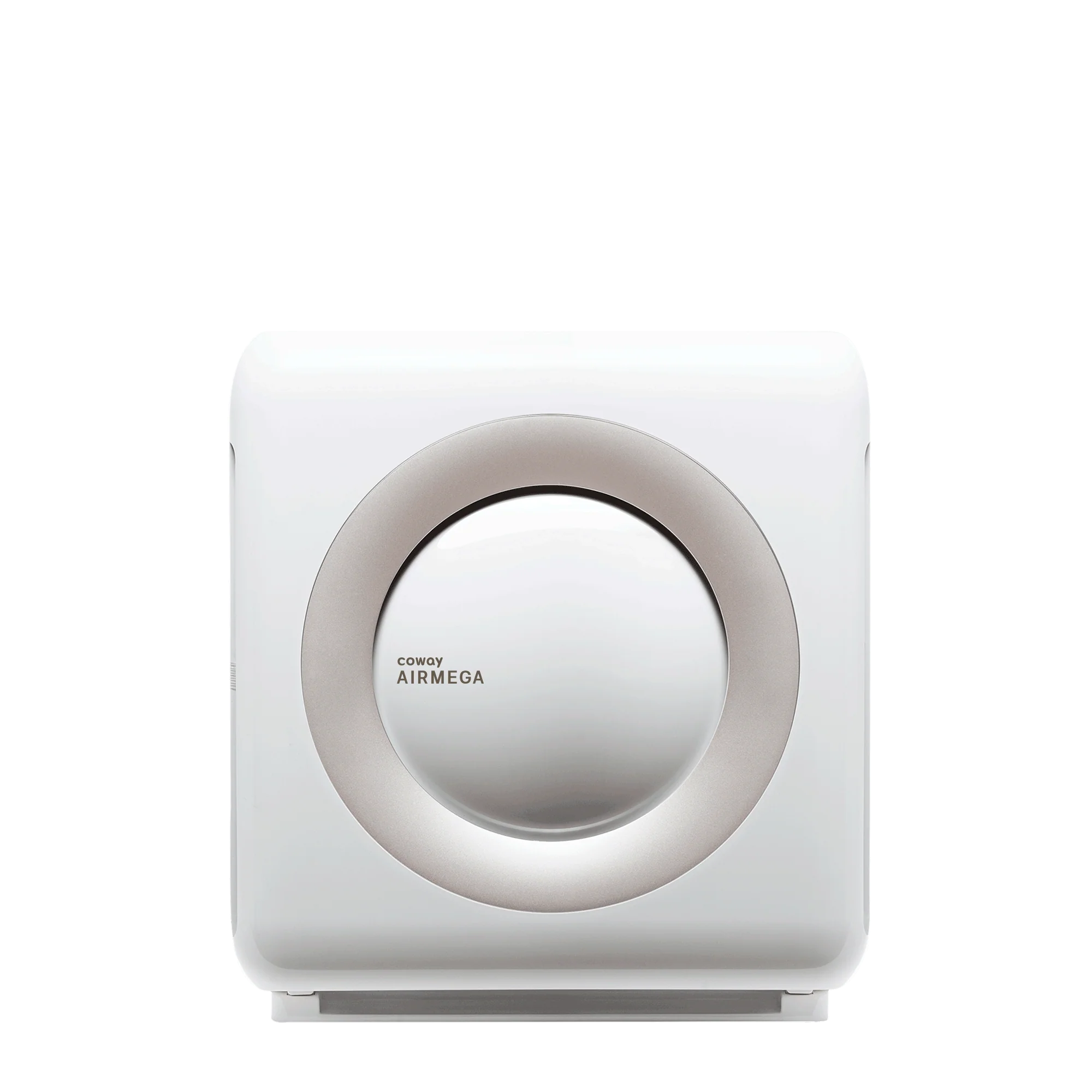
Key Specifications
- Room Coverage
- 361 sq ft
- CADR
- 233/246/240
- Filter
- True HEPA + Carbon + Pre-filter
- Noise
- 24 dB
- Power
- 77 watts
- Best For
- Medium rooms up to 361 sq ft. Wirecutter #1 for 10+ years. Best overall value.
📅 Prices checked . Amazon prices change frequently — click through for current price. Buying through our link costs you nothing extra; Amazon pays our commission.
What's in the Box
- Coway AP-1512HH air purifier
- Pre-installed 4-stage filter set
- Power cord
- User manual
- Filter replacement reminder sticker
Pros
- Wirecutter #1 for 10+ consecutive years
- AHAM verified CADR — no controversy
- True HEPA
- Fastest auto mode response in class
- 24dB ultra quiet sleep mode
- Eco mode at 4.9 watts
- 3-year warranty
Cons
- No WiFi or app control
- Carbon is impregnated fabric — weak on heavy odors
- Ionizer adds trace ozone (9ppb — CARB safe)
- Filter costs $60/year
- Design is dated
Best For
Best for adjacent rooms or light secondhand smoke (smoke in hallway, occasional exposure). AHAM-verified CADR 233. The thin activated carbon pre-filter handles incidental odor and light particle load. Not adequate for rooms where active smoking occurs regularly — the carbon layer will saturate quickly under sustained nicotine and VOC loading, at which point previously captured compounds are released back into room air.
📅 Price checked August 2026 · Buying through this link costs you nothing extra — Amazon covers our commission
What to Know Before You Buy
Carbon Weight Rule of Thumb
Match carbon mass to smoking intensity. Light smoking (a few cigarettes per week, in a well-ventilated space): minimum 3 lbs of activated carbon — the lower threshold where meaningful nicotine and benzene adsorption occurs without premature saturation within weeks. Regular secondhand smoke (daily exposure, not the primary smoking room): 3–10 lbs. Active smoking rooms where someone smokes indoors daily: 10+ lbs, making the Austin Air Healthmate at 15 lbs the practical minimum for serious long-term use. Do not rely on marketing language like "activated carbon filter" without verifying the actual weight. A 50-gram carbon sheet and a 15-lb carbon bed are both "activated carbon filters" — the performance difference is an order of magnitude.
5 ACH Sizing Formula for Smoking Rooms
Standard air purifier room coverage calculations use 4 ACH. For active smoking environments, use 5 ACH — the particle and VOC flux from cigarette smoke is higher than typical allergen environments, and clinical evidence for meaningful smoke reduction uses 5 ACH as the threshold. Formula: Room sq ft x 8 ft ceiling x 5 ACH / 60 = minimum CADR in CFM. A 300 sq ft room requires minimum CADR 200 CFM at 5 ACH. A 400 sq ft room requires CADR 267 CFM minimum.
Filter Replacement in Smoking Environments
Carbon filters saturate faster in smoking environments than any manufacturer schedule assumes. The manufacturer interval is calibrated for average household air quality. In an active smoking room, replace carbon filters at half the recommended interval or sooner. The signal for carbon saturation is not a light or indicator — it is the return of smoke odor despite the unit running. When odor returns, the carbon is exhausted. Do not continue running a saturated carbon filter, as desorption at elevated temperatures can release previously captured compounds. HEPA filters also load faster in smoking environments due to tar aerosols coating the fiber matrix. Budget for more frequent filter replacement than the manufacturer suggests — typically 2x the normal interval for active smoking rooms.
Air Purifiers Do Not Make Indoor Smoking Safe
This is the most important buying tip in this guide. An air purifier running at adequate CADR with substantial activated carbon reduces airborne particle concentrations by 70–90% and VOC concentrations by a meaningful but lower fraction. It does not eliminate health risk. Benzene, formaldehyde, and nicotine are harmful at concentrations below what even the best air purifier can fully capture. Thirdhand smoke on surfaces is outside the scope of air filtration entirely. The correct framing: an air purifier is a harm-reduction tool that lowers exposure, not a technology that makes indoor smoking environmentally equivalent to not smoking. Anyone making that claim is misrepresenting what air purifiers do.
Cigarette Smoke Contains Both Particulate Matter and Gas-Phase Compounds — True HEPA and Activated Carbon Must Work Together for Effective Removal
Cigarette smoke is a polyphasic pollutant mixture that presents two simultaneous air quality challenges. The first is PM2.5 particles in the 0.1–1 micron range — tar aerosol droplets, combustion particles, and tobacco fragment debris. The second is a gas-phase chemical load containing over 4,000 identified compounds. True HEPA captures particles at 99.97% efficiency at 0.3 microns and handles the particulate fraction effectively. The gas-phase fraction passes through HEPA fiber matrices without interaction — a HEPA filter presents no meaningful barrier to molecules like nicotine, benzene, or formaldehyde.
Why HEPA alone fails for cigarette smoke: VOC gas molecules are orders of magnitude smaller than HEPA filter pores. Where PM2.5 particles are 0.1–1 micron in diameter, a nicotine molecule is approximately 0.0007 microns — roughly 100 times smaller than the smallest particle a HEPA filter captures at rated efficiency. Gas molecules interact with filter fibers only through diffusion mechanisms that are negligible at the airflow rates of consumer air purifiers. For practical purposes, HEPA does nothing for nicotine, benzene, acrolein, or formaldehyde.
Why thin carbon pre-filters fail: activated carbon adsorbs gases by binding molecules to its enormous internal surface area. But that surface area has a finite capacity. A carbon sheet weighing 50–100 grams has approximately 50–300 square meters of total adsorption surface. In a room where someone smokes daily, that capacity is exhausted within days. After saturation, gas molecules pass through the carbon layer as freely as through HEPA. Budget purifiers with thin carbon layers are not inadequate because their carbon technology is poor — they are inadequate because there is simply not enough carbon mass to sustain adsorption over any meaningful period in a smoking environment.
The table below classifies the six key cigarette smoke compounds by physical phase, carcinogen classification, and which filtration technology removes them:
| Compound | Phase | IARC Class | True HEPA Removes? | Activated Carbon Removes? |
|---|---|---|---|---|
| PM2.5 tar aerosol | Particle | Group 1 | Yes (99.97% at 0.3 µm) | No |
| Nicotine | Gas / semi-volatile | Not classified (toxin) | No | Yes (partial — saturates under heavy load) |
| Benzene | Gas | Group 1 | No | Yes (adsorbs well on activated carbon) |
| Formaldehyde | Gas | Group 1 | No | Partial (lighter carbon layers saturate quickly) |
| Acrolein | Gas | Group 2A | No | Partial (requires potassium permanganate-impregnated carbon for full removal) |
| Carbon monoxide | Gas | Not classified (acute toxin) | No | No (CO requires catalytic converters, not adsorption) |
The table confirms the fundamental limitation: carbon monoxide from cigarette combustion is not addressed by any consumer air purifier technology. This is one reason why no air purifier can make indoor smoking safe. HEPA and activated carbon together address particles, nicotine, benzene, and formaldehyde — the compounds responsible for the majority of carcinogenic and odor impact — but carbon monoxide and some lightweight gas-phase compounds such as acrolein require different technologies not available in consumer purifiers.
Activated Carbon Adsorption Capacity for Nicotine and Benzene Is Proportional to Carbon Mass — the 3 lb Minimum for Light Smoking Environments
Activated carbon adsorbs organic molecules through Van der Waals forces — weak electrostatic attractions between gas molecules and the carbon pore surface. One gram of activated carbon has approximately 1,000–3,000 square metres of internal surface area, created by a network of micropores and mesopores. Gas molecules flowing through the carbon bed contact these surfaces and adhere. As more molecules accumulate, available surface sites decrease until saturation occurs — the point at which incoming molecules find no available binding sites and pass through the filter.
Saturation is the critical operational concept for cigarette smoke environments. Once the carbon is saturated, no further adsorption occurs. At elevated temperatures — warm rooms, units on high speed — desorption can occur: previously captured molecules are released back into the air stream. This means a saturated carbon filter in an active smoking room is not neutral — it actively re-contaminates room air with compounds it previously captured. The practical implication is that carbon filter replacement in smoking environments must be based on actual saturation signals (return of odor), not calendar schedules.
Carbon mass guidelines for cigarette smoke environments, based on adsorption rate literature and manufacturer media specifications:
| Carbon Mass | Example Purifiers | Months Before Saturation (Light Smoking) | Months Before Saturation (Moderate Smoking) | Months Before Saturation (Heavy / Daily Smoking) |
|---|---|---|---|---|
| 50–100 g (budget pre-filters) | Most budget purifiers under $150 | 1–2 months | 2–4 weeks | 3–7 days |
| 0.5–1.5 lbs | Levoit Core 400S, Winix 5500-2 | 3–5 months | 6–10 weeks | 3–5 weeks |
| 3–5 lbs | IQAir HealthPro Plus (5.1 kg total media) | 12–18 months | 6–10 months | 3–5 months |
| 10+ lbs | Austin Air Healthmate (15 lbs carbon + zeolite) | 36–60 months (full 5-year filter life) | 24–36 months | 12–24 months |
The zeolite component in the Austin Air Healthmate carbon blend is worth specific attention. Zeolite is a mineral adsorbent with selectivity for polar and ionic molecules, including ammonium and amine compounds. Nicotine is a tertiary amine — zeolite adsorbs it more efficiently than activated carbon alone. The combination of activated carbon for benzene and formaldehyde adsorption with zeolite for nicotine-specific adsorption is the reason the Austin Air Healthmate consistently outperforms purifiers that use activated carbon alone in tobacco smoke environments.
Budget purifiers with thin carbon pre-filters are appropriate for cooking odors and general background VOC loads. They are not designed for, and should not be marketed for, cigarette smoke environments. The carbon mass required for meaningful long-term nicotine and benzene adsorption in an active smoking room requires hardware investment — the Austin Air Healthmate at approximately $715 or the IQAir HealthPro Plus at approximately $900. There is no budget shortcut that provides equivalent gas-phase adsorption capacity.
Thirdhand Smoke Off-Gasses from Surfaces, Walls, and Upholstery for Months — an Air Purifier Requires Continuous Runtime for Meaningful Reduction
Thirdhand smoke refers to the residual nicotine and tobacco compounds that deposit on indoor surfaces during and after active smoking and subsequently re-volatilize into room air. Unlike secondhand smoke — the directly exhaled and sidestream smoke produced during active smoking — thirdhand smoke is a persistent, continuous source that persists long after the cigarette is extinguished and the smoker leaves the room. Research published in environmental health literature establishes the half-life of deposited nicotine on common indoor surfaces at approximately 8–13 hours depending on surface type, temperature, and ambient humidity.
What this means practically: in a room where someone smokes daily, even if all active smoking ceases, the nicotine-laden surfaces continue emitting nicotine vapour for weeks to months. The deposition accumulates over time — walls in a long-term smoking room may have years of nicotine and tobacco compound buildup. Each surface acts as a slow-release reservoir, and the rate of off-gassing increases with room temperature and any airflow that disturbs surface boundary layers. Running a HVAC fan, opening doors, or simply occupying the room creates airflow that accelerates off-gassing from surfaces.
The operational implication for air purifiers in thirdhand smoke environments is that intermittent use is ineffective. If a purifier runs for two hours and then stops, the room air that was cleaned begins re-accumulating nicotine and other compounds immediately from surface off-gassing. By the time the purifier runs again, air quality may have returned to a significant fraction of its pre-filtration level. The only strategy that maintains consistently lower compound concentrations is continuous runtime — the purifier running at low to medium speed at all times, with the speed increased for 30 minutes after any active smoking event and then returned to continuous low mode.
Carbon filter replacement in thirdhand smoke environments must be more aggressive than in standard smoking rooms. The surface off-gassing represents a continuous nicotine and VOC source that never pauses between cigarettes. A carbon filter facing both active smoking load and continuous thirdhand off-gassing saturates faster than one facing only active smoking. In a room with significant thirdhand smoke accumulation — years of surface deposition — treat filter replacement intervals as if the room were an active smoking room even if active smoking has ceased. The surface chemistry does not recognise that no one is actively smoking.
Practical runtime protocol for cigarette smoke environments: run the unit at high speed for at least 30 minutes after any active smoking event to capture the peak particle and gas-phase load before it deposits on surfaces. After that initial high-speed cycle, maintain continuous operation at low or auto mode. Do not run only when smoke is visible — the gas-phase compounds that cause the most long-term health concern are present and accumulating even when the air looks clear. Replace carbon filters at the manufacturer minimum interval — not when the unit prompts replacement, and not when odor returns, but proactively on a shorter schedule appropriate for the actual smoking load.
CADR Sizing for Cigarette Smoke Requires 5 ACH — Not the Standard 4 ACH Used for Allergens and General Dust
Standard CADR-to-room-size calculations use 4 ACH as the baseline — derived from the AHAM recommendation that a purifier should process a volume of air equal to the room volume four times per hour. For allergens (dust, pollen, pet dander) in a typical household, 4 ACH provides meaningful particle reduction. For cigarette smoke, 4 ACH is inadequate as a sizing target because the particle and VOC flux from active smoking is substantially higher than a typical allergen environment, and because the clinical evidence for smoke reduction in medical studies uses 5 ACH as the operational threshold. At 5 ACH, the purifier achieves faster clearance after a smoking event — a critical parameter when the goal is minimising total exposure duration at elevated concentrations.
The formula for sizing a purifier to a cigarette smoke room: Room sq ft x 8 ft (standard ceiling height) x 5 ACH / 60 minutes = minimum CADR in CFM. Example: a 300 sq ft room with standard ceilings requires 300 x 8 x 5 / 60 = 200 CFM minimum. Round up by 20–30% to account for filter aging — a new filter at full CADR meets the threshold; an aging filter running at 80% of rated output does not unless the unit was originally oversized.
Room size versus minimum CADR at both 4 ACH and 5 ACH, and which products from this guide meet the 5 ACH threshold:
| Room Size (sq ft) | Min CADR at 4 ACH (CFM) | Min CADR at 5 ACH (CFM) | Meets 5 ACH Threshold |
|---|---|---|---|
| 150 sq ft | 80 CFM | 100 CFM | All four products |
| 200 sq ft | 107 CFM | 133 CFM | All four products |
| 300 sq ft | 160 CFM | 200 CFM | Austin Air (400), Blueair (370), Coway (233), IQAir (~300) |
| 400 sq ft | 213 CFM | 267 CFM | Austin Air (400), Blueair (370), IQAir (~300) — Coway does NOT meet threshold |
| 500 sq ft | 267 CFM | 333 CFM | Austin Air (400), Blueair (370) only |
The Coway AP-1512HH with CADR 233 meets the 5 ACH threshold in rooms up to approximately 350 sq ft. In a 400 sq ft active smoking room it delivers approximately 4.4 ACH — meaningful but below the clinical threshold for smoke clearance. For rooms where active smoking occurs in the 300–400 sq ft range, the Austin Air Healthmate at 400 CFM is the clear sizing choice. The Blueair 211i Max at 370 CFM meets the 5 ACH threshold up to approximately 555 sq ft — the best large-room coverage in this group, though its lighter carbon load limits its suitability for active smoking rooms compared to the Austin Air.
One practical note on CADR ratings and speed settings: CADR is always measured at maximum fan speed. A purifier running at low or medium speed delivers significantly lower effective CADR. During active smoking events, run the unit at maximum speed for at least 30 minutes after the event ends. Continuous auto mode at low speed between events is appropriate for background filtration, but it does not achieve the rated CADR. If your room requires 267 CFM to meet 5 ACH and the purifier is running at medium speed delivering 180 CFM, you are not meeting the sizing threshold regardless of the unit specification.