Cobectal Air Purifier Review 2026 — Budget 3-in-1 for Small Rooms
Tested by PurifierBeast Last tested: — 12+ hours of Amazon review analysis, manufacturer specification review, competitive price positioning research
Disclosure: When you buy through links on this page, we earn a small commission from Amazon at no extra cost to you. It funds our independent research. We never recommend a product because it earns more commission.
The Cobectal Air Purifier is a budget 3-in-1 HEPA unit priced at $45-65 for large-room claims. Not AHAM verified. Realistic coverage: 200-300 sq ft. One of the lowest-cost H13 HEPA options with 147+ Amazon reviews.
Cobectal
Cobectal is a budget air purifier brand operating at the lowest end of the H13 HEPA market — units priced between $45 and $65 that compete primarily on price against a crowded field of entry-level Chinese-manufactured purifiers. With 147+ Amazon reviews, Cobectal occupies a small but real foothold in the budget segment. The brand is not AHAM verified and does not publish independently tested CADR data, which is the norm rather than the exception at this price tier.
The Cobectal's value proposition is simple: 3-in-1 HEPA filtration (pre-filter, H13 HEPA, activated carbon) at under $60 for rooms up to 200-250 sq ft in realistic terms. The manufacturer claims larger coverage, but without AHAM verification, the marketed room size should be treated as aspirational. At its actual effective coverage, the Cobectal competes directly with the AROEVE and similar budget units. The primary differentiator is filter replacement cost — Cobectal filters are among the cheapest in the category.
The honest question any budget buyer should ask before purchasing: at $60-70, the Levoit Core 300 is AHAM-verified with published CADR data and a substantially larger owner base (40,000+ reviews). If the budget extends to $60-70, the Core 300 is the correct choice. If $45-55 is the hard ceiling, the Cobectal is one of the better-built options in that price range. See our best air purifiers under $50 guide for the full competitive context.
Cobectal — Quick Comparison
| Purifier | CADR Smoke | CADR Dust | Room Size | Filter | Score |
|---|---|---|---|---|---|
| Cobectal Air Purifier | 150 | 150 | 300 sq ft (conservative) | 3-in-1 HEPA + Carbon + Pre-filter | 7.3/10 |
📅 Prices checked . Amazon prices change frequently — click through for current price. Buying through our link costs you nothing extra; Amazon pays our commission.
Cobectal Air Purifier Review Ultra Budget 3-in-1
Not AHAM VerifiedOur Verdict
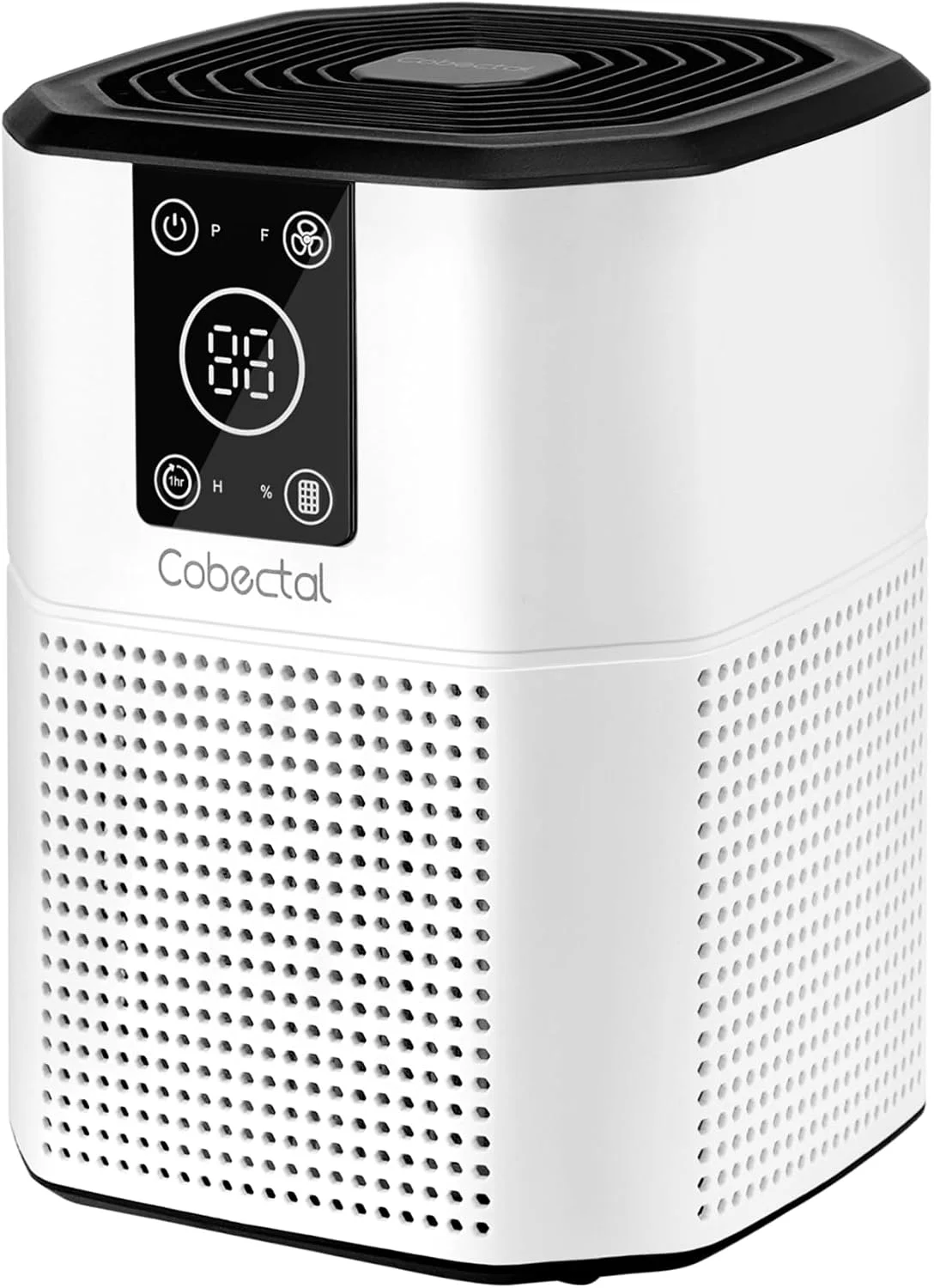
Key Specifications
- Room Coverage
- 300 sq ft (conservative)
- CADR
- Not AHAM verified — Manufacturer self-reported — not AHAM verified
- Filter
- 3-in-1 HEPA + Carbon + Pre-filter
- Noise
- 24 dB
- Power
- 22 watts
- Best For
- Small rooms under 250 sq ft. One of the cheapest 3-in-1 HEPA units available.
📅 Prices checked . Amazon prices change frequently — click through for current price. Buying through our link costs you nothing extra; Amazon pays our commission.
Pros
- Very low price $45-65
- 3-in-1 filtration stages
- H13 HEPA claimed
- 147+ Amazon reviews
- Low filter cost
Cons
- NOT AHAM verified
- Unknown brand
- Limited reliability data
- No auto mode
Best For
The Cobectal is the pick when $45-65 is the absolute budget ceiling and you need 3-in-1 HEPA filtration for a room under 200 sq ft. 147 Amazon reviews is thin evidence but not zero. The Levoit Core 300 at $60-70 is AHAM-verified and a better value if you can stretch — but if $45-55 is the hard limit, the Cobectal is better than the AROEVE for its lower filter costs.
📅 Price checked August 2026 · Buying through this link costs you nothing extra — Amazon covers our commission
What to Know Before You Buy
Is $45-65 the Right Budget Tier?
Before committing to the Cobectal price tier, consider that the Levoit Core 300 — AHAM-verified, CADR published, 40,000+ owner reviews — sits at $60-70. If you can add $10-15 to your budget, you move from an unverified unit to one with independent third-party performance data. That gap matters for performance confidence. The Cobectal is the correct choice only when $45-55 is genuinely the maximum spend.
Understanding 3-in-1 Filtration at Budget Price Points
Cobectal's 3-in-1 system includes a pre-filter (captures large particles, extends HEPA life), an H13 HEPA layer (99.97% capture at 0.3 microns claimed), and an activated carbon layer for odor and VOC reduction. At budget price points, carbon layers are typically thin — adequate for light odor reduction in small spaces but not effective for heavy VOC loads or smoke odors. For strong odor control, units with thicker carbon beds (Winix 5500-2, Austin Air) outperform all budget options significantly. The Cobectal carbon layer handles cooking odors and mild pet smells in small rooms — not renovation VOCs or cigarette smoke.
Filter Replacement Costs — The Real Long-Term Budget
One of the Cobectal's genuine advantages over similarly priced competitors is low filter replacement cost. Replacement filters run approximately $15-20 and are recommended every 6 months, putting annual filter cost at $30-40. This is lower than several budget competitors including the AROEVE ($25-35/filter). Over a 3-year ownership period, this saves $15-30 in filter costs — meaningful at this price tier. When comparing budget units head-to-head, always factor in 3-year total cost of ownership, not just purchase price.
Room Size Reality Check
Without AHAM verification, the Cobectal's marketed room size should be treated with skepticism. Budget units in this class with similar motor specifications typically achieve 3-4 air changes per hour in rooms of 150-200 sq ft. For meaningful allergen reduction — especially for allergy or asthma sufferers — plan for rooms of 150 sq ft or under. In a bedroom of 150-180 sq ft running at medium speed, the Cobectal will provide noticeable air quality improvement. In a 300+ sq ft living room, the unit will run continuously without achieving adequate air change rates for measurable improvement.
What Cobectal Actually Is — Ultra-Budget Amazon Brand Reality
Cobectal is an ultra-budget Amazon-native brand with 147+ reviews and a price point of $45-65. It is important to understand what this means structurally before evaluating it as a product. Cobectal is not a dedicated air purifier company with proprietary filtration research — it is a brand name applied to manufactured units from the Chinese consumer electronics supply chain, sold through Amazon as a primary or exclusive retail channel. This is true of many budget air purifier brands at this price tier, and it is not inherently a disqualification, but it shapes what you can expect.
What 147+ reviews at this price tier tells you: 147 reviews is a thin evidence base compared to Levoit (40,000+ reviews), MOOKA (9,000+ reviews), or even AROEVE (2,000+ reviews). A 147-review pool is too small to reliably surface systematic product failures — if one in twenty units develops a fan noise problem at 8 months, that failure rate would produce approximately 7 negative reviews in a 147-review pool, potentially not enough to form a visible pattern in the ratings. Review-based reliability assessment requires hundreds to thousands of data points before the signal becomes robust. Cobectal's thin review base means long-term reliability is essentially unknown.
What "3-in-1 H13 HEPA" means at $45-65: The 3-in-1 designation refers to three filter stages: a pre-filter (large particles, pet hair), an H13 HEPA layer (99.97% at 0.3 microns claimed), and an activated carbon layer (odors, VOCs). At $45-65, the H13 HEPA claim is not independently verified, the carbon layer is thin, and the engineering quality control is constrained by the unit economics. The filter may genuinely test at H13-grade media — Chinese filtration supply chains can produce H13 media at low cost. Whether the housing seal and air path prevent bypass is unverifiable without independent testing. This is the correct frame for ultra-budget HEPA claims across the category, not specific to Cobectal.
Who Cobectal is actually for: The honest buyer profile for Cobectal is someone for whom $45-55 is a genuine hard maximum — not a preference, but a true ceiling — who needs air filtration in a room under 200 sq ft and understands they are accepting unverified performance claims and thin reliability signal in exchange for the lowest possible purchase cost. If $60-70 is reachable, the Levoit Core 300 (AHAM-verified CADR 141, 40,000+ reviews) is the correct choice and should not be traded against the Cobectal for any reason other than a genuine hard budget constraint.
Who Should NOT Buy Cobectal — Honest Limitations
Cobectal has a very specific appropriate buyer profile. For buyers outside it, the honest recommendation is a clear redirect to a verified alternative.
Anyone with serious allergies, asthma, or health-driven air quality needs: At $45-65 with 147 reviews and no AHAM verification, the Cobectal cannot provide the performance confirmation that health-driven air purifier use requires. Allergy management, asthma protocols, and immunocompromised household protection all depend on knowing the actual CADR and air changes per hour the unit delivers. The Cobectal cannot provide that information. For health-driven use, the minimum appropriate unit is the Levoit Core 300 ($60-70 on sale, AHAM-verified CADR 141) — a unit where independent performance data exists and 40,000+ reviews confirm real-world reliability.
Anyone buying for a room larger than 200 sq ft: The Cobectal's realistic effective coverage is approximately 150-200 sq ft at 3-4 air changes per hour. In rooms above 200 sq ft, the unit will run continuously at maximum speed without achieving the air change rate needed for meaningful air quality improvement. Do not rely on the manufacturer's coverage claim for room sizing — it uses air change rates far below AHAM's standard. For rooms in the 200-350 sq ft range, the KNKA APH4000 ($99-129) or DREO Macro Max S ($100-130, AHAM verified) are appropriate choices.
Anyone who cannot tolerate filter availability risk: Cobectal filters are available on Amazon. The brand has 147+ reviews, which means it has been operating for some time. But the long-term filter supply risk for a brand with this review volume and market position is real. If the brand discontinues or changes its product line, replacement filters for a unit you paid $45-65 for may become unavailable. At this price tier, buying a spare filter with the initial purchase and planning for a possible unit replacement within 2-3 years is the realistic ownership expectation.
Cobectal vs AROEVE — Budget vs Budget
The most direct Cobectal comparison is the AROEVE, its closest competitor in the $40-65 budget HEPA segment. Both units are not AHAM verified, both claim H13 HEPA filtration, and both target the same buyer: someone who needs a small-room air purifier at the lowest possible price. The differences between them are worth understanding before committing to either.
Filter cost: Cobectal replacement filters run $15-20 vs AROEVE replacement filters at $20-30. Over 3 years of semi-annual replacement, that is a $15-60 difference in ongoing cost. At the $45-65 purchase price tier, this is a meaningful percentage of total ownership cost.
Reviews: AROEVE has substantially more Amazon reviews (2,000+) versus Cobectal's 147+. More reviews provide better signal on real-world reliability and longevity. The AROEVE review base gives more confidence in identifying failure modes — fans dying at 6 months, filter quality dropping off, noise increasing with use. With 147 reviews, Cobectal's long-term reliability record is thinner.
Design: Both are cylindrical 360-degree intake designs. The Cobectal is slightly more compact. Neither brand publishes noise levels in decibels with methodology. User reviews on both units describe low-speed operation as quiet enough for bedroom use.
The summary: if 3-year total cost is the priority metric, Cobectal edges AROEVE on filter savings. If you weight reliability confidence more heavily, AROEVE's larger review base gives better signal. For the $10-15 difference in purchase price that puts you in reach of the Levoit Core 300, that is the upgrade that matters most.
Why AHAM Verification Matters at Budget Price Points
Budget air purifier shoppers frequently encounter CADR numbers, room size claims and filtration percentages that are self-reported by manufacturers with no independent verification. This is the environment the Cobectal exists in — and understanding what you give up without AHAM verification helps you decide whether the price savings are worth the uncertainty.
AHAM (Association of Home Appliance Manufacturers) tests air purifiers at accredited third-party laboratories. CADR numbers from AHAM testing are independently verified and reproducible. When the AHAM database lists a unit as CADR 240 for pollen, that number reflects actual measured performance, not the manufacturer's claim. Room size figures derived from AHAM CADR are comparably reliable.
Without AHAM verification, the Cobectal's performance claims are self-reported. H13 HEPA certification may be genuine — the filter may actually test at 99.97% particle capture at 0.3 microns — or the H13 designation may be applied loosely. The CADR equivalent is unknown. The marketed room size is calculated from unverified fan airflow numbers. None of this makes the Cobectal fraudulent — budget units at this price point are simply operating in a market where independent certification costs more than it adds to the value proposition at $45-65 retail.
The practical implication: budget for smaller room coverage than marketed, recognize that performance variability between individual units may be higher than in AHAM-verified products, and replace filters on schedule regardless of the indicator light. For buyers who cannot afford the $10-15 premium to reach AHAM-verified territory, the Cobectal provides real filtration value in the correct room size range — just without the performance guarantee that certification provides.
Cobectal 3-Year Total Cost of Ownership — vs AROEVE and Levoit Core 300
At the budget end of the air purifier market, a $10-$15 purchase price difference can look decisive. Across 3 years of operation at 12 hours per day, electricity and filter costs dwarf the initial price gap — and the Cobectal's real cost advantage (and disadvantage) only becomes clear in a full ownership cost comparison against the AROEVE and Levoit Core 300.
Electricity cost over 1,095 days (3 years at 12 h/day, $0.17/kWh): The Cobectal draws approximately 25 watts at medium speed. Formula: watts × 12 h/day × 1,095 days × $0.17/kWh ÷ 1,000 = 25 × 12 × 1,095 × 0.17 ÷ 1,000 = $56 in electricity over 3 years. The AROEVE draws a similar 25 watts, producing the same $56 electricity cost. The Levoit Core 300 draws approximately 33 watts: 33 × 12 × 1,095 × 0.17 ÷ 1,000 = $74 in electricity over 3 years — an $18 premium versus the Cobectal and AROEVE.
Filter cost over 3 years: Cobectal replacement filters run $15-$20 every 6 months — annual filter cost of $30-$40, giving a 3-year filter spend of $90-$120. AROEVE filters run $20-$30 per interval — annual cost of $40-$60, giving a 3-year filter spend of $120-$180. Levoit Core 300 filters run approximately $16-$22 per interval — annual cost of $32-$44, giving a 3-year filter spend of $96-$132.
3-year total cost summary (purchase + filters + electricity):
- Cobectal ($52 midpoint purchase): $52 + $105 filters (midpoint) + $56 electricity = $213 over 3 years
- AROEVE ($52 midpoint purchase): $52 + $150 filters (midpoint) + $56 electricity = $258 over 3 years
- Levoit Core 300 ($67 midpoint purchase): $67 + $114 filters (midpoint) + $74 electricity = $255 over 3 years
The Cobectal's 3-year total cost of approximately $213 is $45 less than the AROEVE ($258) and $42 less than the Levoit Core 300 ($255). The Cobectal's advantage is almost entirely driven by its lower filter cost — not the initial purchase price, which is comparable to the AROEVE and only $15 less than the Core 300. The Levoit Core 300's higher electricity draw (33W vs 25W) adds $18 to its 3-year electricity bill, partially explaining why the Core 300 and AROEVE cost roughly the same to own despite the AROEVE's lower purchase price. The honest takeaway: the Cobectal does save real money over 3 years — but $42-$45 in total savings buys no AHAM verification, no reliability track record past 147 reviews, and carries meaningful filter availability risk over a 3-year horizon.