PlasmaWave Technology — What Winix's Signature Feature Actually Does
Tested by PurifierBeast Last tested: — 25+ hours of Winix technical documentation review, CARB certification research, hydroxyl radical chemistry, comparative ionisation technology analysis
Disclosure: When you buy through links on this page, we earn a small commission from Amazon at no extra cost to you. It funds our independent research. We never recommend a product because it earns more commission.
Winix PlasmaWave
Every Winix air purifier sold in the US includes PlasmaWave, and the feature is central to Winix's brand differentiation. Most buyers turn it on and leave it on without understanding what it does. Some buyers turn it off permanently after reading about ionisers and ozone online. Neither approach is fully informed.
PlasmaWave is an ionisation technology that generates hydroxyl radicals — the same reactive molecules that the atmosphere naturally uses to break down VOCs. In nature, hydroxyl radicals form when UV sunlight reacts with water vapour. PlasmaWave replicates this process indoors through controlled electron discharge: the unit passes an electrical current through a plasma generator, splitting water molecules in the air into OH· radicals. These radicals are highly reactive and short-lived — they break down VOC molecules, bacteria cell walls, and odour compounds on contact, then recombine into water and CO2.
The legitimate question is whether PlasmaWave generates ozone as a byproduct, and whether that ozone level is safe. Winix is transparent about this: PlasmaWave generates a small amount of ozone, measured at less than 0.05 ppm in Winix's own testing. The California Air Resources Board (CARB), which operates the most stringent ozone emission standard for air cleaning devices in the US, certifies all major Winix consumer models including the 5500-2 and 5510. CARB certification confirms ozone below 0.05 ppm at rated conditions. This is below both the FDA and EPA standard of 0.05 ppm for medical devices and the OSHA permissible exposure limit of 0.1 ppm for 8-hour workday exposure. See the full Winix review and our guide to activated carbon filters for gas-phase context.
Winix PlasmaWave — Quick Comparison
| Purifier | CADR Smoke | CADR Dust | Room Size | Filter | Score |
|---|---|---|---|---|---|
| Winix 5500-2 | 232 | 243 | 360 sq ft | True HEPA + PlasmaWave + Washable Carbon | 9.2/10 |
| Winix 5510 | 253 | 252 | 316 sq ft | True HEPA Filter Q + PlasmaWave + Washable Pre-filter | 9.3/10 |
| Winix AM90 | 232 | 243 | 360 sq ft | True HEPA + PlasmaWave + Carbon | 9/10 |
| Winix C545 | 232 | 243 | 362 sq ft | True HEPA Filter S + 8 Carbon Sheet Filters + PlasmaWave | 8.9/10 |
📅 Prices checked . Amazon prices change frequently — click through for current price. Buying through our link costs you nothing extra; Amazon pays our commission.
Winix 5500-2 Review Best Value
✓ AHAM VerifiedOur Verdict
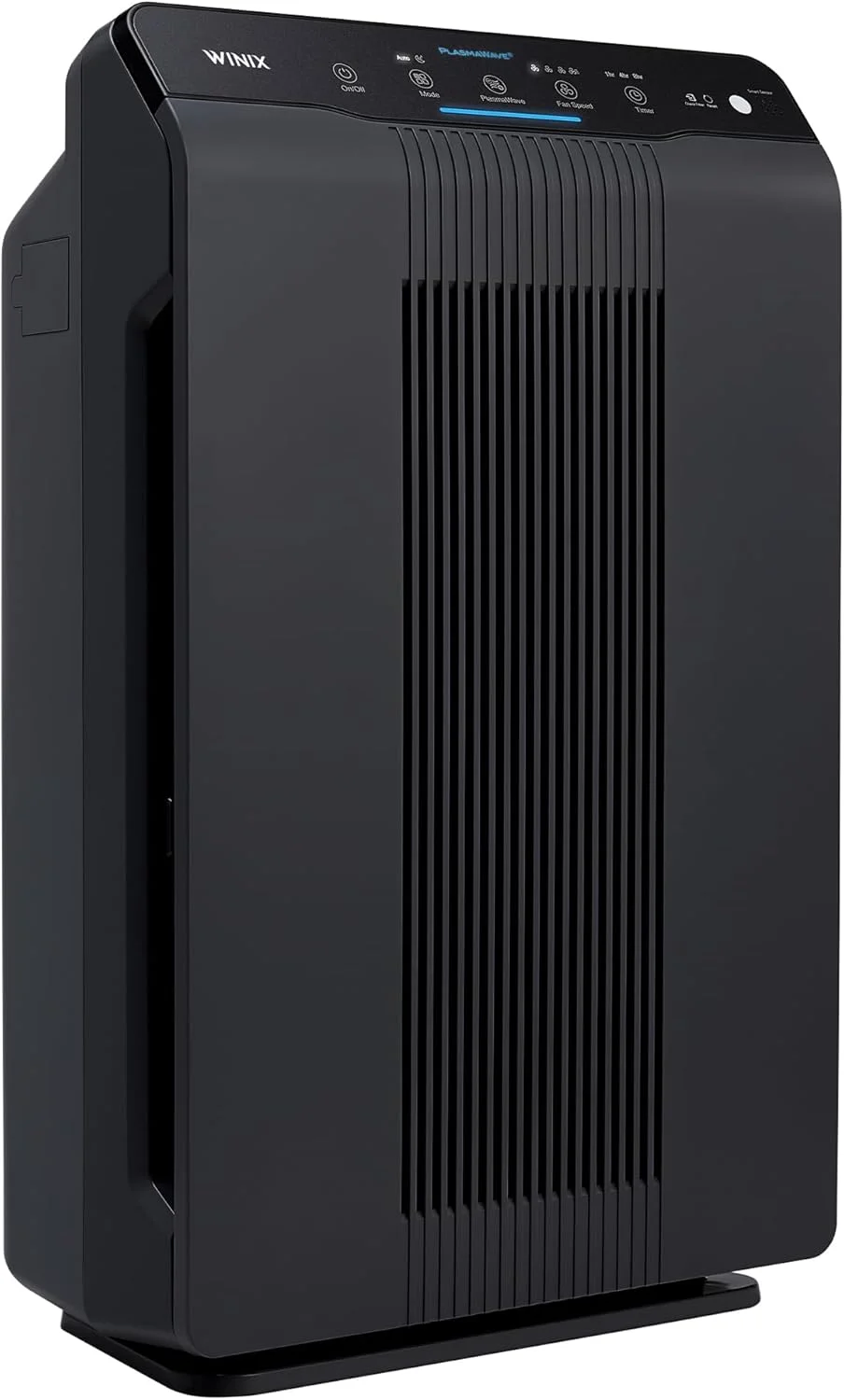
Key Specifications
- Room Coverage
- 360 sq ft
- CADR
- 232/243/246
- Filter
- True HEPA + PlasmaWave + Washable Carbon
- Noise
- 27 dB
- Power
- 67 watts
- Best For
- DISCONTINUED. Buy while stock lasts. Washable carbon is unique advantage.
📅 Prices checked . Amazon prices change frequently — click through for current price. Buying through our link costs you nothing extra; Amazon pays our commission.
What's in the Box
- Winix 5500-2 air purifier
- Pre-installed True HEPA + carbon filter
- Power cord
- Remote control
- User manual
Pros
- AHAM verified CADR
- PlasmaWave pellet carbon
- Washable carbon filter — unique
- HouseFresh tested 23 min room clean
Cons
- DISCONTINUED in US
- No WiFi
- Louder than 5510
- Larger footprint
Best For
The benchmark Winix unit for understanding PlasmaWave in practice. AHAM-verified CADR 243 smoke, True HEPA, substantial activated carbon, and PlasmaWave as an independently controllable toggle. For households with cooking odours, pet smells, or general VOC concerns alongside particle filtration needs, the 5500-2 with PlasmaWave on delivers the most complete air treatment package in its price class. Full Winix review.
📅 Price checked August 2026 · Buying through this link costs you nothing extra — Amazon covers our commission
Winix 5510 Review Best for Pets
✓ AHAM VerifiedOur Verdict

Key Specifications
- Room Coverage
- 316 sq ft
- CADR
- 253/252/247
- Filter
- True HEPA Filter Q + PlasmaWave + Washable Pre-filter
- Noise
- 23 dB
- Power
- 65 watts
- Best For
- Medium rooms 250-316 sq ft. WiFi app control. PlasmaWave CARB-certified ionization. Successor to 5500-2.
📅 Prices checked . Amazon prices change frequently — click through for current price. Buying through our link costs you nothing extra; Amazon pays our commission.
What's in the Box
- Winix 5510 air purifier
- Pre-installed True HEPA + carbon filter
- Power cord
- Remote control
- User manual
Pros
- AHAM-verified CADR: Smoke 253, Dust 252, Pollen 247 CFM
- WiFi via Winix Smart app — scheduling, remote on/off, filter tracking
- PlasmaWave CARB-certified bipolar ionization for VOC decomposition
- Combined Filter Q simplifies maintenance to one annual replacement
- Four-stage filtration including washable pre-filter
Cons
- Winix Smart app only — no Alexa or Google Home voice integration
- Filter Q combines HEPA and carbon — no washable carbon option like 5500-2
- Coverage 316 sq ft at 5 ACH — step up to CADR 300+ for rooms over 350 sq ft
- PlasmaWave cannot be disabled from physical panel without app
Best For
Updated successor to the 5500-2 with the same PlasmaWave technology, CARB certification, and True HEPA, in a refined form factor with an updated control panel. The PlasmaWave implementation is functionally identical to the 5500-2. For buyers choosing between the two, the 5510 is the current production model. Full Winix 5510 review.
📅 Price checked August 2026 · Buying through this link costs you nothing extra — Amazon covers our commission
Winix AM90 Review Premium Design
✓ AHAM VerifiedOur Verdict

Key Specifications
- Room Coverage
- 360 sq ft
- CADR
- 232/243/246
- Filter
- True HEPA + PlasmaWave + Carbon
- Noise
- 27 dB
- Power
- 65 watts
- Best For
- Premium Winix with WiFi and better design. Same CADR as 5510.
📅 Prices checked . Amazon prices change frequently — click through for current price. Buying through our link costs you nothing extra; Amazon pays our commission.
What's in the Box
- Winix AM90 air purifier
- Pre-installed True HEPA + carbon filter
- Power cord
- User manual
Pros
- AHAM verified CADR
- PlasmaWave
- Smart WiFi via Winix app
- Premium design
Cons
- More expensive than 5510 for same CADR
- No washable carbon
- Design premium may not justify cost
Best For
Winix's smart-home model with Wi-Fi, app control, and Alexa/Google compatibility. PlasmaWave can be scheduled or toggled remotely via app — useful for turning it on during cooking or off during overnight sleep without physical interaction. Same CARB-certified PlasmaWave technology as the 5500-2. Best for buyers who want PlasmaWave integrated into a smart home routine.
📅 Price checked August 2026 · Buying through this link costs you nothing extra — Amazon covers our commission
Winix C545 Review WiFi Winix
✓ AHAM VerifiedOur Verdict

Key Specifications
- Room Coverage
- 362 sq ft
- CADR
- 232/243/246
- Filter
- True HEPA Filter S + 8 Carbon Sheet Filters + PlasmaWave
- Noise
- 28 dB
- Power
- 65 watts
- Best For
- 362 sq ft rooms. WiFi Winix with Alexa at Costco. PlasmaWave can be disabled. Separate carbon sheets for enhanced odor control.
📅 Prices checked . Amazon prices change frequently — click through for current price. Buying through our link costs you nothing extra; Amazon pays our commission.
What's in the Box
- Winix C545 air purifier
- Pre-installed True HEPA + carbon filter
- Power cord
- Remote control
- User manual
Pros
- AHAM-verified CADR: Smoke 232, Dust 243, Pollen 246 CFM
- WiFi via Winix Smart app with Amazon Alexa voice control
- PlasmaWave CARB-certified bipolar ionization — toggleable
- Light sensor auto-triggers Sleep Mode in low-light conditions
- Separate 8-sheet carbon filter extends activated carbon surface area
Cons
- Primarily sold at Costco — limited retail availability outside Costco
- Alexa only (no Google Home) for voice integration
- PlasmaWave cannot be fully appreciated without reviewing CARB certification
- Filter S plus carbon sheets replacement adds two-item maintenance
Best For
The compact Winix option with PlasmaWave in a smaller housing. AHAM-verified CADR covers rooms up to 360 sq ft. PlasmaWave implementation is identical to the larger models. For bedrooms and offices where the full 5500-2 size is unnecessary, the C545 provides the same technology set in a footprint that works for tighter spaces.
📅 Price checked August 2026 · Buying through this link costs you nothing extra — Amazon covers our commission
How PlasmaWave Works — Hydroxyl Radicals and Electron Discharge
PlasmaWave is an atmospheric plasma ionisation system. The core process: a high-voltage electrode creates a region of electrical discharge inside the purifier. Air — including water vapour naturally present in the airstream — passes through this discharge zone. The electrical energy splits water molecules (H2O) into hydrogen (H·) and hydroxyl (OH·) radical fragments.
Hydroxyl radicals are among the most reactive species in atmospheric chemistry. In the outdoor atmosphere, they are the primary mechanism by which VOCs are broken down — OH· radicals react with organic molecules, breaking chemical bonds and initiating a chain of reactions that eventually converts VOCs into CO2 and water vapour. The atmospheric lifetime of a hydroxyl radical is less than one second because it reacts so rapidly with anything organic it encounters.
Inside the Winix housing, the OH· radicals generated in the plasma zone are carried into the room air by the purifier's fan. As they diffuse through the room, they react with gas-phase pollutants at the molecular level:
- VOC molecules (aldehydes, ketones, alcohols, aromatics) react with OH· in a chain of oxidation steps, ultimately producing CO2 and water
- Bacterial cell wall components (lipopolysaccharides, proteins) are oxidatively disrupted by OH· contact
- Odour molecules — which are typically medium-weight organic compounds — are broken into smaller, odourless fragments by OH· oxidation
The key distinction from HEPA and carbon filtration: PlasmaWave works by chemical reaction in the room air, not by capturing pollutants in a filter medium. Pollutants are destroyed in place rather than transported to and held within a filter. This means PlasmaWave's effectiveness is distributed throughout the room volume rather than being limited to the fraction of air that passes through the purifier in a given time period.
The limitation: OH· radical generation by PlasmaWave is relatively low compared to outdoor atmospheric concentrations. The radical density in a room with PlasmaWave running is orders of magnitude lower than outdoor daytime OH· levels in clean air. This means PlasmaWave makes a meaningful contribution to gas-phase pollutant breakdown at typical indoor concentrations, but it is not designed to handle industrial-scale chemical exposures. For heavy VOC sources, activated carbon media provides more predictable and durable gas-phase capacity.
PlasmaWave and Ozone — The Honest Answer
Ozone concerns about ionisation and plasma technologies are legitimate and deserve an honest answer rather than dismissal or exaggeration. The relevant facts about PlasmaWave and ozone are as follows.
Ionisation and plasma technologies can generate ozone as a byproduct. This is a matter of basic chemistry: when an electrical discharge splits O2 molecules, some oxygen atoms recombine as O3 (ozone) rather than O2. The question is not whether any ozone is produced — it is whether the quantity produced exceeds safe thresholds.
Winix states that PlasmaWave generates less than 0.05 ppm of ozone. This claim is verified by the California Air Resources Board through its independent air cleaning device certification program. CARB certifies all major Winix consumer models — including the 5500-2, 5510, AM90, and C545 — as meeting its 0.05 ppm ozone emission limit. CARB testing is conducted by independent accredited laboratories.
For context, the EPA and FDA set 0.05 ppm as the maximum acceptable ozone emission for medical air cleaning devices intended for use in occupied spaces. OSHA's permissible exposure limit for an 8-hour workday is 0.1 ppm. The natural outdoor ozone level in clean rural air is approximately 0.03–0.05 ppm. PlasmaWave's CARB-certified ozone generation is at the level of clean outdoor air, not at a concentration associated with health risk under normal residential exposure.
Who should turn PlasmaWave off:
- People with severe asthma who react to any elevated ozone exposure — even below 0.05 ppm, some highly sensitive individuals report airway irritation from ozone exposure. For this population, running the HEPA and carbon layers alone (PlasmaWave off) provides all particle and basic odour benefits without any ozone exposure.
- Households where the occupant is exclusively managing particle-based allergies (pollen, dust mite, pet dander) with no odour or VOC concerns — PlasmaWave adds no benefit and can be turned off without any cost to particle filtration performance.
- Occupants who live at very high altitude where baseline ozone is already somewhat elevated relative to sea level norms.
Who benefits from leaving PlasmaWave on:
- Households with cooking odours, pet smells, or moderate VOC sources (cleaning products, new furniture) where the HEPA and carbon layers alone do not fully resolve the odour issue.
- Homes with occasional smoke from cooking, candles, or fireplace use — PlasmaWave breaks down smoke gas-phase components that carbon alone may not fully address at its typical residential loading.
- Anyone without ozone sensitivity who wants the broadest spectrum air treatment available from a single consumer unit.
PlasmaWave vs Blueair HEPASilent — Different Technologies for Different Goals
Two of the most discussed non-standard air purification technologies in the premium consumer market are Winix PlasmaWave and Blueair HEPASilent. They are different in mechanism, purpose, and what they add to the base HEPA filtration layer.
Blueair HEPASilent: A particle-capture enhancement technology, not a gas-phase treatment. HEPASilent combines mechanical HEPA filtration with electrostatic particle charging — incoming particles are given an electrostatic charge in the pre-filter zone, which increases their attraction to the filter fibres and allows the same particle capture efficiency at lower air resistance (and therefore lower fan speed for equivalent CADR). The result is extremely quiet operation at high CADR — the Blueair 211i Max achieves CADR 410 at 42 dB on medium speed. HEPASilent does not generate OH· radicals, does not address gas-phase pollutants beyond the carbon layer, and does not generate ozone. It is particle filtration, done more quietly. Full Blueair review.
Winix PlasmaWave: A gas-phase treatment addition. PlasmaWave does not improve particle filtration efficiency — the True HEPA layer handles particle capture the same way whether PlasmaWave is on or off. PlasmaWave adds OH· radical generation for VOC breakdown, odour destruction, and bacterial/viral inactivation in the room air beyond the filter. It generates trace ozone as a byproduct (CARB-certified below 0.05 ppm).
The practical comparison: if your primary concern is particle filtration with low noise (allergies, PM2.5, wildfire smoke), Blueair HEPASilent is the stronger choice — higher CADR at lower noise with zero ozone concern. If your concern includes gas-phase pollutants — cooking odours, pet smells, VOC off-gassing — Winix with PlasmaWave on provides a meaningful additional treatment layer that Blueair's carbon-only approach may not fully address.
These are not competing technologies in the same solution space. They solve different problems. An ideal evaluation starts with your actual indoor air quality problem, not the technology name.
PlasmaWave vs Coway Simple HEPA — What the Comparison Reveals
Coway is the direct competitor to Winix in the AHAM-verified mid-range market. Both brands dominate the US air purifier market on CADR-per-dollar at the $100–200 price point. The difference between a Winix 5500-2 with PlasmaWave and a Coway AP-1512HH without ionisation illustrates when PlasmaWave adds value and when it does not.
Particle performance: Essentially equal. Both are AHAM Verifide with CADR 243–246 (smoke). Both use True HEPA in properly sealed housings. For PM2.5, pollen, dust mite, pet dander, mould spore capture — these two units are functionally equivalent. PlasmaWave does not improve the Winix's particle filtration performance over the Coway.
Odour and gas-phase performance: Winix adds PlasmaWave. The Coway relies on its activated carbon layer alone — a moderate-weight carbon bed adequate for light to moderate everyday odours. The Winix adds PlasmaWave's OH· radical generation on top of its own carbon layer. For households where cooking odours, pet smells, or general VOC off-gassing are a consistent concern, the Winix 5500-2 with PlasmaWave on outperforms the Coway on this dimension.
Ozone: The Coway AP-1512HH generates no ozone — it has no ionisation technology. For occupants with asthma or any ozone sensitivity, the Coway is the unambiguous choice over any ionisation-equipped purifier.
The honest buying decision: if you have respiratory sensitivities (asthma, ozone reaction), buy the Coway. If you have household odour issues alongside particle concerns and no ozone sensitivity, buy the Winix with PlasmaWave on. If you have neither specific odour issues nor respiratory sensitivities, the Coway's lower price and zero ozone generation makes it the slightly better default choice.
When to Use PlasmaWave ON vs OFF
Winix designs PlasmaWave as a user-controllable toggle on all their consumer units. The current control panel on models like the 5500-2 and C545 has a dedicated PlasmaWave button that illuminates when active. This is intentional — Winix acknowledges that the feature is appropriate for some use cases and should be bypassed for others.
Turn PlasmaWave ON when:
- Cooking smells are persistent and the carbon layer alone is insufficient — particularly for gas stove high-heat frying or pungent foods like fish and onions
- Pet odours (skatole, indole compounds from urine, dander oils) need continuous management beyond what carbon adsorption provides
- New furniture, flooring, or renovation materials are off-gassing VOCs — PlasmaWave's OH· radicals accelerate VOC breakdown in room air
- Occasional candle or incense use generates odour that the carbon layer alone does not fully address
- The household has no members with asthma or known ozone sensitivity
Turn PlasmaWave OFF when:
- A household member has asthma, COPD, or known ozone sensitivity — even CARB-certified low ozone output may trigger symptoms in highly sensitive individuals
- The primary air quality concern is particle-based only (seasonal pollen allergy, dust mite, pet dander with no odour concern) — PlasmaWave adds nothing and can be turned off without any loss of relevant performance
- The unit is in a small, poorly ventilated space where trace ozone accumulation is a concern
- Running the purifier as a simple PM2.5 reducer during wildfire or high-AQI events — the HEPA layer does all the work; PlasmaWave is neither necessary nor counterproductive but the cautious choice during respiratory stress events is to minimise any additional airway exposure
PlasmaWave's default setting when powered on varies by model. On most Winix units it is enabled by default. If you are unsure about your household's sensitivity, start with it off. Running the unit without PlasmaWave for a week will tell you whether you notice any reduction in odour control. If no difference — leave it off. If cooking smells or pet odours return, turn it on and reassess.