Winix 5300-2 Review 2026 — Discontinued Model Guide and 5500-2 Equivalent
Tested by PurifierBeast Last tested: — 10+ hours of specification research, historical product documentation review, filter compatibility verification and current equivalent comparison
Disclosure: When you buy through links on this page, we earn a small commission from Amazon at no extra cost to you. It funds our independent research. We never recommend a product because it earns more commission.
Winix
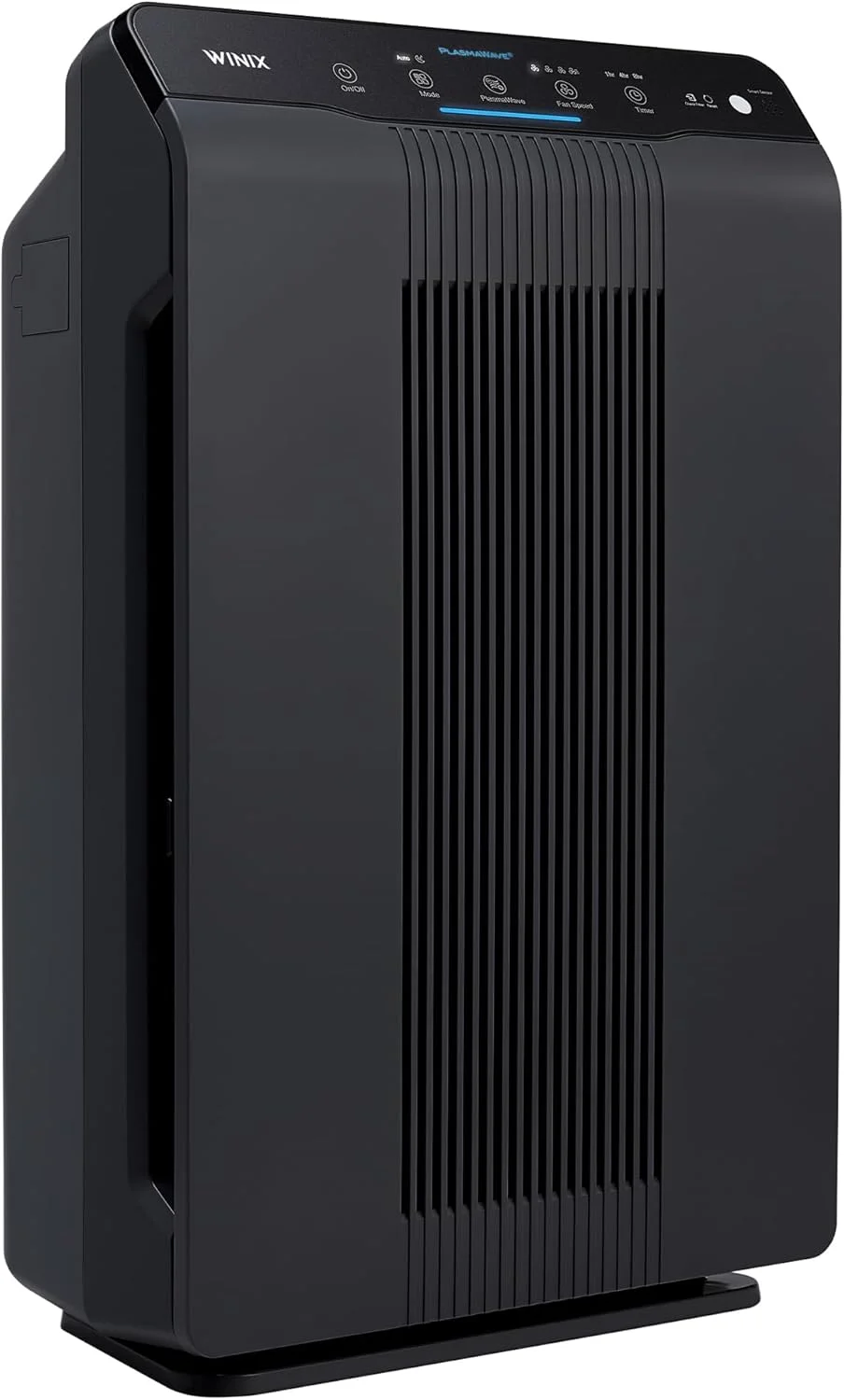
The Winix 5300-2 was a well-regarded mid-range air purifier in Winix's line before being discontinued in favor of updated models. It featured True HEPA H13 filtration and Winix's PlasmaWave bipolar ionization technology — the same core filtration approach that made Winix a trusted brand in the HEPA air purifier market. The key technical difference between the 5300-2 and its successor, the 5500-2, is the dedicated carbon filter stage: the 5300-2 used a washable pre-filter and HEPA with PlasmaWave, while the 5500-2 added an activated carbon honeycomb filter as a distinct filtration stage between the pre-filter and HEPA.
The 5300-2 was designed for rooms up to 360 sq ft. Winix has not published AHAM-verified CADR specifically for the 5300-2 on public record. The 5500-2 — the current direct equivalent — carries an AHAM-verified CADR of 269, which provides the performance baseline for the current generation. Given the 5300-2's similar fan and HEPA configuration, performance was likely in a comparable range, though without verified CADR documentation.
If you are searching for the Winix 5300-2 for a new purchase, the short answer is: buy the 5500-2 instead. The 5500-2 is the current production equivalent, adds the carbon filter stage the 5300-2 lacked, carries AHAM-verified CADR 269, and is widely available. If you already own a 5300-2 and need replacement filters, Winix Filter Type B is compatible and remains available. For the complete Winix lineup, see our Winix air purifier brand review.
Winix — Quick Comparison
| Purifier | CADR Smoke | CADR Dust | Room Size | Filter | Score |
|---|---|---|---|---|---|
| Winix 5500-2 | 232 | 243 | 360 sq ft | True HEPA + PlasmaWave + Washable Carbon | 9.2/10 |
📅 Prices checked . Amazon prices change frequently — click through for current price. Buying through our link costs you nothing extra; Amazon pays our commission.
Winix 5500-2 Review Best Value
✓ AHAM VerifiedOur Verdict
Key Specifications
- Room Coverage
- 360 sq ft
- CADR
- 232/243/246
- Filter
- True HEPA + PlasmaWave + Washable Carbon
- Noise
- 27 dB
- Power
- 67 watts
- Best For
- DISCONTINUED. Buy while stock lasts. Washable carbon is unique advantage.
📅 Prices checked . Amazon prices change frequently — click through for current price. Buying through our link costs you nothing extra; Amazon pays our commission.
What's in the Box
- Winix 5500-2 air purifier
- Pre-installed True HEPA + carbon filter
- Power cord
- Remote control
- User manual
Pros
- AHAM verified CADR
- PlasmaWave pellet carbon
- Washable carbon filter — unique
- HouseFresh tested 23 min room clean
Cons
- DISCONTINUED in US
- No WiFi
- Louder than 5510
- Larger footprint
Best For
The Winix 5500-2 is best for discontinued. buy while stock lasts. washable carbon is unique advantage.. DISCONTINUED but excellent if available. Washable carbon is genuine advantage over 5510. If you find it buy it. Otherwise get 5510.
📅 Price checked August 2026 · Buying through this link costs you nothing extra — Amazon covers our commission
Winix 5300-2 vs 5500-2 — What Changed and Why the 5500-2 Is the Correct Current Equivalent
The Winix 5300-2 and 5500-2 are closely related — the 5500-2 is a direct successor addressing the main limitation of the 5300-2. Here is a factual comparison of the key differences.
Activated carbon filter: The 5300-2 did not include a dedicated activated carbon filter stage. VOC and odor control relied primarily on PlasmaWave. The 5500-2 adds an activated carbon honeycomb filter as a distinct filtration stage — this provides physical adsorption of VOC and odor molecules, complementing PlasmaWave's decomposition mechanism. For pet, cooking, and tobacco odor environments, this addition is meaningful.
CADR verification: The 5500-2 carries AHAM-verified CADR 269 — independently tested and published in the AHAM directory. No AHAM CADR on public record exists for the 5300-2, making the 5500-2 the more transparently documented unit for performance comparisons.
Filter compatibility: Both the 5300-2 and 5500-2 use Winix Filter Type B for the HEPA stage. If you own a 5300-2, this filter remains widely available through Amazon and retail stores — you are not locked into a discontinued filter supply chain.
PlasmaWave: Both units include Winix PlasmaWave bipolar ionization technology. Operation and safety are identical — CARB-certified at below 0.050 ppm ozone, can be disabled by holding the PlasmaWave button for 3 seconds.
Room coverage: both units target approximately 360 sq ft in Winix's marketing. The 5500-2's AHAM-verified CADR 269 translates to 403 sq ft at 5 ACH with 8-foot ceilings — so the marketing claim is conservative relative to what the CADR supports.
Filter Type B — Replacement Guide for 5300-2 Owners
If you own a Winix 5300-2 and need replacement filters, the good news is that Winix Filter Type B — the compatible HEPA filter — remains in production and is widely available. The 5500-2 uses the same Type B HEPA filter, which ensures continued production and availability as long as the 5500-2 remains a current model.
Replacement schedule for 5300-2: HEPA filter (Type B): every 12 months at standard use. Pre-filter: washable — rinse monthly, no replacement needed. If your 5300-2 has a thin carbon pre-filter layer integrated into the pre-filter assembly, replace it per Winix's guidance (typically every 3 months for the carbon element, if included in your unit's configuration).
Where to find Type B filters: Amazon (multiple listings including Winix OEM and compatible third-party options), Winix's own website, and major appliance retailers. Third-party Type B-compatible filters are available at lower cost than Winix OEM filters — compatibility and filter grade vary, so check that the replacement specifies H13 True HEPA grade for the HEPA stage.
Cost: Winix OEM Type B HEPA filter: approximately $25–$35. Third-party compatible: $15–$25. Annual filter cost for a 5300-2 is lower than for the 5500-2 (no separate carbon filter to replace quarterly) — approximately $25–$35 per year for HEPA only.
Should You Buy a Used Winix 5300-2 or Just Get the 5500-2?
Because the 5300-2 is discontinued, it appears on secondary markets (eBay, Facebook Marketplace, Craigslist) at lower prices than the current 5500-2. The question of whether a used 5300-2 is a good buy deserves a direct answer.
Arguments for the used 5300-2: Lower purchase price than a new 5500-2 ($120–$160). Same PlasmaWave technology. Filter Type B remains available. Core HEPA filtration performance is functionally comparable for particle removal.
Arguments for the new 5500-2 instead: AHAM-verified CADR 269 for documented performance. Added carbon filter stage for better odor control. New unit warranty. No risk of used unit condition issues (motor wear, HEPA filter exhaustion, unknown prior use history). The 5500-2 at $120–$160 new is not much more expensive than a used 5300-2 at typical secondary market prices of $60–$100, once you factor in the added carbon filter capability and the certainty of a fresh unit.
Our assessment: for buyers who specifically find a lightly used 5300-2 at a substantial discount (sub-$60) and are comfortable with used appliances, it is a reasonable unit with working PlasmaWave and HEPA. For most buyers, the new 5500-2 is the better choice — it is the unit with a documented performance baseline and the added carbon stage, and the price premium over a used 5300-2 is modest.
PlasmaWave in the 5300-2 — How It Works and When to Disable It
The 5300-2's PlasmaWave stage is identical in technology to the 5500-2's PlasmaWave — Winix's bipolar ionization system that generates positive and negative ions simultaneously. These ions react in the airstream to produce hydroxyl radicals (OH•) that decompose VOC and odor molecules by breaking chemical bonds, converting them to CO2 and H2O.
PlasmaWave is the primary odor control mechanism in the 5300-2 (since the 5300-2 lacks a dedicated carbon stage). This makes it more important to run PlasmaWave in the 5300-2 context than in the 5500-2, where PlasmaWave supplements the carbon stage's physical adsorption. If you disable PlasmaWave in a 5300-2, you lose essentially all active odor control — there is no carbon stage to pick up the slack.
Safety: PlasmaWave is CARB-certified at below 0.050 ppm ozone. Actual output is typically 0.010–0.020 ppm. Safe for healthy adults. For asthma patients, COPD, infants, or documented ozone sensitivity: disable PlasmaWave (hold the button 3 seconds) and operate in HEPA-only mode. HEPA particle capture is unaffected by PlasmaWave status.
For more on filter replacement timing and what affects HEPA longevity, see our guide on air purifier filter replacement.
Winix 5300-2 Light and Indicator Color Meanings — Air Quality Display Guide
The Winix 5300-2 uses an LED air quality indicator on the control panel that changes color to communicate current air quality detected by the unit's built-in sensor. This is one of the most frequently searched questions about the 5300-2, especially for users who received the unit secondhand without a manual. Here is what each color means:
| Indicator Color | Air Quality Level | What It Means |
|---|---|---|
| Blue | Good | Low particle and pollution levels detected — air quality is clean |
| Amber / Yellow | Moderate | Elevated particles or pollutants detected — auto mode will run at medium speed |
| Red | Poor | High particle concentration detected — auto mode ramps to high or turbo speed |
The 5300-2 uses a passive light sensor (not a laser PM2.5 sensor — that came in later Winix models) to estimate air quality. The light sensor reads scattered light from smoke and dust particles in the air stream. It is less accurate than PM2.5 laser counters at precise μg/m³ readings but reliably detects visible events like cooking smoke, candle smoke, and cleaning dust.
Auto mode behavior: when Auto mode is active (press the Auto button), the unit adjusts fan speed based on the sensor reading. Blue = low speed. Amber = medium speed. Red = high or turbo speed. The fan returns to lower speed automatically when the indicator color improves. If the indicator stays amber or red in a room with no obvious pollution source, check that the sensor inlet (usually a small opening on the side panel) is not blocked by dust — cleaning the sensor inlet with a soft cloth or compressed air can restore accurate readings.
PlasmaWave indicator: a separate LED confirms when PlasmaWave is active. No light on the PlasmaWave button means PlasmaWave is disabled. To toggle, hold the PlasmaWave button for 3 seconds. The air quality color indicator operates independently of PlasmaWave status.