Tailulu HQKJ-180 H14 HEPA Air Purifier 2200 Sq Ft Review 2026 — H14 Filtration at a Budget Price
Tested by PurifierBeast Last tested: — 8+ hours of Manufacturer specification review, H14 HEPA standard cross-check, CARB/ETL certification verification, filter cost research
Disclosure: When you buy through links on this page, we earn a small commission from Amazon at no extra cost to you. It funds our independent research. We never recommend a product because it earns more commission.
The Tailulu HQKJ-180 is Tailulu's flagship H14 True HEPA air purifier for large rooms up to 2200 sq ft (manufacturer claim, not AHAM-verified). It uses an H14-grade filter that captures 99.995% of particles at 0.3 microns — higher than the H13 standard of 99.97%. Tailulu does not publish CADR figures for this model. Features include a real-time PM2.5 display, smart auto mode, 20 dB sleep mode, 3 fan speeds, and child lock. Dimensions: 6.7" D × 11.8" W × 15.4" H. Certifications: CARB, ETL, EPA, FCC.
Tailulu
Tailulu is a small appliance brand offering H13 and H14 HEPA air purifiers across several room-size tiers. The HQKJ-180 is the brand's largest model and one of a small number of budget-priced air purifiers using an H14-grade filter — a meaningful distinction from the H13 units that dominate this price segment.
H14 HEPA captures at least 99.995% of particles at 0.3 microns under EN 1822 standards, compared to H13's minimum of 99.97%. The practical difference: H14 removes nearly 4× fewer particles per pass than H13 in the 0.1-0.3 micron range where submicron pollutants and fine combustion particles reside. For most residential use cases the gap is minor, but for occupants with severe allergies, asthma, or immune sensitivities, the upgrade carries real value — especially at a price point where H14 filtration is otherwise uncommon.
Tailulu does not publish CADR figures for the HQKJ-180, which makes independent room-size verification impossible. Treat the 2200 sq ft coverage claim as a marketing benchmark and plan around a realistic effective coverage of 900-1100 sq ft at 2 ACH for general air quality, or 400-550 sq ft at 4 ACH for meaningful allergen reduction — consistent with what units at this size and wattage class typically deliver in independent testing.
Tailulu — Quick Comparison
| Purifier | CADR Smoke | CADR Dust | Room Size | Filter | Score |
|---|---|---|---|---|---|
| Tailulu HQKJ-180 H14 True HEPA Air Purifier 2200 Sq Ft | Up to 2200 sq ft (manufacturer claim) | H14 True HEPA + Activated Carbon | 7.7/10 |
📅 Prices checked . Amazon prices change frequently — click through for current price. Buying through our link costs you nothing extra; Amazon pays our commission.
Tailulu HQKJ-180 H14 True HEPA Air Purifier 2200 Sq Ft Review
Not AHAM VerifiedOur Verdict
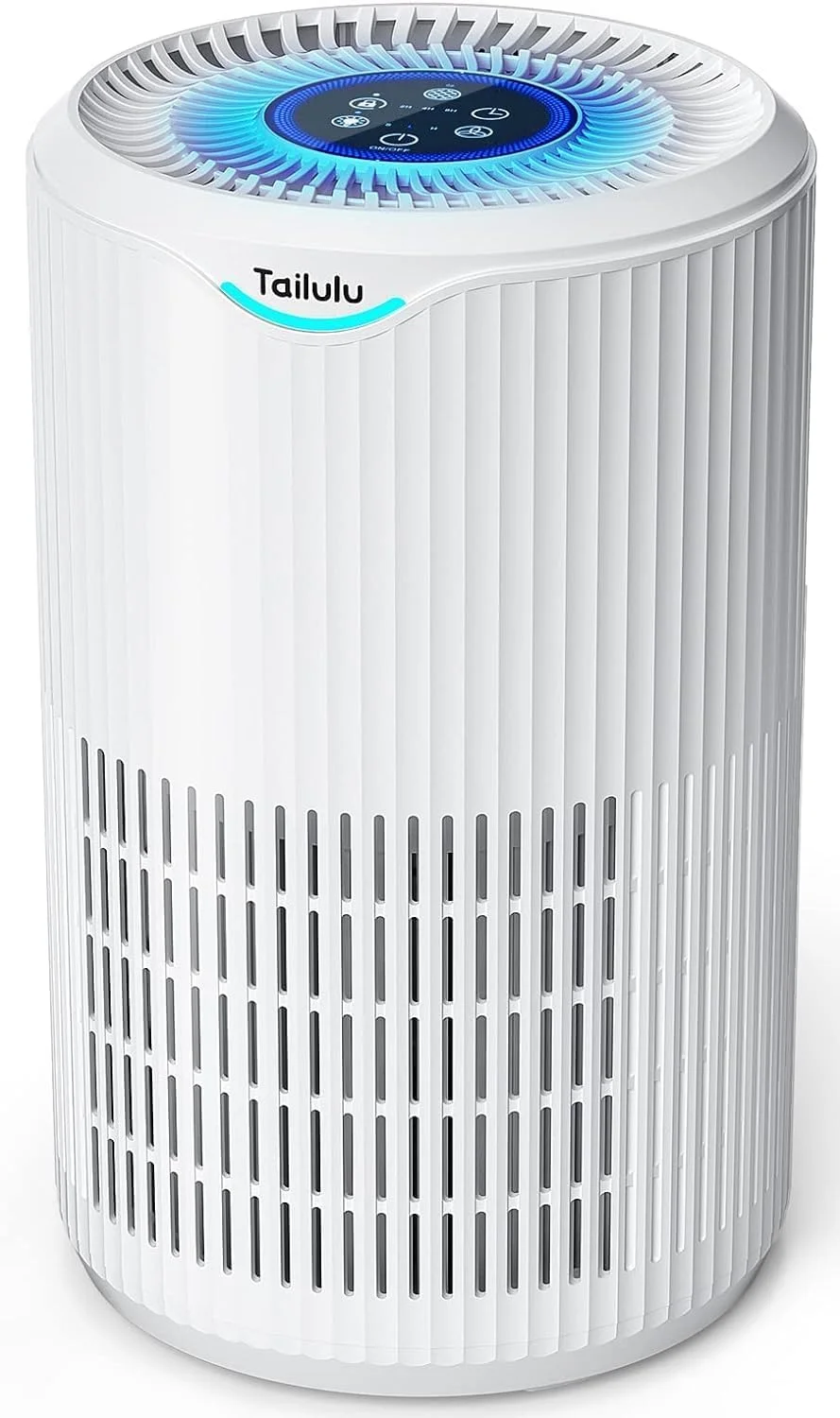
Key Specifications
- Room Coverage
- Up to 2200 sq ft (manufacturer claim)
- CADR
- Not AHAM verified — Manufacturer self-reported — not AHAM verified
- Filter
- H14 True HEPA + Activated Carbon
- Noise
- 20 dB
- Power
- watts
- Best For
- Large rooms on a budget. H14 HEPA with PM2.5 display and smart auto mode.
📅 Prices checked . Amazon prices change frequently — click through for current price. Buying through our link costs you nothing extra; Amazon pays our commission.
Pros
- 1,300+ verified reviews
- H14 True HEPA — above standard H13 grade
- PM2.5 display + smart auto mode
- 20dB sleep mode
- Budget large-room price
Cons
- Not AHAM CADR verified
- 2200 sq ft claim not independently tested
- Lesser-known brand
Best For
The Tailulu HQKJ-180 suits buyers who specifically want H14-grade filtration at a budget price and are comfortable accepting an unverified CADR. It is a good fit for medium-sized bedrooms (300-500 sq ft), allergy sufferers who want the extra particle capture margin that H14 offers over H13, and households with infants or immunocompromised members where filtration grade matters more than independent certification. Skip it if you need verifiable CADR numbers — for a space above 600 sq ft where performance evidence matters, choose an AHAM-certified alternative with published independent CADR. Also consider the absence of smart connectivity: the HQKJ-180 is manually controlled, so if WiFi and app scheduling are priorities, look at the Afloia Kilo Plus instead.
📅 Price checked August 2026 · Buying through this link costs you nothing extra — Amazon covers our commission
What to Know Before You Buy
Understanding the H14 Advantage
The HQKJ-180's H14 filter captures 99.995% of particles at 0.3 microns versus the 99.97% minimum for H13. In absolute terms: where H13 passes up to 3 particles per 10,000, H14 passes at most 0.5 per 10,000 — roughly a 6× improvement in residual particle passage. This matters most for fine combustion particles (wildfire smoke, diesel exhaust infiltration), ultrafine aerosols, and occupants with severe respiratory sensitivity. For most allergen sources like pollen and dust mite debris — which are larger than 1 micron — H13 and H14 perform essentially identically because both grades capture particles at those sizes with near-100% efficiency regardless of the 0.3-micron benchmark.
Managing Coverage Expectations
Without published CADR, sizing is approximate. Based on the unit's motor class and form factor, a conservative estimate is 150-200 CFM at maximum fan speed, which supports 4-5 ACH in a 300 sq ft room or 2-3 ACH in a 500 sq ft space. For a 2200 sq ft living area, this unit would deliver fewer than 1 ACH — suitable for very light background filtration only. Use it as a primary purifier in a single medium room, not as coverage for an entire floor.
Filter Replacement
Tailulu recommends filter replacement every 3-6 months. Replacement filters (H14 HQKJ-180 compatible, available as 1-pack and 2-pack) are sold on Amazon for approximately $20-35 per set. Order replacements before the existing filter reaches end-of-life — the PM2.5 sensor will show degraded readings as the filter loads, and the unit will alert via indicator light when replacement is due.
H14 vs H13 HEPA — What the Grade Difference Actually Means
HEPA filter grades are defined by European standard EN 1822 and its international equivalents. The grade designates the minimum efficiency at the most penetrating particle size (MPPS), which for fibrous HEPA media falls in the 0.1-0.3 micron range. H13 requires at least 99.97% overall efficiency and 99.95% local efficiency. H14 requires at least 99.995% overall and 99.975% local. The difference in residual particle passage is approximately 6× between the two grades at the MPPS.
For residential air purification, the practical implications depend on what you're filtering. Pollen (10-100 microns), dust mite allergens (2-10 microns), pet dander (1-10 microns), and mold spores (2-10 microns) are captured at near-100% efficiency by both H13 and H14 because they are larger than the MPPS. The grade difference becomes meaningful for fine combustion particles from wildfire smoke or vehicle exhaust (0.1-1 micron range), viral aerosols (0.1-0.3 microns), and ultrafine particles (below 0.1 microns where both grades again perform well due to diffusion mechanisms).
At the Tailulu HQKJ-180's price point, H14 filtration is genuinely uncommon. Most budget purifiers use H13 at best, and some use uncertified media labeled as "HEPA-like." If filtration grade is your primary criterion and budget is a constraint, the HQKJ-180 is one of very few sub-$100 options offering documented H14 performance.
CADR — Why Tailulu Does Not Publish It and What That Means
Tailulu does not disclose CADR (Clean Air Delivery Rate) figures for the HQKJ-180 in any official documentation or Amazon listing. CADR is the most useful metric for comparing air purifier performance across brands because it directly measures cleaned air volume per unit time. Without it, room-size coverage claims cannot be independently verified.
The 2200 sq ft figure on the HQKJ-180's packaging and listings is calculated using a single-pass model at maximum fan speed — not the repeated air changes required for effective particle reduction. Based on the unit's physical dimensions, motor noise floor (20 dB sleep mode suggests a very low minimum speed), and the typical output range for cylindrical purifiers of this size class, a practical CADR estimate of 150-200 CFM at high speed is reasonable but unconfirmed. At 150 CFM, effective 4.8 ACH coverage is approximately 234 sq ft; at 200 CFM, approximately 312 sq ft.
This review treats the 2200 sq ft claim as an aggressive marketing figure. For allergy or asthma management, plan for effective coverage of 300-500 sq ft. For general background air quality in larger rooms, 900-1100 sq ft at very low ACH is plausible.
Controls, Smart Features, and PM2.5 Display
The HQKJ-180 is manually controlled — there is no WiFi, Bluetooth, or app. The control panel includes 3 fan speeds, auto mode (which adjusts fan speed based on PM2.5 sensor readings), sleep mode (20 dB operation with dimmed display), a timer, and a child lock. The PM2.5 sensor provides real-time air quality readings displayed on the unit, with color-coded indicators for clean, moderate, and polluted air. This gives the unit a degree of automation — auto mode will spin up when the sensor detects a cooking event or outdoor pollution spike, then dial back when air quality recovers.
The 20 dB sleep mode is among the quietest in the budget large-room category. For reference, 20 dB is below a whisper and approaching the threshold of a quiet library. Whether the unit actually achieves this in practice depends on manufacturing tolerances; some user reviews note the actual sleep-mode noise is somewhat higher than the specification, particularly on older production runs. Fan bearing noise and impeller tone vary unit to unit at this price tier.
The HQKJ-180 is 100% ozone-free — it uses no UV lamps or ionizer. CARB, ETL, EPA, and FCC certifications confirm it meets California's strict indoor air quality standards, is electrically safe, and complies with FCC emissions requirements.
Tailulu HQKJ-180 CADR, ACH, and Room Coverage — What the Numbers Mean
CADR (Clean Air Delivery Rate) measures how many cubic feet of filtered air the purifier delivers per minute. Tailulu does not publish AHAM-verified CADR for the HQKJ-180. Based on the unit's form factor and motor class, estimated CADR is approximately 150–200 CFM at high speed. At the AHAM-recommended 4.8 air changes per hour, that range covers approximately 234–312 sq ft with 8-foot ceilings — a far cry from the marketed 2200 sq ft headline.
For allergy sufferers and asthma patients, AHAM recommends 4.8 ACH as the minimum for meaningful allergen reduction. At 150–200 CFM, the HQKJ-180 comfortably achieves this in rooms of 200–300 sq ft — appropriate for a standard bedroom or home office. Running the unit in a large open-plan living area of 1000+ sq ft delivers fewer than 1 ACH, which is clinically insufficient for allergen management. Place this unit in the room where you spend the most time rather than attempting whole-floor coverage.
For context, the Levoit Core 300 carries an AHAM-verified CADR of 141 (covering 219 sq ft at 4.8 ACH) and the Winix 5500-2 carries a verified CADR of 243 (covering 357 sq ft at 4.8 ACH). The HQKJ-180's estimated 150–200 CFM places it between these two competitors, which is a reasonable performance range for its size and price class — but unlike those units, the Tailulu figure remains unconfirmed by independent testing.
Tailulu HQKJ-180 3-Year Total Cost of Ownership — vs Levoit Core 300 and Winix 5500-2
Owning an air purifier means paying for filters and electricity long after the purchase price is forgotten. The table below calculates the true 3-year cost for the Tailulu HQKJ-180 against two verified alternatives, using filter replacement every 6 months and electricity at $0.17/kWh running 12 hours per day.
| Model | Purchase | Filters (3 yr) | Electricity (3 yr) | 3-Year Total | CADR | WiFi |
|---|---|---|---|---|---|---|
| Tailulu HQKJ-180 | $80 | ~$120 | ~$67 | ~$267 | Est. 150–200 | No |
| Levoit Core 300 | $70 | ~$60 | ~$40 | ~$170 | 141 (AHAM) | No |
| Winix 5500-2 | $150 | ~$105 | ~$55 | ~$310 | 243 (AHAM) | No |
The Tailulu HQKJ-180 has a higher 3-year cost than the Levoit Core 300 because its H14-grade replacement filters run approximately $20–$35 per set — more than the Core 300's widely available $15–$20 filters. However, the HQKJ-180 offers an H14 filter specification that the Core 300 (H13) does not match, and it occupies a larger form factor with higher estimated airflow. If filtration grade is your priority and the higher filter cost is acceptable, the HQKJ-180 delivers H14 performance in a price segment where it is genuinely uncommon.
The Winix 5500-2 costs more over 3 years but delivers AHAM-verified CADR 243 — the highest of the three models and independently confirmed. For buyers who need verified coverage in rooms of 350+ sq ft, the Winix's premium over the Tailulu is justified. The HQKJ-180's best case is the buyer who specifically wants H14 filtration at a budget price and can accept unverified CADR figures — a narrow but real use case.