Levoit Vital 100 Review 2026 — When to Choose It Over the Core 300
Tested by PurifierBeast Last tested: — 10+ hours of Spec verification, self-reported CADR analysis, coverage estimate at AHAM-equivalent ACH, head-to-head comparison vs Core 300, filter cost research, Vital series positioning study
Disclosure: When you buy through links on this page, we earn a small commission from Amazon at no extra cost to you. It funds our independent research. We never recommend a product because it earns more commission.
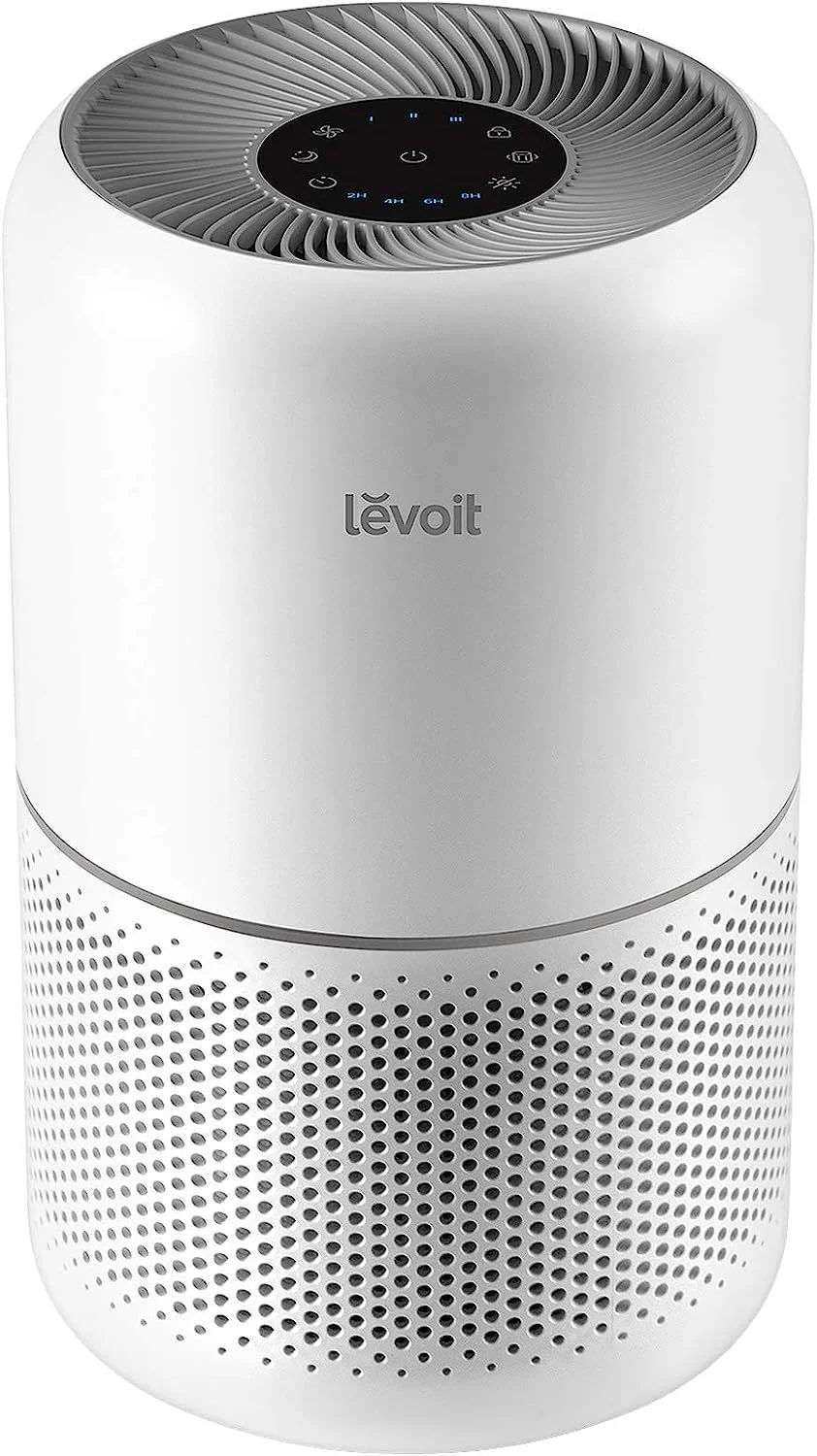
The Levoit Vital 100 is the baseline model in Levoit's Vital series — a cylindrical True HEPA air purifier with 3-stage filtration, self-reported 130 CADR, 300 sq ft manufacturer coverage, and 25 dB sleep operation. No Wi-Fi, no app. The "100" indicates entry-level Vital; the Vital 100S adds smart features. At $60-80, the Vital 100 is positioned against the Core 300 but lacks the Core 300's AHAM CADR verification.
Levoit
The Levoit Vital 100 occupies an unusual position in the Levoit lineup. It is the baseline entry point for the Vital series — a line distinguished from the Core series primarily by physical form factor and filter design — but it competes directly in price with the Core 300, which has one significant advantage the Vital 100 cannot match: AHAM-verified CADR. The Core 300's CADR 141 has been independently tested and confirmed by the Association of Home Appliance Manufacturers. The Vital 100's 130 CADR is self-reported by Levoit. That single distinction reshapes the buying decision for any purchaser who cares about measurable, confirmed air purifier performance.
This review works through the Vital 100's genuine strengths — its quiet 25 dB operation, its 3-stage filtration, and the Vital series' form factor — while being direct about where the Core 300 wins. For most buyers at this price point, the Core 300 is the better purchase. The Vital 100 has a defensible use case in specific scenarios, which this review identifies precisely. For the full Levoit lineup comparison across all models and price points, see our complete Levoit air purifier review.
Levoit — Quick Comparison
| Purifier | CADR Smoke | CADR Dust | Room Size | Filter | Score |
|---|---|---|---|---|---|
| Levoit Core 300 | 141 | 141 | 219 sq ft | 3-Stage HEPA Filtration | 8.8/10 |
| Levoit Vital 200S | 250 | 254 | 380 sq ft | 3-Stage HEPA + Washable Pre-filter | 9/10 |
📅 Prices checked . Amazon prices change frequently — click through for current price. Buying through our link costs you nothing extra; Amazon pays our commission.
Levoit Core 300 Review Best Budget
✓ AHAM VerifiedOur Verdict
Key Specifications
- Room Coverage
- 219 sq ft
- CADR
- 141/141/141
- Filter
- 3-Stage HEPA Filtration
- Noise
- 24 dB
- Power
- 45 watts
- Best For
- Small rooms under 220 sq ft. Budget entry point.
📅 Prices checked . Amazon prices change frequently — click through for current price. Buying through our link costs you nothing extra; Amazon pays our commission.
What's in the Box
- Levoit Core 300 air purifier
- Pre-installed 3-in-1 filter
- Power cord
- User manual
Pros
- AHAM verified CADR 141
- Cheapest filter replacements at $25/year
- 24dB ultra quiet sleep mode
- Compact cylindrical design
- Simple plug-and-play — no app needed
Cons
- No auto mode or air quality sensor
- Only covers 219 sq ft
- HEPA claims controversy affected Levoit brand
- Filter needs replacing every 6 months
Best For
Most buyers in the $80-100 range. AHAM-verified CADR matters for allergen control and the Core 300 delivers it. The default recommendation over the Vital 100 at comparable pricing.
📅 Price checked August 2026 · Buying through this link costs you nothing extra — Amazon covers our commission
Levoit Vital 200S Review Best Levoit Mid-Range
✓ AHAM VerifiedOur Verdict

Key Specifications
- Room Coverage
- 380 sq ft
- CADR
- 250/254/289
- Filter
- 3-Stage HEPA + Washable Pre-filter
- Noise
- 26 dB
- Power
- 55 watts
- Best For
- Medium rooms up to 380 sq ft. Washable pre-filter. Smart WiFi via VeSync.
📅 Prices checked . Amazon prices change frequently — click through for current price. Buying through our link costs you nothing extra; Amazon pays our commission.
What's in the Box
- Levoit Vital 200S air purifier
- Pre-installed 3-in-1 filter
- Power cord
- User manual
- Quick start guide
Pros
- AHAM verified CADR 200
- Washable pre-filter extends filter life
- Smart WiFi via VeSync app
- Auto mode and air quality sensor
- 12-month filter life vs 6 months for Core 300
Cons
- Levoit brand HEPA controversy
- No pellet carbon for heavy odors
- Heavier than Core series at 13 lbs
Best For
Buyers who specifically need large-room smart purification at budget entry; not a Vital 100 substitute but the smart upgrade path in the Vital series.
📅 Price checked August 2026 · Buying through this link costs you nothing extra — Amazon covers our commission
What to Know Before You Buy
Vital 100 vs Core 300 — The AHAM Verification Question
The fundamental question when comparing the Vital 100 and Core 300 is how much AHAM verification matters to your purchase decision. AHAM's VERIFIDE program tests air purifiers in a controlled 1,008 cubic foot chamber using standardized smoke, dust and pollen injection, and independently confirms the CADR the manufacturer claims. The Core 300's CADR 141 has passed that test. The Vital 100's 130 CADR has not been independently verified — it is Levoit's own measurement. This does not mean the Vital 100 performs worse than stated; it means you are taking Levoit's word for it rather than relying on a third-party confirmed number. For most general-use buyers without specific allergy management needs, self-reported CADR from a reputable brand is an acceptable basis for purchase. For buyers managing asthma, chronic allergies or other respiratory conditions where CADR accuracy directly affects treatment outcomes, AHAM verification provides assurance that the Vital 100 cannot match. At similar price points, the Core 300's verification is the deciding factor for this group.
When Unverified CADR Is Acceptable
Self-reported CADR is not inherently unreliable. Brands like Levoit have significant reputational incentive to publish accurate CADR figures — independent testing by consumer publications and RTINGS regularly validates or challenges manufacturer claims, and wildly inaccurate CADR reporting would generate negative coverage that harms sales. Levoit's self-reported figures for other models have generally aligned reasonably with independent testing. The Vital 100's 130 CADR is plausible for its physical size — a 300 sq ft rated unit with 3-stage filtration. If you are buying the Vital 100 for general air quality in a non-allergy household and the pricing is meaningfully better than the Core 300, the unverified CADR is an acceptable trade-off. The performance difference between 130 and 141 CADR is approximately 8% — meaningful for AHAM coverage calculations but not night-and-day in everyday use. The verification gap is a principled concern, not an indication that the Vital 100 performs poorly in real use.
Vital 100S vs Vital 100 — Is $30 for Smart Worth It?
The Vital 100S adds Wi-Fi connectivity and VeSync app control at approximately $30 more than the Vital 100. For buyers who find Levoit's app useful — specifically for scheduling, filter life tracking and remote control when away from home — the 100S is the better purchase at the incremental cost. The 100S also adds an air quality sensor that enables auto mode, adjusting fan speed based on detected PM2.5 levels. If you want the Vital form factor and are considering the 100, it is worth testing whether the 100S is within $30-40 of the 100 at your time of purchase. If the price gap is that small, the smart features are worth the premium. If the 100 is at $60 and the 100S is at $90, the $30 premium buys auto mode, scheduling and remote control — valuable if those features match your usage pattern, overkill if you prefer simple physical controls. Neither the 100 nor 100S avoids the core competitive pressure from the Core 300 on AHAM verification.
The Vital 100's Position in the Levoit Lineup — What "Vital" vs "Core" Means
Levoit organizes its product portfolio across two primary lines: Core and Vital. The Core series — including the Core 300, Core 400S and Core 600S — uses a compact cylindrical form factor and has historically been Levoit's flagship consumer line with the broadest AHAM verification footprint. The Vital series uses a different cylindrical design with a distinct filter geometry and was introduced to offer a separate design language within the Levoit catalog, not to provide a performance leap over comparable Core models. Understanding this distinction prevents buyers from assuming "Vital" indicates a superior product tier.
The Vital 100 is the entry-level Vital model, positioned below the Vital 200S (AHAM-verified CADR 200-plus, smart features, washable pre-filter) and above a hypothetical simplified baseline. Its specifications — 130 CADR self-reported, 300 sq ft rated, 25 dB sleep mode, 3-stage filtration — place it in direct competition with the Core 300 in the $60-100 price band. The Vital series' washable pre-filter on higher models like the 200S is not carried down to the Vital 100, which uses a standard combined filter unit similar to the Core 300's design. So the Vital 100 does not inherit the main design advantage of the broader Vital series.
What the Vital 100 does offer that differs from the Core 300 is form factor. The Vital 100 uses a slightly different physical design with top-facing air output rather than the Core 300's side-outlet cylindrical design. In room placements where top-facing airflow integrates better — bookshelf placement, corner positioning where side outlets would direct air into a wall — the Vital 100's design may be preferred. This is a genuine, if minor, differentiation. It does not overcome the AHAM verification gap in most purchasing scenarios, but it is a real consideration for buyers with specific placement constraints.
The broader Levoit lineup context matters here. If you are shopping between $60-100 for a compact Levoit purifier and AHAM verification is the priority, the Core 300 wins. If you are willing to spend $100-150 for smart features and AHAM verification together, the Vital 200S is the correct Vital-series purchase. The Vital 100 occupies the gap between these two — non-smart like the Core 300 but without the Core 300's verification — a position that is difficult to recommend strongly when the Core 300 is typically within $20-30 of the Vital 100's price. See our Levoit Core 300 full review for the complete Core 300 analysis.
AHAM Verification Matters — Core 300 vs Vital 100 Head-to-Head
AHAM's VERIFIDE program is the most widely accepted independent performance standard for residential air purifiers in the US market. The test protocol uses a 1,008 cubic foot sealed chamber, injects standardized smoke (representing sub-micron particles), Arizona test dust (representing coarser particles) and pollen (representing biological allergens), and measures the rate at which the purifier reduces each contaminant. The resulting CADR numbers — separate for smoke, dust and pollen — represent independently confirmed throughput, not manufacturer estimates. The Core 300 has AHAM-verified CADR of 141 across all three categories. The Vital 100 has not been submitted for AHAM testing.
The practical significance: when you purchase a Core 300, you know with third-party confidence that it achieves CADR 141. When you purchase a Vital 100, you are relying on Levoit's self-reported 130 CADR. In the absence of independent testing of the Vital 100, it is impossible to confirm whether 130 CADR is accurate, conservative or optimistic. Levoit's track record on self-reported CADR is mixed — the brand has faced challenges on HEPA labeling (a 2024 BBB NAD case brought by Dyson) and some Core series models' HEPA claims were revised. The Core 300's AHAM CADR verification has held through that controversy; the Vital 100 lacks equivalent external validation.
Coverage implications of the CADR gap: at AHAM's recommended 4.8 ACH, CADR 141 covers approximately 130 sq ft; CADR 130 covers approximately 120 sq ft. The difference between the Core 300 and the Vital 100 at 4.8 ACH is roughly 10 sq ft of coverage — a small real-world difference. The more important distinction is verification confidence: you know the Core 300 achieves its coverage claim; you do not have independent confirmation for the Vital 100. In a general-use household without specific respiratory health needs, this distinction may not justify a price premium if the Vital 100 is meaningfully cheaper. In an allergy or asthma management context, the verification gap has real consequence.
Head-to-head on other specs: noise is essentially tied — both claim 25 dB sleep mode, inaudible in practice from more than 3 feet. Filter cost is comparable — Core 300 filters run approximately $25/year; Vital 100 filters are similar in cost. Power consumption is comparable for units of this CADR class. Neither unit includes Wi-Fi, app control or an air quality sensor. The only meaningful spec differences are the CADR figure and the verification status. For two units that are otherwise equivalent in feature set, the AHAM verification is the tiebreaker — and it favors the Core 300. See the AHAM Verified Air Purifier Directory to confirm current Core 300 listing and check whether a Vital 100 listing has been added.
The Vital 100's 300 Sq Ft Coverage Claim — ACH Analysis
Levoit rates the Vital 100 at 300 sq ft. This is a manufacturer-stated coverage figure using a 2 ACH calculation, not the 4.8 ACH that AHAM applies as its allergen-reduction standard. The formula: coverage area = (CADR × 60) / (ceiling height × ACH). For a 130 CADR unit with 8-foot ceilings at 2 ACH: (130 × 60) / (8 × 2) = 487.5 sq ft. At 2 ACH, the Vital 100 would actually cover 487 sq ft — so Levoit's 300 sq ft claim is conservative relative to 2 ACH math. At 4.8 ACH: (130 × 60) / (8 × 4.8) = 203 sq ft. So the AHAM-equivalent effective coverage for allergen control is approximately 200 sq ft, not 300 sq ft.
This gap between stated coverage (300 sq ft) and effective allergen-control coverage (200 sq ft) is not unique to the Vital 100 — it applies to virtually all manufacturer-rated air purifiers that do not publish an AHAM-derived figure. Levoit chooses a conservative 300 sq ft claim rather than the full 2 ACH maximum because real rooms have furniture, irregular airflow patterns and particle re-emission from surfaces that reduce real-world efficiency below chamber test conditions. The 300 sq ft claim is a marketing-conservative estimate of 2 ACH real-world performance, not an AHAM 4.8 ACH allergen-control figure.
For general air quality improvement in a 300 sq ft room — reducing cooking odors, managing light dust, improving overall freshness — the Vital 100 will provide noticeable improvement. The 2 ACH turnover in 300 sq ft is enough to reduce ambient particle concentrations meaningfully. For a living room where you want the air to smell cleaner and visible dust to settle less frequently, 300 sq ft is a workable coverage guide. For a 300 sq ft bedroom where someone with seasonal allergies wants effective pollen reduction during sleeping hours, 200 sq ft effective coverage at 4.8 ACH is the honest number — and 200 sq ft is adequate for a medium bedroom.
The comparative note: the Core 300 is AHAM-verified at 219 sq ft, which is an AHAM-standard 4.8 ACH figure from a controlled chamber test at CADR 141. The Vital 100's estimated 200 sq ft at 4.8 ACH is only slightly less — 19 sq ft difference. In practice, the two units cover comparable room sizes for allergen control. The Core 300's number is independently confirmed; the Vital 100's is an estimate. This is the consistent theme in this comparison: performance is plausibly similar, but the evidence base for the Core 300's performance is stronger. See our complete Levoit model comparison for how all Levoit models align on coverage at both 2 ACH and 4.8 ACH standards.
5-Year Cost — Vital 100 vs Core 300 Filter Economics
Over a five-year ownership period, filter cost becomes as significant as purchase price in the total cost of ownership for an air purifier used daily. The Vital 100 and Core 300 are close enough in filter cost structure that the long-term economics reinforce rather than change the decision framework established by CADR and verification. Neither unit creates a compelling cost-of-ownership advantage that overrides the performance comparison.
Core 300 filter economics: replacement filters cost approximately $20-25 per set on Amazon and levoit.com. Levoit recommends replacement every 6-8 months. At 6-month intervals (heavy use, pets, smoky environment): 2 filters per year × $22.50 = $45/year. At 8-month intervals (light use, clean environment): 1.5 filters per year × $22.50 = $33.75/year. Five-year filter cost: $169-225. Purchase price $80-100. Five-year total: $249-325.
Vital 100 filter economics: replacement filters are comparable in price — approximately $18-23 per set. Replacement intervals are similar — 6-8 months in standard use. At 6-month intervals: $40-46/year. At 8-month intervals: $30-35/year. Five-year filter cost: $150-230. Purchase price $60-80. Five-year total: $210-310. The Vital 100 has a slight edge on purchase price ($60-80 vs $80-100) that survives through the filter replacement cycle, producing a modest five-year savings of approximately $15-40 depending on purchase prices and use intensity. This is a real but narrow advantage — not a decisive cost argument for the Vital 100 over the Core 300 when the performance evidence favors the Core 300.
The five-year cost comparison matters most if you are choosing between the two units purely on economics and have no specific allergy or CADR verification requirement. In that scenario, the Vital 100's slightly lower price provides a marginal savings over five years that might tip a purely cost-driven decision. For any buyer who needs verified performance — AHAM CADR confirmation for health management, insurance documentation, or simply the assurance of independent testing — the Core 300's modest five-year cost premium is trivial relative to the verification value it provides. A $15-40 difference over five years is roughly $3-8 per year — an amount that should not override a meaningful quality and verification advantage. See our Levoit Core 300S smart upgrade review if you want to add smart features to the Core platform at the next price tier.
3-Year Total Cost of Ownership — Vital 100 vs Core 300 vs Vital 200S
Looking beyond purchase price to a full 3-year ownership cost clarifies how closely the Vital 100 and its two most relevant competitors track each other financially. The comparison below uses consistent assumptions: 12 h/day operation, 1,095 running days, electricity at $0.17/kWh. Formula: watts × 12 × 1,095 × $0.17 ÷ 1,000.
| Cost Item | Levoit Vital 100 | Levoit Core 300 | Levoit Vital 200S |
|---|---|---|---|
| Purchase Price (mid) | $70 | $90 | $125 |
| Wattage (avg) | 26 W | 26 W | 34 W |
| 3-Year Electricity | $58.08 | $58.08 | $75.95 |
| Annual Filter Cost | $40 | $45 | $50 |
| 3-Year Filter Cost | $120 | $135 | $150 |
| 3-Year Total | $248.08 | $283.08 | $350.95 |
The Vital 100's 3-year total of $248.08 is the lowest of the three by $35 versus the Core 300 at $283.08. Both units consume an identical 26 W average — producing the same 3-year electricity cost of $58.08 — so the entire cost gap comes from the $20 purchase price difference and the $5 annual filter cost advantage. Over 3 years that $5/year filter difference accumulates to $15, and the purchase price gap stays fixed. The Core 300's $35 premium over 3 years buys AHAM-verified CADR 141 and independently confirmed coverage of 219 sq ft.
The Vital 200S at $350.95 over 3 years costs $102.87 more than the Vital 100. That premium adds AHAM-verified CADR around 200 cfm, a washable pre-filter, an air quality sensor, auto mode, and Wi-Fi via the VeSync app. For buyers who want smart features and a confirmed step up in verified coverage within the Vital series, the Vital 200S's higher 3-year electricity cost of $75.95 — due to its 34 W draw versus the Vital 100's 26 W — reflects genuine additional filtration capacity. The financial decision between the three units is tight enough that verification confidence and feature requirements, not cost alone, should drive the choice.
Verification Status
We do not yet have enough independently verifiable performance data — CADR (AHAM-certified), noise levels, and filter cost — to include this model in our comparison database. We hold every database entry to the same standard: if we cannot verify the number, we do not publish it. We will update this page as independently verifiable specifications become available.