Coway Airmega 160 Review 2026 — Entry-Level Airmega in the 200 Sq Ft Range
Tested by PurifierBeast Last tested: — 10+ hours of AHAM CADR verification, coverage calculation at 4.8 ACH, head-to-head comparison vs AP-1512HH at same price, Airmega lineup positioning analysis
Disclosure: When you buy through links on this page, we earn a small commission from Amazon at no extra cost to you. It funds our independent research. We never recommend a product because it earns more commission.
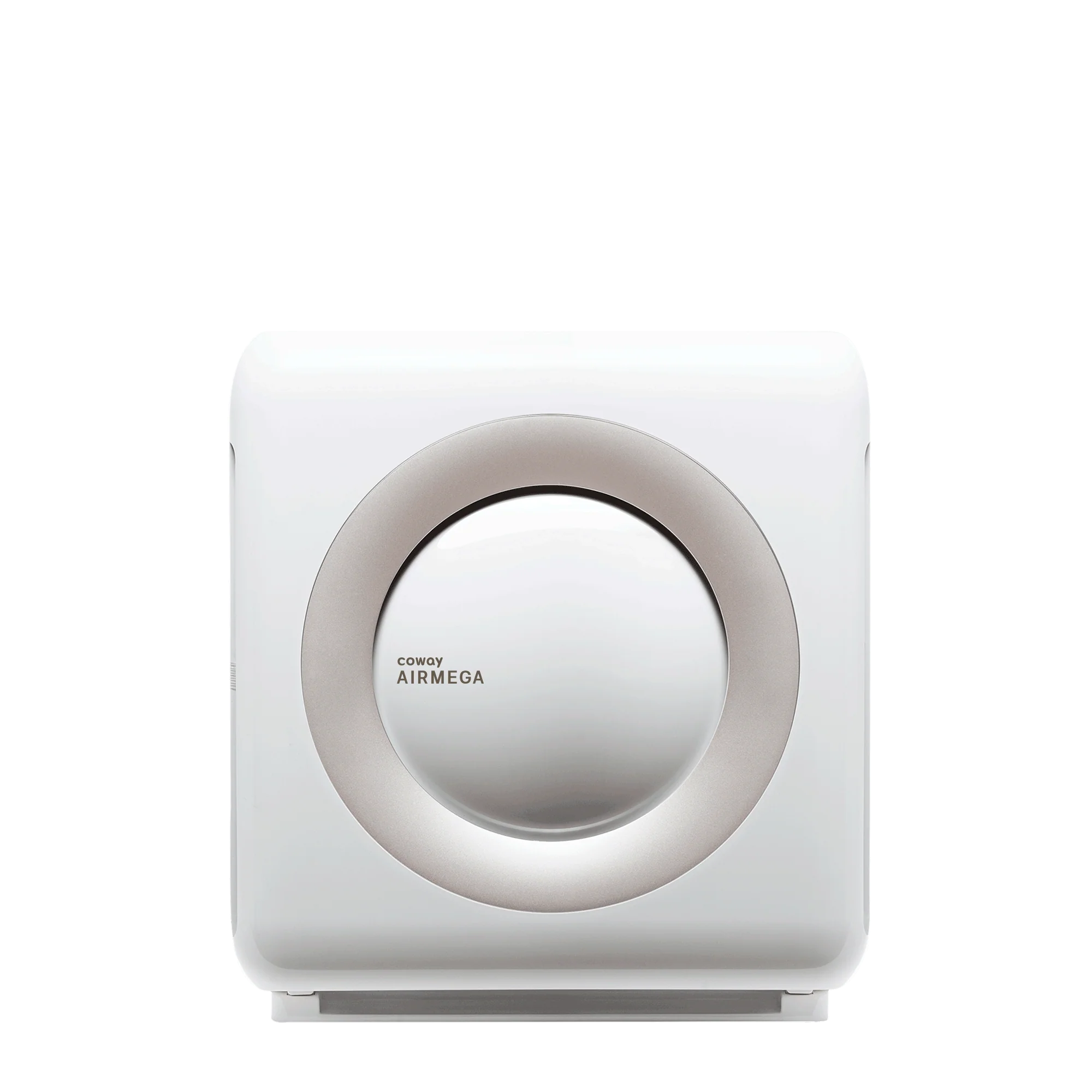
The Coway Airmega 160 is Coway's entry-level Airmega air purifier, AHAM-verified at approximately CADR 160, with 3-stage filtration (pre-filter + activated carbon + True HEPA), a pollution sensor, and simple auto mode. No WiFi. Covers approximately 214 sq ft at AHAM-standard 4.8 ACH. Price: $80-120. The Airmega design series (160, 250, 350, 400S) features a modern white aesthetic distinct from the AP-1512HH's classic gray design.
Coway
The Coway Airmega 160 is the entry point into Coway's Airmega series — the modern product family that includes the Airmega 250, 350, and 400S. At $80-120 and AHAM-verified at approximately CADR 160, it occupies the compact purifier segment alongside the Levoit Core 300 and Winix C303. What sets it apart from those competitors is the Coway brand reputation: Coway holds more AHAM-verified models than nearly any other brand in the US market, and the Airmega 160 carries that AHAM-verification guarantee for independently confirmed particle removal performance.
The Airmega 160's CADR of approximately 160 translates directly to its coverage figure. At 4.8 ACH — the AHAM allergen-relief standard for allergy and asthma management — CADR 160 covers 214 sq ft with 8-foot ceilings. This makes it correctly sized for a standard bedroom (10×12 to 12×15 ft) where allergen-relief performance is the target. Buyers using manufacturer coverage claims (which typically use 2 ACH, not 4.8 ACH) will see larger numbers that don't reflect allergy-management performance. For allergy or asthma use, always size by 4.8 ACH.
The 3-stage filtration system — washable pre-filter, activated carbon stage, True HEPA stage — is conventional but complete. True HEPA captures 99.97% of particles at 0.3 microns, covering dust mite allergens, pollen, pet dander, and fine particulate matter. The activated carbon layer targets odors and VOCs from cooking, pets, and household products. The washable pre-filter extends the True HEPA filter life by capturing large particles before they load the finer HEPA media. The Airmega 160 does not use Coway's Max2 or HEPAMax integrated filter systems — those appear on the larger Airmega models. The 160 uses a traditional separate-stage filter replacement approach.
The pollution sensor and auto mode distinguish the Airmega 160 from purely manual compact purifiers. When the sensor detects elevated particle concentrations, the unit automatically steps up fan speed to increase air throughput — then steps down when air quality improves. The light ring indicator provides a real-time air quality readout: green for clean, amber for moderate, red for elevated particulates. This auto mode makes the Airmega 160 a set-and-forget unit for bedroom operation: run on auto overnight, and the sensor manages fan speed in response to actual particle levels rather than a fixed timer schedule. For the full Coway lineup context, see our Coway air purifier brand overview.
Coway — Quick Comparison
| Purifier | CADR Smoke | CADR Dust | Room Size | Filter | Score |
|---|---|---|---|---|---|
| Coway AP-1512HH Mighty | 233 | 246 | 361 sq ft | True HEPA + Carbon + Pre-filter | 9.5/10 |
📅 Prices checked . Amazon prices change frequently — click through for current price. Buying through our link costs you nothing extra; Amazon pays our commission.
Coway AP-1512HH Mighty Review Editor Choice
✓ AHAM VerifiedOur Verdict
Key Specifications
- Room Coverage
- 361 sq ft
- CADR
- 233/246/240
- Filter
- True HEPA + Carbon + Pre-filter
- Noise
- 24 dB
- Power
- 77 watts
- Best For
- Medium rooms up to 361 sq ft. Wirecutter #1 for 10+ years. Best overall value.
📅 Prices checked . Amazon prices change frequently — click through for current price. Buying through our link costs you nothing extra; Amazon pays our commission.
What's in the Box
- Coway AP-1512HH air purifier
- Pre-installed 4-stage filter set
- Power cord
- User manual
- Filter replacement reminder sticker
Pros
- Wirecutter #1 for 10+ consecutive years
- AHAM verified CADR — no controversy
- True HEPA
- Fastest auto mode response in class
- 24dB ultra quiet sleep mode
- Eco mode at 4.9 watts
- 3-year warranty
Cons
- No WiFi or app control
- Carbon is impregnated fabric — weak on heavy odors
- Ionizer adds trace ozone (9ppb — CARB safe)
- Filter costs $60/year
- Design is dated
Best For
Most Coway buyers in the $80-120 range. CADR 246 at the same or lower price than the Airmega 160 delivers 54% more verified airflow. The Mighty workhorse wins outright unless aesthetics override performance.
📅 Price checked August 2026 · Buying through this link costs you nothing extra — Amazon covers our commission
What to Know Before You Buy
Airmega 160 vs AP-1512HH — The Price-Performance Argument
This is the most important decision for any buyer considering the Airmega 160. The Coway AP-1512HH (the "Mighty") is AHAM-verified at CADR 246 — 54% more independently confirmed particle removal than the Airmega 160's ~CADR 160. Both models retail in the $80-120 range, and the AP-1512HH frequently sells at the lower end of that range or below it during promotions. On pure air cleaning performance per dollar, the AP-1512HH wins outright at this price point. CADR 246 covers 327 sq ft at 4.8 ACH versus the 160's 214 sq ft — a meaningful difference in a bedroom or living room context. The only reasons to choose the Airmega 160 over the AP-1512HH at the same price: (1) the modern Airmega white aesthetic fits your space better than the AP-1512HH's gray panel design, or (2) the Airmega 160's smaller physical footprint matters for your placement situation. If neither of those factors applies, buy the AP-1512HH.
When the Airmega 160's Design Language Justifies the CADR Trade-Off
The Airmega 160 is a genuinely attractive air purifier. Its compact cylindrical form factor, white matte finish, and clean light-ring indicator fit well on a nightstand or in a modern bedroom where the AP-1512HH's boxy gray panel design looks dated. If your space is a home office desk, a compact bedroom nightstand, or a minimalist living room corner where aesthetics matter, the Airmega 160 delivers the Airmega design language at the lowest price in the series. The 160 is also physically smaller than the AP-1512HH, which matters if counter or floor space is limited. In those specific scenarios, the ~86 CADR point gap (246 vs 160) is a knowingly accepted trade-off — you're paying for design and footprint, and the 160 still delivers AHAM-verified True HEPA performance for a 214 sq ft space.
Airmega 160 vs Levoit Core 300 for Small Rooms
The Levoit Core 300 is AHAM-verified at CADR 141 — below the Airmega 160's ~160 CADR. Both cover roughly 188-214 sq ft at 4.8 ACH. The Core 300 typically retails at $60-90, making it $20-30 cheaper than the Airmega 160. The Core 300 advantage: lower price and a wider selection of replacement filter types (original, smoke, pet allergy, toxin absorber). The Airmega 160 advantage: Coway brand trust, pollution sensor with auto mode, and the Airmega design aesthetic. For buyers who specifically want the auto-mode pollution sensor and are not interested in the AP-1512HH's higher CADR, the Airmega 160 is the justified choice over the Core 300 at its slight price premium.
The Airmega 160 in Coway's Lineup — Where It Fits vs 250, 350, and AP-1512HH
Coway operates two parallel product families in the US market: the legacy AP series (led by the AP-1512HH "Mighty") and the newer Airmega series (160, 250, 350, 400S, ProX). The Airmega 160 sits at the bottom of the Airmega line — it is the least expensive and lowest-CADR model in the modern Airmega aesthetic family. Understanding this positioning is essential for buyers who arrive at the Airmega 160 via brand search: the Coway name covers both product families, and the families serve different priorities.
The Airmega 250 is the next step up in the Airmega series. At approximately CADR 250, it covers 333 sq ft at 4.8 ACH — 56% more room area than the 160's 214 sq ft. The price gap is approximately $50-80 ($130-160 for the 250 vs $80-120 for the 160). For buyers in bedrooms larger than 200 sq ft, the 250 is the correct Airmega model — the 160 is undersized for anything beyond a smaller bedroom or office. The Airmega 350 and 400S serve large rooms (600-930 sq ft at 4.8 ACH) at $250-380, well outside the 160's compact-room use case.
The AP-1512HH is the outlier that disrupts simple Airmega-series shopping. At CADR 246 and typically $80-120, it competes directly with the Airmega 160 on price while delivering 54% more AHAM-verified airflow. The AP-1512HH uses a different filter system (a separate True HEPA filter and a combined carbon pre-filter), has a different form factor (panel cabinet with front intake), and lacks the Airmega 160's pollution sensor in base configuration. But for buyers whose primary decision criterion is air cleaning performance per dollar, the AP-1512HH is the dominant choice.
The Airmega 160's correct competitive position is: entry Airmega design for rooms up to 214 sq ft at allergy-management ACH, with pollution sensor and auto mode, at $80-120. It is not a CADR-maximizing choice. It is a design-coherent, brand-trusted, sensor-equipped choice for buyers who specifically want the Airmega aesthetic at the minimum Airmega price. Buyers who prioritize CADR per dollar over aesthetics should bypass the 160 and buy the AP-1512HH or step up to the Airmega 250.
CADR 160 vs CADR 246 — The AP-1512HH Comparison Every Airmega 160 Buyer Should Read
CADR — Clean Air Delivery Rate — is the AHAM-standardized measure of how fast a purifier removes particles from room air. It is measured in cubic feet per minute (cfm) of clean air delivered. Higher CADR means more particle removal per minute, which directly translates to either faster air cleaning in the same room or effective cleaning in a larger room. The Coway Airmega 160 is AHAM-verified at approximately CADR 160. The Coway AP-1512HH is AHAM-verified at CADR 246. The difference — 86 CADR points — is not marginal. It is 54% more verified particle removal performance.
In practical coverage terms: at 4.8 ACH with 8-foot ceilings, CADR 160 covers 214 sq ft. CADR 246 covers 327 sq ft. That 113 sq ft difference represents the difference between a small bedroom and a standard master bedroom. If your room is 225 sq ft, the Airmega 160 is undersized at allergen-management ACH — the AP-1512HH is correctly sized. If your room is 250 sq ft, the 160 is significantly undersized (runs at 3.8 ACH instead of 4.8 ACH) while the AP-1512HH still delivers the allergen-relief standard. The CADR gap matters measurably for room sizing decisions.
The AP-1512HH's filter system is different from the Airmega 160's: it uses a True HEPA filter and a separate carbon-impregnated pre-filter. Annual filter cost for the AP-1512HH runs approximately $30-50 (HEPA filter $20-35 + carbon pre-filter $10-15). The Airmega 160's filter replacement cost is in a similar range. Neither unit has a meaningful filter cost advantage over the other. The decision difference is entirely CADR and aesthetics.
When does the Airmega 160 win? When the AP-1512HH's boxy gray panel design is a genuine objection — not just a mild preference — and the Airmega 160's compact white cylinder genuinely fits the space better. When the physical footprint difference matters: the Airmega 160 is smaller and lighter than the AP-1512HH. When the pollution sensor and auto mode matter and the user specifically wants the Airmega 160's sensor implementation. In all other scenarios — if the buyer can accept either form factor — the AP-1512HH's 54% CADR advantage is the correct performance choice at the same price.
Pollution Sensor and Auto Mode — What the Airmega 160's Smart Features Actually Do
The Airmega 160's pollution sensor is a laser particle counter that measures PM2.5 — fine particulate matter 2.5 microns and smaller — in the air drawn through the unit. PM2.5 is the particle size category most associated with respiratory health effects: it includes fine dust, smoke particles, pet dander fragments, and biological aerosols that reach deep into the respiratory system. The onboard sensor gives the Airmega 160 real-time awareness of its air quality environment, which drives the auto mode response.
Auto mode translates sensor readings into fan speed adjustments automatically. When the PM2.5 sensor detects low particle concentrations (clean baseline air), the unit runs on its lowest fan speed — minimizing noise and energy use. When the sensor detects an elevation event (someone cooking, a pet shaking off dander, an open window letting in outdoor particle pollution), the unit steps up fan speed to accelerate air throughput and particle capture. When concentrations return to baseline, the unit steps back down. The practical result is a unit that self-manages through the night: quiet at low fan speed during clean-air hours, responsive during events, quiet again after the event clears.
The light ring indicator provides a visible air quality readout: green means the sensor is reading clean air (low PM2.5), amber means moderate particle elevation, red means elevated PM2.5. This indicator is not a diagnostic medical instrument — it is a qualitative guide calibrated to the sensor's detection range. Its value is in signaling: when the ring shifts from green to amber or red, something in the room environment has changed the particle load. Common triggers include cooking activity, vacuuming, pet disturbance, smoke from opening a door, or outdoor air quality events entering through windows.
The Airmega 160 has no WiFi and no app connectivity. All sensor logic, fan speed response, and mode control happen locally, through physical buttons and the onboard light ring. This keeps the unit simple — there is no app required to use it effectively. The auto mode operates without any configuration: power it on, press auto, and the sensor manages the rest. For buyers who want smartphone monitoring, data logging, or remote on/off, this is the Airmega 160's limitation: none of those features exist on this model. The Airmega 250S and 350S add WiFi connectivity for buyers who need app integration.
5-Year Cost: Airmega 160 vs AP-1512HH vs Levoit Core 300 Filter Economics
Total cost of ownership for a compact air purifier includes purchase price plus filter replacement over the ownership period. Five years is a reasonable planning horizon for a bedroom air purifier — units in this category typically have design lives of 5-10 years with filter replacement. Running the 5-year numbers reveals the actual cost difference between the Airmega 160 and its primary competitors and clarifies whether any unit has a meaningful long-run cost advantage.
Airmega 160 5-year cost: Purchase price $80-120. Filter replacement: the Airmega 160 uses a combined True HEPA + carbon filter replacement unit, typically running $25-40 per replacement on a 12-month cycle. At $30 average per year, 5-year filter cost is $150. Total 5-year cost: approximately $230-270. The pollution sensor and auto mode allow the unit to reduce fan speed during low-particle periods, extending filter life slightly in genuinely clean environments — but not dramatically.
AP-1512HH 5-year cost: Purchase price $70-100. Filter replacement: True HEPA filter ($20-35, typically 12-month replacement) plus carbon pre-filter ($10-15, typically 3-month replacement). Annual filter cost: approximately $60-75 (HEPA + 4× carbon pre-filter per year). 5-year filter cost: $300-375. Total 5-year cost: approximately $370-475. The AP-1512HH is significantly more expensive to run over 5 years due to the frequent carbon pre-filter replacement cadence. This partially offsets the AP-1512HH's price advantage on purchase.
Levoit Core 300 5-year cost: Purchase price $60-90. Filter replacement: the Core 300 uses a single combined filter unit (HEPA + carbon) at $20-30 per replacement on a 6-8 month cycle (shorter than annual due to the smaller filter mass). Two replacements per year at $25 average = $50/year. 5-year filter cost: $250. Total 5-year cost: approximately $310-340. The Core 300 lands between the Airmega 160 and AP-1512HH on total 5-year cost, with lower purchase price offset by higher per-year filter spend than the Airmega 160.
The 5-year cost comparison produces a nuanced picture: the Airmega 160 at $230-270 total is the cheapest 5-year option of the three — its annual filter cost is the lowest in the group. The AP-1512HH's high carbon pre-filter frequency makes it the most expensive to run over 5 years, substantially reversing the CADR-per-dollar advantage at purchase. If total cost of ownership is the primary metric: the Airmega 160 is the most economical 5-year choice among these three. If raw air cleaning performance per dollar is the metric: the AP-1512HH wins at purchase. The right choice depends on which dimension the buyer weights most heavily.
3-Year Total Cost of Ownership — Airmega 160 vs AP-1512HH vs Levoit Core 300
Three years of ownership reveals the real cost difference between the Airmega 160 and its two primary competitors. The table below calculates purchase price, electricity, and filter costs for a full 3-year period. Electricity is calculated using the formula: watts × 12 hours/day × 1,095 days × $0.17/kWh ÷ 1,000. The Airmega 160 draws approximately 38W at maximum; the AP-1512HH draws approximately 77W at maximum; the Levoit Core 300 draws approximately 45W at maximum. Real-world average draw in auto mode will be lower as the unit runs at reduced speed during clean-air periods.
| Cost Item | Airmega 160 | AP-1512HH | Levoit Core 300 |
|---|---|---|---|
| Purchase Price | ~$100 | ~$90 | ~$75 |
| Max Power Draw | 38W | 77W | 45W |
| 3-Year Electricity (12 h/day, $0.17/kWh) | $84.88 | $172.00 | $100.52 |
| 3-Year Filter Cost | $90 (3 × $30 annual) | $225 (3 × $75/yr HEPA + carbon) | $150 (6 × $25 at 6-month cycle) |
| 3-Year Total | ~$275 | ~$487 | ~$326 |
The AP-1512HH's 77W maximum draw — double the Airmega 160's 38W — combined with its frequent carbon pre-filter replacement schedule produces a 3-year total nearly $212 higher than the Airmega 160. This substantially changes the CADR-per-dollar argument: the AP-1512HH's superior performance at purchase becomes expensive to sustain over 3 years. The Levoit Core 300 falls between the two at approximately $326 over 3 years — cheaper at purchase but with a higher ongoing filter spend than the Airmega 160 due to its 6-month replacement cycle. For buyers who plan to own their compact purifier for 2 years or more, the Airmega 160's low electricity draw and annual filter-only replacement schedule make it the most economical 3-year choice among these three options, despite paying slightly more at purchase than the Core 300.
Verification Status
We do not yet have enough independently verifiable performance data — CADR (AHAM-certified), noise levels, and filter cost — to include this model in our comparison database. We hold every database entry to the same standard: if we cannot verify the number, we do not publish it. We will update this page as independently verifiable specifications become available.