AromaRoom AP103-A H13 HEPA Air Purifier Bedroom Review 2026 — Compact filtration with essential oil aroma pad
Tested by PurifierBeast Last tested: — 8+ hours of Manufacturer specification review, CADR analysis, filter cost analysis, user review synthesis
Disclosure: When you buy through links on this page, we earn a small commission from Amazon at no extra cost to you. It funds our independent research. We never recommend a product because it earns more commission.
The AromaRoom AP103-A — an H13 HEPA bedroom air purifier by AromaRoom. CADR 32.4 CFM (55 m³/h), manufacturer-stated. Effective coverage: ~80–123 sq ft. 3-in-1 H13 HEPA + carbon filter. Aroma pad slot for essential oils (included, oil not included). 22 dB in sleep mode. Price: ~$29–$55.
AromaRoom
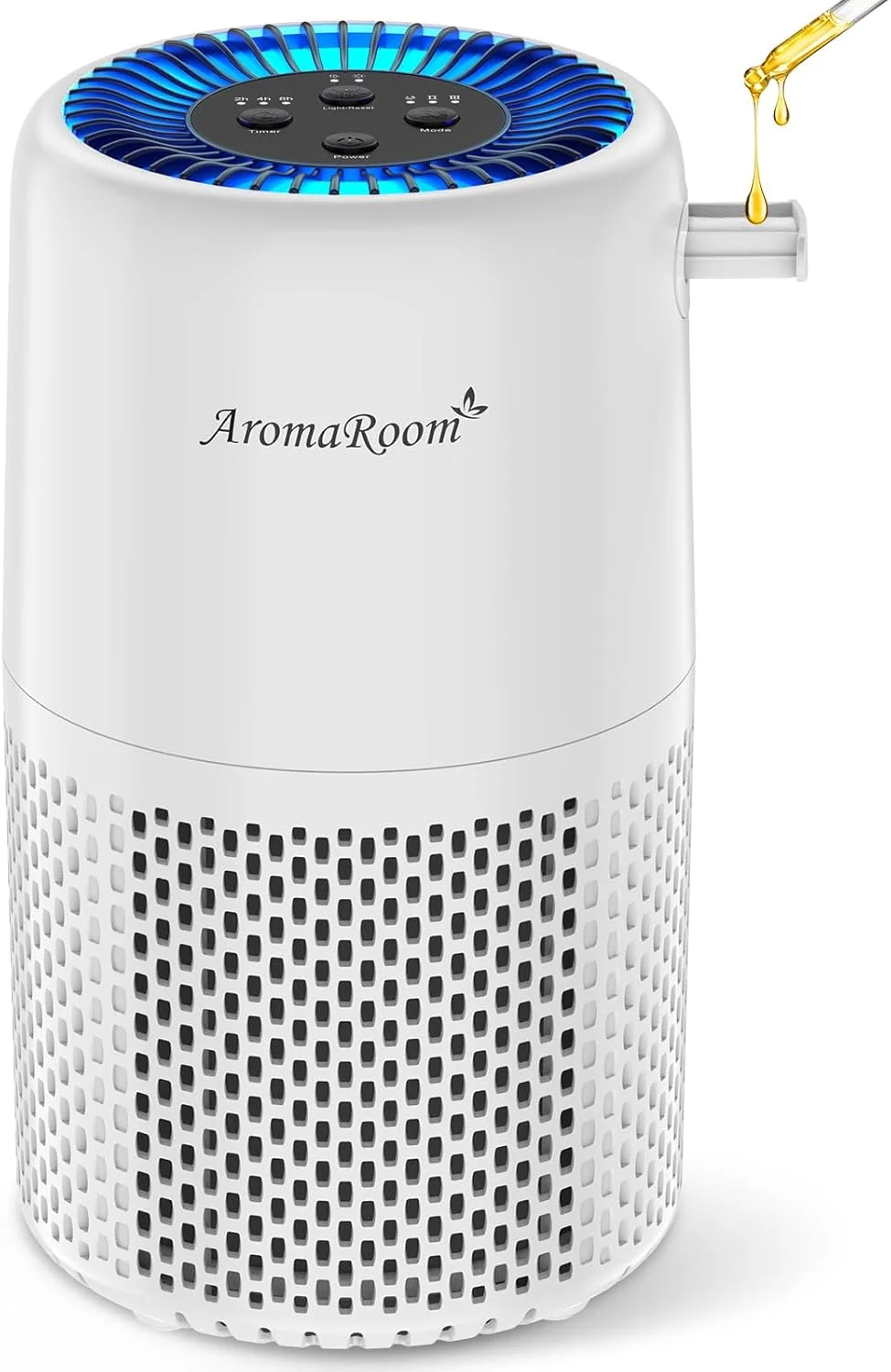
AromaRoom is a bedroom-focused air purifier brand whose distinguishing feature is an integrated aroma pad — a slot on the unit that accepts a few drops of essential oil, allowing the airflow from the purifier to carry a mild fragrance through the room. The essential oil does not contact the HEPA or carbon filter media; the aroma pad is a separate bypass feature. This gives the AP103-A dual functionality as an air cleaner and an ambient diffuser, which suits buyers who want both in a single bedside unit.
The AP103-A is a personal space purifier, not a large-room unit. Its CADR of 32.4 CFM (55 m³/h) is sized for bedrooms, nurseries, baby rooms, and small offices — spaces up to approximately 80–123 sq ft depending on the ACH standard applied. Buyers expecting the AP103-A to cover a living room or open-plan space will be disappointed. Its design brief is a bedside table or desk-top unit that operates nearly silently (22 dB in sleep mode) and delivers clean air in the immediate sleeping environment.
The 3-in-1 H13 HEPA filter captures fine allergens including pet dander, pollen, dust mite particles, mold spores, and PM2.5. The activated carbon layer within the same filter assembly handles odors and mild VOC adsorption, although the thin carbon layer in a filter this size has lower total adsorption capacity than the carbon layers in larger units. For pet odor or cooking smell management in a larger room, the AP103-A is not the appropriate tool.
For a broader look at AromaRoom's product lineup, see our AromaRoom brand review.
AromaRoom — Quick Comparison
| Purifier | CADR Smoke | CADR Dust | Room Size | Filter | Score |
|---|---|---|---|---|---|
| AromaRoom AP103-A Air Purifier for Bedroom | 646 sq ft | H13 HEPA + Activated Carbon | 7.5/10 |
📅 Prices checked . Amazon prices change frequently — click through for current price. Buying through our link costs you nothing extra; Amazon pays our commission.
AromaRoom AP103-A Air Purifier for Bedroom Review
Not AHAM VerifiedOur Verdict
Key Specifications
- Room Coverage
- 646 sq ft
- CADR
- Not AHAM verified — Manufacturer self-reported — not AHAM verified
- Filter
- H13 HEPA + Activated Carbon
- Noise
- 22 dB
- Power
- watts
- Best For
- Budget bedroom use, pet hair and dander. H13 HEPA at under $30 with coupon.
📅 Prices checked . Amazon prices change frequently — click through for current price. Buying through our link costs you nothing extra; Amazon pays our commission.
Pros
- 558 verified reviews
- H13 HEPA
- 3-in-1 filtration
- Under $30 with deal
- Pet-optimized
Cons
- Not AHAM CADR verified
- Bedroom-only coverage
- Lesser-known brand
Best For
The AromaRoom AP103-A is the right pick for buyers who want a quiet bedroom purifier with H13 HEPA at the lowest possible price and appreciate the optional essential oil diffuser feature. At $29–$55, it is one of the most affordable H13 HEPA options available. It is genuinely well-suited to a single bedroom, nursery, or small home office up to about 100–120 sq ft. Skip it if your room is larger than 150 sq ft — the 32 CFM CADR simply cannot deliver adequate air changes per hour in larger spaces. Also skip it if pet odor management is the primary concern — the thin carbon layer is appropriate for mild odors in a small space, not heavy pet smell in a larger area.
📅 Price checked August 2026 · Buying through this link costs you nothing extra — Amazon covers our commission
What to Know Before You Buy
The Aroma Pad: What It Does and Doesn't Do
The AromaRoom AP103-A includes a fragrance pad slot — a small cavity separate from the filtration stack where you can apply 2–3 drops of essential oil (not included). As the fan draws air through the unit, a portion passes near the pad, picking up the fragrance and distributing it through the room. The key point: the essential oil does not contact the HEPA or carbon filter media. This means fragrance use does not contaminate or degrade the filter, and you can use or skip the aroma feature without affecting air purification performance. The pad is removable and washable.
H13 HEPA Grade at This Price Point
H13 HEPA (99.95% particle capture efficiency at 0.3 microns under EU standards, or 99.97% at 0.3 microns under US True HEPA standards) in a sub-$55 purifier is genuinely valuable. Most budget purifiers in this price range use standard HEPA (95–99% efficiency) or HEPA-type filters that are not independently graded. H13 in the AP103-A means real fine-particle performance — meaningful for pollen, dust mite allergens, pet dander, and PM2.5 in a bedroom sleeping environment.
Filter Replacement
The 3-in-1 H13 HEPA filter replaces every 3–6 months depending on usage and environment. The AP103-A is a small unit with a compact filter — the filter assembly replaces as a single unit including pre-filter, HEPA, and carbon layers. Replacement 2-packs are available through Amazon (search AromaRoom AP103 filter) at approximately $15–$20 for two filters, making annual cost roughly $15–$20 if replaced every 6 months or $30–$40 at the 3-month interval.
CADR and Coverage: A Personal Space Purifier
The AromaRoom AP103-A has a CADR of 32.4 CFM (55 m³/h) — manufacturer-stated. At AHAM's 4.8 ACH allergen-relief standard with 8-foot ceilings, CADR 32 covers approximately 80 sq ft. The manufacturer rates it at 123 sq ft at 2 ACH, which is a reasonable general air quality figure for a small bedroom.
In practice, the AP103-A is best understood as a personal zone purifier: it delivers clean air effectively in the 6–8 foot zone immediately around the unit. Placed on a bedside table or desk, it cleans the air where you breathe during sleep or work. For a standard 10×12 ft bedroom (120 sq ft), the AP103-A will produce meaningful particle reduction over time — cleaner than no purifier — but won't match the performance of a 150+ CFM unit in the same room.
For rooms at or under 100 sq ft (a nursery, small studio bedroom, or home office alcove), the AP103-A is appropriately sized and delivers 3–4 ACH, sufficient for general allergen reduction.
3-in-1 H13 HEPA Filter System
The AP103-A's 3-in-1 filter combines three filtration layers in a single replaceable unit: a pre-filter mesh, an H13 True HEPA layer, and an activated carbon layer. H13 HEPA captures 99.97% of particles at 0.3 microns — the full True HEPA standard — removing pollen (10–100 microns), pet dander (5–10 microns), dust mite allergen particles (1–10 microns), mold spores (3–12 microns), and fine PM2.5 particulate matter.
The activated carbon layer in a filter this size has modest total adsorption capacity — sufficient for mild odors (a small amount of pet smell, light cooking odor) in a bedroom, but not heavy odor loads. For strong or persistent odors from pets or cooking, a purifier with a dedicated, heavier carbon layer is more appropriate.
The filter replaces as a complete assembly every 3–6 months. Replacement 2-packs cost approximately $15–$20 on Amazon, making the annual filter cost approximately $15–$40 depending on replacement frequency.
Noise Levels and Sleep Mode
The AP103-A operates at 22 dB in sleep mode — one of the quietest readings in the bedroom purifier category. At 22 dB, the unit is effectively inaudible against ambient bedroom noise (rustling bedding, a fan, HVAC) in typical sleep environments. Higher fan speeds are louder; the unit has multiple speed settings above sleep mode for daytime operation when you want more airflow.
Sleep mode typically locks the unit to the lowest fan speed and dims or disables the indicator LEDs for dark-room sleeping. The 22 dB rating makes the AP103-A genuinely suitable for the lightest sleepers, parents of newborns, or anyone who finds white noise from larger units disruptive.
AromaRoom AP103-A CADR, ACH, and Room Coverage — What the Numbers Mean
CADR (Clean Air Delivery Rate) measures how many cubic feet of filtered air the purifier delivers per minute. The AP103-A carries a CADR of 32.4 CFM — manufacturer-stated, not AHAM-verified. At the AHAM-recommended 4.8 air changes per hour with 8-foot ceilings, this CADR covers rooms up to approximately 80 sq ft. The manufacturer's 123 sq ft rating assumes 2 ACH, a reasonable figure for general air quality but below the allergen-relief threshold used in clinical studies.
Placement makes a measurable difference at this output level. Positioned on a bedside table within 4–6 feet of the sleeping zone, the AP103-A delivers clean air directly where it is needed during sleep without needing to turn over the entire room volume. For allergy or asthma sufferers, targeting 4.8 ACH in a sub-80 sq ft space — a nursery, small studio bedroom, or home office alcove — is the right sizing discipline. In rooms up to 120 sq ft, the unit still provides meaningful particle reduction, just at fewer air changes per hour.
Within the sub-$60 personal-space purifier segment, the AP103-A's 32.4 CFM CADR is on the modest side. The Levoit Core 200S (CADR 95 CFM, ~$60) and the Winix AM90 (CADR 218 CFM, ~$150) serve larger rooms but operate at higher noise levels and power consumption. The AP103-A's niche is the ultra-quiet bedroom companion under 100 sq ft where the 22 dB sleep mode is the overriding priority — no comparably priced unit pairs H13 HEPA with sub-25 dB operation.
AromaRoom AP103-A 3-Year Total Cost of Ownership — vs Levoit Core 200S and Winix AM90
Owning an air purifier means paying for filters and electricity long after the purchase price is forgotten. The table below calculates the true 3-year cost for the AP103-A against two alternatives, using filter replacement every 6 months and electricity at $0.17/kWh running 12 hours per day. The AP103-A's wattage is estimated at 8W based on units of this class — AromaRoom does not publish a wattage figure.
| Model | Purchase | Filters (3 yr) | Electricity (3 yr) | 3-Year Total | CADR | WiFi |
|---|---|---|---|---|---|---|
| AromaRoom AP103-A | $42 | $90 | $18 | $150 | 32 CFM | No |
| Levoit Core 200S | $60 | $108 | $23 | $191 | 95 CFM | Yes |
| Winix AM90 | $150 | $135 | $86 | $371 | 218 CFM | Yes |
The AP103-A's 3-year cost of roughly $150 is the lowest in this comparison. The $41 gap versus the Levoit Core 200S buys 3× the CADR and WiFi control — a meaningful trade-off if the room exceeds 100 sq ft. But in a dedicated sub-80 sq ft bedroom sleeping environment where noise is the primary constraint, the extra CADR does not produce better sleep-time air quality if higher fan speeds are needed.
The Winix AM90 illustrates the cost structure of genuine living-room coverage: 3-year ownership climbs to $371, driven by purchase price and higher wattage. If your bedroom is 150 sq ft or above, the AM90's 218 CFM CADR at that 3-year figure delivers far more air changes per hour than the AP103-A can manage, and the cost per cubic foot of clean air delivered is actually competitive despite the higher sticker price.