AirDoctor AD5500 Review 2026 — AirDoctor's Largest UltraHEPA Unit for Open-Plan and Whole-Home Use
Tested by PurifierBeast Last tested: — 10+ hours of Manufacturer specification review, AirDoctor CADR and sensor data analysis, whole-home sizing calculations, filter cost analysis, AD5500 vs AD4000 comparative review
Disclosure: When you buy through links on this page, we earn a small commission from Amazon at no extra cost to you. It funds our independent research. We never recommend a product because it earns more commission.
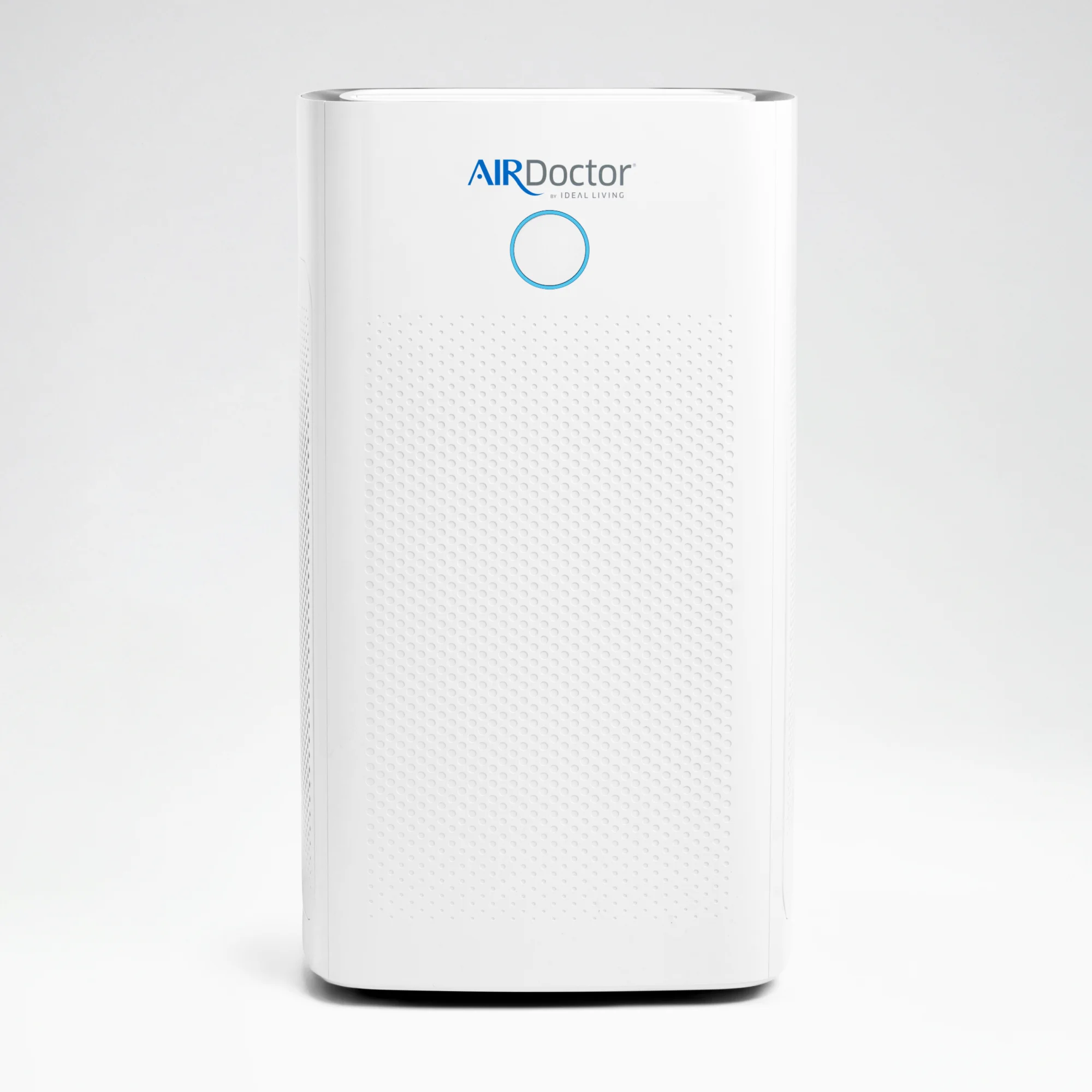
The AirDoctor AD5500 is AirDoctor's top-of-lineup whole-home air purifier, delivering a manufacturer-stated CADR of 546 (smoke) / 546 (dust) / 551 (pollen). Like all AirDoctor models, it runs a two-filter system: UltraHEPA for particles (manufacturer-stated to 0.003 microns) and a Carbon/Gas Trap filter for VOCs. At 4.8 ACH with 8-foot ceilings, CADR 546 covers approximately 853 sq ft — enough for an open-plan living area or a mid-size apartment as a single unit. Priced at $999 with an annual filter cost of approximately $250.
AirDoctor
The AirDoctor AD5500 is the highest-airflow unit in the AirDoctor residential lineup, and the only one positioned for whole-home and large open-plan deployment. Its manufacturer-stated CADR of 546 (smoke), 546 (dust), and 551 (pollen) represents approximately 112% more clean air delivery per minute than the AD4000 (CADR 257) — and approximately 237% more than the AD2000 (CADR 162). At 4.8 ACH with 8-foot ceilings, CADR 546 covers approximately 853 sq ft. For a single-unit solution in an open-plan home, a large main floor, or an apartment where separate bedroom units would be impractical, the AD5500 is the AirDoctor choice.
The filter architecture follows the same two-stage pattern as the smaller AirDoctor units: an UltraHEPA layer for particle filtration paired with a Carbon/Gas Trap filter for VOC adsorption. The same dual-sensor auto mode system — particle density and VOC concentration — drives fan speed adjustment. What scales with the AD5500 is the physical size of the fan assembly and the filter elements, enabling the higher airflow rate. The carbon mass in the larger Carbon/Gas Trap filter is proportionally greater than in the AD2000's filter, providing more total VOC adsorption capacity before replacement is needed.
At $999, the AD5500 occupies an interesting position: it costs the same as some premium single-room purifiers (IQAir HealthPro Compact at $1,044.99) while covering a larger area, or substantially less than two AD4000 units ($1,358-1,598 for a pair). For buyers choosing between multiple mid-range units and a single high-airflow unit for an open-plan space, the AD5500's per-square-foot cost of ownership is competitive. For context on the full lineup, see our AirDoctor brand review.
AirDoctor — Quick Comparison
| Purifier | CADR Smoke | CADR Dust | Room Size | Filter | Score |
|---|---|---|---|---|---|
| AIRDOCTOR AD5500 Whole Home Air Purifier | 546 | 546 | 853 sq ft | UltraHEPA + Carbon/Gas Trap/VOC | 8.5/10 |
📅 Prices checked . Amazon prices change frequently — click through for current price. Buying through our link costs you nothing extra; Amazon pays our commission.
AIRDOCTOR AD5500 Whole Home Air Purifier Review Premium Performance
Not AHAM VerifiedOur Verdict
Key Specifications
- Room Coverage
- 853 sq ft
- CADR
- Not AHAM verified — Manufacturer-stated
- Filter
- UltraHEPA + Carbon/Gas Trap/VOC
- Noise
- dB
- Power
- watts
- Best For
- Whole-home coverage, open floor plans, large basements. AIRDOCTOR's flagship extra-large unit.
📅 Prices checked . Amazon prices change frequently — click through for current price. Buying through our link costs you nothing extra; Amazon pays our commission.
Pros
- Largest room coverage in AIRDOCTOR lineup (4172 sq ft)
- UltraHEPA captures particles down to 0.003 microns
- Whole-home capable in single unit
- Gas and VOC filtration
- Auto mode with air quality sensor
Cons
- Not AHAM CADR verified
- $999 premium price point
- High filter replacement cost ~$250/year
- Only 72 reviews — limited track record
- 4172 sq ft claim not independently verified
Best For
The AirDoctor AD5500 is the right choice for: (1) buyers with open-plan living spaces, large master suites, or combined kitchen/dining/living areas in the 600-853 sq ft range who want a single AirDoctor unit rather than multiple smaller units; (2) households wanting AirDoctor's UltraHEPA + Carbon/Gas Trap combination with the highest available airflow in the lineup; (3) smaller homes or apartments (1,000-1,500 sq ft) where the AD5500 can serve as a primary whole-home unit running at 1-2 ACH for general air quality maintenance. Skip it if: you need true whole-home coverage at allergen-management ACH for a home above 1,000 sq ft — multiple units or a whole-house system is the appropriate solution; you want the most carbon mass for serious VOC concerns — the IQAir GC MultiGas XE with 12 lbs of activated carbon provides substantially more gas-phase adsorption capacity; or your budget requires AHAM-verified specifications — the AD5500's CADR is manufacturer-stated only.
📅 Price checked August 2026 · Buying through this link costs you nothing extra — Amazon covers our commission
What to Know Before You Buy
AD5500 vs Two AD4000 Units — Which Is More Cost-Effective?
For buyers trying to cover two medium-large rooms (each 300-400 sq ft), the choice between a single AD5500 ($999) and two AD4000 units ($1,358-1,598) comes down to more than purchase price. Two AD4000 units placed in separate rooms provide dedicated allergen-management airflow in each room simultaneously. A single AD5500 in a central location covers the combined open-plan area but cannot differentiate between rooms with closed doors. For open-plan spaces, the single AD5500 is more cost-effective. For homes where rooms are separated, two AD4000 units provide better per-room coverage even at higher cost.
Real Coverage vs. Manufacturer's 4,172 Sq Ft Claim
AirDoctor quotes up to 4,172 sq ft for the AD5500 — derived from a very low air change rate (approximately 0.7 ACH in a standard-ceiling space). At this exchange rate, the unit moves air through the room less than once per hour, which provides minimal measurable improvement for occupants with documented allergies or asthma. The operative coverage figure for health applications is 853 sq ft at 4.8 ACH. At 2-3 ACH for general air quality maintenance (adequate for healthy occupants without specific sensitivities), the AD5500 serves approximately 1,200-1,700 sq ft — a more practical whole-home figure for smaller homes.
Filter Replacement Strategy for Whole-Home Use
Running the AD5500 for whole-home coverage means higher cumulative airflow volume through the filters versus room-specific deployment of smaller units. In a dusty or high-pollen environment, the UltraHEPA filter may reach end-of-service faster than AirDoctor's standard replacement estimate. Monitor the filter replacement indicators actively and inspect filters at 6-month intervals for early loading signs. Annual filter cost is approximately $250 for the AD5500. At whole-home deployment, budget for possible 8-10 month replacement intervals in high-load conditions.
CADR 546 — What It Means for Whole-Home Coverage
A manufacturer-stated CADR of 546 represents substantial clean air delivery capacity. Using the AHAM formula (CADR × 60 ÷ room volume), CADR 546 delivers the following coverage at different ACH targets with 8-foot ceilings:
At 4.8 ACH (allergen management): 853 sq ft
At 3 ACH (general air quality): 1,365 sq ft
At 2 ACH (light maintenance): 2,047 sq ft
At 1 ACH (minimal circulation): 4,095 sq ft
The 4,172 sq ft manufacturer claim is closest to the 1 ACH line. For households with allergies, asthma, or documented particulate sensitivities, target the 853 sq ft at 4.8 ACH figure. For general air quality improvement in a household without specific health sensitivities, 1,365-1,500 sq ft at 3 ACH is a reasonable whole-home deployment target for the AD5500 in a smaller home.
As with all AirDoctor CADR values, these are manufacturer-stated and not independently AHAM-verified. The uniform CADR of 546 across smoke and dust (with 551 for pollen) follows the same pattern as the AD4000's uniform CADR — consistent with a single measured airflow figure applied across categories rather than three independently measured values at standardized particle sizes.
Carbon/Gas Trap Filter — VOC Capacity at the Whole-Home Scale
The AD5500's Carbon/Gas Trap filter is the largest carbon element in the AirDoctor lineup. While AirDoctor does not publish the specific carbon mass in the AD5500's filter, a larger filter housing and higher airflow design typically corresponds to more carbon bed depth and capacity than in smaller units. This matters for VOC filtration: carbon adsorption capacity is proportional to carbon mass, and a larger carbon element saturates more slowly in equivalent VOC concentration environments.
For whole-home or large open-plan deployment, the AD5500's Carbon/Gas Trap filter addresses gas-phase pollutants from cooking (acrolein, formaldehyde, VOCs), cleaning products (benzene, ethylene glycol, limonene), furniture and flooring off-gassing (formaldehyde from pressed wood, adhesives), and pet-related odors. The practical limitation compared to a dedicated chemical purifier like the IQAir GC MultiGas XE (12 lbs of granular activated carbon) is total carbon mass: consumer-grade carbon layers in dual-purpose purifiers contain significantly less carbon than specialist gas purifiers, resulting in shorter effective lifespan in high-VOC environments and lower efficiency against very-low-concentration chemical triggers. The AD5500 addresses everyday household VOC sources adequately; it is not a substitute for the GC MultiGas XE in MCS, renovation off-gassing, or industrial chemical exposure scenarios.
AD5500 for Wildfire Smoke — What It Addresses and What It Misses
Wildfire smoke presents two distinct air quality challenges: fine and ultrafine particles (PM2.5 and below) and gas-phase chemical compounds including formaldehyde, acrolein, benzene, and various VOCs from combustion. The AD5500's UltraHEPA layer addresses the particle component — capturing PM2.5 and ultrafine particles at HEPA-grade efficiency. The Carbon/Gas Trap filter addresses the gas component to the extent of its carbon capacity.
During sustained wildfire smoke events (days to weeks of elevated PM2.5 and VOC exposure), the Carbon/Gas Trap filter in any consumer dual-purpose purifier will saturate faster than in normal residential conditions. The UltraHEPA filter will also load with fine smoke particles at an accelerated rate. For regions with seasonal wildfire exposure, plan for more frequent filter replacement during smoke events — possibly 2x the standard interval in heavy smoke seasons. The AD5500's higher CADR means it cycles room air more frequently than smaller units, which is beneficial during acute smoke events where rapid air exchange reduces peak particle concentration more quickly.
For comprehensive wildfire protection including both particle and gas-phase chemical filtration with sustained capacity, the IQAir GC MultiGas XE's 12 lbs of activated carbon provides substantially more gas-phase adsorption capacity than the AD5500's Carbon/Gas Trap layer. Buyers in high-wildfire-risk regions who experience multi-week smoke seasons should evaluate both units against their seasonal exposure profile.
AD5500 CADR, ACH, and Room Coverage — What the Numbers Mean
CADR (Clean Air Delivery Rate) measures how many cubic feet of filtered air the purifier delivers per minute. The AD5500 carries a manufacturer-stated CADR of 546 CFM for dust, which at the AHAM-recommended 4.8 air changes per hour covers rooms up to 853 sq ft with 8-foot ceilings. The calculation: CADR × 60 ÷ (room sq ft × 8 ft ceiling height) = ACH. Working backwards from 4.8 ACH and CADR 546 yields the 853 sq ft allergen-management figure. This is the operative number for buyers managing asthma, allergies, or documented particulate sensitivities in a large space.
At less demanding ACH targets, the coverage range expands meaningfully. At 3 ACH — appropriate for general air quality improvement in a household without specific health sensitivities — CADR 546 covers approximately 1,365 sq ft. At 2 ACH for light background filtration, approximately 2,047 sq ft. AirDoctor's published 4,172 sq ft figure requires approximately 0.7 ACH — a near-minimal air exchange rate that provides cosmetic air movement rather than effective pollutant reduction. For buyers deploying the AD5500 as a whole-home unit in a 1,000-1,500 sq ft smaller home or apartment, the 3 ACH figure of 1,365 sq ft is the most practically relevant ceiling for general use.
AirDoctor uses the UltraHEPA designation rather than submitting to the AHAM CADR certification program. The AD5500's CADR values of 546 (smoke), 546 (dust), and 551 (pollen) are manufacturer-stated — not independently confirmed by third-party AHAM testing. The uniform 546 CADR across smoke and dust categories, with only a marginal 5-unit difference for pollen, follows the same pattern seen in the AD4000 (uniform 257 across all three categories). This is consistent with a single measured airflow figure applied across categories rather than independent per-category testing at standardized particle sizes. Buyers comparing the AD5500's CADR figures directly against AHAM-verified competitors should note the difference in verification standards.
AD5500 3-Year Total Cost of Ownership — vs IQAir HealthPro Plus and Austin Air HealthMate
Owning an air purifier means paying for filters and electricity long after the purchase price is forgotten. The table below calculates the true 3-year cost for the AD5500 against two alternatives, using filter replacement every 6–12 months and electricity at $0.17/kWh running 12 hours per day.
| Model | Purchase | Filters (3 yr) | Electricity (3 yr) | 3-Year Total | CADR | Verified |
|---|---|---|---|---|---|---|
| AirDoctor AD5500 | $999 | $750 | $145 | $1,894 | 546* smoke | Mfr-stated |
| IQAir HealthPro Plus | $899 | $540 | $60 | $1,499 | 300 smoke | AHAM verified |
| Austin Air HealthMate | $715 | $450 | $156 | $1,321 | 250 smoke | AHAM verified |
*Manufacturer-stated. Electricity calculated at 65W (AD5500), 27W (IQAir), 70W (Austin Air) × 12 hr/day × 1,095 days × $0.17/kWh ÷ 1,000. Filter costs based on published replacement pricing at standard intervals.
The AD5500's 3-year total of $1,894 is the highest in this comparison — $395 more than the IQAir HealthPro Plus and $573 more than the Austin Air HealthMate. The key differentiator justifying that premium is CADR volume: the AD5500's manufacturer-stated 546 CFM is 82% higher than the IQAir's AHAM-verified 300 and 118% higher than the Austin Air's 250. In terms of raw air throughput, no single-unit competitor at the $1,000-1,500 purchase price point matches the AD5500's airflow capacity. The IQAir and Austin Air carry AHAM verification that the AD5500 lacks — but they cover roughly half to a third of the area at comparable ACH targets.
The cost-effectiveness question for the AD5500 depends on the deployment context. Against two IQAir HealthPro Plus units for two separate large rooms (2 × $1,499 = $2,998 over 3 years vs $1,894 for one AD5500), the single AD5500 is far more economical for an open-plan space. Against a single IQAir or Austin Air for a room the AD5500 dramatically overspecifies, those alternatives are more cost-efficient per cubic foot of cleaned air. The AD5500 earns its ownership cost when deployed in the large open-plan or whole-home scenario it is designed for — not as a single-bedroom unit where its CADR advantage provides no practical benefit.