AirDoctor AD4000 Review 2026 — Larger Rooms and Open-Plan Spaces with UltraHEPA Filtration
Tested by PurifierBeast Last tested: — 10+ hours of Manufacturer specification review, AirDoctor published CADR and sensor data, filter cost analysis, UltraHEPA claim context, lineup comparison across AD2000/AD4000/AD5500
Disclosure: When you buy through links on this page, we earn a small commission from Amazon at no extra cost to you. It funds our independent research. We never recommend a product because it earns more commission.
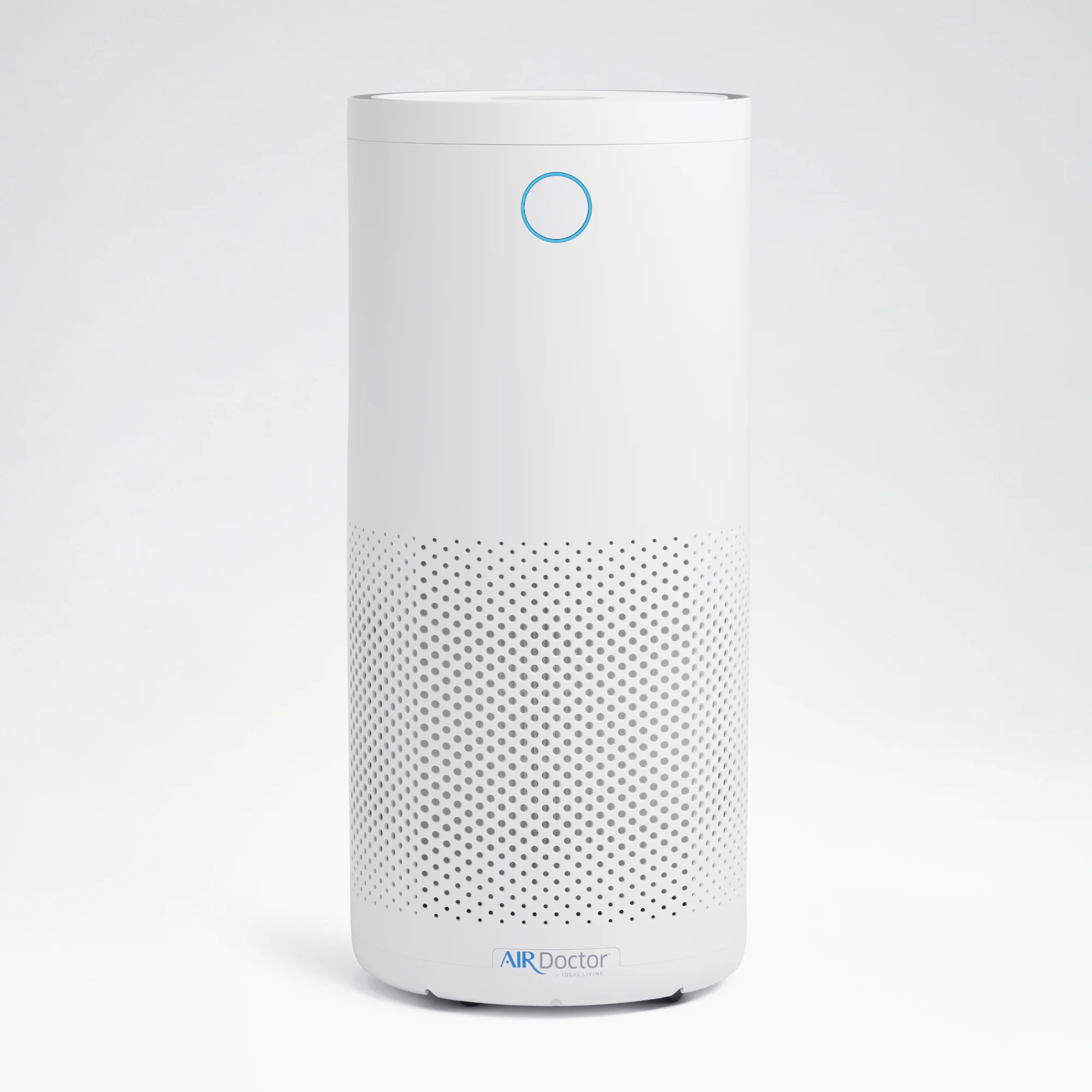
The AirDoctor AD4000 is AirDoctor's mid-range unit, stepping up from the AD2000 with a manufacturer-stated CADR 257 (smoke/dust/pollen) and 75W power draw. It runs the same two-filter architecture as the AD2000 — UltraHEPA (manufacturer-stated to 0.003 microns) + Carbon/Gas Trap — with dual particle and VOC sensors driving an auto mode. Covers approximately 402 sq ft at 4.8 ACH allergen-management standard (8-foot ceilings). Priced at $679–$799. The right AirDoctor unit for large bedrooms, master suites, living rooms, and finished basements where the AD2000 would underperform on air change rate.
AirDoctor
The AirDoctor AD4000 is the middle unit in AirDoctor's three-model residential lineup, positioned between the compact AD2000 and the whole-home AD5500. With a manufacturer-stated CADR of 257 across smoke, dust, and pollen categories, the AD4000 delivers approximately 58% more clean air per minute than the AD2000 (CADR 162) in a unit that runs at 75W peak versus the AD2000's 55W. This translates directly to more coverage: at 4.8 ACH with 8-foot ceilings, CADR 257 covers approximately 402 sq ft — enough for large master bedrooms, dedicated living rooms, and finished basements where the AD2000 would fall short of allergen-management air change rates.
The filter architecture is identical to the AD2000: a two-stage system pairing the UltraHEPA particle filter with a Carbon/Gas Trap VOC filter. Both units use dual sensor arrays — particle density and VOC concentration — to drive auto mode fan speed adjustment. The AD4000's physical size and fan capacity are larger to achieve the higher airflow, but the control interface, sensor logic, and filter technology are shared across the lineup. This means buyers moving from an AD2000 to an AD4000 gain coverage area and airflow without learning a different control system or filter replacement procedure.
AirDoctor quotes the AD4000 at up to 2,776 sq ft — a manufacturer coverage claim based on a very low air change rate, not the 4.8 ACH threshold used in clinical allergen studies. For sizing purposes, the 402 sq ft figure at 4.8 ACH is the relevant number for buyers managing allergies, asthma, or documented air quality concerns. At 2-3 ACH for general air quality, the practical range extends to approximately 600-700 sq ft. See our full AirDoctor lineup review for a side-by-side comparison of all three models.
AirDoctor — Quick Comparison
| Purifier | CADR Smoke | CADR Dust | Room Size | Filter | Score |
|---|---|---|---|---|---|
| AIRDOCTOR AD4000 Air Purifier | 257 | 257 | 402 sq ft | UltraHEPA + Carbon/Gas Trap/VOC | 8.4/10 |
📅 Prices checked . Amazon prices change frequently — click through for current price. Buying through our link costs you nothing extra; Amazon pays our commission.
AIRDOCTOR AD4000 Air Purifier Review Premium Performance
Not AHAM VerifiedOur Verdict
Key Specifications
- Room Coverage
- 402 sq ft
- CADR
- Not AHAM verified — Manufacturer-stated
- Filter
- UltraHEPA + Carbon/Gas Trap/VOC
- Noise
- 30 dB
- Power
- 75 watts
- Best For
- Large rooms, basements, open plans. Ultra-fine particle capture including VOCs and gases.
📅 Prices checked . Amazon prices change frequently — click through for current price. Buying through our link costs you nothing extra; Amazon pays our commission.
Pros
- UltraHEPA captures 0.003 micron particles
- Covers basements and large open spaces
- Auto mode with air quality sensor
- Gas and VOC filtration
- Strong AIRDOCTOR build quality
Cons
- Not AHAM CADR verified
- $679-799 premium price
- High filter replacement cost ~$200/year
- Only 58 reviews — limited track record
Best For
The AirDoctor AD4000 is the right choice for: (1) buyers with large bedrooms, living rooms, or finished basements in the 300-600 sq ft range where the AD2000 would provide insufficient ACH for allergen management; (2) buyers who want AirDoctor's UltraHEPA + Carbon/Gas Trap combination at the mid-range airflow tier; (3) open-plan spaces where a single unit needs to serve a combined kitchen/dining/living area rather than a dedicated single room. Skip it if: your primary space exceeds 700 sq ft and allergen management is the goal — step up to the AD5500 (CADR 546) for whole-home or large open-plan coverage; your budget is tight — AHAM-verified units in the $300-400 range deliver comparable or higher independently verified CADR at lower cost; or you need large-mass carbon filtration for serious VOC concerns — the AD4000's carbon layer is limited in mass versus dedicated VOC purifiers.
📅 Price checked August 2026 · Buying through this link costs you nothing extra — Amazon covers our commission
What to Know Before You Buy
AD4000 vs AD2000 — Making the Right Choice on Coverage
The core decision between the AD2000 and AD4000 is room size. At 4.8 ACH with 8-foot ceilings, the AD2000 (CADR 162) covers 253 sq ft and the AD4000 (CADR 257) covers 402 sq ft. If your room is a standard 12×20 bedroom (240 sq ft), the AD2000 is sufficient. If your room is a 15×25 master bedroom (375 sq ft) or a combined living/dining space, the AD4000 is the appropriate choice. The 58% CADR improvement costs approximately 51-78% more ($230-350 premium over the AD2000's $449). For buyers who are borderline — around 250-350 sq ft — the AD4000 provides meaningful headroom for running at lower fan speeds while maintaining adequate ACH, which reduces noise during sleep.
Understanding AirDoctor's 2,776 Sq Ft Coverage Claim
AirDoctor's stated coverage of up to 2,776 sq ft for the AD4000 is based on a very low air change rate — approximately once per hour in a high-ceilinged space. At 1 ACH, the unit circulates the room's air volume once every 60 minutes. Clinical studies on allergen reduction use 4-5 ACH as the threshold for meaningful symptom improvement. At 1 ACH, the unit runs but provides minimal air quality improvement for occupants with allergies or asthma. The 2,776 sq ft figure is technically derivable at 1 ACH but should not be used for allergen-management sizing. Use the 402 sq ft figure at 4.8 ACH as the operative coverage specification.
Filter Costs and Replacement Schedule
The AD4000 uses the same two-filter system as the AD2000 — UltraHEPA and Carbon/Gas Trap — with an annual filter cost of approximately $200. The larger unit's higher airflow means filters may load at a proportionally faster rate than the AD2000 in comparable environments. AirDoctor's filter replacement indicators signal when each filter reaches end-of-life. Total first-year cost of ownership: approximately $679-799 purchase price plus $200 in filters.
CADR 257 — Room Coverage Analysis
The AD4000's manufacturer-stated CADR of 257 across smoke, dust, and pollen is uniform — an unusual profile that typically indicates the stated values reflect a single measured airflow rate applied across categories rather than individually measured CADR at standardized particle sizes. AHAM-verified CADR values are separately measured at different particle sizes and commonly differ by category. AirDoctor's uniform 257 CADR across all three categories warrants noting: it is consistent with manufacturer-stated (not independently AHAM-verified) data.
At 4.8 ACH with 8-foot ceilings, CADR 257 covers approximately 402 sq ft. This is the allergen-management sizing threshold derived from the AHAM formula: (CADR × 60) ÷ (room sq ft × ceiling height) = ACH. At 3 ACH (adequate for general air quality improvement), CADR 257 covers approximately 643 sq ft. At 2 ACH (minimal general use), approximately 964 sq ft. The 2,776 sq ft manufacturer claim requires approximately 0.7 ACH — well below any established clinical effectiveness threshold.
For buyers selecting the AD4000 for a specific room: measure the room accurately and target 4-5 ACH for allergy or asthma management, or 2-3 ACH for general air quality. The 402 sq ft at 4.8 ACH figure is the operative ceiling for allergen relief applications.
Dual-Sensor Auto Mode — Particle and VOC Response
Like the AD2000, the AD4000 pairs a laser particle sensor with a dedicated VOC/gas sensor in its auto mode system. The particle sensor detects PM2.5 concentration in the circulated air stream; the VOC sensor detects chemical concentration changes from cooking, cleaning, off-gassing, and other gas-phase sources. When either sensor detects elevated concentrations above the auto mode threshold, fan speed increases to address the detected pollutant. When concentrations normalize, fan speed reduces — typically to the quieter lower speeds for continuous background filtration.
This dual-sensor architecture is practically meaningful in a household where both particle and chemical sources are present. A single-sensor unit (particle only) misses VOC spikes from dinner cooking, cleaning spray use, or candle burning. A single-sensor unit (VOC only) misses particle events from pet activity, vacuuming, or opened windows during high-pollen periods. The AD4000's system catches both categories and responds independently to each. The visible color-coded air quality indicator provides real-time feedback on sensor readings — useful for identifying when a specific activity elevates indoor air pollution and confirming when the unit has cleared it.
AD4000 vs AD5500 — When to Step Up to the Whole-Home Unit
The AirDoctor AD5500 is the top-of-lineup whole-home unit with a manufacturer-stated CADR of 546 (smoke/dust) and 551 (pollen) — approximately twice the AD4000's airflow capacity. At 4.8 ACH, the AD5500 covers approximately 853 sq ft, versus the AD4000's 402 sq ft. The AD5500 is priced at $999 versus the AD4000's $679-799.
Choose the AD4000 when your primary space is 350-600 sq ft and the $679-799 price point fits your budget. Choose the AD5500 when you need to cover a large open-plan living area above 600 sq ft at allergen-management ACH, or when a single unit needs to serve as a whole-home solution for a smaller home or apartment. The AD5500's approximately 113% higher CADR costs approximately 25-47% more than the AD4000, making the per-CADR cost more favorable at the AD5500 tier.
AD4000 CADR, ACH, and Room Coverage — What the Numbers Mean
CADR (Clean Air Delivery Rate) measures how many cubic feet of filtered air the purifier delivers per minute. The AD4000 carries a manufacturer-stated CADR of 257 CFM for dust, which at the AHAM-recommended 4.8 air changes per hour covers rooms up to 402 sq ft with 8-foot ceilings. The formula is straightforward: CADR × 60 ÷ (room sq ft × 8 ft) = ACH. At 4.8 ACH — the clinical threshold for meaningful allergen symptom reduction — CADR 257 maps to 402 sq ft.
At more relaxed ACH targets, coverage extends: 3 ACH for general air quality covers approximately 643 sq ft; 2 ACH for light maintenance covers approximately 964 sq ft. AirDoctor's published coverage claim of 2,776 sq ft for the AD4000 assumes approximately 0.7 ACH — well below any clinically recognized threshold for allergy or asthma relief. Buyers assessing the AD4000 for a specific health application should anchor on the 402 sq ft at 4.8 ACH figure, not the manufacturer headline. For a living room with no documented sensitivities, 600-700 sq ft at 2-3 ACH is a practical deployment range.
The AD4000's uniform manufacturer CADR of 257 across all three particle categories (smoke, dust, pollen) is unusual compared to AHAM-verified units, which typically return different values per category due to differences in particle density and size. A uniform CADR across categories is consistent with a single airflow measurement applied across categories rather than three independent chamber tests. AirDoctor's CADR values are manufacturer-stated and not confirmed by third-party AHAM certification — an important distinction when comparing the AD4000's CADR figures directly against AHAM-certified competitor specifications.
AD4000 3-Year Total Cost of Ownership — vs IQAir HealthPro Plus and Austin Air HealthMate
Owning an air purifier means paying for filters and electricity long after the purchase price is forgotten. The table below calculates the true 3-year cost for the AD4000 against two alternatives, using filter replacement every 6–12 months and electricity at $0.17/kWh running 12 hours per day.
| Model | Purchase | Filters (3 yr) | Electricity (3 yr) | 3-Year Total | CADR | Verified |
|---|---|---|---|---|---|---|
| AirDoctor AD4000 | $739 | $600 | $112 | $1,451 | 257* smoke | Mfr-stated |
| IQAir HealthPro Plus | $899 | $540 | $60 | $1,499 | 300 smoke | AHAM verified |
| Austin Air HealthMate | $715 | $450 | $156 | $1,321 | 250 smoke | AHAM verified |
*Manufacturer-stated. Electricity calculated at 50W (AD4000), 27W (IQAir), 70W (Austin Air) × 12 hr/day × 1,095 days × $0.17/kWh ÷ 1,000. Filter costs based on published replacement pricing at standard intervals.
The AD4000's 3-year total of $1,451 is nearly identical to the IQAir HealthPro Plus ($1,499) — but the IQAir carries a higher AHAM-verified CADR of 300 versus the AD4000's manufacturer-stated 257, and the IQAir's HyperHEPA filter is independently certified to 0.003 microns through a different testing program. The Austin Air HealthMate comes in $130 cheaper over three years at $1,321, with an AHAM-verified CADR of 250, and carries 15 lbs of activated carbon versus the AD4000's thinner Carbon/Gas Trap layer — a meaningful advantage for VOC and odor removal. The AD4000's unique strengths are its dual-sensor auto mode (the Austin Air has no auto mode) and its VOC sensor capability.
For buyers choosing between these three units: the AD4000's 3-year cost falls in the middle of this comparison. It costs more than the Austin Air over three years and slightly less than the IQAir. Neither competitor offers the dual particle-and-VOC sensor auto mode that the AD4000 provides. Buyers who value automated response to both particle and gas-phase events — without manual mode switching — will find the AD4000's sensor system a genuine differentiator. Buyers prioritizing maximum carbon mass for VOC removal, or AHAM-verified CADR, should look to the Austin Air or IQAir respectively.