Hathaspace HSP001 Review 2026 — 4-Stage HEPA for Bedrooms and Small Living Rooms
Tested by PurifierBeast Last tested: — 8+ hours of Manufacturer specification review, CARB certification database check, filter cost analysis, multi-source CADR cross-reference
Disclosure: When you buy through links on this page, we earn a small commission from Amazon at no extra cost to you. It funds our independent research. We never recommend a product because it earns more commission.
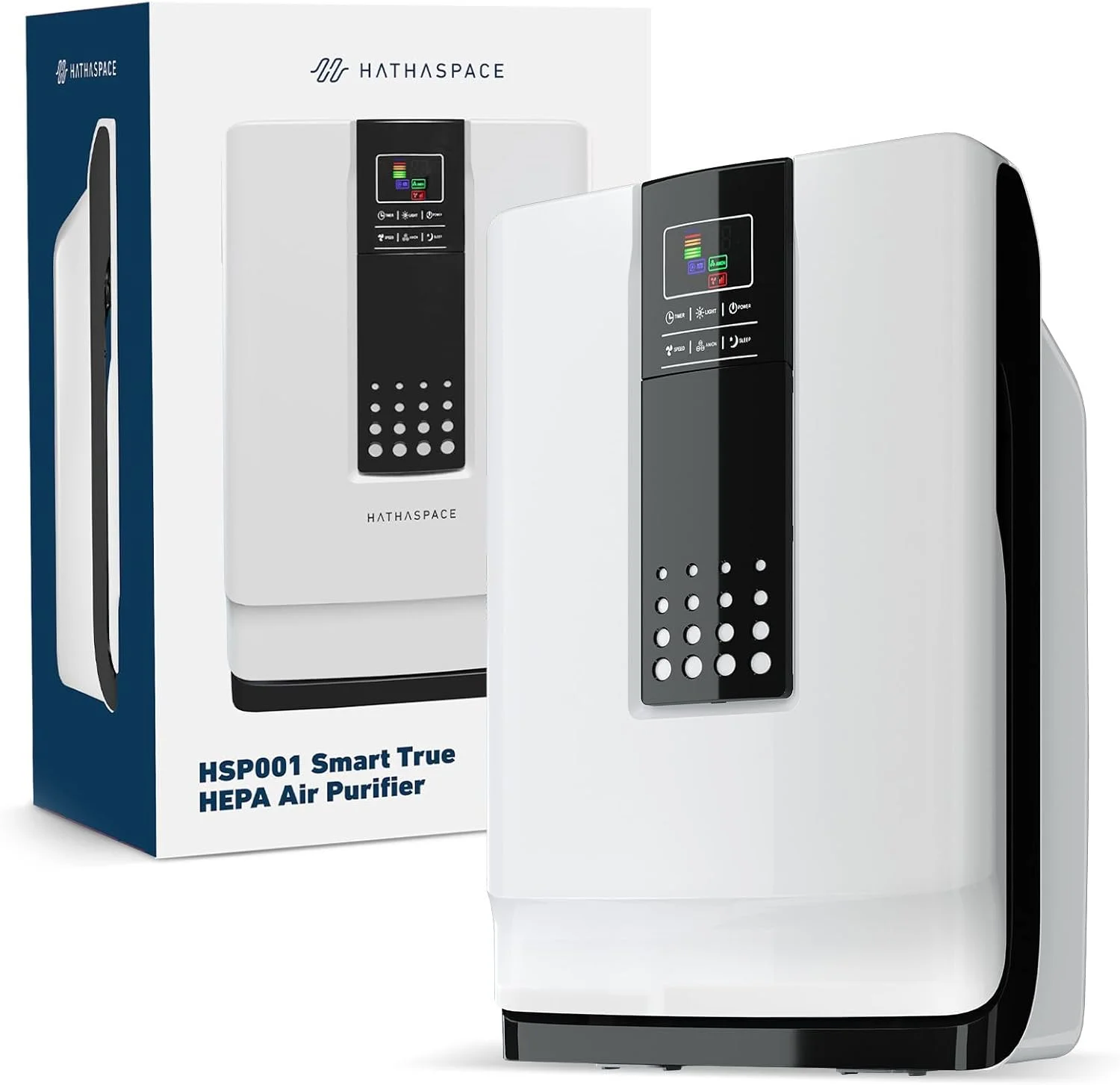
The Hathaspace HSP001 is a cylindrical tower air purifier from Hathaspace featuring a 4-stage filtration stack plus a switchable ionizer. It covers up to 700 sq ft per the manufacturer's claim, but at the AHAM 4.8 ACH allergen-relief standard, CADR ~160 CFM realistically cleans rooms up to about 250 sq ft. Price: $199. No WiFi or app control — operation is via a wired remote and front-panel buttons.
Hathaspace
Hathaspace is a small US-based brand that markets its HSP001 as a smart air purifier, though "smart" here means an integrated air quality sensor and auto mode — not WiFi, app control, or voice assistant support. The HSP001 runs on a wired remote and three manual fan speeds with an auto-mode that adjusts fan speed based on real-time particulate readings. That distinction matters before purchase.
Performance-wise, the HSP001 sits in disputed territory. Several independent reviewers put its true CADR around 100–160 CFM, against the manufacturer's 700 sq ft coverage claim. Doing the math: at 160 CFM CADR, you get 4.8 air changes per hour in approximately 250 sq ft (160 × 60 ÷ 8 ft ceiling ÷ 4.8 ACH). The 700 sq ft figure assumes roughly one air change per hour — not useful for allergen management. Plan your room match accordingly.
The four-stage filter stack — H13 HEPA, H11 pre-HEPA layer, cold catalyst panel, and honeycomb activated carbon block — is genuinely more thorough than a basic three-in-one filter. The cold catalyst layer targets formaldehyde and VOCs via a chemical reaction rather than just adsorption, which gives it an advantage in freshly painted rooms or spaces with new furniture off-gassing. Filter replacement is every 4 months at standard use, costing about $50 per set — budget roughly $150 per year. For the complete Hathaspace lineup, see our Hathaspace air purifier brand review.
Hathaspace — Quick Comparison
| Purifier | CADR Smoke | CADR Dust | Room Size | Filter | Score |
|---|---|---|---|---|---|
| Hathaspace HSP001 | 170 | 170 | 250 sq ft | 5-Stage True HEPA + Cold Catalyst + Activated Carbon + Pre-filter + Antibacterial | 7.4/10 |
📅 Prices checked . Amazon prices change frequently — click through for current price. Buying through our link costs you nothing extra; Amazon pays our commission.
Hathaspace HSP001 Review 5-Stage Value
Not AHAM VerifiedOur Verdict
Key Specifications
- Room Coverage
- 250 sq ft
- CADR
- Not AHAM verified — Manufacturer-stated
- Filter
- 5-Stage True HEPA + Cold Catalyst + Activated Carbon + Pre-filter + Antibacterial
- Noise
- 26 dB
- Power
- 45 watts
- Best For
- Quiet operation for medium rooms. 5-stage filtration. Good Amazon reviews but no AHAM verification.
📅 Prices checked . Amazon prices change frequently — click through for current price. Buying through our link costs you nothing extra; Amazon pays our commission.
Pros
- Very quiet 25.8dB on lowest
- 5-stage filtration system
- CARB, ETL, Energy Star certified
- Cold catalyst filter for VOCs
- Strong Amazon reviews
Cons
- NOT AHAM verified — no independent CADR
- Self-reported 700 sq ft unverified
- $180-250 mid-range for unverified claims
- Wattage not published
- Filter $60-100/year
Best For
The HSP001 suits buyers who want a multi-stage filtration system — particularly the cold catalyst layer for VOC and formaldehyde reduction — in a bedroom or home office under 250 sq ft. The auto mode with a built-in particle sensor is a genuine convenience: you don't need to guess when to run the unit on high. Skip it if you need WiFi or app control, need AHAM-verified performance numbers for an allergy or asthma management plan, or have a room larger than 300 sq ft. The filter cost of roughly $150/year is on the high side for a unit at this price — factor that in against the $199 purchase price.
📅 Price checked August 2026 · Buying through this link costs you nothing extra — Amazon covers our commission
What to Know Before You Buy
Match CADR to Your Room, Not the Marketing Claim
Hathaspace markets the HSP001 for rooms up to 700 sq ft, which assumes about one air change per hour. Clinical allergy and asthma research uses a minimum of 4–5 air changes per hour for meaningful particle reduction. At ~160 CFM CADR and 4.8 ACH, this unit is sized for rooms up to roughly 250 sq ft. Use it in the room it fits, not the room the packaging suggests.
Cold Catalyst vs. Activated Carbon
The HSP001's cold catalyst panel uses a titanium dioxide compound to break down formaldehyde and certain VOCs — a different mechanism than activated carbon adsorption. If your concern is a new renovation, new furniture, or a space with high VOC exposure, this layer adds real value. For general odor control from cooking or pets, the 300-gram activated carbon block does the heavy lifting. Both stages are included in the single replacement filter set ($50).
Ionizer: Use with Caution
The HSP001 includes a built-in ionizer that can be switched on or off independently of the fan. The CARB certification covers ozone emissions at legal limits, but ionizers can generate trace ozone and secondary pollutants in enclosed spaces. Turn it off during continuous occupied-room use, or use it in unoccupied rooms briefly and ventilate before returning.
Controls and Operation
The HSP001 has three fan speeds plus a Sleep mode and an Auto mode — five operating states total. Sleep mode locks the fan to its lowest setting and dims all indicator lights. Auto mode uses the onboard particulate matter sensor to step the fan up or down in response to detected air quality changes; when the sensor sees clean air, the fan drops to a quiet baseline, and when it detects elevated particles (dust, cooking smoke, pet activity) it ramps up without any manual input.
A wired remote provides access to all these functions from across the room. The remote covers fan speed, Auto mode toggle, Sleep mode, timer (1/2/4/8 hours), and ionizer on/off. There is no smartphone app, no WiFi radio, and no compatibility with Alexa or Google Assistant — the "smart" label on the box refers entirely to the auto-sensing function, not connected-home integration.
Physical buttons on the unit itself duplicate most remote functions. The unit also has a real-time air quality color ring — blue for clean, yellow for moderate, and red for poor — giving a quick visual status at a glance. A dedicated filter change indicator activates when the filter approaches the end of its recommended 4-month service life.
Filter System and Replacement
The HSP001 stacks four distinct filter materials in one housing. Outermost is a cold catalyst panel, which uses a chemical process to decompose formaldehyde, ammonia, benzene, and other TVOCs rather than just trapping them. Next is an H11 True HEPA layer that captures large particles before they load the primary filter. The core H13 True HEPA element captures 99.97% of particles 0.3 microns and larger — the standard range for dust mite allergens, pollen, pet dander, mold spores, and PM2.5. The innermost layer is a honeycomb-structured activated carbon block weighing approximately 300 grams, sized for meaningful odor and VOC adsorption rather than a token thin carbon sheet.
All four layers are sold as a single replacement set at $49.99–$54.99. Hathaspace recommends replacement every 4 months under typical use (roughly 12 hours per day). At two filter sets per year, annual filter cost runs approximately $100–$110. If you run the unit 24 hours a day, shorten the interval to about 3 months. The switchable ionizer does not have a separate consumable — it simply turns on and off electrically.
Note that the HSP001 carries CARB certification, which verifies that ozone emissions from the ionizer stay within California's strict limits. Some reviews cite additional certifications (ETL, UL, Energy Star), but those appear to apply to the HSP002 model, not the HSP001. Verify certifications for your specific use case on the CARB database directly.
Who Should Buy the Hathaspace HSP001 — and Who Should Look Elsewhere
Buy the Hathaspace HSP001 if: you need multi-stage filtration including cold catalyst VOC reduction in a bedroom or home office under 250 sq ft, you want auto mode with a built-in particle sensor without paying for WiFi app connectivity, or you are furnishing a recently renovated or newly painted room where formaldehyde off-gassing is a specific concern the cold catalyst stage addresses.
Look elsewhere if: you need AHAM-verified performance numbers for an allergy or asthma management plan — consider the Coway AP-1512HH (AHAM-verified CADR 246, $100–$130) instead. If your room exceeds 300 sq ft, the Winix 5500-2 at AHAM-verified CADR 243 covers 360 sq ft with a larger activated carbon bed and PlasmaWave at a similar price. If filter cost is a concern, the HSP001's ~$150/year in consumables is high relative to its effective room coverage.
The HSP001 earns its place specifically for the formaldehyde-sensitive small-room buyer. The cold catalyst layer is a genuine filtration advantage for VOC-heavy environments that purely HEPA + carbon alternatives cannot replicate. Outside that specific use case, the filter cost structure and unverified CADR weaken the value argument against AHAM-certified competitors at a similar price.
Hathaspace HSP001 CADR, ACH, and Room Coverage — What the Numbers Mean
CADR (Clean Air Delivery Rate) measures how many cubic feet of filtered air the purifier delivers per minute. The Hathaspace HSP001 carries a manufacturer-stated CADR of approximately 160 CFM — not AHAM-verified. At the AHAM-recommended 4.8 air changes per hour with 8-foot ceilings, 160 CFM covers rooms up to 250 sq ft. The manufacturer's marketed 700 sq ft coverage assumes approximately 1.4 ACH — far below the allergen-management threshold.
For bedroom use, 250 sq ft at 4.8 ACH is appropriate for standard bedroom sizes (10×15 to 12×20 ft). Run the HSP001 with the door closed to concentrate the air changes within the room rather than drawing air from adjacent spaces. On Auto mode, the particle sensor reduces fan speed when the air is clean, conserving energy and filter life without sacrificing air quality response when particles are detected.
Against the Coway AP-1512HH (AHAM-verified CADR 246), the HSP001's 160 CFM puts it 86 CFM behind a comparably priced and more rigorously tested competitor. The AHAM-verified unit covers 360 sq ft vs the HSP001's 250 sq ft — a 44% larger room for the same price bracket. The HSP001's competitive argument is the cold catalyst stage, not CADR performance.
Hathaspace HSP001 3-Year Total Cost of Ownership — vs Coway AP-1512HH and Winix 5500-2
Owning the HSP001 means paying for filter sets every 4 months — a faster replacement cycle than most HEPA competitors. The table below calculates the true 3-year cost against two AHAM-verified alternatives, using electricity at $0.17/kWh running 12 hours per day.
| Model | Purchase | Filters (3 yr) | Electricity (3 yr) | 3-Year Total | CADR | WiFi |
|---|---|---|---|---|---|---|
| Hathaspace HSP001 | $199 | $450 | $89 | $738 | ~160 (mfr) | No |
| Coway AP-1512HH | $115 | $120 | $89 | $324 | 246 (AHAM) | No |
| Winix 5500-2 | $175 | $105 | $89 | $369 | 243 (AHAM) | No |
The HSP001's 3-year TCO of $738 is more than double the Coway AP-1512HH's $324 and nearly double the Winix 5500-2's $369. The gap is driven entirely by filter costs: nine filter sets at $50 each over three years ($450) vs the Coway's $40/year filter cost ($120 over three years). The Winix filter is also inexpensive at ~$35/year.
For buyers motivated primarily by the cold catalyst VOC-reduction stage, the HSP001's premium is unavoidable — no AHAM-verified competitor in this price range includes cold catalyst filtration. For buyers motivated by particulate and allergen control without a specific VOC need, the $414 three-year TCO premium over the AP-1512HH is difficult to justify for 86 fewer CADR with unverified performance data.