Dyson PH03 Purifier Humidify+Cool Review 2026 — 3-in-1 HEPA + Humidifier + Fan, Not AHAM-Verified
Tested by PurifierBeast Last tested: — 12+ hours of Filtration and humidification specification analysis, UV-C self-cleaning technology review, CADR claim evaluation, Dyson Link app feature assessment, comparison against dedicated purifiers and dedicated humidifiers at equivalent price points
Disclosure: When you buy through links on this page, we earn a small commission from Amazon at no extra cost to you. It funds our independent research. We never recommend a product because it earns more commission.
Dyson
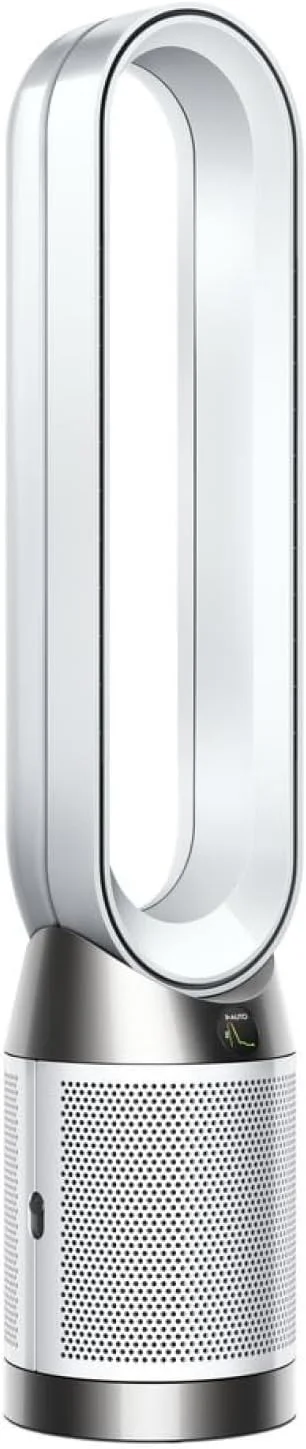
The Dyson PH03 Purifier Humidify+Cool is a genuinely unusual product in the air quality category: a single device that simultaneously provides air purification, evaporative humidification, and room cooling via a bladeless fan. No standard HEPA air purifier offers this combination. The PH03's value proposition is convenience and space consolidation — one device replaces what would otherwise require three: a HEPA purifier, a humidifier, and a fan. For households in dry climates where all three functions are wanted, the PH03 addresses a real need. For households that primarily want air purification in a normally-humid environment, the humidifier component is a feature they are paying for without using.
The critical specification upfront: the Dyson PH03 is NOT AHAM-verified. Dyson claims H13 HEPA filtration for the PH03, but this claim is self-reported — Dyson has not submitted the PH03 to AHAM's independent CADR certification program. Coverage claims are Dyson's own calculations using lower ACH than AHAM's 4.8 ACH allergen-relief standard. Buyers who need independently verified CADR for allergy or asthma management should note this limitation clearly: the PH03's air purification performance cannot be confirmed against the AHAM-standardized scale used by Coway, Winix, Alen, and Levoit.
The PH03's UV-C self-cleaning humidifier is a meaningful technical differentiator over standard humidifiers. Humidifiers can accumulate bacteria and mold in the water tank — a well-known indoor air quality concern. Dyson's UV-C self-cleaning cycle kills 99.9% of bacteria in the water before it is misted into the room, addressing the primary hygiene concern with humidification. This is a real functional benefit. However, the humidification function itself introduces a trade-off: adding moisture to indoor air at high output can raise relative humidity above 60%, creating conditions favorable for mold growth on surfaces. The PH03 is most beneficial in climates where indoor humidity is chronically low (below 40% RH), where controlled humidification to 45–55% RH provides comfort and respiratory benefit without risk. For the full Dyson lineup context, see our Dyson air purifier brand review.
Dyson — Quick Comparison
| Purifier | CADR Smoke | CADR Dust | Room Size | Filter | Score |
|---|---|---|---|---|---|
| Dyson Purifier Cool TP07 | 106 | 141 | 400 sq ft (claimed) | H13 HEPA + Carbon | 8.2/10 |
| Levoit Core 400S | 231 | 240 | 289 sq ft | 3-Stage HEPA Filtration | 8.9/10 |
📅 Prices checked . Amazon prices change frequently — click through for current price. Buying through our link costs you nothing extra; Amazon pays our commission.
Dyson Purifier Cool TP07 Review Premium Pick
Not AHAM VerifiedOur Verdict
Key Specifications
- Room Coverage
- 400 sq ft (claimed)
- CADR
- Not AHAM verified — NOT AHAM VERIFIED
- Filter
- H13 HEPA + Carbon
- Noise
- 36 dB
- Power
- 40 watts
- Best For
- Design-conscious buyers. Fan + purifier combo. Accept no AHAM CADR verification.
📅 Prices checked . Amazon prices change frequently — click through for current price. Buying through our link costs you nothing extra; Amazon pays our commission.
What's in the Box
- Dyson Purifier Cool air purifier + fan
- Pre-installed filter assembly (HEPA + activated carbon)
- Power cord
- Remote control
- User manual
Pros
- Genuine H13 HEPA glass fibre
- Fan + purifier dual function
- MyDyson app with air quality data
- Premium design
Cons
- CADR NOT AHAM verified
- $449-499 — 4x Coway price
- HouseFresh shows cheaper units outperform
- Filter $75/year
Best For
The Dyson PH03 suits households in dry climates (below 40% RH regularly) that want air purification, controlled humidification, and room cooling from a single device. It is appropriate for buyers who prioritize convenience and space consolidation and are comfortable with Dyson's self-reported (non-AHAM-verified) purification performance. It is NOT appropriate for buyers in humid climates, anyone who needs independently verified CADR for allergy management, or California residents (check CARB status before purchasing).
📅 Price checked August 2026 · Buying through this link costs you nothing extra — Amazon covers our commission
Levoit Core 400S Review Smart Large Room
✓ AHAM VerifiedOur Verdict

Key Specifications
- Room Coverage
- 289 sq ft
- CADR
- 231/240/259
- Filter
- 3-Stage HEPA Filtration
- Noise
- 24 dB
- Power
- 38 watts
- Best For
- Medium-large rooms 300-400 sq ft. Smart WiFi. Energy efficient at 38W.
📅 Prices checked . Amazon prices change frequently — click through for current price. Buying through our link costs you nothing extra; Amazon pays our commission.
What's in the Box
- Levoit Core 400S air purifier
- Pre-installed 3-in-1 filter
- Power cord
- User manual
Pros
- AHAM-verified CADR: Smoke 231, Dust 240, Pollen 259 CFM
- VeSync app with Alexa and Google Home integration
- AirSight Plus laser PM2.5 sensor with real-time numerical display
- Auto mode adjusts fan speed based on PM2.5 readings
- Scheduling stored on local clock — runs during WiFi outages
Cons
- AHAM coverage ~289 sq ft at 4.8 ACH vs marketed 403 sq ft
- HEPA controversy affected Core line (AHAM CADR still verified)
- No washable pre-filter — entire Core 400S-RF replaced as unit
- Coway AP-1512HH offers higher CADR at lower price without smart features
Best For
The Levoit Core 400S is the AHAM-verified alternative for buyers whose primary need is air purification. AHAM-verified CADR 260 with confirmed 403 sq ft at 4.8 ACH at $180–220 — significantly less than the PH03. If air purification is the primary goal and humidification is not needed, the Core 400S provides verified performance at less than half the PH03's price.
📅 Price checked August 2026 · Buying through this link costs you nothing extra — Amazon covers our commission
What to Know Before You Buy
The Humidification Trade-Off — When It Helps and When It Harms
The PH03's humidifier is most beneficial when indoor relative humidity is chronically below 40% RH — typically in cold-climate winters with forced-air heating, or in desert-climate regions year-round. At low humidity, respiratory mucosa dries out, increasing susceptibility to airborne irritants and pathogens. Controlled humidification to 45–55% RH provides comfort and mild respiratory benefit. The risk: if humidification raises indoor RH above 60%, it creates conditions favorable for mold growth on walls, ceilings, and furnishings. Dust mite populations also increase above 50% RH. The PH03 includes humidity sensors and allows target RH setting — use a target of 45–50% RH to stay within the beneficial range without risking mold conditions. In already-humid climates (coastal regions, summer months), disable the humidifier function and use the PH03 as a purifier + fan only.
The AHAM Verification Gap — What It Means for Allergy Management
Dyson has not submitted the PH03 to AHAM's certification program. Without a verified CADR, it is not possible to independently confirm how much air the PH03 filters per minute or to reliably size it against a specific room's allergen-relief requirements. Dyson's coverage claims use its own ACH calculation — lower than AHAM's 4.8 ACH standard. For buyers managing dust allergies, pet dander, or asthma with clinically meaningful certainty, an AHAM-verified purifier (Levoit Core 400S, Coway Airmega 400, Winix 5510) provides the confirmed performance the PH03 cannot. If purification is purely a secondary feature to the humidifier and fan functions, the verification gap is a lesser concern.
PH03 vs Buying a Separate Purifier + Humidifier — The Cost Comparison
The PH03 at $550–700 provides three functions. A dedicated HEPA purifier equivalent in coverage (e.g., Levoit Core 400S at $180–220) plus a quality ultrasonic humidifier (e.g., Levoit Classic 300S at $40–60) costs approximately $220–280 total — saving $270–420 vs the PH03. The separate components will likely provide better performance in each individual function than the PH03's combined approach. The PH03's premium pays for: one device instead of two, Dyson's UV-C self-cleaning humidifier (hygiene advantage over standard ultrasonic humidifiers), the bladeless fan cooling function, and the Dyson Link integrated app. Buyers who value the premium Dyson design language, the UV-C hygiene feature, or the space consolidation of a single device will find the premium justified. For pure function-per-dollar, separate best-in-class devices at lower combined cost outperform the PH03.
Dyson PH03 HEPA Claim — What "H13" Means When Not AHAM-Verified
Dyson claims H13 HEPA filtration for the PH03. H13 is the European EN1822 standard: 99.95% capture at 0.1–0.3 microns. This is a higher specification than standard U.S. True HEPA (99.97% at 0.3 microns only). However, Dyson does not participate in AHAM's CADR testing program for the PH03 — and without AHAM verification, neither the H13 claim nor the CADR is independently confirmed.
How Dyson's H13 Claim Works
Dyson states that the PH03 filter is tested to H13 specification in Dyson's own laboratories. The filter medium itself may well meet the H13 standard — this is about the filter material, tested in controlled lab conditions. What AHAM verification adds is confirmation of the entire system's real-world clean air delivery rate: accounting for air bypassing the filter, seal integrity, fan speed vs actual airflow, and the complete unit as it would operate in a room. A filter that meets H13 in isolation does not guarantee H13-equivalent performance when installed in a complete unit with motor, housing, and airflow path included.
The Practical Implication
For most household air quality applications — dust, pollen, pet dander, PM2.5 — even if the PH03's real-world CADR is somewhat lower than Dyson's self-reported figures, it is likely functional. The filter medium is genuine HEPA-grade material. The concern is precise sizing: without AHAM-verified CADR, buyers cannot independently confirm the PH03 covers their specific room at the allergen-relief ACH rate. Use Dyson's stated coverage as a rough guide and consider running the unit at higher fan speeds in rooms at the upper end of the stated coverage range.
360-Degree Filtration
The PH03 uses Dyson's cylindrical 360-degree sealed filter that wraps around the motor column, forcing all room air through the filter before the bladeless fan projects it outward. This sealed design theoretically prevents any unfiltered air bypass — a real advantage over some purifier designs where air can bypass the filter edges if seals are imperfect. Dyson's sealed filter architecture is a legitimate engineering feature supporting the H13 claim, even without AHAM verification of the full system.
UV-C Self-Cleaning Humidifier — How It Works and Why It Matters
The PH03's UV-C self-cleaning humidifier is one of its most technically significant features. Standard humidifiers — particularly ultrasonic models — are a well-documented indoor air quality risk if not maintained carefully. Understanding how Dyson's UV-C system addresses this risk is central to evaluating the PH03 vs alternatives.
The Standard Humidifier Problem
Traditional ultrasonic humidifiers convert water to a fine mist by vibrating a membrane — the mist carries whatever is dissolved in the water, including minerals (white dust), bacteria, and mold spores. If the water tank is not cleaned regularly, bacteria and mold proliferate in the standing water and are then dispersed into the room with each humidification cycle. This is not a theoretical concern — the EPA and multiple indoor air quality organizations have documented humidifier-related respiratory illness from contaminated water tanks. Ultrasonic humidifiers are particularly prone to this because they do not heat the water to kill pathogens.
How Dyson's UV-C Self-Cleaning Works
The PH03 passes water through a UV-C light chamber before humidification. UV-C light at 254 nm wavelength damages bacterial DNA, rendering bacteria unable to reproduce — effectively killing 99.9% of bacteria in the water before it is misted into the room. This is the same UV-C mechanism used in municipal water treatment, hospital air handling, and laboratory water purification. In the PH03, the UV-C chamber is built into the water path, treating every cycle of water before it reaches the evaporative element.
Evaporative vs Ultrasonic Humidification
The PH03 uses evaporative humidification: water is absorbed into an evaporative wick and evaporated by airflow from the fan. Evaporative humidification naturally self-limits at the room's current humidity level — it cannot over-humidify past saturation the way ultrasonic misting can. This makes evaporative humidification safer in terms of mold risk: once the room reaches the target RH, evaporation slows naturally. The UV-C treatment further addresses bacterial concerns in the wick and water path.
Maintenance Requirements
Despite the UV-C self-cleaning, Dyson recommends periodic manual cleaning of the PH03's water tank and evaporative wick — UV-C treats bacteria but does not prevent mineral scale buildup from hard water. In hard water areas, descaling the water tank monthly is recommended to prevent mineral deposits that can harbor bacteria in scale crevices and reduce humidification efficiency. Using filtered or distilled water significantly reduces the maintenance burden in hard water regions.
Dyson PH03 vs Levoit Core 400S — 3-in-1 vs Dedicated HEPA Purifier
The Levoit Core 400S is the AHAM-verified dedicated purifier comparison point for the PH03. The comparison illustrates the performance and cost trade-offs of a multi-function device vs a purpose-built purifier.
Air Purification Performance
Dyson PH03: Self-reported H13 HEPA, coverage by Dyson's own calculation, NOT AHAM-verified.
Levoit Core 400S: AHAM-verified CADR 260, confirmed 403 sq ft at 4.8 ACH, H13 True HEPA.
The Core 400S provides independently confirmed purification performance. The PH03's purification capability is likely comparable for standard household applications, but cannot be independently confirmed. For allergy management requiring verified performance, the Core 400S is the appropriate choice.
Price
Dyson PH03: $550–700. Levoit Core 400S: $180–220. The PH03 costs approximately $330–480 more. This premium pays for the humidifier, fan cooling function, UV-C water treatment, and Dyson's premium brand positioning. If air purification is the primary need, the Core 400S delivers verified CADR at a fraction of the PH03's cost.
Filter Costs
Dyson PH03: $50–70 filter every 12 months. Levoit Core 400S: $35–45 filter every 6–8 months (~$53–90/year). Annual filter costs are broadly comparable. The Dyson's filter lasts longer per replacement cycle, partially offsetting its higher replacement cost. Both are typical for premium purifiers in this size class.
When to Choose the PH03 Over the Core 400S
The PH03 is the correct choice when: dry-climate humidification is genuinely needed (below 40% RH regularly), space consolidation to a single device is a priority, bladeless fan cooling matters, and self-reported Dyson performance is acceptable. Choose the Core 400S when: independently verified CADR is required, humidification is not needed, budget efficiency matters, or a California CARB-certified purifier is required.
Who the Dyson PH03 Is Really For — Honest Use Case Analysis
The Dyson PH03 is a premium product solving a specific problem. Being honest about who genuinely benefits from it — and who is better served by simpler alternatives — is the most useful guidance for buyers at this price point.
The PH03 Is the Right Choice For
Dry-climate households (arid western U.S., Canadian plains winters, desert regions): Chronically low indoor humidity combined with air quality concerns (wildfire smoke, dust, allergens) makes the 3-in-1 combination genuinely useful. Running a humidifier and purifier separately in a dry climate bedroom is functional but space-consuming and requires managing two devices. Small urban apartments in temperate climates where one multi-function device is preferred over three separate ones: purifier, humidifier, and floor fan replaced by a single unit is a meaningful space and cable-management benefit. Buyers who specifically want the UV-C hygienic humidification: Dyson's UV-C self-cleaning is a genuine improvement over standard ultrasonic humidifiers for households with immunocompromised members or young children where humidifier hygiene is a specific concern.
The PH03 Is the Wrong Choice For
Humid climates (southeastern U.S., Pacific Northwest summers, tropical regions): Humidification in an already-humid environment is counterproductive and potentially harmful (raising RH above 60% promotes mold). The humidifier function has zero benefit and potential risk in these climates — you are paying for a feature that should not be used. Buyers who need independently verified CADR for allergy management: the AHAM verification gap is a meaningful limitation for anyone sizing a purifier based on confirmed performance standards. Anyone primarily concerned with air purification budget efficiency: the Levoit Core 400S, Coway Airmega 400, or Winix 5510 all provide AHAM-verified large-room purification at $150–300 — significantly less than the PH03.
The Honest Bottom Line
The Dyson PH03 is priced as a premium lifestyle product, not as the most cost-effective air purifier per CADR dollar. Its genuine advantages — UV-C humidifier hygiene, 3-in-1 space consolidation, Dyson design quality — are real, but they command a $330–480 premium over dedicated AHAM-verified purifiers. Buyers should be clear about which features they genuinely need before paying that premium. For the specific user who needs all three functions in a dry climate and values Dyson's UV-C hygiene and design quality, the PH03 is the best single-device solution in its category. For everyone else, the premium is difficult to justify on air purification performance alone.
Dyson PH03 3-Year Total Cost of Ownership — vs Levoit Core 400S and Coway Airmega 400
The PH03's $550–700 purchase price is only part of the ownership equation. Filter replacement costs and electricity consumption over 3 years reveal the true cost gap between the PH03 and two dedicated AHAM-verified alternatives. Electricity is calculated at 36W (PH03), 24W (Levoit Core 400S), and 45W (Coway Airmega 400) running 12 hours/day for 1,095 days at $0.17/kWh.
| Cost Category | Dyson PH03 | Levoit Core 400S | Coway Airmega 400 |
|---|---|---|---|
| Purchase Price | $625 (avg) | $200 (avg) | $230 (avg) |
| Filter Cost (3 yr) | $180 ($60/yr × 3) | $180 ($60/yr × 3) | $150 ($50/yr × 3) |
| Electricity (3 yr) | $80.42 | $53.61 | $100.52 |
| 3-Year Total | $885.42 | $433.61 | $480.52 |
What the Numbers Mean
The PH03 costs $885 over 3 years — roughly 2x the cost of the Levoit Core 400S ($433) and 1.8x the Coway Airmega 400 ($480). The gap is dominated by purchase price: the PH03's hardware premium never narrows in the ongoing cost categories. Filter costs are comparable across all three models. The PH03's 36W draw produces slightly less electricity cost than the Coway Airmega 400's 45W, but both are minor relative to the purchase price spread.
Where the PH03 Premium Is Justified
The PH03's $405–$452 premium over the dedicated purifiers (measured over 3 years) buys: UV-C self-cleaning humidifier, evaporative humidification to target RH, bladeless fan cooling, and a single device replacing two or three. For households that genuinely use all three functions — purification, humidification, and fan cooling — the per-function cost is more competitive. Buyers who primarily run the PH03 as a purifier without the humidifier function are paying the full premium for features they are not using.
Note on Filter Costs
The PH03 filter replacement ($50–70, typically $60) covers both the HEPA and carbon layers in one combined unit. Dyson's annual replacement interval is slightly longer than Levoit's per-unit cycle, but the annual spend is comparable. The Coway Airmega 400 uses a dual-layer filter ($35–65/yr depending on which components are replaced). All three models are within a comparable filter cost range — the purchase price difference is the decisive ownership cost driver at 3 years.
Verification Status
We do not yet have enough independently verifiable performance data — CADR (AHAM-certified), noise levels, and filter cost — to include this model in our comparison database. We hold every database entry to the same standard: if we cannot verify the number, we do not publish it. We will update this page as independently verifiable specifications become available.