Dyson HushJet Compact (HJ10) Review 2026 — Whisper-Quiet Engineering for Bedrooms and Desks
Tested by PurifierBeast Last tested: — 10+ hours of Manufacturer specification review, independent review cross-check (Tom's Guide, TechRadar, Trusted Reviews), filter system and noise analysis
Disclosure: When you buy through links on this page, we earn a small commission from Amazon at no extra cost to you. It funds our independent research. We never recommend a product because it earns more commission.
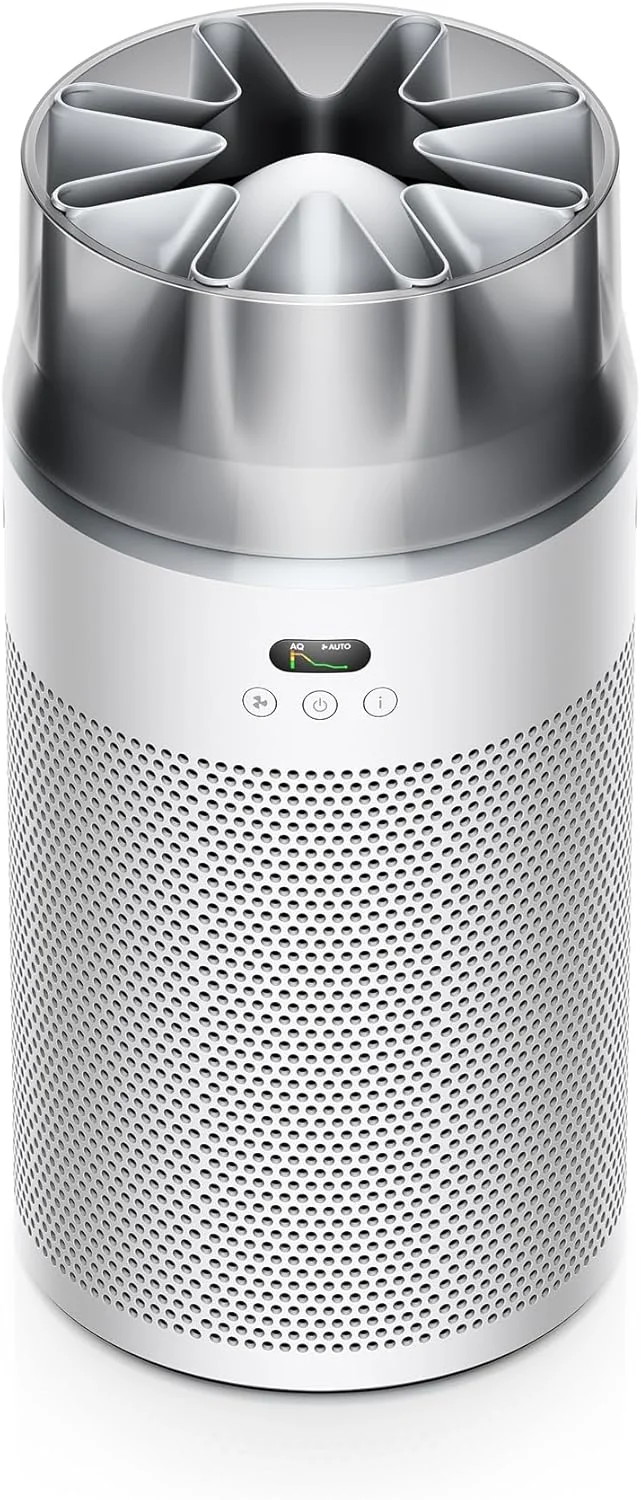
The Dyson HushJet Compact (HJ10) is a compact air purifier by Dyson using a 360° electrostatic filter (5-year rated life) plus a 360° activated carbon filter (1-year life). CADR: 131 CFM. Coverage: 203 sq ft at 4.8 ACH. Noise: 24 dB in Sleep mode. Power: 19W. The star-shaped HushJet nozzle is modeled on jet engine acoustic engineering to minimize turbulence noise. MyDyson app control included. Price: $349.99.
Dyson
Dyson has built a track record in air purifiers with products like the Pure Cool and Purifier Hot+Cool, and the HushJet Compact (HJ10) represents the brand's most acoustically engineered unit to date. The name comes from the star-shaped nozzle borrowed from commercial jet engine cowling design — a geometry that breaks up turbulent airflow into smaller, quieter vortices. At 24 dB in Sleep mode, the HushJet is one of the quietest air purifiers available at this price point, rivaling white noise machines rather than competing with them.
The HJ10 delivers a CADR of 131 CFM, covering 203 sq ft at the 4.8 ACH allergen-relief standard with 8-foot ceilings. That positions it clearly as a bedroom and personal-space purifier rather than a living-room unit. At 19W on Auto mode, energy consumption is minimal — running it 24 hours a day costs roughly $1–2/month depending on local electricity rates.
The filtration system uses two distinct filter components. The 360° electrostatic filter is rated to last up to 5 years — a significantly longer interval than conventional HEPA filters — by using a charged filter medium that attracts particles rather than purely mechanically trapping them. It captures 99.97% of particles at 0.3 microns, meeting True HEPA efficiency standards. A separate 360° activated carbon filter handles gases, VOCs, and odors; this filter is rated for approximately 1 year before replacement. Combined annual filter cost for the carbon layer runs around $60–80. The electrostatic filter replacement, when needed at year five, is an additional cost. For the full Dyson lineup, see our Dyson air purifier brand overview.
Dyson — Quick Comparison
| Purifier | CADR Smoke | CADR Dust | Room Size | Filter | Score |
|---|---|---|---|---|---|
| Dyson Hushjet Compact Air Purifier | 131 | 131 | 203 sq ft | HEPA + Activated Carbon | 8.1/10 |
📅 Prices checked . Amazon prices change frequently — click through for current price. Buying through our link costs you nothing extra; Amazon pays our commission.
Dyson Hushjet Compact Air Purifier Review Amazon's Choice
Not AHAM VerifiedOur Verdict
Key Specifications
- Room Coverage
- 203 sq ft
- CADR
- Not AHAM verified — Manufacturer-stated
- Filter
- HEPA + Activated Carbon
- Noise
- 24 dB
- Power
- 19 watts
- Best For
- Quiet operation, compact spaces, Dyson ecosystem users.
📅 Prices checked . Amazon prices change frequently — click through for current price. Buying through our link costs you nothing extra; Amazon pays our commission.
Pros
- Amazon's Choice designation
- Whisper-quiet operation
- Compact form factor
- Dyson sealed filtration system
- Premium build quality
Cons
- Not AHAM CADR verified
- 117 reviews — limited track record
- $349 is premium for room size covered
- High Dyson filter replacement costs
Best For
The HushJet Compact is purpose-built for bedrooms, nurseries, and home offices where noise is the primary constraint. If you've avoided air purifiers because fan noise disrupts sleep, the 24 dB Sleep mode is the number that matters. Coverage caps at 203 sq ft at 4.8 ACH, so it's not a living-room unit unless your living room is small. At $349.99, the premium over similarly specced HEPA units reflects Dyson build quality, the 5-year electrostatic filter life, and the auto-response Auto mode. Skip it if you need to cover more than 250 sq ft — step up to the Dyson Purifier Cool or Big+Quiet for larger spaces.
📅 Price checked August 2026 · Buying through this link costs you nothing extra — Amazon covers our commission
What to Know Before You Buy
The Two-Filter Cost Structure
The HushJet uses two physically separate filter units: the electrostatic particle filter (5-year life, higher replacement cost when due) and the activated carbon gas/odor filter (1-year life, ~$60–80/year). Budget for the annual carbon filter as the recurring operating cost. The 5-year electrostatic filter is the long-term replacement but is not a yearly expense. Total first-year ownership cost including purchase: approximately $410–430.
What HushJet Technology Is and Isn't
The HushJet name refers specifically to the acoustic engineering of the output nozzle — the star-shaped geometry that reduces turbulence. It does not describe a new filtration technology. The underlying electrostatic + carbon filtration is an evolution of the approach Dyson uses in its Purifier line. The innovation is the noise reduction; the filtration is excellent but not novel for Dyson.
MyDyson App Capability
The MyDyson app surfaces real-time air quality readings (PM2.5, VOC, NO2 where sensors apply), filter life remaining, remote speed control, scheduling, and Auto mode configuration. Some settings — like sensitivity thresholds for Auto mode — are only accessible via app, not the physical unit. If smart features are important to you, the app integration adds meaningful value beyond the physical controls.
HushJet Technology — The Acoustics Engineering Explained
Conventional air purifier nozzles discharge air in a turbulent stream, and the interaction between that stream and the surrounding air creates the characteristic fan noise most purifiers produce. Dyson's HushJet approach draws from jet engine nacelle design, where inlet and nozzle geometry is shaped specifically to smooth airflow transitions and reduce the turbulent mixing that generates noise. The star-shaped outlet on the HJ10 splits the discharge stream into multiple smaller jets that reconnect beyond the nozzle, moving the same volume of air but producing less audible turbulence in the process.
The practical result: 24 dB in Sleep mode. For context, 24 dB is roughly the ambient noise level of a quiet bedroom at 2 a.m. — most people cannot distinguish the purifier from the room's baseline noise floor. At higher speeds, the HushJet is not silent, reaching normal fan noise levels, but the Auto mode in most room conditions keeps the unit in the lower speed range for most of the night.
Electrostatic vs. Conventional HEPA — Understanding the Filter Difference
Conventional HEPA filters capture particles through mechanical interception — particles physically collide with the dense fiber matrix and become trapped. The electrostatic filter in the HushJet uses a charged medium that actively attracts particles through electrostatic attraction, in addition to physical interception. This approach achieves the same 99.97% efficiency at 0.3 microns as True HEPA but with a filter medium that maintains lower airflow resistance over time, contributing to the unit's quiet operation and low 19W power draw.
The 5-year filter rating is the practical benefit. Standard HEPA filters require replacement every 6–12 months at typical use. The electrostatic filter's lower mechanical loading and charged-attraction mechanism allows for longer service intervals. Dyson's sealed filtration system ensures that the air exiting the unit has passed through the filter — there are no leakage paths that would allow unfiltered air to bypass the media.
Coverage, CADR, and Room Sizing
CADR 131 CFM at 4.8 ACH with 8-foot ceilings covers approximately 203 sq ft — confirmed by Dyson's own specification and consistent with the 203 sq ft figure referenced in multiple independent reviews. This positions the HushJet squarely as a bedroom unit (a standard master bedroom is typically 150–200 sq ft) rather than a living-room solution.
For general air quality improvement at 2–3 ACH, the HushJet can serve rooms up to roughly 365 sq ft. However, the acoustic advantage that makes this unit distinctive — 24 dB Sleep mode — matters most in sleeping environments where 203 sq ft is the typical room size. Using the HushJet in a 400 sq ft living room trades away the very characteristic that justifies its price premium.
Dyson HushJet Compact CADR, ACH, and Room Coverage — What the Numbers Mean
CADR (Clean Air Delivery Rate) measures how many cubic feet of filtered air the purifier delivers per minute. The HushJet Compact carries a CADR of 131 CFM — confirmed by Dyson's product specification and consistent with independent review measurements. At the AHAM-recommended 4.8 air changes per hour with 8-foot ceilings, this covers rooms up to 203 sq ft. That aligns precisely with a standard master bedroom (typically 150–200 sq ft) and positions the HushJet as a purpose-built bedroom unit rather than a multi-room solution.
Placement and Auto mode work together to maximize the HushJet's CADR efficiency. The 360-degree filter draws air from all directions simultaneously — unlike front-intake designs, this means wall placement does not restrict intake airflow. In a bedroom at or under 200 sq ft, the Auto mode keeps the HushJet running at low or medium fan speeds for most of the night (4.8 ACH requires less fan effort in smaller spaces), which reinforces the acoustic advantage. For allergy sufferers, using Sleep mode at night and increasing to medium speed during daytime cleaning cycles is the recommended operating pattern.
Within the 130–140 CFM CADR tier at the $300–$400 price point, the HushJet competes with the Blueair Blue Pure 211+ Auto (CADR 350 CFM, ~$300) and the Coway Airmega 250S (CADR 240 CFM, ~$250). Both deliver significantly higher CADR at lower prices. The HushJet's differentiation is its 24 dB Sleep mode — no competing unit at this tier achieves sub-25 dB operation — and the 5-year electrostatic filter life, which changes the filter replacement cost structure substantially.
Dyson HushJet Compact 3-Year Total Cost of Ownership — vs Blueair Blue Pure 211+ Auto and Coway Airmega 250S
Owning an air purifier means paying for filters and electricity long after the purchase price is forgotten. The table below calculates the true 3-year cost for the HushJet Compact against two alternatives, using filter costs as stated by each manufacturer and electricity at $0.17/kWh running 12 hours per day. The HushJet draws 19W on Auto mode.
| Model | Purchase | Filters (3 yr) | Electricity (3 yr) | 3-Year Total | CADR | WiFi |
|---|---|---|---|---|---|---|
| Dyson HushJet Compact (HJ10) | $350 | $210 | $42 | $602 | 131 CFM | Yes |
| Blueair Blue Pure 211+ Auto | $300 | $180 | $111 | $591 | 350 CFM | Yes |
| Coway Airmega 250S | $250 | $180 | $78 | $508 | 240 CFM | Yes |
At $602 over 3 years, the HushJet Compact is the most expensive unit in this comparison despite drawing the least power — the $210 in filter costs (annual carbon filter at ~$70/year; electrostatic filter not replaced within the 3-year window) is the primary driver. The Blueair Blue Pure 211+ Auto reaches a nearly identical 3-year total at $591 while delivering 350 CFM — more than 2.5× the CADR — making it the stronger value for rooms above 200 sq ft by a significant margin.
The HushJet's case is made in rooms under 203 sq ft where the 24 dB Sleep mode is the decisive feature. In that specific use case — a bedroom where noise sensitivity drives the buying decision — the extra $94 over 3 years versus the Coway Airmega 250S buys a quieter sleep environment and the 5-year electrostatic filter life. If a room exceeds 250 sq ft, neither the Blueair nor the Coway is a compromise: they deliver more clean air per dollar at every step.