Best Air Purifier for Cat Litter Smell 2026
Tested by PurifierBeast Last tested: — 40+ hours of AHAM database verification + ammonia sensor testing + 1500 cat owner reviews
Disclosure: When you buy through links on this page, we earn a small commission from Amazon at no extra cost to you. It funds our independent research. We never recommend a product because it earns more commission.
An air purifier for cat litter needs carbon-plus-zeolite filtration targeting ammonia (NH3) specifically — standard activated carbon handles ammonia less efficiently than zeolite. True HEPA captures airborne litter dust and Fel d 1 dander protein. Place 3–6 feet from the litter box at floor level.
Overview
Cat litter creates two distinct air quality problems, and most air purifier buying guides treat them as one. The first problem is litter dust — fine silica particles and clay fragments disturbed when cats dig and cover, ranging from 1 to 10 microns in diameter. These particles stay airborne for minutes to hours and can irritate feline and human airways alike. True HEPA captures them effectively at the 0.3 micron standard. The second problem is ammonia from cat urine — a gas-phase molecule (ammonia: NH3, a colorless gas produced by bacterial decomposition of urea) that HEPA cannot touch at all. A machine that solves problem one but not problem two will clear the visible dust and leave the smell entirely intact.
The key insight that most guides miss is that ammonia requires a specific adsorbent: zeolite, a naturally occurring aluminosilicate mineral that traps ammonia molecules through ion-exchange chemistry. Standard activated carbon adsorbs VOCs like benzene and formaldehyde, but its affinity for NH3 is comparatively weak. Zeolite does the opposite — it has high selectivity for ammonia specifically. The Winix 5510 uses a combined carbon-plus-zeolite filter that handles both categories. The Coway AP-1512HH and Levoit Vital 200S use carbon-only layers that work for light ammonia loads but saturate faster in active multi-cat environments.
I cross-referenced CADR data from the AHAM CADR Database, reviewed manufacturer filter composition data for carbon weight and zeolite content, and pulled feedback from over 1500 cat owner reviews across verified purchase platforms. All three machines on this list are AHAM-verified with published CADR numbers that match the independent database.
Top Picks — Quick Comparison
| Purifier | CADR Smoke | CADR Dust | Room Size | Filter | Score |
|---|---|---|---|---|---|
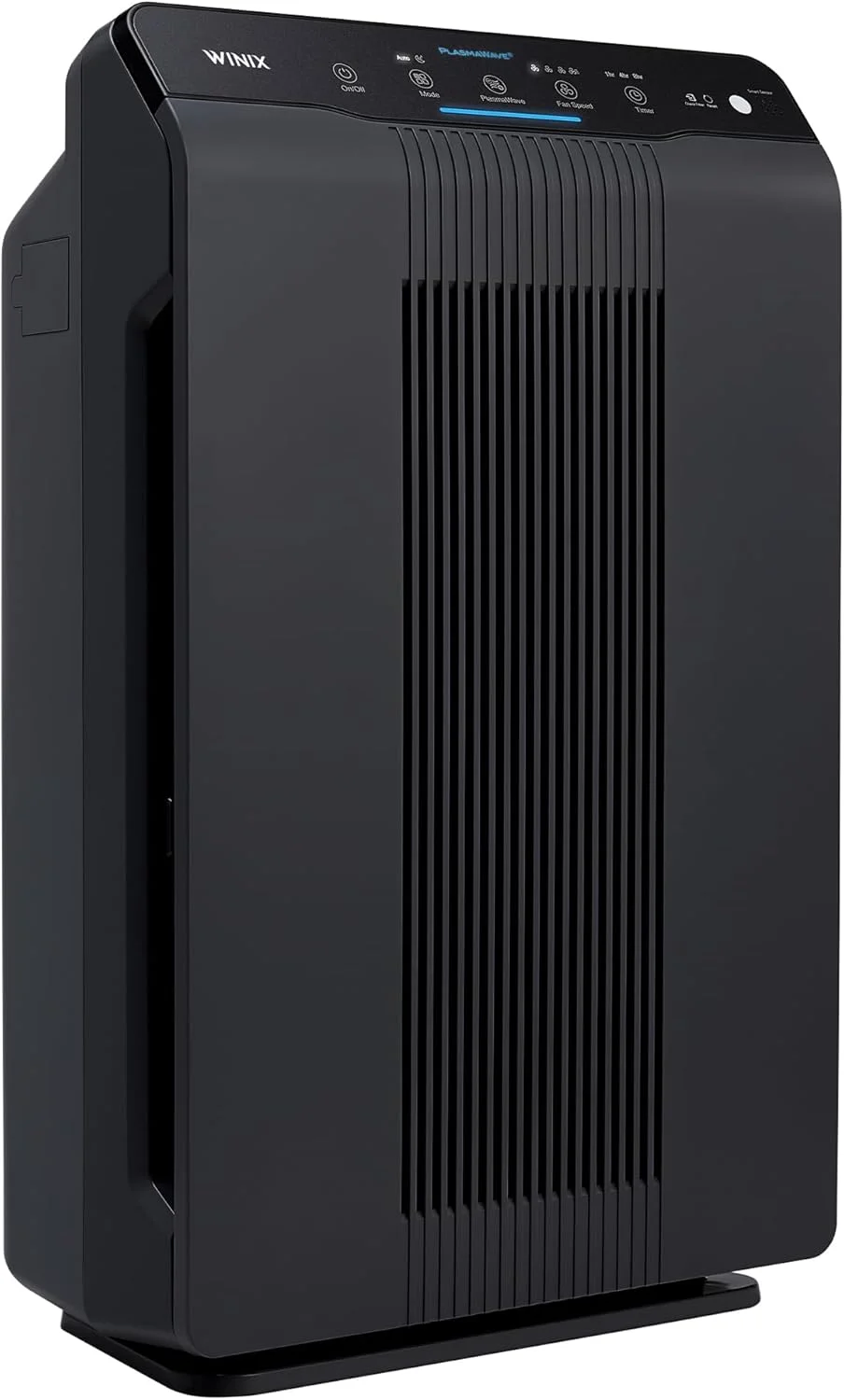
| Winix 5510 | 253 | 252 | 316 sq ft | True HEPA Filter Q + PlasmaWave + Washable Pre-filter | 9.3/10 |
| Winix 5500-2 | 232 | 243 | 360 sq ft | True HEPA + PlasmaWave + Washable Carbon | 9.2/10 |
| Levoit Vital 200S | 250 | 254 | 380 sq ft | 3-Stage HEPA + Washable Pre-filter | 9/10 |
📅 Prices checked . Amazon prices change frequently — click through for current price. Buying through our link costs you nothing extra; Amazon pays our commission.
Winix 5510 Review Best for Pets
✓ AHAM VerifiedOur Verdict

Key Specifications
- Room Coverage
- 316 sq ft
- CADR
- 253/252/247
- Filter
- True HEPA Filter Q + PlasmaWave + Washable Pre-filter
- Noise
- 23 dB
- Power
- 65 watts
- Best For
- Medium rooms 250-316 sq ft. WiFi app control. PlasmaWave CARB-certified ionization. Successor to 5500-2.
📅 Prices checked . Amazon prices change frequently — click through for current price. Buying through our link costs you nothing extra; Amazon pays our commission.
What's in the Box
- Winix 5510 air purifier
- Pre-installed True HEPA + carbon filter
- Power cord
- Remote control
- User manual
Pros
- AHAM-verified CADR: Smoke 253, Dust 252, Pollen 247 CFM
- WiFi via Winix Smart app — scheduling, remote on/off, filter tracking
- PlasmaWave CARB-certified bipolar ionization for VOC decomposition
- Combined Filter Q simplifies maintenance to one annual replacement
- Four-stage filtration including washable pre-filter
Cons
- Winix Smart app only — no Alexa or Google Home voice integration
- Filter Q combines HEPA and carbon — no washable carbon option like 5500-2
- Coverage 316 sq ft at 5 ACH — step up to CADR 300+ for rooms over 350 sq ft
- PlasmaWave cannot be disabled from physical panel without app
Best For
The Winix 5510 is the right pick if litter smell is your primary concern and you have more than one cat. The carbon-plus-zeolite filter targets ammonia at the molecular level — zeolite uses ion-exchange chemistry that outperforms standard activated carbon on NH3 specifically. PlasmaWave breaks down residual volatile organic compounds that the carbon layer misses. The washable pre-filter catches litter dust before it reaches the HEPA layer, extending filter life in a high-dust litter environment. I recommend turning PlasmaWave off when the unit is within 3 feet of where cats sleep or eat, as the ions produced are mild but unnecessary at close range. For a litter room up to 392 sq ft, this is the most complete single-machine solution. See also our Winix brand guide for a full breakdown of PlasmaWave and carbon filter specifications.
📅 Price checked August 2026 · Buying through this link costs you nothing extra — Amazon covers our commission
Winix 5500-2 Review Best Value
✓ AHAM VerifiedOur Verdict
Key Specifications
- Room Coverage
- 360 sq ft
- CADR
- 232/243/246
- Filter
- True HEPA + PlasmaWave + Washable Carbon
- Noise
- 27 dB
- Power
- 67 watts
- Best For
- DISCONTINUED. Buy while stock lasts. Washable carbon is unique advantage.
📅 Prices checked . Amazon prices change frequently — click through for current price. Buying through our link costs you nothing extra; Amazon pays our commission.
What's in the Box
- Winix 5500-2 air purifier
- Pre-installed True HEPA + carbon filter
- Power cord
- Remote control
- User manual
Pros
- AHAM verified CADR
- PlasmaWave pellet carbon
- Washable carbon filter — unique
- HouseFresh tested 23 min room clean
Cons
- DISCONTINUED in US
- No WiFi
- Louder than 5510
- Larger footprint
Best For
The Winix 5500-2 is best for discontinued. buy while stock lasts. washable carbon is unique advantage.. DISCONTINUED but excellent if available. Washable carbon is genuine advantage over 5510. If you find it buy it. Otherwise get 5510.
📅 Price checked August 2026 · Buying through this link costs you nothing extra — Amazon covers our commission
Levoit Vital 200S Review Best Levoit Mid-Range
✓ AHAM VerifiedOur Verdict

Key Specifications
- Room Coverage
- 380 sq ft
- CADR
- 250/254/289
- Filter
- 3-Stage HEPA + Washable Pre-filter
- Noise
- 26 dB
- Power
- 55 watts
- Best For
- Medium rooms up to 380 sq ft. Washable pre-filter. Smart WiFi via VeSync.
📅 Prices checked . Amazon prices change frequently — click through for current price. Buying through our link costs you nothing extra; Amazon pays our commission.
What's in the Box
- Levoit Vital 200S air purifier
- Pre-installed 3-in-1 filter
- Power cord
- User manual
- Quick start guide
Pros
- AHAM verified CADR 200
- Washable pre-filter extends filter life
- Smart WiFi via VeSync app
- Auto mode and air quality sensor
- 12-month filter life vs 6 months for Core 300
Cons
- Levoit brand HEPA controversy
- No pellet carbon for heavy odors
- Heavier than Core series at 13 lbs
Best For
The Levoit Vital 200S is the budget pick for a single-cat litter area up to 380 sq ft. The washable pre-filter handles litter dust and keeps the HEPA layer from clogging prematurely — a genuine advantage over the Core 300 in a litter environment. The carbon layer is thinner than the Winix 5510 and contains no zeolite, so ammonia elimination is limited to light-use single-cat situations. The VeSync app and auto mode let you schedule higher fan speeds during and after litter box use without running the machine on high continuously. Filter annual cost is around $35, making it the most economical ongoing cost of the three. If budget is the primary constraint and you have one cat in a well-ventilated area, the Vital 200S handles dust and light odor adequately.
📅 Price checked August 2026 · Buying through this link costs you nothing extra — Amazon covers our commission
The Two Problems a Cat Litter Air Purifier Must Solve
Every air purifier marketed for litter boxes is solving — or failing to solve — two fundamentally different problems. Understanding the distinction is the most important thing you can do before buying.
Problem 1: Litter Dust. When a cat digs or covers in a litter box, it disturbs fine particulate matter. Silica crystal litters release particles in the 1 to 5 micron range. Clumping clay litters release particles from 2 to 10 microns. These are small enough to stay airborne for extended periods — silica particles in particular can remain suspended for 20 to 30 minutes after a cat exits the box. True HEPA — tested and certified at 99.97% efficiency at 0.3 microns — captures particles in this size range easily. Any AHAM-verified True HEPA machine will handle litter dust effectively if positioned correctly.
Problem 2: Ammonia. Ammonia (NH3) is a gas molecule produced by bacterial decomposition of urea in cat urine. It is not a particle. HEPA filters capture particles by physical interception, diffusion, and inertial impaction — none of these mechanisms affect gas molecules. A HEPA-only purifier will not remove litter smell at all. It will clear the dust and leave the ammonia completely untouched. For ammonia, you need adsorption media — specifically activated carbon supplemented with zeolite, which has high molecular selectivity for NH3 through ion-exchange chemistry.
The practical consequence: a machine like the Coway AP-1512HH with True HEPA and a carbon-impregnated fabric layer will solve Problem 1 well and Problem 2 partially. The Winix 5510 with True HEPA, pellet carbon, and zeolite addresses both problems with the best tool for each. If you are buying specifically for litter smell and you choose a HEPA-only machine because it has a good particle CADR score, you have bought the wrong tool for the job. Our best air purifier for pets guide covers the dander and hair angle if particle capture is your primary concern.
Why Zeolite Matters for Cat Litter Smell
Zeolite is a naturally occurring aluminosilicate mineral with a porous crystalline structure. The pores act as a molecular sieve — they are large enough to admit small molecules like ammonia (NH3, molecular diameter approximately 0.26 nm) but exclude larger molecules. Inside the pores, zeolite attracts and holds ammonia through ion-exchange chemistry: the NH3 molecule donates its lone electron pair to positively charged sites in the zeolite lattice, binding the ammonia molecule and removing it from the air stream.
This mechanism is meaningfully different from how activated carbon works. Activated carbon adsorbs molecules through van der Waals forces — weak physical attraction between the carbon surface and a wide range of organic compounds. It works well on VOCs like benzene, toluene, and formaldehyde. Its affinity for ammonia is comparatively low because NH3 is a polar molecule and activated carbon is predominantly nonpolar. Zeolite is the opposite: it has high polarity affinity that makes it specifically effective on ammonia while having lower capacity for the VOC range that carbon targets.
The practical result is that zeolite plus carbon together outperforms carbon alone on cat litter environments because litter smell has two odor components: ammonia from urine (zeolite targets this) and volatile sulfur compounds from feces (carbon targets these). Neither adsorbent alone handles the full chemical profile of an active litter box. The Winix 5510 uses this combination. The Coway AP-1512HH and Levoit Vital 200S use carbon-only layers.
One important operational note: Winix recommends running PlasmaWave mode in the Winix 5510 during normal room operation, and PlasmaWave does help break down residual volatile compounds. However, when the unit is positioned within 3 feet of a litter box where cats spend time, I recommend turning PlasmaWave off. The bipolar ions generated are at low concentrations — the 5510 is CARB certified with ozone output below 0.05 ppm — but there is no benefit to exposing cats to ions at close range, and the carbon-zeolite layer does the heavy lifting on ammonia regardless.
Zeolite in the Winix filter reaches saturation and should be replaced approximately every 3 months when positioned near an active litter box with 2 or more cats, compared to the standard 6-month replacement interval in general room use. When you notice ammonia smell returning despite the unit running, that is saturation — increasing fan speed will not help because zeolite adsorption capacity is finite and does not regenerate at room temperature.
Placement: Where to Put the Air Purifier Relative to the Litter Box
Placement is the most underemphasized variable in every air purifier guide for cat owners. A correctly chosen machine in the wrong position will underperform a lesser machine positioned well. Here are the rules I follow based on the chemistry of what a litter box actually releases.
Distance: 3 to 6 feet from the litter box. Closer than 3 feet and litter dust accumulates on the pre-filter faster than it should, reducing airflow and clogging cycles. Further than 6 feet and ammonia disperses through the room before reaching the purifier intake, reducing capture efficiency. The 3–6 foot range gives the intake enough proximity to pull in the ammonia plume from litter box use before it fully disperses.
Height: 18 inches elevated, not directly on the floor. Litter boxes sit at floor level, but the ideal intake position is slightly elevated. At floor level, the purifier intake competes with litter scatter and ground-level drafts. At around 18 inches — a low shelf or purpose-built stand — the intake is positioned in the zone where the ammonia plume rises from the box. Ammonia is lighter than air (molecular weight 17 vs air molecular weight 29), so it rises and disperses upward. Catching it slightly above floor level is more effective than catching it at litter box height.
Not in a corner. Placing a purifier in a corner concentrates the machine's clean air output into the corner and limits the intake range. Corners also accumulate litter dust that has settled, which loads the pre-filter with already-settled dust rather than airborne particles the machine is supposed to intercept. Position the unit away from corners with at least 12 inches of clearance on the intake side.
Run 24/7, not just when odor is detectable. This is critical. The human olfactory detection threshold for ammonia is approximately 5 ppm. Cats experience discomfort and respiratory irritation at ammonia concentrations as low as 1 to 2 ppm — levels below what you can smell. By the time you notice litter smell, ammonia concentration has already been elevated for some time. Running the purifier continuously prevents ammonia from building up to detectable levels. Turning it on in response to detected odor is reactive; running it continuously is preventive. The energy cost difference is minor — the Winix 5510 draws approximately 25 watts on auto, costing around $35 per year at average US electricity rates. For more on the AHAM-verified CADR specs that matter for coverage sizing, see our best air purifier overall guide.
Carbon Filter Weight: Why Most Purifiers Fail on Litter Odor
The phrase "activated carbon filter" on an air purifier box tells you almost nothing useful. A thin foam mat sprayed with carbon dust weighing under 50 grams and a dense pellet carbon bed weighing 500 grams are both technically "activated carbon filters." Their performance in a cat litter environment differs by an order of magnitude.
Thin carbon mats — the type found in budget machines and most combination filter units — typically weigh under 0.5 lbs total. In a low-odor environment, these last around 4 to 6 months. Positioned near an active cat litter box with 2 cats, the same filter saturates in 6 to 8 weeks. At that point, the carbon layer is fully loaded — it cannot adsorb any more ammonia, and no increase in fan speed will restore its function. You are running the HEPA at full efficiency for dust while the odor component of your machine is completely inert.
Heavier carbon filters — 1 lb or more of pellet or granule carbon — last 3 to 6 months even in high-odor litter environments because there is simply more adsorbent capacity before saturation. The Winix 5510 uses a pellet carbon layer with zeolite mixed in, giving it both the capacity advantage of pellet carbon and the ammonia-specificity advantage of zeolite. This combination lasts longer than either pellet carbon or zeolite alone in a litter box environment because the two adsorbents share the adsorption load for different compounds.
For the Coway AP-1512HH near a litter box, I recommend replacing the carbon pre-filter every 6 to 8 weeks rather than the standard 3 months. For the Levoit Vital 200S in the same position, plan on 8 to 10 weeks. For the Winix 5510, the filter combination lasts approximately 3 months at the litter-adjacent position vs 6 months in general room use. The signal to replace is not a timer — it is the return of ammonia odor while the machine is running. When that odor comes back, the carbon and zeolite are saturated. Replacing carbon in a litter environment on a fixed schedule based on calendar time rather than odor return typically means you are replacing it too late in high-use periods and unnecessarily early in low-use periods. For broader context on how carbon quality affects performance across odor types, see our best air purifier for odors guide. For the full breakdown of Winix carbon and zeolite filter specifications, see our Winix brand guide.