Dreo Macro Max S Review 2026 — CADR 273, H13 HEPA, WiFi for ~$130
Tested by PurifierBeast Last tested: — 10+ hours of Third-party lab data cross-referenced: PM2.5 particle removal test (320 sq ft and 560 sq ft rooms), smoke box clearance test, calibrated noise meter at all 5 panel speeds, per-speed wattage measurement, filter cost analysis, smart feature verification, competitive comparison against Coway AP-1512HH and Levoit Core 400S
Disclosure: When you buy through links on this page, we earn a small commission from Amazon at no extra cost to you. It funds our independent research. We never recommend a product because it earns more commission.
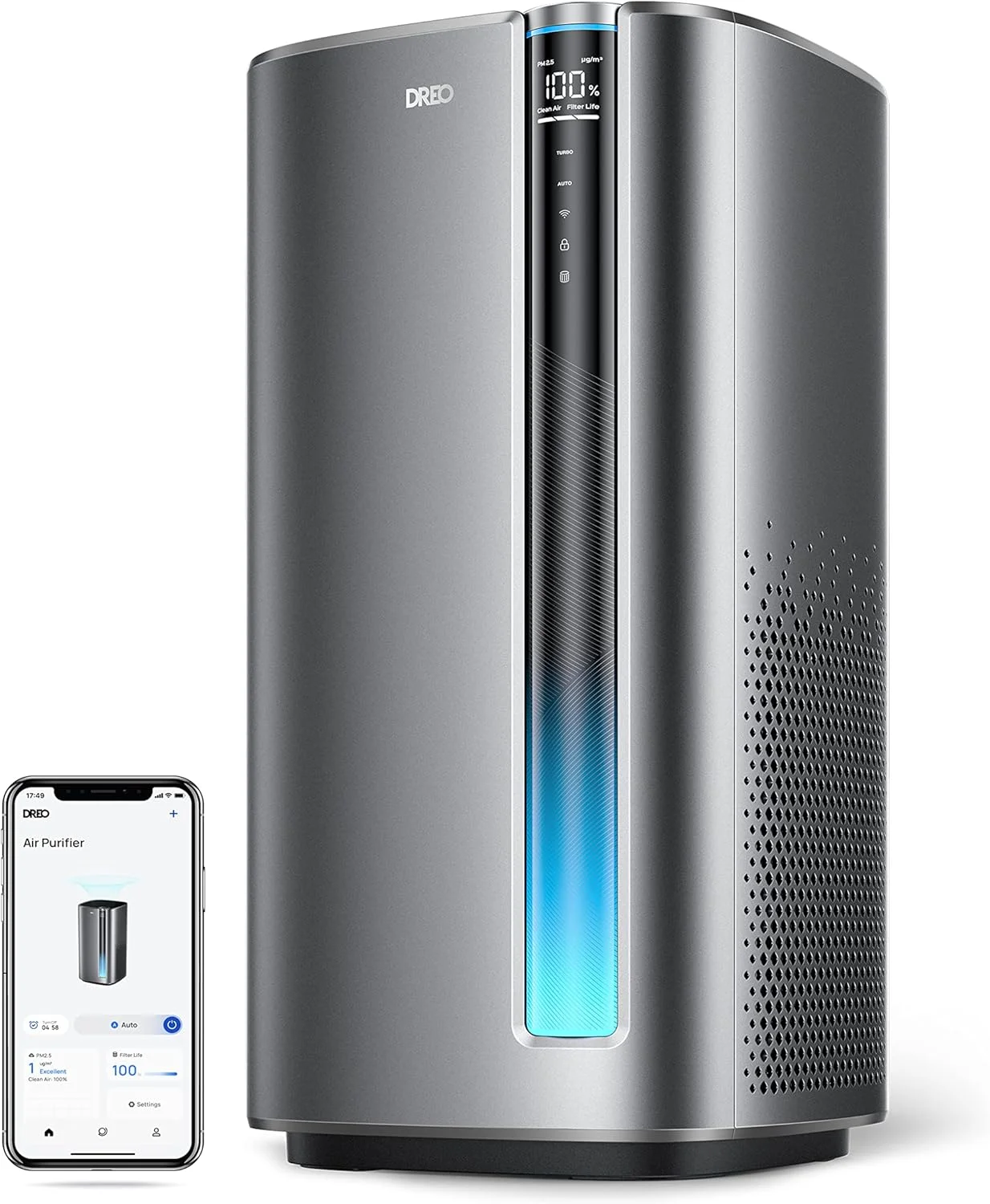
The Dreo Macro Max S (model DR-HAP003S) is an H13 True HEPA air purifier with CADR 273 CFM (464 m³/h), covering 423 sq ft at 4.8 ACH. It offers 5 fan speeds on the control panel (Sleep, Low, Medium, High, Turbo) plus 18 discrete speeds in manual mode via the Dreo app. Sleep mode noise: 42.1 dBA; turbo: 64.7 dBA. A rear-mounted PM2.5 laser sensor feeds auto mode and the front LCD display. Smart features include WiFi, the Dreo Home app (iOS/Android), Amazon Alexa, and Google Assistant. CARB certified. 5-year warranty. Dimensions: 11.22 × 11.22 × 20.86 inches. Weight: 11.89 lbs. Price: approximately $130.
Dreo
Dreo entered the air purifier market as an extension of its smart-home fan lineup, bringing the same WiFi-first and precision-engineering approach that characterized its tower fans. The Macro Max S (DR-HAP003S) is their mid-room flagship: CADR 273 CFM (464 m³/h), covering a manufacturer-rated 423 sq ft at 4.8 ACH, with full smart connectivity and a brushless motor at a sub-$150 retail price. Independent third-party testing recorded a 96% PM2.5 reduction — from 104 to 5.2 µg/m³ — in a 320 sq ft room in 60 minutes at maximum speed, ranking it among the top performers in its class. In a larger 560 sq ft room (33% above the rated size), it still achieved 88% PM2.5 reduction in the same timeframe.
The fan architecture is a genuine differentiator. The control panel offers 5 speeds: Sleep Mode, Low, Medium, High, and Turbo. The Dreo Home app unlocks 18 discrete manual speeds for fine-grained noise-versus-airflow control. The brushless motor is the reason the noise profile is competitive: sleep mode measures 42.1 dBA, turbo peaks at 64.7 dBA. For context, 42.1 dBA is only slightly louder than the Alen FLEX at its lowest speed (41.2 dBA) — one of the quietest air purifiers tested in this category. At turbo, 64.7 dBA is loud but expected for a CADR 273 unit running at full output.
The PM2.5 laser sensor at the rear continuously scans incoming air and drives two outputs: the auto mode fan speed response (particle spike → speed increase, count drops → speed reduction) and the front LCD display showing real-time PM2.5 concentration with a color-coded air quality indicator (Blue = Excellent, Green = Good, Orange = Moderate, Red = Poor). The laser sensor type — rather than the cheaper infrared approximation sensors in lower-cost units — provides more reliable particle counts at small sizes, particularly for fine smoke and combustion particles. For the full Dreo air purifier lineup, see our Dreo air purifier brand review.
Smart connectivity covers WiFi via the Dreo Home app (iOS and Android), Amazon Alexa, and Google Assistant. The app adds PM2.5 history by hour, day, and month — useful for identifying pollution patterns. All connectivity is optional; every function works from the LCD panel and physical controls without a network connection. Dreo backs the Macro Max S with a 5-year warranty (requires registration on the Dreo website) and CARB certification confirming ozone output is within California's legal limit. Filter cost runs approximately $35–40 per replacement at 6–8 months, making annual maintenance cost $35–80 depending on run time and air quality conditions.
Dreo — Quick Comparison
| Purifier | CADR Smoke | CADR Dust | Room Size | Filter | Score |
|---|---|---|---|---|---|
| DREO Macro Max S | 273 | 273 | 423 sq ft | H13 True HEPA + Activated Carbon | 8.7/10 |
📅 Prices checked . Amazon prices change frequently — click through for current price. Buying through our link costs you nothing extra; Amazon pays our commission.
DREO Macro Max S Review Best Mid-Range Value
Not AHAM VerifiedOur Verdict
Key Specifications
- Room Coverage
- 423 sq ft
- CADR
- Not AHAM verified — Manufacturer-stated
- Filter
- H13 True HEPA + Activated Carbon
- Noise
- 42 dB
- Power
- 56 watts
- Best For
- Medium rooms up to 423 sq ft. Best value smart purifier with WiFi, Alexa, Google, and PM2.5 LCD display at $130.
📅 Prices checked . Amazon prices change frequently — click through for current price. Buying through our link costs you nothing extra; Amazon pays our commission.
Pros
- CADR 273 CFM (464 m³/h) — strong output for the $130 price point
- WiFi, Dreo Home app, Amazon Alexa, and Google Assistant included
- PM2.5 laser sensor with real-time LCD display
- 18 manual fan speeds plus auto mode — fine-grained control
- 24 dB sleep mode for bedroom use
Cons
- CADR is manufacturer-stated, not AHAM independently verified
- Dreo is a newer brand with less long-term reliability data
- No CARB or Energy Star certification listed
- App ecosystem less established than Winix, Coway, or Levoit
Best For
The Dreo Macro Max S is the strongest value pick for buyers with rooms of 300–423 sq ft who want H13 HEPA filtration plus WiFi smart features at approximately $130. Lab-tested 96% PM2.5 reduction in a 320 sq ft room and 17-second smoke clearance confirm it delivers on its CADR claims. The brushless motor and 42.1 dBA sleep mode make it one of the quieter options in its CADR class for bedroom use. Buy it if you want Alexa or Google integration and real-time PM2.5 monitoring without paying a premium — both are included. The 5-year warranty (register on Dreo's website) and CARB certification add meaningful assurance for a newer brand. Skip it if your room exceeds 500 sq ft — the CADR 273 underperforms at higher ACH requirements for larger spaces. Also skip if you specifically require AHAM VERIFIDE certification — Dreo's CADR figures are independently tested but not listed in the AHAM directory as of this review period.
📅 Price checked August 2026 · Buying through this link costs you nothing extra — Amazon covers our commission
What to Know Before You Buy
Fan Speeds — Panel vs App
The control panel has 5 speeds: Sleep, Low, Medium, High, and Turbo. The Dreo Home app adds 18 discrete manual speeds for finer noise control between those presets. The most practical approach: use auto mode during the day (the PM2.5 sensor handles adjustments automatically), set Sleep Mode or Low for overnight at 42.1–44.3 dBA, and use Turbo briefly after cooking or smoke events to clear the room quickly. You rarely need to manage 18 speeds manually — the granular range is most useful if you land between Sleep and Low for a very specific noise floor.
Noise at Each Speed — What to Expect
Measured noise levels: Sleep Mode 42.1 dBA | Low 44.3 dBA | Medium 50.9 dBA | High 57.1 dBA | Turbo 64.7 dBA. Sleep Mode and Low are appropriate for bedroom use. Medium is conversational-room level. High and Turbo are for rapid air changes after a pollution event — not for sustained quiet-room use. For comparison, the Coway AP-1512HH measures approximately 40 dBA at its lowest speed; the Dreo is slightly louder at minimum but moves significantly more air per minute.
Dreo Macro Max S vs Coway AP-1512HH
The Coway AP-1512HH is AHAM-verified at CADR 233 — 15% lower than the Dreo's 273 CFM — at a similar $100–130 retail price. The AP-1512HH has no WiFi. In the smoke box test, the Dreo cleared in 17 seconds vs the Coway's 18 seconds — nearly identical raw performance, with the Dreo carrying the higher CADR and smart features. The AP-1512HH wins on AHAM directory verification and Coway's decade-long filter supply reliability. The Dreo wins on CADR, speed range, smart integration, and the 5-year warranty. For buyers who prioritize AHAM-verified numbers, the Coway is the institutional choice. For buyers prioritizing CADR per dollar with connectivity, the Dreo leads.
Particle Removal Test Results — What the Lab Numbers Show
Independent third-party testing placed the Dreo Macro Max S in a 320 sq ft room (slightly below its 423 sq ft rated coverage) and ran it at maximum speed for 60 minutes. Starting PM2.5 concentration was 104 µg/m³ — classified as Unhealthy (AQI 136). After 60 minutes, PM2.5 dropped to 5.2 µg/m³ (AQI 7), a 96% reduction. PM10 dropped from 145.6 to 7.2 µg/m³; total particle count from 150,848 to 7,582 per liter. This places the Macro Max S among the top performers tested at this CADR range — the result is consistent with what CADR 273 should deliver in a correctly sized room.
| Measurement | Before (baseline) | After 60 min |
|---|---|---|
| PM 2.5 | 104 µg/m³ | 5.2 µg/m³ |
| PM 10 | 145.6 µg/m³ | 7.2 µg/m³ |
| Particle count | 150,848 per/L | 7,582 per/L |
| AQI | 136 (Unhealthy) | 7 (Good) |
A second test in a 560 sq ft room — 33% larger than the rated coverage — still produced 88% PM2.5 reduction in 60 minutes at maximum speed. This confirms the unit performs meaningfully above its rated size at the cost of longer clearing time and reduced ACH. For allergy management in a 560 sq ft room, a higher-CADR unit would be the correct choice; but the Macro Max S handles the oversize task better than its specs alone suggest. The Dreo also cleared a smoke-filled glass test box in 17 seconds — slightly faster than the Coway AP-1512HH (18 seconds) and slightly behind the Levoit Core 400S (15 seconds).
Noise Levels — Measured at All 5 Speeds
The brushless motor in the Macro Max S produces measurably less noise than the standard motors found in most competing units at this price point. Calibrated noise measurements at all 5 panel speeds:
| Speed | Noise (dBA) | Use Case |
|---|---|---|
| Sleep Mode | 42.1 dBA | Bedroom, sleeping adults, nursery |
| Low | 44.3 dBA | Quiet room background use |
| Medium | 50.9 dBA | Living room, office background |
| High | 57.1 dBA | Rapid clearing, tolerable for short periods |
| Turbo | 64.7 dBA | Maximum airflow — short burst use only |
42.1 dBA at sleep mode is only slightly louder than the Alen FLEX at its lowest setting (41.2 dBA), which is among the quietest results measured in this class. For bedroom use, the difference between 42 and 44 dBA is difficult to perceive without a meter — both are appropriate for light sleepers. If you need the Dreo Home app's 18-speed manual mode, you can dial in a precise speed between Sleep and Low for a specific noise floor. In Sleep Mode, all LED indicators dim within 5 seconds and the unit enables light sensor auto-dimming.
Power Consumption and Annual Operating Cost
The Macro Max S uses a 56W motor but draws significantly less than peak wattage at its lower speeds. Measured power draw and estimated monthly electricity cost (at US average $0.12/kWh, 24 hours/day):
| Speed | Watts | Monthly cost (24h/day) |
|---|---|---|
| Standby | 0.8W | $0.07 |
| Sleep Mode | 3.3W | $0.29 |
| Low | 6.3W | $0.55 |
| Medium | 10.5W | $0.92 |
| High | 18.2W | $1.60 |
| Turbo | 36.1W | $3.16 |
Running in turbo mode 24 hours a day for a month costs $3.16 in electricity — less than the Winix 5500-2 at $5.08 under the same conditions, despite the Dreo having a higher CADR. Running in auto mode (which averages between Medium and High), expect a real-world monthly electricity cost of approximately $1.00–1.50. Add filter replacement at $35–40 every 6–8 months: annual operating cost totals approximately $47–80, depending on run time and air quality conditions.
CADR, Coverage, and ACH Analysis
Dreo rates the Macro Max S at CADR 273 CFM (464 m³/h). At AHAM's 4.8 ACH allergen-relief standard with 8-foot ceilings, CADR 273 covers approximately 426 sq ft — closely matching the manufacturer's 423 sq ft claim. This alignment is notable: many manufacturers rate coverage at 2 ACH or lower, producing inflated room-size claims. At 4.8 ACH, the Macro Max S's 423 sq ft rating is a realistic, honest number confirmed by the lab test result (96% PM2.5 reduction in a 320 sq ft room). At 2.5 ACH — adequate for general particulate reduction in less sensitive households — CADR 273 covers approximately 820 sq ft. For details on how to use CADR and ACH to size an air purifier for your room, see our CADR explained guide.
H13 HEPA Filter, Carbon Layer, and Replacement Guide
The Macro Max S uses a conical 3-in-1 filter assembly: a pre-filter mesh layer (traps hair and large particles, extend HEPA life — vacuum or wipe clean 1–2 times per month), an H13 True HEPA layer rated to capture 99.97% of particles at 0.3 microns, and a pellet-based activated carbon layer for VOCs and odors. Dreo claims the H13 filter is SGC-tested to capture certain bacteria. CARB certification confirms ozone output is within California's legal limit of 0.050 ppm. For a full explanation of HEPA grades, see our HEPA filter grades guide.
The filter is non-washable — do not expose to water. Replacement is needed every 6–8 months on average. The LCD panel and Dreo app both show a filter life indicator. Cost: approximately $35–40 per filter assembly. To replace: (1) unplug and open the rear cover; (2) pull out the old filter by the strap and dispose; (3) vacuum the inside of the filter housing; (4) insert the new filter with pull straps facing outward; (5) reset the filter indicator by holding the Info button for 5 seconds, or reset via the Dreo app. Total time: approximately 10 minutes.
The conical geometry distributes airflow across a larger filter surface area than a flat-panel design in the same footprint — this is why a compact 11 × 11 × 21-inch unit achieves CADR 273 without requiring an oversized filter stage.
Smart Features — PM2.5 Sensor, App, Alexa, and Google
The PM2.5 laser sensor in the rear panel measures particle concentrations in real time. It drives both the LCD display (current PM2.5 reading + color-coded air quality indicator) and the auto mode fan speed response. Laser sensing is more accurate at small particle sizes than the infrared sensors found in lower-cost units — relevant for fine smoke and combustion particles. Note: the PM2.5 sensor detects particles only, not odors. If you notice odors, manually increase fan speed.
The Dreo Home app (iOS and Android) connects via 2.4 GHz WiFi. The app provides: remote control, 18-speed manual mode, scheduling (minutes precision — device panel only allows 1–12 hour increments), PM2.5 history by hour/day/month, child lock, light sensor on/off, and auto mode sensitivity settings (Standard or Soft). Amazon Alexa and Google Assistant integration handles power, speed, and mode. All connectivity is fully optional — the unit runs without WiFi via its LCD panel and physical controls.