AirFanta 3Pro Review 2026 — High CADR Collapsible Purifier Under $160
Tested by PurifierBeast Last tested: — 8+ hours of Independent CADR data from HouseFresh lab testing, manufacturer specification cross-check, filter cost analysis, design and certification review
Disclosure: When you buy through links on this page, we earn a small commission from Amazon at no extra cost to you. It funds our independent research. We never recommend a product because it earns more commission.
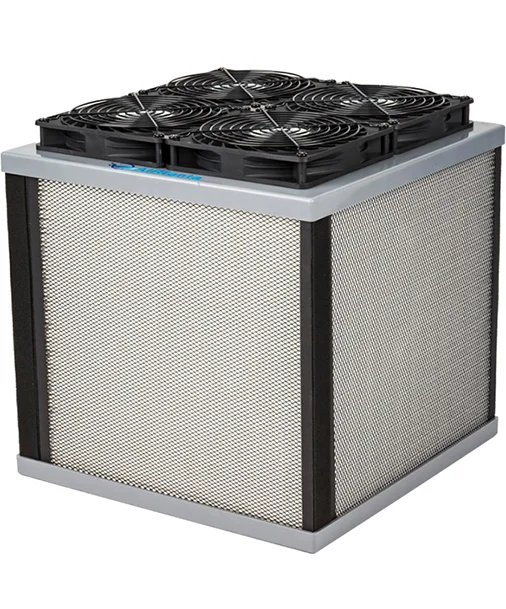
The AirFanta 3Pro is a Corsi-Rosenthal box-style air purifier from AirFanta — four H11 HEPA filter panels on each face of a 13-inch cube, with a 140mm fan array on top pulling air through all four sides simultaneously. Manufacturer-claimed CADR is 413 CFM; independent lab testing by HouseFresh recorded 353 CFM. H11 filter grade means ≥95% particle capture at 0.3 microns — not H13's 99.97%. Price: $149–159. Collapses to suitcase size.
AirFanta
AirFanta built the 3Pro around the Corsi-Rosenthal box concept — a design originally proposed during the COVID-19 pandemic that stacks four HEPA filter panels in a square with a box fan pulling air through all faces simultaneously. AirFanta's version miniaturizes this into a 13-inch cube with a purpose-built fan array rather than a box fan, and the whole assembly collapses flat to 5.5 inches thick for travel or storage. It is one of the few commercially produced CR-box-style purifiers with independent test data behind it.
HouseFresh measured 353 CFM CADR at the 3Pro's top speed — significantly higher than most purifiers in this price bracket. AirFanta claims 413 CFM at its rated 12V input. The gap is typical: independent PM1 particle testing in a real room differs from manufacturer airflow numbers. Either figure puts the 3Pro among the highest CADR-per-dollar options available in 2026. At 353 CFM and 4.8 ACH, the unit covers approximately 460 sq ft; AirFanta's own 5-ACH standard yields a 529 sq ft recommendation.
The filter grade matters here: the 3Pro uses H11 HEPA, which captures ≥95% of particles at 0.3 microns. H13 True HEPA captures ≥99.97% of the same particle size. For most general air quality and allergy use, H11 still provides meaningful particle reduction — but buyers managing clinical asthma or severe allergies who specifically need ≥99.97% capture should note this distinction. An optional activated carbon filter set is available for odor control. For the full AirFanta lineup, see our AirFanta air purifier brand review.
AirFanta — Quick Comparison
| Purifier | CADR Smoke | CADR Dust | Room Size | Filter | Score |
|---|---|---|---|---|---|
| AirFanta 3Pro | 353 | 353 | 460 sq ft | HEPA + Carbon | 8.2/10 |
📅 Prices checked . Amazon prices change frequently — click through for current price. Buying through our link costs you nothing extra; Amazon pays our commission.
AirFanta 3Pro Review Budget CADR King
Not AHAM VerifiedOur Verdict
Key Specifications
- Room Coverage
- 460 sq ft
- CADR
- Not AHAM verified — Manufacturer-stated
- Filter
- HEPA + Carbon
- Noise
- 36 dB
- Power
- 45 watts
- Best For
- Budget buyers who want high CADR. HouseFresh top budget pick 2024-2025.
📅 Prices checked . Amazon prices change frequently — click through for current price. Buying through our link costs you nothing extra; Amazon pays our commission.
Pros
- HouseFresh tested CADR 353
- Cheapest high-CADR option available
- Good filter cost at $40/year
- HouseFresh budget winner
- Cleaned room in 17 minutes
Cons
- NOT AHAM verified
- Unknown brand — less trust
- Less long-term reliability data
- No auto mode or sensors
Best For
The AirFanta 3Pro is the right buy for anyone who prioritizes raw CADR throughput and accepts an unconventional form factor. With independently verified 353 CFM, it outcleans most purifiers costing $300–$400. The collapsible design is genuinely useful for renters who move frequently or anyone who wants a purifier they can pack for travel. Skip it if you need H13 True HEPA (≥99.97% capture) rather than H11 (≥95%), if you want an app or smart home integration, or if the bare-bones Corsi-Rosenthal aesthetic doesn't fit your space. The filter cost of $54–$74 per set every 6–12 months also runs higher than the existing page's $40 estimate — budget $67–$118 per year depending on use.
📅 Price checked August 2026 · Buying through this link costs you nothing extra — Amazon covers our commission
What to Know Before You Buy
H11 vs H13: What the Filter Grade Means Here
The 3Pro uses H11 HEPA, not H13. In practical terms: H11 removes ≥95% of 0.3-micron particles per pass; H13 removes ≥99.97%. Because the 3Pro moves so much air (353–413 CFM), it compensates with sheer volume — multiple passes per hour can achieve cumulative particle reduction comparable to a lower-CADR H13 unit. But per-pass capture efficiency is lower. If you need guaranteed ≥99.97% per-pass performance for a medical or cleanroom application, choose an H13-equipped purifier.
Activated Carbon Option
The base 3Pro ships with plain H11 HEPA panels. AirFanta sells an activated carbon upgrade set ($74.99 for four panels) that adds a pelleted carbon layer to each HEPA filter face. If cooking odors, VOCs from materials, or smoke are a concern alongside particulates, the carbon upgrade is worth the extra cost. The plain HEPA set at $54 per set handles particulates only.
Speed Dial and Noise Tradeoffs
The 3Pro uses a six-position voltage-stepped speed dial rather than digital fan controls. At low speeds (positions 1–2), the unit runs below 40 dB and draws under 5 watts — suitable for sleeping. Top speed pulls 38–43 watts and reaches around 56 dB at 3 feet. The sweet spot for a bedroom is position 3–4 at night (50 dB range, 11–19 watts) stepping up to 5–6 during the day when noise is less critical.
Controls and Operation
The AirFanta 3Pro is controlled by a single rotary speed dial with six positions, stepping from low airflow (position 1, about 2W) to full speed (position 6, about 33–43W). There are no digital buttons, no app, no WiFi, and no auto mode with a particle sensor. The operation model is manual: you choose your speed and leave it. The dial's stepped design uses a voltage controller to ramp the DC fan motor — the same principle used in DIY CR-box builds, but packaged into a factory unit with a power adapter included.
At position 1 the unit measures around 36–37 dB at 3 feet — below the threshold most people notice in a quiet room. Position 4 reaches approximately 43 dB, and top speed (6) hits around 56 dB at close range. For a bedroom, positions 2–3 are the practical nighttime range. The unit has no filter change indicator. AirFanta recommends filter inspection at 6 months and replacement at 6–12 months depending on local air quality and run hours.
Assembly and disassembly take under a minute. The four filter panels Velcro to the frame sides and the fan array lifts off the top. Collapsed dimensions are approximately 13" × 13" × 5.5", fitting into a 20-inch carry-on bag — a legitimate feature for frequent movers or travelers who want purified air in hotel rooms or temporary spaces.
Filter System and Replacement
Four H11 True HEPA filter panels sit on each face of the cube, drawing air inward from all sides simultaneously. H11 is the HEPA grade rated for ≥95% filtration efficiency at the most-penetrating particle size (0.3 microns). Each panel measures approximately 11.4" × 11.4" × 1", pleated for maximum surface area. The large combined filter surface area relative to the airflow rate is part of why the 3Pro achieves high CADR at relatively low motor wattage — the air does not have to be forced through a tight, restrictive single-panel filter at high pressure.
The optional activated carbon panels ($74.99 per set of four) add a pelleted carbon layer bonded to the HEPA substrate. Pelleted carbon has higher adsorption capacity than powder-bonded carbon sheets, making it effective for VOCs, cooking odors, and smoke byproducts. The standard H11-only set costs $54–$59 per set of four panels. AirFanta recommends replacement every 6–12 months. At one set per year, annual filter cost is $54–$75 for HEPA-only, or $75 for the carbon version. At two sets per year (continuous 24/7 operation), budget up to $110–$150 annually.
Third-party filters are available but quality varies widely. AirFanta's official panels are manufactured to their specific 11.4" × 11.4" size; many aftermarket replacements use thinner media with lower pleat counts that reduce effective filter area and airflow. The CADR difference between genuine and low-quality third-party filters can be significant in this design because the filter media itself is the primary airflow restriction. Genuine AirFanta panels are sold directly at airfanta.com and on Amazon.
Who Should Buy the AirFanta 3Pro — and Who Should Look Elsewhere
Buy the AirFanta 3Pro if: you want maximum CADR per dollar in a sub-$160 purifier, you move frequently and need a unit that collapses to carry-on size, or you are cleaning a room of 400–530 sq ft where most competitors in this price bracket fall short.
Look elsewhere if: you need H13 True HEPA (≥99.97% per-pass capture) rather than H11 (≥95%) — consider the Coway Airmega 250 instead. If you want WiFi, a sensor-driven auto mode, or a smartphone app, the Levoit Core 600S at $180–$220 delivers AHAM-verified CADR 410 with full smart features. If the Corsi-Rosenthal cube aesthetic does not fit your space or decor, a traditional tower-style purifier will suit better.
The 3Pro's buyer profile is a practical, performance-first purchaser who has read the spec sheets, accepts an unconventional look, and wants the most verified airflow throughput their budget can buy. Students, renters, and frequent movers who value portability alongside cleaning power are the ideal fit.
AirFanta 3Pro CADR, ACH, and Room Coverage — What the Numbers Mean
CADR (Clean Air Delivery Rate) measures how many cubic feet of filtered air the purifier delivers per minute. The AirFanta 3Pro carries an independently tested CADR of 353 CFM for fine particles at top speed, measured by HouseFresh. At the AHAM-recommended 4.8 air changes per hour, 353 CFM covers rooms up to 460 sq ft with 8-foot ceilings. AirFanta's own 5-ACH standard yields a 529 sq ft recommendation using the manufacturer's 413 CFM claim.
Placement matters: the Corsi-Rosenthal design draws air from all four sides simultaneously, so the 3Pro does not need to be positioned away from walls the way a single-intake tower unit does. Centering it in the room maximises the multi-directional intake, but it performs well near walls too because the intake is distributed across four large filter faces rather than concentrated at one grille.
At 353 CFM independently verified, the 3Pro beats nearly every purifier in the under-$200 category on raw airflow. The closest AHAM-verified competitor at this price is the Winix 5500-2 at CADR 243 — the 3Pro delivers 45% more airflow throughput for a similar price. The trade-off is H11 vs H13 filter grade, not CADR.
AirFanta 3Pro 3-Year Total Cost of Ownership — vs Coway Airmega 250 and Winix 5500-2
Owning an air purifier means paying for filters and electricity long after the purchase price is forgotten. The table below calculates the true 3-year cost for the AirFanta 3Pro against two alternatives, using filter replacement every 6–12 months and electricity at $0.17/kWh running 12 hours per day.
| Model | Purchase | Filters (3 yr) | Electricity (3 yr) | 3-Year Total | CADR | WiFi |
|---|---|---|---|---|---|---|
| AirFanta 3Pro | $155 | $162–$225 | $85 | $402–$465 | 353 CFM (tested) | No |
| Coway Airmega 250 | $205 | $105–$150 | $95 | $405–$450 | 240 CFM (AHAM) | 250S only |
| Winix 5500-2 | $155 | $90–$135 | $90 | $335–$380 | 243 CFM (AHAM) | No |
Electricity calculated as: watts × 12 h/day × 1,095 days × $0.17 / 1,000. The 3Pro draws approximately 38W at mid-speed (the practical daily setting), giving roughly $85 over three years. Filter cost is higher than either competitor because the four-panel set costs $54–$75 per replacement — one to two sets per year adds up to $162–$225 over three years at typical replacement intervals.
The 3-year totals show the three units cluster tightly around $350–$465. The 3Pro's higher filter cost partially offsets its lower purchase price against the Coway. The Winix 5500-2 wins on total cost with the lowest filter spend and near-identical CADR to the Coway — but at 243 CFM (AHAM) vs the 3Pro's 353 CFM (tested), buyers choosing the 3Pro are paying for 45% more airflow throughput at roughly the same 3-year cost. For large rooms and maximum clean air delivery per dollar over a 3-year horizon, the 3Pro competes effectively. For smaller rooms or filter-cost sensitivity, the Winix is the leaner option.